Opportunistic Infections
In Acquired Immune Deficiency Syndrome
By
Dr. Vijay Bhushanam
Objectives
• Discuss basic factors regarding Opportunistic
infections (OIs)
• See the frequency with which these OIs occur &
Clinical features, Diagnosis & treatment of some
OIs.
• Discuss patient education messages for
preventing OIs.
AIDS Definition
• CDC definition of an HIV +ve person as having
AIDS
-- Has had at least one of over 21 AIDS
defining OIs
and/or
--Has had a CD4 cell count of 200 or less
• NACO Definition: AIDS has been defined as the
occurrence of life threatening opportunistic
infections, malignancies, neurological diseases
and other specific illnesses in patients with HIV
infection and/or with CD4 count less than
200/cmm
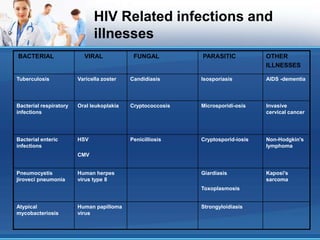
HIV Related infections and
illnesses
BACTERIAL VIRAL FUNGAL PARASITIC OTHER
ILLNESSES
Tuberculosis Varicella zoster Candidiasis Isosporiasis AIDS -dementia
Bacterial respiratory
infections
Oral leukoplakia Cryptococcosis Microsporidi-osis Invasive
cervical cancer
Bacterial enteric
infections
HSV
CMV
Penicilliosis Cryptosporid-iosis Non-Hodgkin's
lymphoma
Pneumocystis
jiroveci pneumonia
Human herpes
virus type 8
Giardiasis
Toxoplasmosis
Kaposi's
sarcoma
Atypical
mycobacteriosis
Human papilloma
virus
Strongyloidiasis
The basics of OIs
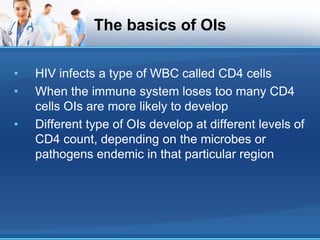
• HIV infects a type of WBC called CD4 cells
• When the immune system loses too many CD4
cells OIs are more likely to develop
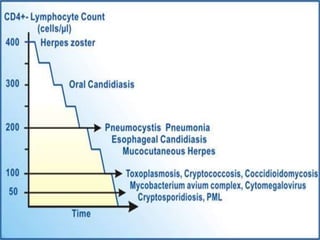
• Different type of OIs develop at different levels of
CD4 count, depending on the microbes or
pathogens endemic in that particular region
% of OIs in AIDS cases in INDIA
NACO reported cases (n=5204)
0
10
20
30
40
50
60
70
80
90
100
TB Can Cryp. Dia HZ Tox Bact. Inf. PCP Cryp.
Men
KS
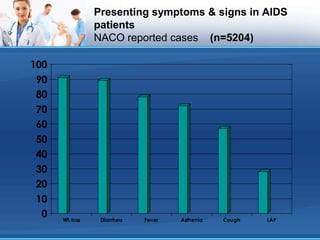
Presenting symptoms & signs in AIDS
patients
NACO reported cases (n=5204)
0
10
20
30
40
50
60
70
80
90
100
Wt. loss Diarrhea Fever Asthenia Cough LAP
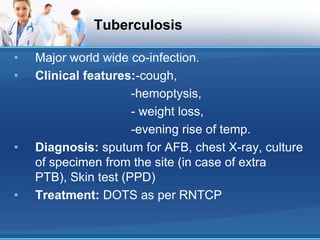
Tuberculosis
• Major world wide co-infection.
• Clinical features:-cough,
-hemoptysis,
- weight loss,
-evening rise of temp.
• Diagnosis: sputum for AFB, chest X-ray, culture
of specimen from the site (in case of extra
PTB), Skin test (PPD)
• Treatment: DOTS as per RNTCP
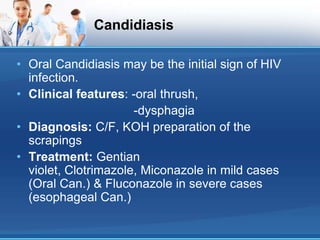
Candidiasis
• Oral Candidiasis may be the initial sign of HIV
infection.
• Clinical features: -oral thrush,
-dysphagia
• Diagnosis: C/F, KOH preparation of the
scrapings
• Treatment: Gentian
violet, Clotrimazole, Miconazole in mild cases
(Oral Can.) & Fluconazole in severe cases
(esophageal Can.)
Cryptosporidiosis
• Found in about 35% of AIDS diarrheal cases.
• Clinical features: -watery diarrhea,
-Abdominal bloating,
-profound weight loss .
• Diagnosis: Microscopy
• Treatment: Paromomycin/ Azithromycin.
Response is poor with all available therapies.
Prevention of malnutrition & symptomatic
relief vital in management.
Pneumocystis carinii Pneumonia
• Occurs in advanced HIV disease, when CD4
falls below 250
• Clinical features:-fever,
-dry cough,
-chest pain,
-shortness of breath.
• Diagnosis- C/F, sputum tests, X-ray
• Treatment-TMP-SMZ (co-trimoxazole)
Cytomegalovirus
• Never occurs unless CD4 cell count less than 50
• Most typically affects the eyes
• Clinical features:-Blurry vision,
- Respiratory, CNS &
Gastrointestinal complications.
• Diagnosis: specialist (ophthalmologist)
examination
• Treatment: Gancyclovir, Foscarnet.
Cryptococcal meningitis
• Most common cause of meningitis in AIDS
• Clinical features:
-headache, fever,
-nausea and vomiting,
-confusion and impaired consciousness,
-signs of meningism (only in about 40%)
• Diagnosis: CSF examination (Indian ink staining,
Ag Titre)
• Treatment: Amphotericin B/Fluconazole with or
without 5-flucytosine.
Toxoplasmosis
• Commonest cause of focal cerebral lesions in
HIV/AIDS
• Clinical features:
-focal neurological deficit (FND),
-Seizures, intracranial hemorrhage,
-altered mental state and coma
• Diagnosis: CT Brain
• Treatment: Sulfadiazine or Clindamycin,
plus Pyrimethamine & Folinic acid.
Mycobacterium Avium Complex
• Usually occurs only if the CD4 count is less than
75
• Clinical features:-Flu like fever,
-chills, sweats,
-anemia, fatigue.
• Treatment-Clarithromycin, ethambutol
• Note: certain infections like
Histoplasmosis, Blastomycosis, Mycobacterium
Avium intra cellular (MAC) have not been
reported from our country so far
Patient Education
• Best way to prevent OIs is to keep immune
system strong
• Appropriate medication at certain CD4 cell levels
can prevent many OIs (prophylaxis)
• Treatment options available if OIs develop
• After recovery from OIs on-going maintenance
treatment is still needed
• Can stop prophylaxis or maintenance treatment
if CD4 cell count goes up
• Should not discontinue any treatment without
discussing first with Doctor
&…
General preventive measures:
• Prevent exposure to ill patients.
• Personal hygiene (washing hands etc.)
• Avoid contact with raw food, soil, cats, bird
excreta, litter boxes etc.
• Wash vegetables before cooking, avoid raw
meat intake, drink boiled water.
• Use condoms during sexual contact.
Thus….
• OIs develop in an HIV infected individual
depending on the CD4 count & microbial
environment
• Most common OIs are TB, Candidiasis,
Cryptosporidiosis, Herpes zoster, Toxoplasmosis,
PCP
• Patient education plays vital role in preventing OIs
Thank you

Opportunistic infections

  • 1.
    Opportunistic Infections In AcquiredImmune Deficiency Syndrome By Dr. Vijay Bhushanam
  • 2.
    Objectives • Discuss basicfactors regarding Opportunistic infections (OIs) • See the frequency with which these OIs occur & Clinical features, Diagnosis & treatment of some OIs. • Discuss patient education messages for preventing OIs.
  • 3.
    AIDS Definition • CDCdefinition of an HIV +ve person as having AIDS -- Has had at least one of over 21 AIDS defining OIs and/or --Has had a CD4 cell count of 200 or less • NACO Definition: AIDS has been defined as the occurrence of life threatening opportunistic infections, malignancies, neurological diseases and other specific illnesses in patients with HIV infection and/or with CD4 count less than 200/cmm
  • 4.
    HIV Related infectionsand illnesses BACTERIAL VIRAL FUNGAL PARASITIC OTHER ILLNESSES Tuberculosis Varicella zoster Candidiasis Isosporiasis AIDS -dementia Bacterial respiratory infections Oral leukoplakia Cryptococcosis Microsporidi-osis Invasive cervical cancer Bacterial enteric infections HSV CMV Penicilliosis Cryptosporid-iosis Non-Hodgkin's lymphoma Pneumocystis jiroveci pneumonia Human herpes virus type 8 Giardiasis Toxoplasmosis Kaposi's sarcoma Atypical mycobacteriosis Human papilloma virus Strongyloidiasis
  • 5.
    The basics ofOIs • HIV infects a type of WBC called CD4 cells • When the immune system loses too many CD4 cells OIs are more likely to develop • Different type of OIs develop at different levels of CD4 count, depending on the microbes or pathogens endemic in that particular region
  • 7.
    % of OIsin AIDS cases in INDIA NACO reported cases (n=5204) 0 10 20 30 40 50 60 70 80 90 100 TB Can Cryp. Dia HZ Tox Bact. Inf. PCP Cryp. Men KS
  • 8.
    Presenting symptoms &signs in AIDS patients NACO reported cases (n=5204) 0 10 20 30 40 50 60 70 80 90 100 Wt. loss Diarrhea Fever Asthenia Cough LAP
  • 9.
    Tuberculosis • Major worldwide co-infection. • Clinical features:-cough, -hemoptysis, - weight loss, -evening rise of temp. • Diagnosis: sputum for AFB, chest X-ray, culture of specimen from the site (in case of extra PTB), Skin test (PPD) • Treatment: DOTS as per RNTCP
  • 10.
    Candidiasis • Oral Candidiasismay be the initial sign of HIV infection. • Clinical features: -oral thrush, -dysphagia • Diagnosis: C/F, KOH preparation of the scrapings • Treatment: Gentian violet, Clotrimazole, Miconazole in mild cases (Oral Can.) & Fluconazole in severe cases (esophageal Can.)
  • 11.
    Cryptosporidiosis • Found inabout 35% of AIDS diarrheal cases. • Clinical features: -watery diarrhea, -Abdominal bloating, -profound weight loss . • Diagnosis: Microscopy • Treatment: Paromomycin/ Azithromycin. Response is poor with all available therapies. Prevention of malnutrition & symptomatic relief vital in management.
  • 12.
    Pneumocystis carinii Pneumonia •Occurs in advanced HIV disease, when CD4 falls below 250 • Clinical features:-fever, -dry cough, -chest pain, -shortness of breath. • Diagnosis- C/F, sputum tests, X-ray • Treatment-TMP-SMZ (co-trimoxazole)
  • 13.
    Cytomegalovirus • Never occursunless CD4 cell count less than 50 • Most typically affects the eyes • Clinical features:-Blurry vision, - Respiratory, CNS & Gastrointestinal complications. • Diagnosis: specialist (ophthalmologist) examination • Treatment: Gancyclovir, Foscarnet.
  • 14.
    Cryptococcal meningitis • Mostcommon cause of meningitis in AIDS • Clinical features: -headache, fever, -nausea and vomiting, -confusion and impaired consciousness, -signs of meningism (only in about 40%) • Diagnosis: CSF examination (Indian ink staining, Ag Titre) • Treatment: Amphotericin B/Fluconazole with or without 5-flucytosine.
  • 15.
    Toxoplasmosis • Commonest causeof focal cerebral lesions in HIV/AIDS • Clinical features: -focal neurological deficit (FND), -Seizures, intracranial hemorrhage, -altered mental state and coma • Diagnosis: CT Brain • Treatment: Sulfadiazine or Clindamycin, plus Pyrimethamine & Folinic acid.
  • 16.
    Mycobacterium Avium Complex •Usually occurs only if the CD4 count is less than 75 • Clinical features:-Flu like fever, -chills, sweats, -anemia, fatigue. • Treatment-Clarithromycin, ethambutol • Note: certain infections like Histoplasmosis, Blastomycosis, Mycobacterium Avium intra cellular (MAC) have not been reported from our country so far
  • 17.
    Patient Education • Bestway to prevent OIs is to keep immune system strong • Appropriate medication at certain CD4 cell levels can prevent many OIs (prophylaxis) • Treatment options available if OIs develop • After recovery from OIs on-going maintenance treatment is still needed • Can stop prophylaxis or maintenance treatment if CD4 cell count goes up • Should not discontinue any treatment without discussing first with Doctor
  • 18.
    &… General preventive measures: •Prevent exposure to ill patients. • Personal hygiene (washing hands etc.) • Avoid contact with raw food, soil, cats, bird excreta, litter boxes etc. • Wash vegetables before cooking, avoid raw meat intake, drink boiled water. • Use condoms during sexual contact.
  • 19.
    Thus…. • OIs developin an HIV infected individual depending on the CD4 count & microbial environment • Most common OIs are TB, Candidiasis, Cryptosporidiosis, Herpes zoster, Toxoplasmosis, PCP • Patient education plays vital role in preventing OIs
  • 20.