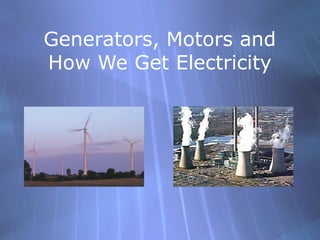
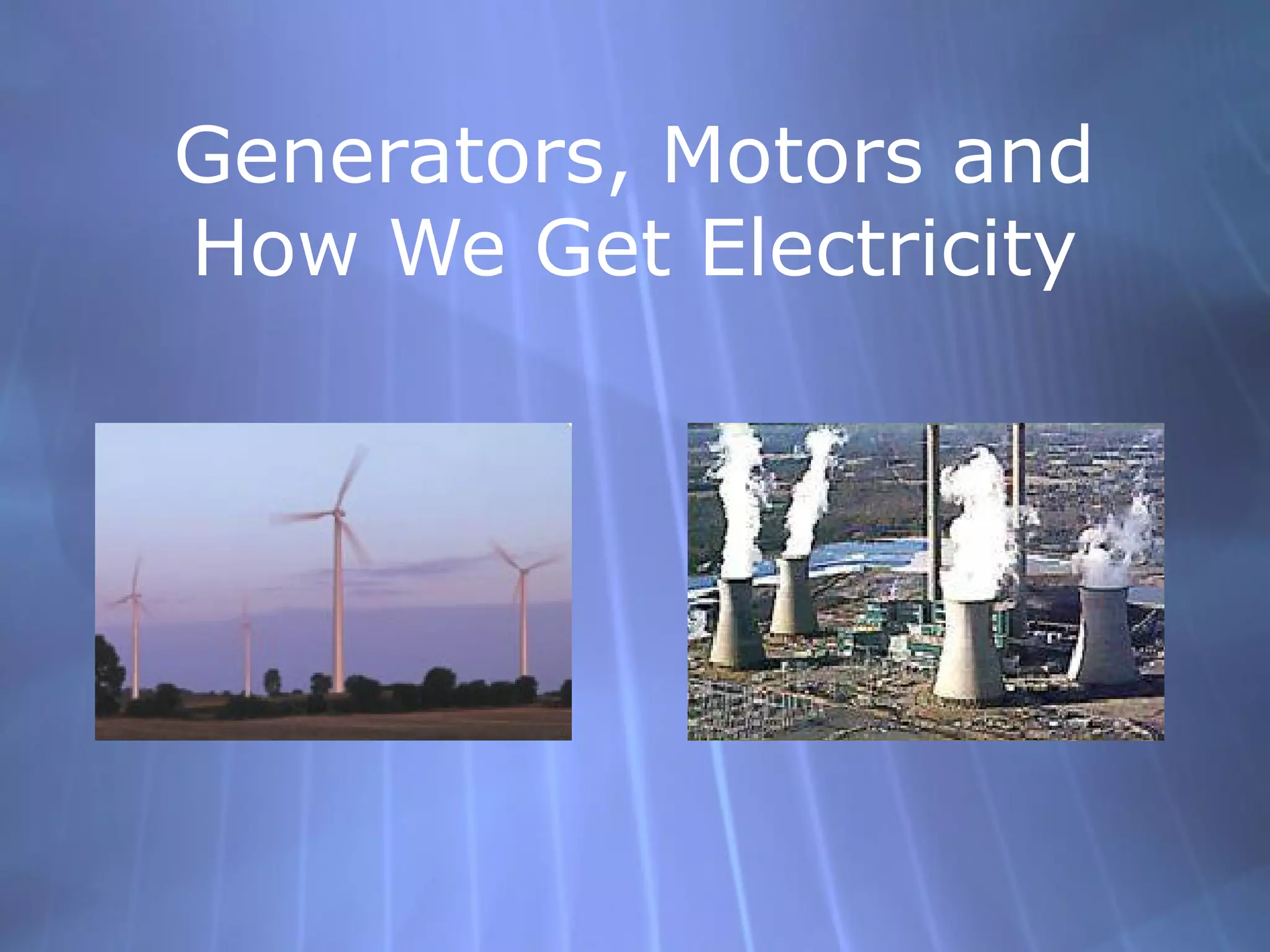
Generators, Motors and
How We Get Electricity
Topics
 What is electricity?
 Energy Conversion
 The Faraday Effect
 Motor vs. Generator
 AC/DC
 Energy Trends - the case for Green
What is Electricity?
Electricity is energy transported by
the motion of electrons
**We do not make electricity, we
CONVERT other energy sources into
electrical energy**
Conversion is the name of the game
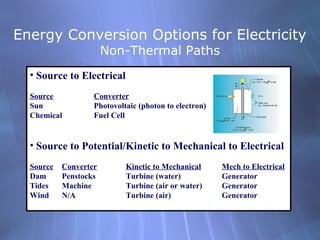
Energy Conversion Options for Electricity
Non-Thermal Paths
• Source to Electrical
 
Source Converter
Sun Photovoltaic (photon to electron)
Chemical Fuel Cell
 
• Source to Potential/Kinetic to Mechanical to Electrical
 
Source Converter Kinetic to Mechanical Mech to Electrical
Dam Penstocks Turbine (water) Generator
Tides Machine Turbine (air or water) Generator
Wind N/A Turbine (air) Generator 
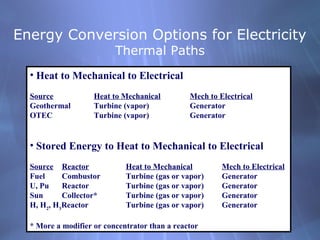
Energy Conversion Options for Electricity
Thermal Paths
• Heat to Mechanical to Electrical 
 
Source Heat to Mechanical Mech to Electrical
Geothermal Turbine (vapor) Generator
OTEC Turbine (vapor) Generator
 
• Stored Energy to Heat to Mechanical to Electrical 
 
Source Reactor     Heat to Mechanical       Mech to Electrical
Fuel Combustor Turbine (gas or vapor) Generator
U, Pu Reactor Turbine (gas or vapor) Generator
Sun Collector* Turbine (gas or vapor) Generator
H, H2
, H3
Reactor Turbine (gas or vapor) Generator
 
* More a modifier or concentrator than a reactor
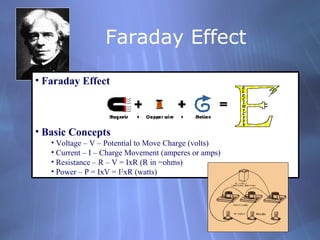
Faraday Effect
• Faraday Effect
• Basic Concepts
• Voltage – V – Potential to Move Charge (volts)
• Current – I – Charge Movement (amperes or amps)
• Resistance – R – V = IxR (R in =ohms)
• Power – P = IxV = I2
xR (watts)
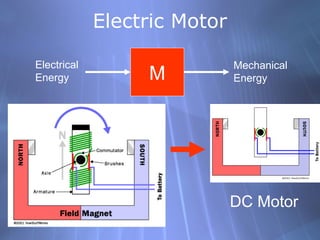
Electric Motor
M
Electrical
Energy
Mechanical
Energy
DC Motor
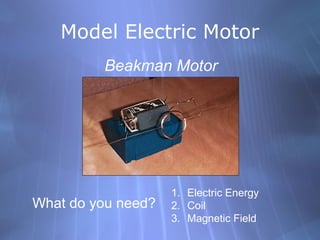
Model Electric Motor
Beakman Motor
What do you need?
1. Electric Energy
2. Coil
3. Magnetic Field
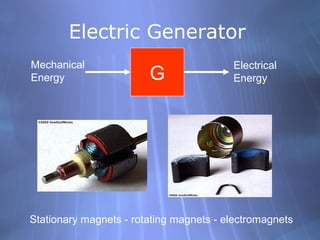
Electric Generator
G
Mechanical
Energy
Electrical
Energy
Stationary magnets - rotating magnets - electromagnets
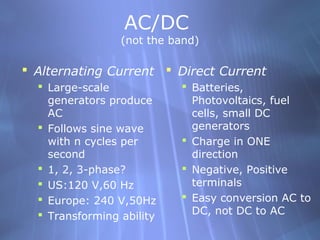
AC/DC
(not the band)
 Alternating Current
 Large-scale
generators produce
AC
 Follows sine wave
with n cycles per
second
 1, 2, 3-phase?
 US:120 V,60 Hz
 Europe: 240 V,50Hz
 Transforming ability
 Direct Current
 Batteries,
Photovoltaics, fuel
cells, small DC
generators
 Charge in ONE
direction
 Negative, Positive
terminals
 Easy conversion AC to
DC, not DC to AC
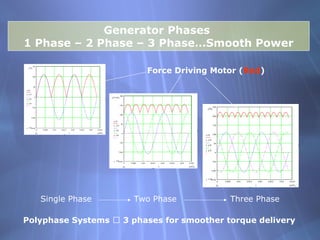
Generator Phases
1 Phase – 2 Phase – 3 Phase…Smooth Power
0 0.005 0.01 0.015 0.02 0.025 0.03 0.035
150
100
50
0
50
100
150
200
250
220
110−
ς τ( )
ς 1 τ( )
ς 2 τ( )
ς 3 τ( )
0.0330 τ
0 0.005 0.01 0.015 0.02 0.025 0.03 0.035
150
100
50
0
50
100
150
110
110−
ς τ( )
ς 1 τ( )
ς 2 τ( )
ς 3 τ( )
0.0330 τ
0 0.005 0.01 0.015 0.02 0.025 0.03 0.035
150
100
50
0
50
100
150
200
155.563
110−
ς τ( )
ς 1 τ( )
ς 2 τ( )
ς 3 τ( )
0.0330 τ
Polyphase Systems  3 phases for smoother torque delivery
Force Driving Motor (Red)
Single Phase Two Phase Three Phase
Where do we get our
Electricity?
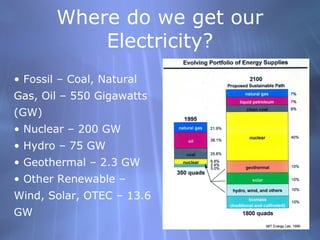
• Fossil – Coal, Natural
Gas, Oil – 550 Gigawatts
(GW)
• Nuclear – 200 GW
• Hydro – 75 GW
• Geothermal – 2.3 GW
• Other Renewable –
Wind, Solar, OTEC – 13.6
GW
0
1
2
3
4
5
6
7
8
9
USA
CanadaNorwayRussia Japan
U.K.
Mexico China India Africa
Bangladesh
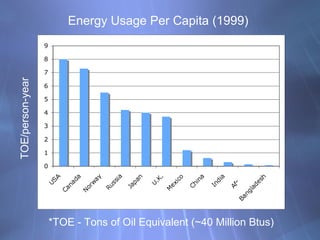
Energy Usage Per Capita (1999)TOE/person-year
*TOE - Tons of Oil Equivalent (~40 Million Btus)
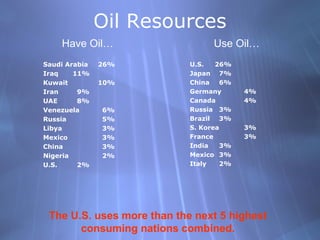
Oil Resources
Saudi Arabia 26%
Iraq 11%
Kuwait 10%
Iran 9%
UAE 8%
Venezuela 6%
Russia 5%
Libya 3%
Mexico 3%
China 3%
Nigeria 2%
U.S. 2%
U.S. 26%
Japan 7%
China 6%
Germany 4%
Canada 4%
Russia 3%
Brazil 3%
S. Korea 3%
France 3%
India 3%
Mexico 3%
Italy 2%
Have Oil… Use Oil…
The U.S. uses more than the next 5 highest
consuming nations combined.
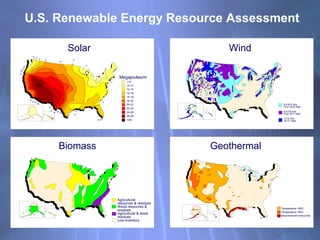
U.S. Renewable Energy Resource Assessment
WindSolar
Geothermal
Temperature <90C
Temperature >90C
Geopressured resources
o
o
10
10
12
12
14
14
16
16
18
18
20
20
22
24
26
22 24
26
16
14
14
16
14
12
10
10
12 <10
10-12
12-14
14-16
16-18
18-20
20-22
22-24
24-26
26-28
>28
6.0-6.5 m/s
13.4-14.6 mph
6.5-70 m/s
14.6-15.7 mph
>7.0 m/s
15.7+ mph
Megajoules/m
2
Biomass
Agricultural
resources & residues
Wood resources &
residues
Agricultural & wood
residues
Low inventory
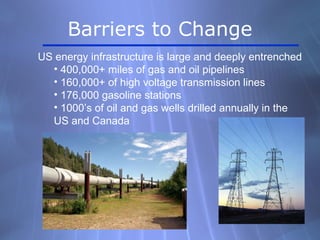
US energy infrastructure is large and deeply entrenched
• 400,000+ miles of gas and oil pipelines
• 160,000+ of high voltage transmission lines
• 176,000 gasoline stations
• 1000’s of oil and gas wells drilled annually in the
US and Canada
Barriers to Change
 oil and gas are readily available as a world
commodity at low cost -- equivalent to $ 4 to 5 /
million Btu
 US coal is even more abundant and cheaper –
approximately $1/million Btu
 US electricity prices remain low relative to
other commodities
The average American family spends only 3
to 4% of their income on energy!!
Barriers to Change

Motors and generators

  • 1.
    Generators, Motors and HowWe Get Electricity
  • 2.
    Topics  What iselectricity?  Energy Conversion  The Faraday Effect  Motor vs. Generator  AC/DC  Energy Trends - the case for Green
  • 3.
    What is Electricity? Electricityis energy transported by the motion of electrons **We do not make electricity, we CONVERT other energy sources into electrical energy** Conversion is the name of the game
  • 4.
    Energy Conversion Optionsfor Electricity Non-Thermal Paths • Source to Electrical   Source Converter Sun Photovoltaic (photon to electron) Chemical Fuel Cell   • Source to Potential/Kinetic to Mechanical to Electrical   Source Converter Kinetic to Mechanical Mech to Electrical Dam Penstocks Turbine (water) Generator Tides Machine Turbine (air or water) Generator Wind N/A Turbine (air) Generator 
  • 5.
    Energy Conversion Optionsfor Electricity Thermal Paths • Heat to Mechanical to Electrical    Source Heat to Mechanical Mech to Electrical Geothermal Turbine (vapor) Generator OTEC Turbine (vapor) Generator   • Stored Energy to Heat to Mechanical to Electrical    Source Reactor     Heat to Mechanical       Mech to Electrical Fuel Combustor Turbine (gas or vapor) Generator U, Pu Reactor Turbine (gas or vapor) Generator Sun Collector* Turbine (gas or vapor) Generator H, H2 , H3 Reactor Turbine (gas or vapor) Generator   * More a modifier or concentrator than a reactor
  • 6.
    Faraday Effect • Faraday Effect • Basic Concepts • Voltage– V – Potential to Move Charge (volts) • Current – I – Charge Movement (amperes or amps) • Resistance – R – V = IxR (R in =ohms) • Power – P = IxV = I2 xR (watts)
  • 7.
  • 8.
    Model Electric Motor BeakmanMotor What do you need? 1. Electric Energy 2. Coil 3. Magnetic Field
  • 9.
  • 10.
    AC/DC (not the band) Alternating Current  Large-scale generators produce AC  Follows sine wave with n cycles per second  1, 2, 3-phase?  US:120 V,60 Hz  Europe: 240 V,50Hz  Transforming ability  Direct Current  Batteries, Photovoltaics, fuel cells, small DC generators  Charge in ONE direction  Negative, Positive terminals  Easy conversion AC to DC, not DC to AC
  • 11.
    Generator Phases 1 Phase– 2 Phase – 3 Phase…Smooth Power 0 0.005 0.01 0.015 0.02 0.025 0.03 0.035 150 100 50 0 50 100 150 200 250 220 110− ς τ( ) ς 1 τ( ) ς 2 τ( ) ς 3 τ( ) 0.0330 τ 0 0.005 0.01 0.015 0.02 0.025 0.03 0.035 150 100 50 0 50 100 150 110 110− ς τ( ) ς 1 τ( ) ς 2 τ( ) ς 3 τ( ) 0.0330 τ 0 0.005 0.01 0.015 0.02 0.025 0.03 0.035 150 100 50 0 50 100 150 200 155.563 110− ς τ( ) ς 1 τ( ) ς 2 τ( ) ς 3 τ( ) 0.0330 τ Polyphase Systems  3 phases for smoother torque delivery Force Driving Motor (Red) Single Phase Two Phase Three Phase
  • 12.
    Where do weget our Electricity? • Fossil – Coal, Natural Gas, Oil – 550 Gigawatts (GW) • Nuclear – 200 GW • Hydro – 75 GW • Geothermal – 2.3 GW • Other Renewable – Wind, Solar, OTEC – 13.6 GW
  • 13.
    0 1 2 3 4 5 6 7 8 9 USA CanadaNorwayRussia Japan U.K. Mexico ChinaIndia Africa Bangladesh Energy Usage Per Capita (1999)TOE/person-year *TOE - Tons of Oil Equivalent (~40 Million Btus)
  • 14.
    Oil Resources Saudi Arabia26% Iraq 11% Kuwait 10% Iran 9% UAE 8% Venezuela 6% Russia 5% Libya 3% Mexico 3% China 3% Nigeria 2% U.S. 2% U.S. 26% Japan 7% China 6% Germany 4% Canada 4% Russia 3% Brazil 3% S. Korea 3% France 3% India 3% Mexico 3% Italy 2% Have Oil… Use Oil… The U.S. uses more than the next 5 highest consuming nations combined.
  • 15.
    U.S. Renewable EnergyResource Assessment WindSolar Geothermal Temperature <90C Temperature >90C Geopressured resources o o 10 10 12 12 14 14 16 16 18 18 20 20 22 24 26 22 24 26 16 14 14 16 14 12 10 10 12 <10 10-12 12-14 14-16 16-18 18-20 20-22 22-24 24-26 26-28 >28 6.0-6.5 m/s 13.4-14.6 mph 6.5-70 m/s 14.6-15.7 mph >7.0 m/s 15.7+ mph Megajoules/m 2 Biomass Agricultural resources & residues Wood resources & residues Agricultural & wood residues Low inventory
  • 16.
    US energy infrastructureis large and deeply entrenched • 400,000+ miles of gas and oil pipelines • 160,000+ of high voltage transmission lines • 176,000 gasoline stations • 1000’s of oil and gas wells drilled annually in the US and Canada Barriers to Change
  • 17.
     oil andgas are readily available as a world commodity at low cost -- equivalent to $ 4 to 5 / million Btu  US coal is even more abundant and cheaper – approximately $1/million Btu  US electricity prices remain low relative to other commodities The average American family spends only 3 to 4% of their income on energy!! Barriers to Change