Report for MTE521 Metallurgy in Welding By ndrilon 2009 Types of  Welding
 
What is WELDING in engineering, any process in which two or more pieces of metal are joined together by the application of heat, pressure, or a combination of both.
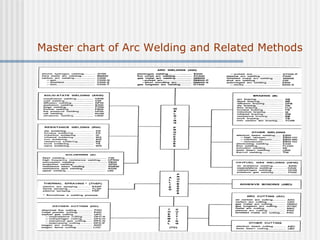
Master chart of Arc Welding and Related Methods
Types of welds Bead Groove Fillet Surfacing Tack Plug Slot Resistance
Bead weld Produced by a single pass Stinger Bead - which is made without weaving motion. Weave Bead-  made by side-side oscillation
Groove weld Groove welds are simply welds made in the groove between two members to be joined.
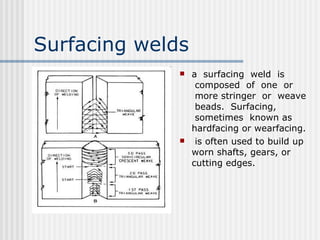
Surfacing welds a  surfacing  weld  is  composed  of  one  or  more stringer  or  weave  beads.  Surfacing,  sometimes  known as hardfacing or wearfacing. is often used to build up worn shafts, gears, or cutting edges.
Fillet weld This weld is used to join two sur- faces that are at approximately right angles to each other in a lap, tee, or comer joint
Plug and Slot weld are welds made through holes or slots in one member of a lap joint.
Tack weld   is a weld made to hold parts of an assembly in proper alignment temporarily until the final welds are made. they are normally between 1/2 inch to 3/4 inch in length, but never more than 1 inch in length.
Basic Welding Positions
Common Welding Types Arc Welding (AW) Oxyfuel Gas Welding(OFW) Resistance Welding
Types of ARC Welding Shielded Metal Arc Welding (SMAW) Submerged Arc Welding (SAW) Flux Cored Arc Welding (FCAW) Gas Tungsten Arc Welding (GTAW or TIG) Gas Metal Arc Welding (GMAW or MIG)
SMAW is performed by striking an arc between a coated-metal electrode and the base metal.  Flux- the coating of the metal electrode will form as shield to the molten metal.
Shielded Metal Arc Welding
SMAW OPERATION
Arc Welding MAchines
Electrode and Holder
Advantages of SMAW High quality welds are made rapidly at a low cost. Can be used easily even to thick and wide work piece to be joined. Can be used from thinner to thicker materials.
Disadvantages SMAW Consumes bigger electric current Dirty work finish Root pass is lower than TIG and MIG Prone to slag inclusions Weld deposits is prone to blue holes
SUBMERGED ARC WELDING (SAW) Is a process in which is done by an automatic electrode feeding machine wherein the tip of the electrode is submerged into a granular flux which shields the arc and the molten metal.
SAW operations
SAW Welding Machine
SAW block diagram
SAW APPLICATIONS widely used in heavy steel plate fabrication work.  welding of structural shapes. longitudinal seam of larger diameter pipe. manufacture of machine components for all types of heavy industry. manufacture of vessels.  pressure and storage tanks.
Advantages of SAW high quality of the weld metal.  extremely high deposition rate and speed.  smooth, uniform finished weld with no spatter.  little or no smoke.  no arc flash, thus minimal need for protective clothing.  high utilization of electrode wire.  easy automation for high-operator factor. normally, no involvement of manipulative skills.
Disadvantages of SAW used only to weld mild and low-alloy high-strength steels.  Unseen arc and puddle can cause poor penetration. high-heat input, slow-cooling cycle can be a problem when welding quenched and tempered steels. limited-position welding process only flat and horizontal
GTAW or TIG Gas Tungsten Arc Welding or Tungsten Inert Gas or HELIARC Welding is a process in which the joining of metals is produced by heating therewith an arc between a tungsten (non consumable) electrode and the work. A shielding gas is used, normally Argon.  normally done with a pure tungsten or tungsten alloy rod, but multiple electrodes are sometimes used. Filler metals are used such as stainless steel, Aluminum and Bronze.
Flux Cored Arc Welding (FCAW) is an automatic or semi-automatic electric arc welding process that uses an arc between a continuously fed flux-filled electrode and the weld pool. The process is used with shielded gas from a flux contained within the tubular electrode with or without additional shielding from an externally supplied gas.
FCAW flux filled electrode and torch
No shielding gas (FCAW)
With Shielding Gas (FCAW)
Two Types of FCAW no shielding gas -  using flux core in the tubular consumable electrode  uses a shielding gas -  gas that must be supplied by an external supply. This is known informally as "dual shield" welding.
Uses of FCAW Mild and low alloy steels Stainless steels Some high nickel alloys Some wear facing/surfacing alloys
Advantages of FCAW FCAW may be an "all-position" process with the right filler metals (the consumable electrode) No shielding gas needed making it suitable for outdoor welding and/or windy conditions A high-deposition rate process (speed at which the filler metal is applied) in the 1G/1F/2F Some "high-speed" (e.g., automotive applications) Less pre cleaning of metal required Metallurgical benefits from the flux such as the weld metal being protected initially from external factors until the flux is chipped away
Disadvantages of FCAW Melted Contact Tip – happens when the electrode actually contacts the base metal, thereby fusing the two Irregular wire feed – typically a mechanical problem Porosity – the gases (specifically those from the flux-core) don’t escape the welded area before the metal hardens, leaving holes in the welded metal More costly filler material/wire as compared to GMAW Less suitable for applications that require painting, such as automotive body works. Cannot be used in a rugged environment limited to shop use only.
FCAW Equipment set up
TIG WELDING
GTAW or TIG process
GTAW  Welding Equipment
TIG Welding Machine
TIG Torch
ADVANTAGES of GTAW most popular method for welding aluminum stainless steels, and nickel-base alloys.  Produces top quality welds. No smoke or fumes  clean – no slag and spatter to be clean during welding reduced distortion in the weld joint because of the concentrated heat source.  is very good for joining thin base metals because of excellent control of heat input.
ADVANTAGES of GTAW especially useful for joining aluminum and magnesium which form refractory oxides,  excellent to use for the reactive metals like titanium and zirconium, which dissolve oxygen and nitrogen and become brittle if exposed to air while melting. welding process by fusion alone without the addition of filler metal.( non-consumable electrode) Used in very critical service application and on very expensive metal or parts.
Disadvantages  of  GTAW EXPENSIVE  a. Arc travel speed and weld metal deposition rates are lower.  b. high price of Inert gases for shielding such as  Argon and Helium.  c. price of Tungsten electrode is high. d. Equipment costs are greater than that for other processes, such as SMAW, which require less precise controls.  MANY LIMITATIONS   and cannot be used in full welding operations
Limitations of GTAW SLOWER WELDING PROCESS   slower than consumable electrode arc welding. FAST CONTAMINATION 1.   During   transfer of molten tungsten from the  electrode to  the weld. 2.  tungsten inclusion(unbalance gas shielding the inclusion is hard & brittle) 3.  During exposure of the hot filler rod to air.  4.  When there is improper welding techniques along the line
GMAW  or  MIG is an electric arc welding process which joins metals by heating them with an arc established between a  continuous filler metal  (consumable)  electrode  and the  work.   Shielding of the arc and molten weld pool is obtained entirely from an externally supplied gas or gas mixture both inert and reactive gases.
GMAW Welding Operations
MIG Machine with Spool feeder
GUN used in GMAW
MIG  Torch
GMAW Weld Diagram
Advantages of GMAW Produced High quality welds  & much faster than with SMAW  and TIG welding.  No flux is used no slag entrapment  in the weld metal.  Very little loss of alloying elements as the metal transfers across the arc.  Minor weld spatter is produced, and it is easily removed.
Advantages of GMAW Versatile  and can be used with a wide variety of metals and alloys, such as Aluminum, Copper, Magnesium, Nickel, Iron and many of their alloys. The process can be operated in several ways, including semi- and fully automatic.  MIG welding is widely used by many industries for   welding a broad variety of materials, parts, and structures.
Disadvantages of GMAW IT  cannot be used in the vertical or overhead welding positions due to the high heat input and the fluidity of the weld puddle. Has  complex equipment compared to equipment used for the shielded metal-arc welding process.
Oxygen Fuel Gas Welding (OFW) is a group of welding processes which join metals by heating with a fuel gas flame or flares with or without the application of pressure and with or without the use of filler metal.
Types of Oxy-fuel Gas Welding Oxy-Acetylene or Oxygen- Acetylene Gas Welding Oxy-Hydrogen or Oxygen- Hydrogen Gas Welding Methylacetone-Propadiene Gas Welding Pressure Gas Welding.
Advantages  of  Oxy-fuel    Gas Welding Easy to use both welding and cutting Controlled heat input Controlled bead size Convenient to use in welding thin sheets, tubes and small diameter pipes
Disadvantages  of  Oxy-Fuel  Gas Welding Cannot be use to weld on thick work piece. Expensive gas
Oxy-Acetylene Diagram     Welding Equipment
Complete Oxy-Acetylene Welding Equipment
Resistance Welding   is a  process in which the fusing temperature is generated at the joint by the resistance to the flow of an electrical current .  is  accomplished  by  clamping  two  or  more  sheets  of metal  between  copper  electrodes  and  then  passing  an electrical  current  through  them.  When  the  metals  are heated to a melting temperature, forging pressure is applied through either a manual or automatic means to weld  the  pieces  together. Two common types are Spot  and Seam  welding
2 Types of Resistance  Welding SPOT WELDING SEAM WELDING
SPOT WELDING The metal to be joined is placed between two electrodes and pressure is applied.  A charge of electricity is sent from one electrode through the material to the other electrode.
SEAM Welding is  like spot welding except that the spots overlap each other, making a continuous weld seam.

Types%20of%20 Welding[1]

  • 1.
    Report for MTE521Metallurgy in Welding By ndrilon 2009 Types of Welding
  • 2.
  • 3.
    What is WELDINGin engineering, any process in which two or more pieces of metal are joined together by the application of heat, pressure, or a combination of both.
  • 4.
    Master chart ofArc Welding and Related Methods
  • 5.
    Types of weldsBead Groove Fillet Surfacing Tack Plug Slot Resistance
  • 6.
    Bead weld Producedby a single pass Stinger Bead - which is made without weaving motion. Weave Bead- made by side-side oscillation
  • 7.
    Groove weld Groovewelds are simply welds made in the groove between two members to be joined.
  • 8.
    Surfacing welds a surfacing  weld  is  composed  of  one  or  more stringer  or  weave  beads.  Surfacing,  sometimes  known as hardfacing or wearfacing. is often used to build up worn shafts, gears, or cutting edges.
  • 9.
    Fillet weld Thisweld is used to join two sur- faces that are at approximately right angles to each other in a lap, tee, or comer joint
  • 10.
    Plug and Slotweld are welds made through holes or slots in one member of a lap joint.
  • 11.
    Tack weld  is a weld made to hold parts of an assembly in proper alignment temporarily until the final welds are made. they are normally between 1/2 inch to 3/4 inch in length, but never more than 1 inch in length.
  • 12.
  • 13.
    Common Welding TypesArc Welding (AW) Oxyfuel Gas Welding(OFW) Resistance Welding
  • 14.
    Types of ARCWelding Shielded Metal Arc Welding (SMAW) Submerged Arc Welding (SAW) Flux Cored Arc Welding (FCAW) Gas Tungsten Arc Welding (GTAW or TIG) Gas Metal Arc Welding (GMAW or MIG)
  • 15.
    SMAW is performedby striking an arc between a coated-metal electrode and the base metal. Flux- the coating of the metal electrode will form as shield to the molten metal.
  • 16.
  • 17.
  • 18.
  • 19.
  • 20.
    Advantages of SMAWHigh quality welds are made rapidly at a low cost. Can be used easily even to thick and wide work piece to be joined. Can be used from thinner to thicker materials.
  • 21.
    Disadvantages SMAW Consumesbigger electric current Dirty work finish Root pass is lower than TIG and MIG Prone to slag inclusions Weld deposits is prone to blue holes
  • 22.
    SUBMERGED ARC WELDING(SAW) Is a process in which is done by an automatic electrode feeding machine wherein the tip of the electrode is submerged into a granular flux which shields the arc and the molten metal.
  • 23.
  • 24.
  • 25.
  • 26.
    SAW APPLICATIONS widelyused in heavy steel plate fabrication work. welding of structural shapes. longitudinal seam of larger diameter pipe. manufacture of machine components for all types of heavy industry. manufacture of vessels. pressure and storage tanks.
  • 27.
    Advantages of SAWhigh quality of the weld metal. extremely high deposition rate and speed. smooth, uniform finished weld with no spatter. little or no smoke. no arc flash, thus minimal need for protective clothing. high utilization of electrode wire. easy automation for high-operator factor. normally, no involvement of manipulative skills.
  • 28.
    Disadvantages of SAWused only to weld mild and low-alloy high-strength steels. Unseen arc and puddle can cause poor penetration. high-heat input, slow-cooling cycle can be a problem when welding quenched and tempered steels. limited-position welding process only flat and horizontal
  • 29.
    GTAW or TIGGas Tungsten Arc Welding or Tungsten Inert Gas or HELIARC Welding is a process in which the joining of metals is produced by heating therewith an arc between a tungsten (non consumable) electrode and the work. A shielding gas is used, normally Argon. normally done with a pure tungsten or tungsten alloy rod, but multiple electrodes are sometimes used. Filler metals are used such as stainless steel, Aluminum and Bronze.
  • 30.
    Flux Cored ArcWelding (FCAW) is an automatic or semi-automatic electric arc welding process that uses an arc between a continuously fed flux-filled electrode and the weld pool. The process is used with shielded gas from a flux contained within the tubular electrode with or without additional shielding from an externally supplied gas.
  • 31.
    FCAW flux filledelectrode and torch
  • 32.
  • 33.
  • 34.
    Two Types ofFCAW no shielding gas - using flux core in the tubular consumable electrode uses a shielding gas - gas that must be supplied by an external supply. This is known informally as "dual shield" welding.
  • 35.
    Uses of FCAWMild and low alloy steels Stainless steels Some high nickel alloys Some wear facing/surfacing alloys
  • 36.
    Advantages of FCAWFCAW may be an "all-position" process with the right filler metals (the consumable electrode) No shielding gas needed making it suitable for outdoor welding and/or windy conditions A high-deposition rate process (speed at which the filler metal is applied) in the 1G/1F/2F Some "high-speed" (e.g., automotive applications) Less pre cleaning of metal required Metallurgical benefits from the flux such as the weld metal being protected initially from external factors until the flux is chipped away
  • 37.
    Disadvantages of FCAWMelted Contact Tip – happens when the electrode actually contacts the base metal, thereby fusing the two Irregular wire feed – typically a mechanical problem Porosity – the gases (specifically those from the flux-core) don’t escape the welded area before the metal hardens, leaving holes in the welded metal More costly filler material/wire as compared to GMAW Less suitable for applications that require painting, such as automotive body works. Cannot be used in a rugged environment limited to shop use only.
  • 38.
  • 39.
  • 40.
    GTAW or TIGprocess
  • 41.
    GTAW WeldingEquipment
  • 42.
  • 43.
  • 44.
    ADVANTAGES of GTAWmost popular method for welding aluminum stainless steels, and nickel-base alloys. Produces top quality welds. No smoke or fumes clean – no slag and spatter to be clean during welding reduced distortion in the weld joint because of the concentrated heat source. is very good for joining thin base metals because of excellent control of heat input.
  • 45.
    ADVANTAGES of GTAWespecially useful for joining aluminum and magnesium which form refractory oxides, excellent to use for the reactive metals like titanium and zirconium, which dissolve oxygen and nitrogen and become brittle if exposed to air while melting. welding process by fusion alone without the addition of filler metal.( non-consumable electrode) Used in very critical service application and on very expensive metal or parts.
  • 46.
    Disadvantages of GTAW EXPENSIVE a. Arc travel speed and weld metal deposition rates are lower. b. high price of Inert gases for shielding such as Argon and Helium. c. price of Tungsten electrode is high. d. Equipment costs are greater than that for other processes, such as SMAW, which require less precise controls. MANY LIMITATIONS and cannot be used in full welding operations
  • 47.
    Limitations of GTAWSLOWER WELDING PROCESS slower than consumable electrode arc welding. FAST CONTAMINATION 1. During transfer of molten tungsten from the electrode to the weld. 2. tungsten inclusion(unbalance gas shielding the inclusion is hard & brittle) 3. During exposure of the hot filler rod to air. 4. When there is improper welding techniques along the line
  • 48.
    GMAW or MIG is an electric arc welding process which joins metals by heating them with an arc established between a continuous filler metal (consumable) electrode and the work. Shielding of the arc and molten weld pool is obtained entirely from an externally supplied gas or gas mixture both inert and reactive gases.
  • 49.
  • 50.
    MIG Machine withSpool feeder
  • 51.
  • 52.
  • 53.
  • 54.
    Advantages of GMAWProduced High quality welds & much faster than with SMAW and TIG welding. No flux is used no slag entrapment in the weld metal. Very little loss of alloying elements as the metal transfers across the arc. Minor weld spatter is produced, and it is easily removed.
  • 55.
    Advantages of GMAWVersatile and can be used with a wide variety of metals and alloys, such as Aluminum, Copper, Magnesium, Nickel, Iron and many of their alloys. The process can be operated in several ways, including semi- and fully automatic. MIG welding is widely used by many industries for welding a broad variety of materials, parts, and structures.
  • 56.
    Disadvantages of GMAWIT cannot be used in the vertical or overhead welding positions due to the high heat input and the fluidity of the weld puddle. Has complex equipment compared to equipment used for the shielded metal-arc welding process.
  • 57.
    Oxygen Fuel GasWelding (OFW) is a group of welding processes which join metals by heating with a fuel gas flame or flares with or without the application of pressure and with or without the use of filler metal.
  • 58.
    Types of Oxy-fuelGas Welding Oxy-Acetylene or Oxygen- Acetylene Gas Welding Oxy-Hydrogen or Oxygen- Hydrogen Gas Welding Methylacetone-Propadiene Gas Welding Pressure Gas Welding.
  • 59.
    Advantages of Oxy-fuel Gas Welding Easy to use both welding and cutting Controlled heat input Controlled bead size Convenient to use in welding thin sheets, tubes and small diameter pipes
  • 60.
    Disadvantages of Oxy-Fuel Gas Welding Cannot be use to weld on thick work piece. Expensive gas
  • 61.
    Oxy-Acetylene Diagram Welding Equipment
  • 62.
  • 63.
    Resistance Welding  is a process in which the fusing temperature is generated at the joint by the resistance to the flow of an electrical current . is  accomplished  by  clamping  two  or  more  sheets  of metal  between  copper  electrodes  and  then  passing  an electrical  current  through  them.  When  the  metals  are heated to a melting temperature, forging pressure is applied through either a manual or automatic means to weld  the  pieces  together. Two common types are Spot  and Seam  welding
  • 64.
    2 Types ofResistance Welding SPOT WELDING SEAM WELDING
  • 65.
    SPOT WELDING Themetal to be joined is placed between two electrodes and pressure is applied. A charge of electricity is sent from one electrode through the material to the other electrode.
  • 66.
    SEAM Welding is like spot welding except that the spots overlap each other, making a continuous weld seam.