Group Members
ShafqatUllah 2k14-Me-07
Khalid Rasheed 2k14-Me-20
Adnan Khan 2k14-Me-06
Yasir Abbas 2k14-Me-03
Topic:
Arc Welding
Why is Welding Important?
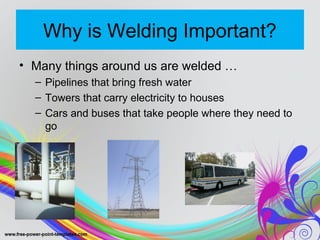
• Many things around us are welded …
– Pipelines that bring fresh water
– Towers that carry electricity to houses
– Cars and buses that take people where they need to
go
What is Arc Welding?
Arc welding is most commonly used to join two
pieces of metal
The welder creates an electric arc that melts the base
metals and filler metal (consumable) together so that
they all fuse into one solid piece of metal
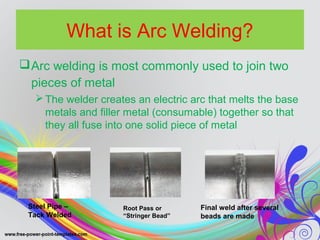
Steel Pipe –
Tack Welded
Root Pass or
“Stringer Bead”
Final weld after several
beads are made
Basics of Arc Welding
The arc is struck between the electrode
and the metal. It then heats the metal to a
melting point. The electrode is then
removed, breaking the arc between the
electrode and the metal. This allows the
molten metal to “freeze” or solidify.
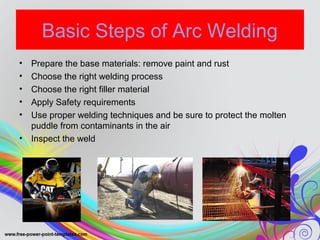
Basic Steps of Arc Welding
• Prepare the base materials: remove paint and rust
• Choose the right welding process
• Choose the right filler material
• Apply Safety requirements
• Use proper welding techniques and be sure to protect the molten
puddle from contaminants in the air
• Inspect the weld
How arc welding is done?
Welding Processes
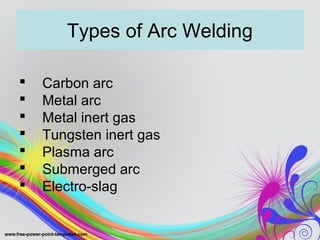
 SMAW (Shielded Metal Arc Welding)
 GMAW (Gas Metal Arc Welding)
 GTAW (Gas Tungsten Arc Welding)
 Oxygen/ Fuel Welding
Types of Arc Welding
 Carbon arc
 Metal arc
 Metal inert gas
 Tungsten inert gas
 Plasma arc
 Submerged arc
 Electro-slag
Carbon Arc Welding
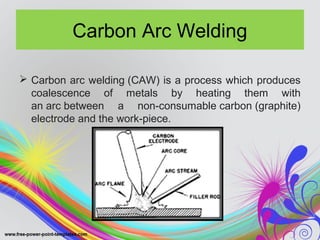
 Carbon arc welding (CAW) is a process which produces
coalescence of metals by heating them with
an arc between a non-consumable carbon (graphite)
electrode and the work-piece.
Metal Arc Welding
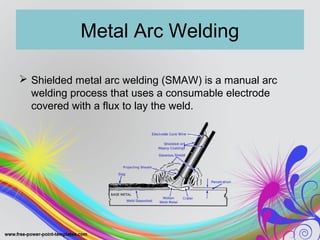
 Shielded metal arc welding (SMAW) is a manual arc
welding process that uses a consumable electrode
covered with a flux to lay the weld.
Metal & Tungsten Inert Arc
• Gas metal arc welding (GMAW), sometimes referred to by its
subtypes metal inert gas (MIG) welding is a welding process in
which an electric arc forms between a consumable wire electrode
and the work piece metal which heats the work piece metal causing
them to melt and join.
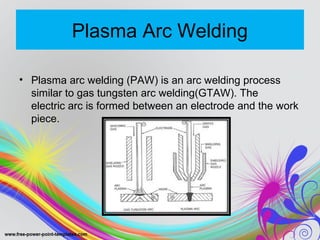
Plasma Arc Welding
• Plasma arc welding (PAW) is an arc welding process
similar to gas tungsten arc welding(GTAW). The
electric arc is formed between an electrode and the work
piece.
Submerged Arc Welding
• Submerged arc welding (SAW) is a common arc
welding process. The first patent on the
submerged-arc welding (SAW) process was
taken out in 1935 and covered an
electric arc beneath a bed of granulated flux.
Electro Slag Arc Welding
• Electro slag welding (ESW) is a highly
productive
• It is a single pass welding process for thick
(greater than 25 mm up to about 300 mm)
materials in a vertical or close to vertical
position.
Arc welding
Advantages
– Most efficient way to join
metals
– Lowest-cost joining method
– Inexpensive Power source
is used as domestic
electricity is compatible
– Joins all commercial
metals
– Provides design flexibility
Limitations
• Manually applied, therefore
high labor cost.
• Need high energy causing
danger
• Not convenient for
disassembly.
• Defects are hard to detect at
joints.
19
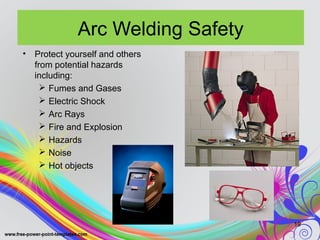
Arc Welding Safety
• Protect yourself and others
from potential hazards
including:
 Fumes and Gases
 Electric Shock
 Arc Rays
 Fire and Explosion
 Hazards
 Noise
 Hot objects
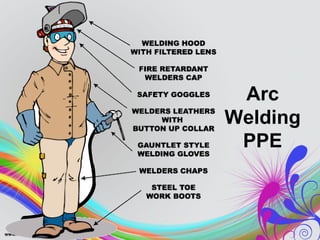
Arc
Welding
PPE
Arc Welding

Arc Welding

  • 2.
    Group Members ShafqatUllah 2k14-Me-07 KhalidRasheed 2k14-Me-20 Adnan Khan 2k14-Me-06 Yasir Abbas 2k14-Me-03
  • 3.
  • 4.
    Why is WeldingImportant? • Many things around us are welded … – Pipelines that bring fresh water – Towers that carry electricity to houses – Cars and buses that take people where they need to go
  • 5.
    What is ArcWelding? Arc welding is most commonly used to join two pieces of metal The welder creates an electric arc that melts the base metals and filler metal (consumable) together so that they all fuse into one solid piece of metal Steel Pipe – Tack Welded Root Pass or “Stringer Bead” Final weld after several beads are made
  • 6.
    Basics of ArcWelding The arc is struck between the electrode and the metal. It then heats the metal to a melting point. The electrode is then removed, breaking the arc between the electrode and the metal. This allows the molten metal to “freeze” or solidify.
  • 7.
    Basic Steps ofArc Welding • Prepare the base materials: remove paint and rust • Choose the right welding process • Choose the right filler material • Apply Safety requirements • Use proper welding techniques and be sure to protect the molten puddle from contaminants in the air • Inspect the weld
  • 8.
  • 9.
    Welding Processes  SMAW(Shielded Metal Arc Welding)  GMAW (Gas Metal Arc Welding)  GTAW (Gas Tungsten Arc Welding)  Oxygen/ Fuel Welding
  • 11.
    Types of ArcWelding  Carbon arc  Metal arc  Metal inert gas  Tungsten inert gas  Plasma arc  Submerged arc  Electro-slag
  • 12.
    Carbon Arc Welding Carbon arc welding (CAW) is a process which produces coalescence of metals by heating them with an arc between a non-consumable carbon (graphite) electrode and the work-piece.
  • 13.
    Metal Arc Welding Shielded metal arc welding (SMAW) is a manual arc welding process that uses a consumable electrode covered with a flux to lay the weld.
  • 14.
    Metal & TungstenInert Arc • Gas metal arc welding (GMAW), sometimes referred to by its subtypes metal inert gas (MIG) welding is a welding process in which an electric arc forms between a consumable wire electrode and the work piece metal which heats the work piece metal causing them to melt and join.
  • 15.
    Plasma Arc Welding •Plasma arc welding (PAW) is an arc welding process similar to gas tungsten arc welding(GTAW). The electric arc is formed between an electrode and the work piece.
  • 16.
    Submerged Arc Welding •Submerged arc welding (SAW) is a common arc welding process. The first patent on the submerged-arc welding (SAW) process was taken out in 1935 and covered an electric arc beneath a bed of granulated flux.
  • 17.
    Electro Slag ArcWelding • Electro slag welding (ESW) is a highly productive • It is a single pass welding process for thick (greater than 25 mm up to about 300 mm) materials in a vertical or close to vertical position.
  • 18.
    Arc welding Advantages – Mostefficient way to join metals – Lowest-cost joining method – Inexpensive Power source is used as domestic electricity is compatible – Joins all commercial metals – Provides design flexibility Limitations • Manually applied, therefore high labor cost. • Need high energy causing danger • Not convenient for disassembly. • Defects are hard to detect at joints.
  • 19.
    19 Arc Welding Safety •Protect yourself and others from potential hazards including:  Fumes and Gases  Electric Shock  Arc Rays  Fire and Explosion  Hazards  Noise  Hot objects
  • 21.