Ahmad A. Y. Al-Qenaei Int. Journal of Engineering Research and Applications www.ijera.com
ISSN: 2248-9622, Vol. 6, Issue 3, (Part - 2) March 2016, pp.78- 83
www.ijera.com 78|P a g e
Fusion Welding Techniques
Ahmad A. Y. Al-Qenaei
The Public Authority for Applied Education and Training
ABSTRACT
Welding is an art of joining two pieces of metal together permanently by melting the parts that touch. This is by
raising their temperature to the fusion point so that they form a sort of pool of molten metal at the ends to the
joined. Sometimes, the pool is supplemented with a filler metal forming a homogeneous mixture, which create
permanent join once it is allowed to get solidify. There is wide diversity in welding technology, in this paper an
introduction to fusion welding techniques with details about the applications, advantages and disadvantages of
each technique will be presented.
Importance of Welding
Welding is used as a fabrication process in every
industry scale (large or small) as it is considered as
a principal means of fabricating and repairing metal
products. It has wide range in applications in air,
underwater and space.
Classification of Welding Processes
The welding processes differ in the manner in
which temperature and pressure are combined and
achieved. The welding process is divided into two
major categories:
 Fusion welding. Processes use heat to
melt the base metals. In many fusion-
welding operations, a filler metal is added
to the molten pool to facilitate the process
and provide bulk and strength to the
welded joint.
 Solid-state joining welding. Joining
processes in which coalescence results
from application of pressure alone or a
combination of heat and pressure.
The fusion category includes the most widely used
welding processes, which can be organized into the
following general groups:
I. GAS WELDING
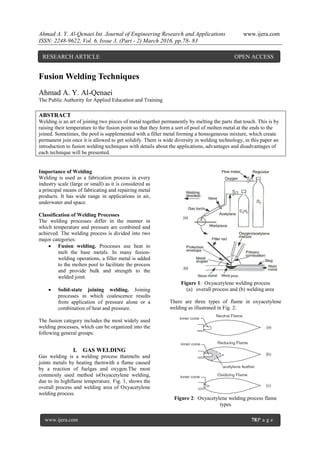
Gas welding is a welding process thatmelts and
joints metals by heating themwith a flame caused
by a reaction of fuelgas and oxygen.The most
commonly used method isOxyacetylene welding,
due to its highflame temperature. Fig. 1, shows the
overall process and welding area of Oxyacetylene
welding process.
Figure 1: Oxyacetylene welding process
(a) overall process and (b) welding area
There are three types of flame in oxyacetylene
welding as illustrated in Fig. 2:
Figure 2: Oxyacetylene welding process flame
types
RESEARCH ARTICLE OPEN ACCESS
Ahmad A. Y. Al-Qenaei Int. Journal of Engineering Research and Applications www.ijera.com
ISSN: 2248-9622, Vol. 6, Issue 3, (Part - 2) March 2016, pp.78- 83
www.ijera.com 79|P a g e
(a) Neutral flame. Acetylene (C2H2) and O2 are
mixed in equal amounts and burn at the tip of
the welding torch. The inner cone gives 2/3 of
heat whereas the outer envelope provides 1/3
of the energy.
(b) Reducing flame. The excess amount of
acetylene is used, giving a reducing flame.
The combustion of acetylene is incomplete
(greenish) between the inner cone and the
outer envelope. Good for welding aluminum
alloys, high carbon steels.
(c) Oxidizing flame. The excess amount of O2 is
used, giving anoxidizing flame. Good for
welding brass.
The advantages and disadvantages of Gas welding
process are indicated in Table 1.
Advantages
-
-
-
-
Simple equipment
Portable
Inexpensive
Easy maintenance & repair
Disadvantages
-
-
-
-
-
-
Limited power density
Very low welding speed
High total heat input per unit length
Large heat affected zone
Severe distortion
Not recommended for welding reactive metals
such as titanium and zirconium
Table 1: Advantages and Disadvantages of
Oxyacetylene welding process
II. Arc Welding
Arc welding is a type of fusion welding that uses a
welding power supply to create an electric arc
between an electrode and the base material to melt
the metals at the welding point. They can use either
direct (DC) or alternating (AC) current, and
consumable or non-consumable electrodes. Arc
welding processes may be manual, semi-automatic,
or fully automated. First developed in the late part
of the 19th century, arc welding became
commercially important in shipbuilding during the
Second World War. Today it remains an important
process for the fabrication of steel structures and
vehicles. Arc welding methods can be categorized
into the following categories:
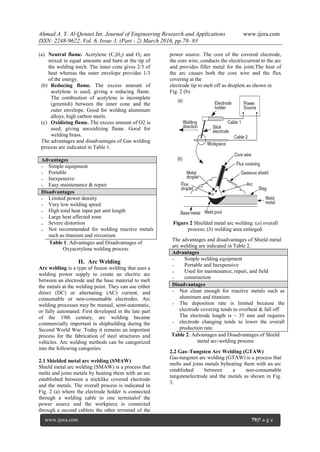
2.1 Shielded metal arc welding (SMAW)
Shield metal arc welding (SMAW) is a process that
melts and joins metals by heating them with an arc
established between a sticklike covered electrode
and the metals. The overall process is indicated in
Fig. 2 (a) where the electrode holder is connected
through a welding cable to one terminalof the
power source and the workpiece is connected
through a second cableto the other terminal of the
power source. The core of the covered electrode,
the core wire, conducts the electriccurrent to the arc
and provides filler metal for the joint.The heat of
the arc causes both the core wire and the flux
covering at the
electrode tip to melt off as droplets as shown in
Fig. 2 (b).
Figure 2 Shielded metal arc welding: (a) overall
process; (b) welding area enlarged.
The advantages and disadvantages of Shield metal
arc welding are indicated in Table 2.
Advantages
-
-
-
-
Simple welding equipment
Portable and Inexpensive
Used for maintenance, repair, and field
construction
Disadvantages
-
-
-
Not clean enough for reactive metals such as
aluminum and titanium.
The deposition rate is limited because the
electrode covering tends to overheat & fall off
The electrode length is ~ 35 mm and requires
electrode changing tends to lower the overall
production rate.
Table 2: Advantages and Disadvantages of Shield
metal arc-welding process
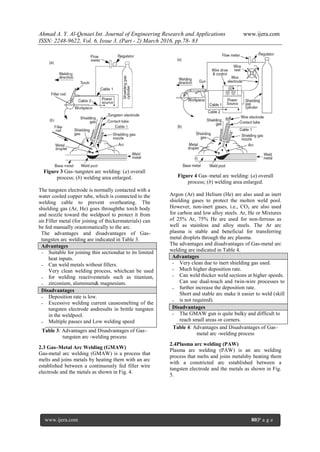
2.2 Gas–Tungsten Arc Welding (GTAW)
Gas-tungsten arc welding (GTAW) is a process that
melts and joins metals byheating them with an arc
established between a non-consumable
tungstenelectrode and the metals as shown in Fig.
3.
Ahmad A. Y. Al-Qenaei Int. Journal of Engineering Research and Applications www.ijera.com
ISSN: 2248-9622, Vol. 6, Issue 3, (Part - 2) March 2016, pp.78- 83
www.ijera.com 80|P a g e
Figure 3 Gas–tungsten arc welding: (a) overall
process; (b) welding area enlarged.
The tungsten electrode is normally contacted with a
water cooled copper tube, which is connected to the
welding cable to prevent overheating. The
shielding gas (Ar, He) goes throughthe torch body
and nozzle toward the weldpool to protect it from
air.Filler metal (for joining of thickermaterials) can
be fed manually orautomatically to the arc.
The advantages and disadvantages of Gas-
tungsten arc welding are indicated in Table 3.
Advantages
-
-
-
-
Suitable for joining thin sectiondue to its limited
heat inputs.
Can weld metals without fillers.
Very clean welding process, whichcan be used
for welding reactivemetals such as titanium,
zirconium, aluminum& magnesium.
Disadvantages
-
-
-
Deposition rate is low.
Excessive welding current causesmelting of the
tungsten electrode andresults in brittle tungsten
in the weldpool.
Multiple passes and Low welding speed
Table 3: Advantages and Disadvantages of Gas–
tungsten arc -welding process
2.3 Gas–Metal Arc Welding (GMAW)
Gas-metal arc welding (GMAW) is a process that
melts and joins metals by heating them with an arc
established between a continuously fed filler wire
electrode and the metals as shown in Fig. 4.
Figure 4 Gas–metal arc welding: (a) overall
process; (b) welding area enlarged.
Argon (Ar) and Helium (He) are also used as inert
shielding gases to protect the molten weld pool.
However, non-inert gases, i.e., CO2 are also used
for carbon and low alloy steels. Ar, He or Mixtures
of 25% Ar, 75% He are used for non-ferrous as
well as stainless and alloy steels. The Ar arc
plasma is stable and beneficial for transferring
metal droplets through the arc plasma.
The advantages and disadvantages of Gas-metal arc
welding are indicated in Table 4.
Advantages
-
-
-
-
-
Very clean due to inert shielding gas used.
Much higher deposition rate.
Can weld thicker weld sections at higher speeds.
Can use dual-touch and twin-wire processes to
further increase the deposition rate.
Short and stable arc make it easier to weld (skill
is not required).
Disadvantages
- The GMAW gun is quite bulky and difficult to
reach small areas or corners.
Table 4: Advantages and Disadvantages of Gas–
metal arc -welding process
2.4Plasma arc welding (PAW)
Plasma arc welding (PAW) is an arc welding
process that melts and joins metalsby heating them
with a constricted arc established between a
tungsten electrode and the metals as shown in Fig.
5.
Ahmad A. Y. Al-Qenaei Int. Journal of Engineering Research and Applications www.ijera.com
ISSN: 2248-9622, Vol. 6, Issue 3, (Part - 2) March 2016, pp.78- 83
www.ijera.com 81|P a g e
Figure 5 Plasma arc welding overall process
Plasma arc welding is similar to GTAW but an
orifice gas and a shielding gas is used. The arc is
constricted due to the covering action of the orifice
gas nozzle. The tungsten electrode is recessed in
the orifice gas nozzle and the arc is initiated by a
high frequency generator between the electrode tip
and the water-cooled orifice gas nozzle. The arc is
then transferred to between the electrode tip and the
work piece.
The advantages and disadvantages of Plasma arc
welding are indicated in Table 5.
Advantages
-
-
-
The electrode is recessed in the nozzle, so no
contamination to the weld metal.
Less sensitive to arc length variation.
Full penetration.
High welding speed.
Disadvantages
-
-
-
More complicated.
Require proper electrode tip configuration and
positioning and orifice selection.
Equipment is more expensive
Table 5: Advantages and Disadvantages of Plasma
arc welding process
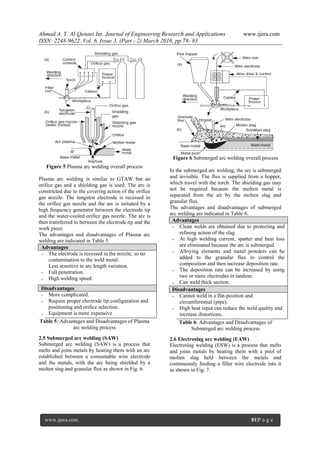
2.5 Submerged arc welding (SAW)
Submerged arc welding (SAW) is a process that
melts and joins metals by heating them with an arc
established between a consumable wire electrode
and the metals, with the arc being shielded by a
molten stag and granular flux as shown in Fig. 6.
Figure 6 Submerged arc welding overall process
In the submerged arc welding, the arc is submerged
and invisible. The flux is supplied from a hopper,
which travel with the torch. The shielding gas may
not be required because the molten metal is
separated from the air by the molten slag and
granular flux.
The advantages and disadvantages of submerged
arc welding are indicated in Table 6.
Advantages
-
-
-
-
-
Clean welds are obtained due to protecting and
refining action of the slag.
At high welding current, spatter and heat loss
are eliminated because the arc is submerged.
Alloying elements and metal powders can be
added to the granular flux to control the
composition and then increase deposition rate.
The deposition rate can be increased by using
two or more electrodes in tandem.
Can weld thick section.
Disadvantages
-
-
Cannot weld in a flat-position and
circumferential (pipe).
High heat input can reduce the weld quality and
increase distortions.
Table 6: Advantages and Disadvantages of
Submerged arc welding process
2.6 Electroslag arc welding (EAW)
Electroslag welding (ESW) is a process that melts
and joins metals by heating them with a pool of
molten slag held between the metals and
continuously feeding a filler wire electrode into it
as shown in Fig. 7.
Ahmad A. Y. Al-Qenaei Int. Journal of Engineering Research and Applications www.ijera.com
ISSN: 2248-9622, Vol. 6, Issue 3, (Part - 2) March 2016, pp.78- 83
www.ijera.com 82|P a g e
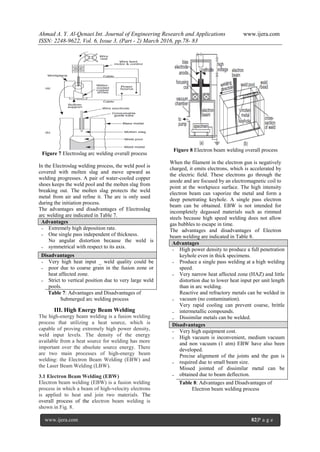
Figure 7 Electroslag arc welding overall process
In the Electroslag welding process, the weld pool is
covered with molten slag and move upward as
welding progresses. A pair of water-cooled copper
shoes keeps the weld pool and the molten slag from
breaking out. The molten slag protects the weld
metal from air and refine it. The arc is only used
during the initiation process.
The advantages and disadvantages of Electroslag
arc welding are indicated in Table 7.
Advantages
-
-
-
Extremely high deposition rate.
One single pass independent of thickness.
No angular distortion because the weld is
symmetrical with respect to its axis.
Disadvantages
-
-
-
Very high heat input _ weld quality could be
poor due to coarse grain in the fusion zone or
heat affected zone.
Strict to vertical position due to very large weld
pools.
Table 7: Advantages and Disadvantages of
Submerged arc welding process
III. High Energy Beam Welding
The high-energy beam welding is a fusion welding
process that utilizing a heat source, which is
capable of proving extremely high power density,
weld input levels. The density of the energy
available from a heat source for welding has more
important over the absolute source energy. There
are two main processes of high-energy beam
welding: the Electron Beam Welding (EBW) and
the Laser Beam Welding (LBW).
3.1 Electron Beam Welding (EBW)
Electron beam welding (EBW) is a fusion welding
process in which a beam of high-velocity electrons
is applied to heat and join two materials. The
overall process of the electron beam welding is
shown in Fig. 8.
Figure 8 Electron beam welding overall process
When the filament in the electron gun is negatively
charged, it emits electrons, which is accelerated by
the electric field. These electrons go through the
anode and are focused by an electromagnetic coil to
point at the workpiece surface. The high intensity
electron beam can vaporize the metal and form a
deep penetrating keyhole. A single pass electron
beam can be obtained. EBW is not intended for
incompletely degassed materials such as rimmed
steels because high speed welding does not allow
gas bubbles to escape in time.
The advantages and disadvantages of Electron
beam welding are indicated in Table 8.
Advantages
-
-
-
-
-
-
High power density to produce a full penetration
keyhole even in thick specimens.
Produce a single pass welding at a high welding
speed.
Very narrow heat affected zone (HAZ) and little
distortion due to lower heat input per unit length
than in arc welding.
Reactive and refractory metals can be welded in
vacuum (no contamination).
Very rapid cooling can prevent coarse, brittle
intermetallic compounds.
Dissimilar metals can be welded.
Disadvantages
-
-
-
-
Very high equipment cost.
High vacuum is inconvenient, medium vacuum
and non vacuum (1 atm) EBW have also been
developed.
Precise alignment of the joints and the gun is
required due to small beam size.
Missed jointed of dissimilar metal can be
obtained due to beam deflection.
Table 8: Advantages and Disadvantages of
Electron beam welding process
Ahmad A. Y. Al-Qenaei Int. Journal of Engineering Research and Applications www.ijera.com
ISSN: 2248-9622, Vol. 6, Issue 3, (Part - 2) March 2016, pp.78- 83
www.ijera.com 83|P a g e
3.2 Laser Beam Welding (LBW)
Laser beam welding (LBW) is a process that melts
and joins metals by heating them with a laser beam.
The overall process of the laser beam welding is
shown in Fig. 9.
The laser beam can be produced by a solid state
laser (YAG-Yttrium-aluminium garnet crystal) or a
gas (CO2) laser, which can be focused and directed
by optical means to achieve high power densities.
The CO2 laser gives higher power than YAG. Laser
is produced when excited electrons return to their
normal state. A plasma (an ionic gas) produced
during welding can absorb and scatter the laser
beam, which reduces the weld penetration. Inert
gas (He, Ar) is required to increase weld
penetration.
Figur
e 9 Laser beam welding overall process
The advantages and disadvantages of laser beam
welding are indicated in Table 9.
Advantages
-
-
-
Produce deep and narrow welds at high welding
speeds.
Narrow heat-affected zone.
Little distortion.
Can be used for welding dissimilar metals in
varying sizes.
Disadvantages
-
-
-
Very high reflectivity of a laser beam by the
metal surface.
High equipment cost.
Require precise joint and laser beam alignment.
Table 9: Advantages and Disadvantages of Laser
beam welding process
REFERENCES
[1] Kou, S., Welding metallurgy, 2nd
edition,
2003, John Willey and Sons, Inc., USA.
[2] Gourd, L.M., Principles of welding
technology, 3rd edition, 1995, Edward
Arnold.
[3] Welding Handbook, Vol. 3, 7th ed.,
American Welding Society, Miami, FL,
1980.
[4] Mendez, P. F., and Eagar, T. W.,
Advanced Materials and Processes, 2001.

Fusion Welding Techniques

  • 1.
    Ahmad A. Y.Al-Qenaei Int. Journal of Engineering Research and Applications www.ijera.com ISSN: 2248-9622, Vol. 6, Issue 3, (Part - 2) March 2016, pp.78- 83 www.ijera.com 78|P a g e Fusion Welding Techniques Ahmad A. Y. Al-Qenaei The Public Authority for Applied Education and Training ABSTRACT Welding is an art of joining two pieces of metal together permanently by melting the parts that touch. This is by raising their temperature to the fusion point so that they form a sort of pool of molten metal at the ends to the joined. Sometimes, the pool is supplemented with a filler metal forming a homogeneous mixture, which create permanent join once it is allowed to get solidify. There is wide diversity in welding technology, in this paper an introduction to fusion welding techniques with details about the applications, advantages and disadvantages of each technique will be presented. Importance of Welding Welding is used as a fabrication process in every industry scale (large or small) as it is considered as a principal means of fabricating and repairing metal products. It has wide range in applications in air, underwater and space. Classification of Welding Processes The welding processes differ in the manner in which temperature and pressure are combined and achieved. The welding process is divided into two major categories:  Fusion welding. Processes use heat to melt the base metals. In many fusion- welding operations, a filler metal is added to the molten pool to facilitate the process and provide bulk and strength to the welded joint.  Solid-state joining welding. Joining processes in which coalescence results from application of pressure alone or a combination of heat and pressure. The fusion category includes the most widely used welding processes, which can be organized into the following general groups: I. GAS WELDING Gas welding is a welding process thatmelts and joints metals by heating themwith a flame caused by a reaction of fuelgas and oxygen.The most commonly used method isOxyacetylene welding, due to its highflame temperature. Fig. 1, shows the overall process and welding area of Oxyacetylene welding process. Figure 1: Oxyacetylene welding process (a) overall process and (b) welding area There are three types of flame in oxyacetylene welding as illustrated in Fig. 2: Figure 2: Oxyacetylene welding process flame types RESEARCH ARTICLE OPEN ACCESS
  • 2.
    Ahmad A. Y.Al-Qenaei Int. Journal of Engineering Research and Applications www.ijera.com ISSN: 2248-9622, Vol. 6, Issue 3, (Part - 2) March 2016, pp.78- 83 www.ijera.com 79|P a g e (a) Neutral flame. Acetylene (C2H2) and O2 are mixed in equal amounts and burn at the tip of the welding torch. The inner cone gives 2/3 of heat whereas the outer envelope provides 1/3 of the energy. (b) Reducing flame. The excess amount of acetylene is used, giving a reducing flame. The combustion of acetylene is incomplete (greenish) between the inner cone and the outer envelope. Good for welding aluminum alloys, high carbon steels. (c) Oxidizing flame. The excess amount of O2 is used, giving anoxidizing flame. Good for welding brass. The advantages and disadvantages of Gas welding process are indicated in Table 1. Advantages - - - - Simple equipment Portable Inexpensive Easy maintenance & repair Disadvantages - - - - - - Limited power density Very low welding speed High total heat input per unit length Large heat affected zone Severe distortion Not recommended for welding reactive metals such as titanium and zirconium Table 1: Advantages and Disadvantages of Oxyacetylene welding process II. Arc Welding Arc welding is a type of fusion welding that uses a welding power supply to create an electric arc between an electrode and the base material to melt the metals at the welding point. They can use either direct (DC) or alternating (AC) current, and consumable or non-consumable electrodes. Arc welding processes may be manual, semi-automatic, or fully automated. First developed in the late part of the 19th century, arc welding became commercially important in shipbuilding during the Second World War. Today it remains an important process for the fabrication of steel structures and vehicles. Arc welding methods can be categorized into the following categories: 2.1 Shielded metal arc welding (SMAW) Shield metal arc welding (SMAW) is a process that melts and joins metals by heating them with an arc established between a sticklike covered electrode and the metals. The overall process is indicated in Fig. 2 (a) where the electrode holder is connected through a welding cable to one terminalof the power source and the workpiece is connected through a second cableto the other terminal of the power source. The core of the covered electrode, the core wire, conducts the electriccurrent to the arc and provides filler metal for the joint.The heat of the arc causes both the core wire and the flux covering at the electrode tip to melt off as droplets as shown in Fig. 2 (b). Figure 2 Shielded metal arc welding: (a) overall process; (b) welding area enlarged. The advantages and disadvantages of Shield metal arc welding are indicated in Table 2. Advantages - - - - Simple welding equipment Portable and Inexpensive Used for maintenance, repair, and field construction Disadvantages - - - Not clean enough for reactive metals such as aluminum and titanium. The deposition rate is limited because the electrode covering tends to overheat & fall off The electrode length is ~ 35 mm and requires electrode changing tends to lower the overall production rate. Table 2: Advantages and Disadvantages of Shield metal arc-welding process 2.2 Gas–Tungsten Arc Welding (GTAW) Gas-tungsten arc welding (GTAW) is a process that melts and joins metals byheating them with an arc established between a non-consumable tungstenelectrode and the metals as shown in Fig. 3.
  • 3.
    Ahmad A. Y.Al-Qenaei Int. Journal of Engineering Research and Applications www.ijera.com ISSN: 2248-9622, Vol. 6, Issue 3, (Part - 2) March 2016, pp.78- 83 www.ijera.com 80|P a g e Figure 3 Gas–tungsten arc welding: (a) overall process; (b) welding area enlarged. The tungsten electrode is normally contacted with a water cooled copper tube, which is connected to the welding cable to prevent overheating. The shielding gas (Ar, He) goes throughthe torch body and nozzle toward the weldpool to protect it from air.Filler metal (for joining of thickermaterials) can be fed manually orautomatically to the arc. The advantages and disadvantages of Gas- tungsten arc welding are indicated in Table 3. Advantages - - - - Suitable for joining thin sectiondue to its limited heat inputs. Can weld metals without fillers. Very clean welding process, whichcan be used for welding reactivemetals such as titanium, zirconium, aluminum& magnesium. Disadvantages - - - Deposition rate is low. Excessive welding current causesmelting of the tungsten electrode andresults in brittle tungsten in the weldpool. Multiple passes and Low welding speed Table 3: Advantages and Disadvantages of Gas– tungsten arc -welding process 2.3 Gas–Metal Arc Welding (GMAW) Gas-metal arc welding (GMAW) is a process that melts and joins metals by heating them with an arc established between a continuously fed filler wire electrode and the metals as shown in Fig. 4. Figure 4 Gas–metal arc welding: (a) overall process; (b) welding area enlarged. Argon (Ar) and Helium (He) are also used as inert shielding gases to protect the molten weld pool. However, non-inert gases, i.e., CO2 are also used for carbon and low alloy steels. Ar, He or Mixtures of 25% Ar, 75% He are used for non-ferrous as well as stainless and alloy steels. The Ar arc plasma is stable and beneficial for transferring metal droplets through the arc plasma. The advantages and disadvantages of Gas-metal arc welding are indicated in Table 4. Advantages - - - - - Very clean due to inert shielding gas used. Much higher deposition rate. Can weld thicker weld sections at higher speeds. Can use dual-touch and twin-wire processes to further increase the deposition rate. Short and stable arc make it easier to weld (skill is not required). Disadvantages - The GMAW gun is quite bulky and difficult to reach small areas or corners. Table 4: Advantages and Disadvantages of Gas– metal arc -welding process 2.4Plasma arc welding (PAW) Plasma arc welding (PAW) is an arc welding process that melts and joins metalsby heating them with a constricted arc established between a tungsten electrode and the metals as shown in Fig. 5.
  • 4.
    Ahmad A. Y.Al-Qenaei Int. Journal of Engineering Research and Applications www.ijera.com ISSN: 2248-9622, Vol. 6, Issue 3, (Part - 2) March 2016, pp.78- 83 www.ijera.com 81|P a g e Figure 5 Plasma arc welding overall process Plasma arc welding is similar to GTAW but an orifice gas and a shielding gas is used. The arc is constricted due to the covering action of the orifice gas nozzle. The tungsten electrode is recessed in the orifice gas nozzle and the arc is initiated by a high frequency generator between the electrode tip and the water-cooled orifice gas nozzle. The arc is then transferred to between the electrode tip and the work piece. The advantages and disadvantages of Plasma arc welding are indicated in Table 5. Advantages - - - The electrode is recessed in the nozzle, so no contamination to the weld metal. Less sensitive to arc length variation. Full penetration. High welding speed. Disadvantages - - - More complicated. Require proper electrode tip configuration and positioning and orifice selection. Equipment is more expensive Table 5: Advantages and Disadvantages of Plasma arc welding process 2.5 Submerged arc welding (SAW) Submerged arc welding (SAW) is a process that melts and joins metals by heating them with an arc established between a consumable wire electrode and the metals, with the arc being shielded by a molten stag and granular flux as shown in Fig. 6. Figure 6 Submerged arc welding overall process In the submerged arc welding, the arc is submerged and invisible. The flux is supplied from a hopper, which travel with the torch. The shielding gas may not be required because the molten metal is separated from the air by the molten slag and granular flux. The advantages and disadvantages of submerged arc welding are indicated in Table 6. Advantages - - - - - Clean welds are obtained due to protecting and refining action of the slag. At high welding current, spatter and heat loss are eliminated because the arc is submerged. Alloying elements and metal powders can be added to the granular flux to control the composition and then increase deposition rate. The deposition rate can be increased by using two or more electrodes in tandem. Can weld thick section. Disadvantages - - Cannot weld in a flat-position and circumferential (pipe). High heat input can reduce the weld quality and increase distortions. Table 6: Advantages and Disadvantages of Submerged arc welding process 2.6 Electroslag arc welding (EAW) Electroslag welding (ESW) is a process that melts and joins metals by heating them with a pool of molten slag held between the metals and continuously feeding a filler wire electrode into it as shown in Fig. 7.
  • 5.
    Ahmad A. Y.Al-Qenaei Int. Journal of Engineering Research and Applications www.ijera.com ISSN: 2248-9622, Vol. 6, Issue 3, (Part - 2) March 2016, pp.78- 83 www.ijera.com 82|P a g e Figure 7 Electroslag arc welding overall process In the Electroslag welding process, the weld pool is covered with molten slag and move upward as welding progresses. A pair of water-cooled copper shoes keeps the weld pool and the molten slag from breaking out. The molten slag protects the weld metal from air and refine it. The arc is only used during the initiation process. The advantages and disadvantages of Electroslag arc welding are indicated in Table 7. Advantages - - - Extremely high deposition rate. One single pass independent of thickness. No angular distortion because the weld is symmetrical with respect to its axis. Disadvantages - - - Very high heat input _ weld quality could be poor due to coarse grain in the fusion zone or heat affected zone. Strict to vertical position due to very large weld pools. Table 7: Advantages and Disadvantages of Submerged arc welding process III. High Energy Beam Welding The high-energy beam welding is a fusion welding process that utilizing a heat source, which is capable of proving extremely high power density, weld input levels. The density of the energy available from a heat source for welding has more important over the absolute source energy. There are two main processes of high-energy beam welding: the Electron Beam Welding (EBW) and the Laser Beam Welding (LBW). 3.1 Electron Beam Welding (EBW) Electron beam welding (EBW) is a fusion welding process in which a beam of high-velocity electrons is applied to heat and join two materials. The overall process of the electron beam welding is shown in Fig. 8. Figure 8 Electron beam welding overall process When the filament in the electron gun is negatively charged, it emits electrons, which is accelerated by the electric field. These electrons go through the anode and are focused by an electromagnetic coil to point at the workpiece surface. The high intensity electron beam can vaporize the metal and form a deep penetrating keyhole. A single pass electron beam can be obtained. EBW is not intended for incompletely degassed materials such as rimmed steels because high speed welding does not allow gas bubbles to escape in time. The advantages and disadvantages of Electron beam welding are indicated in Table 8. Advantages - - - - - - High power density to produce a full penetration keyhole even in thick specimens. Produce a single pass welding at a high welding speed. Very narrow heat affected zone (HAZ) and little distortion due to lower heat input per unit length than in arc welding. Reactive and refractory metals can be welded in vacuum (no contamination). Very rapid cooling can prevent coarse, brittle intermetallic compounds. Dissimilar metals can be welded. Disadvantages - - - - Very high equipment cost. High vacuum is inconvenient, medium vacuum and non vacuum (1 atm) EBW have also been developed. Precise alignment of the joints and the gun is required due to small beam size. Missed jointed of dissimilar metal can be obtained due to beam deflection. Table 8: Advantages and Disadvantages of Electron beam welding process
  • 6.
    Ahmad A. Y.Al-Qenaei Int. Journal of Engineering Research and Applications www.ijera.com ISSN: 2248-9622, Vol. 6, Issue 3, (Part - 2) March 2016, pp.78- 83 www.ijera.com 83|P a g e 3.2 Laser Beam Welding (LBW) Laser beam welding (LBW) is a process that melts and joins metals by heating them with a laser beam. The overall process of the laser beam welding is shown in Fig. 9. The laser beam can be produced by a solid state laser (YAG-Yttrium-aluminium garnet crystal) or a gas (CO2) laser, which can be focused and directed by optical means to achieve high power densities. The CO2 laser gives higher power than YAG. Laser is produced when excited electrons return to their normal state. A plasma (an ionic gas) produced during welding can absorb and scatter the laser beam, which reduces the weld penetration. Inert gas (He, Ar) is required to increase weld penetration. Figur e 9 Laser beam welding overall process The advantages and disadvantages of laser beam welding are indicated in Table 9. Advantages - - - Produce deep and narrow welds at high welding speeds. Narrow heat-affected zone. Little distortion. Can be used for welding dissimilar metals in varying sizes. Disadvantages - - - Very high reflectivity of a laser beam by the metal surface. High equipment cost. Require precise joint and laser beam alignment. Table 9: Advantages and Disadvantages of Laser beam welding process REFERENCES [1] Kou, S., Welding metallurgy, 2nd edition, 2003, John Willey and Sons, Inc., USA. [2] Gourd, L.M., Principles of welding technology, 3rd edition, 1995, Edward Arnold. [3] Welding Handbook, Vol. 3, 7th ed., American Welding Society, Miami, FL, 1980. [4] Mendez, P. F., and Eagar, T. W., Advanced Materials and Processes, 2001.