INTRODUCTION SOIL STRUCTURE
INTRODUCTION TO GEOTECHNICAL
ENGINEERING:
 Geotechnical Engineering is a term which includes Soil Mechanics,
Rock Mechanics and Geology.
 Soil Mechanics deals with action of forces on soil and with flow of
water on soil.
 Rock Mechanics deals with mechanics of rock.
 Geology deals with the study of Earth, the rocks of which it is
composed, and the processes by which they change.
 Out of the above 3, we mainly deal with Soil Mechanics for this
course.
APPLICATIONS TO CIVIL ENGINEERING:
A) Foundations:
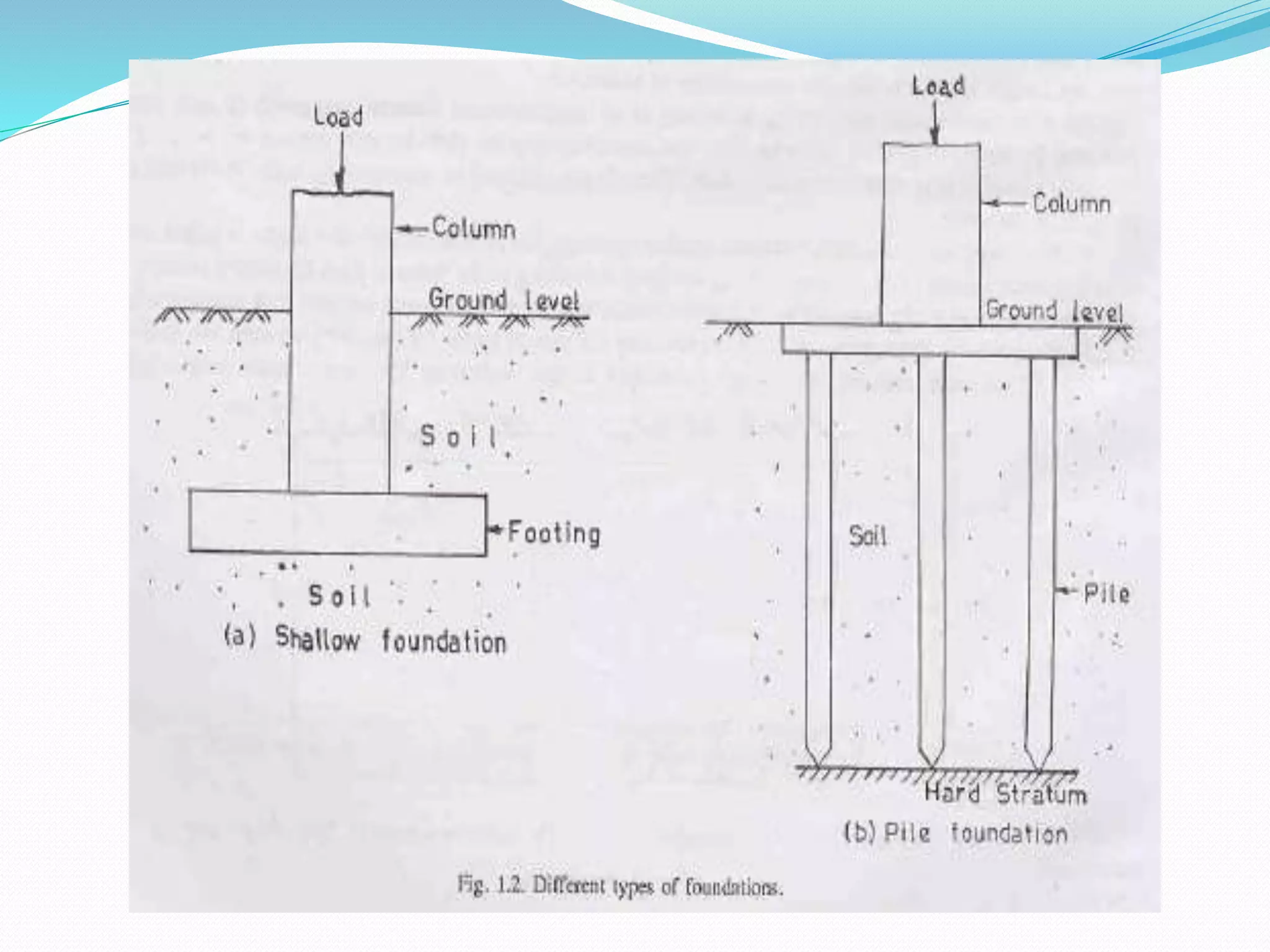
 Every civil engineering structure – building or bridge or dam, it is
founded on or below the surface of earth.
 Foundations are required to transmit the load of the structure safely to
the soil.
 Foundation Engineering is an important branch in Geotechnical
Engineering.
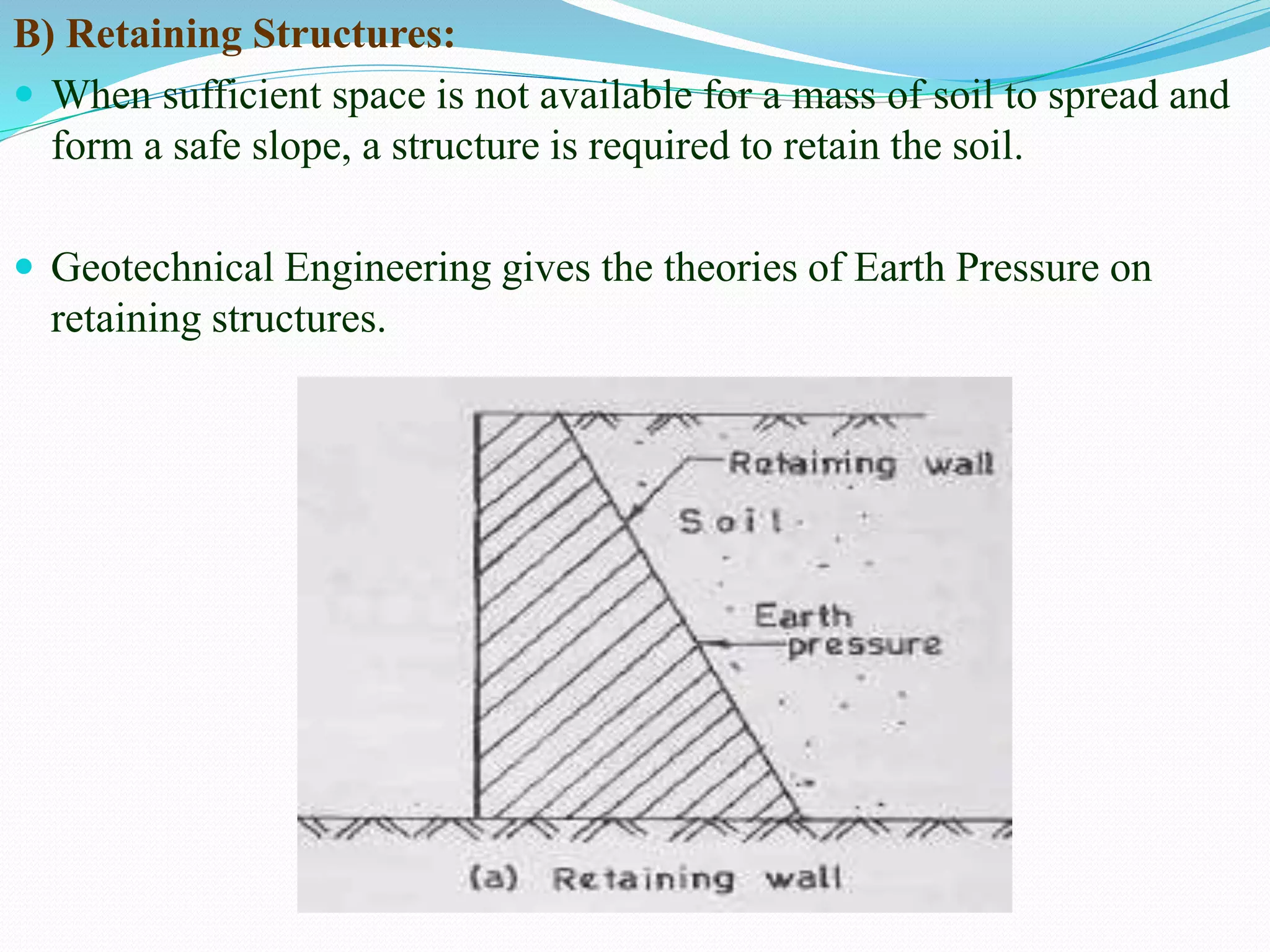
B) Retaining Structures:
 When sufficient space is not available for a mass of soil to spread and
form a safe slope, a structure is required to retain the soil.
 Geotechnical Engineering gives the theories of Earth Pressure on
retaining structures.
C) Slope Stability:
 Whether natural slope or man nade slope – to prevent landslides,
slope stability is important.
 Geotechnical Engineering provides methods to check stability of
slopes.
D) Pavement Design:
 A pavement is a hard crust placed on soil for the purpose of providing
a smooth and strong surface on which the vehicles can move.
 Pavement consists of subgrade, sub base course, base course and
surface course.
 Behaviour of subgrade on various loading and environmental
conditions are studied in Geotechnical Engineering.
PAVEMENT DETAILS
COMPLEXITY OF SOIL STRUCTURE:
 Soil is a highly complex material.
 It differs from conventional structural materials such as steel and
concrete.
 Properties of steel can be accurately controlled and properties of
concrete can be controlled to some extent during its preparation.
 Soil is a material which has been subjected to changes of nature and
we cannot control that.
 Thus, soil is a heterogeneous and unpredictable material.
 Properties of soil also change with change in environmental, loading
and drainage conditions.
 Main engineering properties of steel and concrete are Elastic Modulus
(stress/strain), Tensile strength and Compressive Strength.
 Most of the design work can be done if these above properties are
known.
 However, engineering properties of soils depend on a lot of factors and
it is not possible to characterize them by 2 or 3 parameters.
 Detailed testing is required to determine the characteristics of soil and
only then design can be done.
 Steel and concrete can be inspected before use, soils for foundations
are at great depth and not open to inspection.
MAJOR SOIL DEPOSITS OF INDIA:
Soil deposits of India can be classified into 5 major groups.
A) Alluvial Soil:
 A large part of North India is covered with Alluvial soils.
 The distinct characteristics of Alluvial deposits is the existence of
alternating layers of sand, silt and clay.
 Thickness of each layer depends on the local terrain and nature of
floods in the rivers causing deposition.
B) Black Cotton Soil:
 A large portion of central India and a portion of South India are
covered with Black Cotton Soils.
 These soils are residual deposits formed from basalt rocks.
 These soils are clays of high plasticity.
 They have high shrinkage and swelling properties.
 Shear strength, Bearing capacity of this soil are extremely low.
C) Laterite Soil:
 Laterite soils are formed by decomposition of rock, removal of bases
and silica and accumulation of Iron oxide and Aluminium oxide.
 Presence of Iron oxide gives these soils the characteristic red or pink
colour.
 These are residual soils formed from basalt.
(Basalt: Most common type of solidified lava; a dense dark grey fine-
grained igneous rock)
 These soils exist in Central, Southern and Eastern India.
 These are soft and can be cut with a chisel when wet but they become
hard as time passes.
D) Desert Soil:
 A large part of Rajasthan and adjoining states is covered with sand
dunes.
 In this area, arid conditions exist with little rainfall. (Arid: No water)
 Size of the particles is in the range of fine sands.
 They are uniform in gradation.
 (Gradation): Proportion of material of each grain size present in a soil.
E) Marine Soil:
 They contain a large amount of organic matter.
 They are present along the coast.
 They have very low shear strength, highly plastic,highly compressible.
FIELD IDENTIFICATION OF SOILS:
Cohesion:
It is the bonding force or attractive fore between the particles of fine
grained soils that creates shear strength.
Sizes of soil:
Gravel – Between 80 mm and 4.75 mm.
Sand – Between 4.75 mm and 75 microns.
Silt – Between 75 microns and 0.002 mm.
Clay – Finer than 0.002 mm.
Thank You

Introduction to Soil Structure

  • 1.
  • 2.
    INTRODUCTION TO GEOTECHNICAL ENGINEERING: Geotechnical Engineering is a term which includes Soil Mechanics, Rock Mechanics and Geology.  Soil Mechanics deals with action of forces on soil and with flow of water on soil.  Rock Mechanics deals with mechanics of rock.  Geology deals with the study of Earth, the rocks of which it is composed, and the processes by which they change.  Out of the above 3, we mainly deal with Soil Mechanics for this course.
  • 3.
    APPLICATIONS TO CIVILENGINEERING: A) Foundations:  Every civil engineering structure – building or bridge or dam, it is founded on or below the surface of earth.  Foundations are required to transmit the load of the structure safely to the soil.  Foundation Engineering is an important branch in Geotechnical Engineering.
  • 5.
    B) Retaining Structures: When sufficient space is not available for a mass of soil to spread and form a safe slope, a structure is required to retain the soil.  Geotechnical Engineering gives the theories of Earth Pressure on retaining structures.
  • 6.
    C) Slope Stability: Whether natural slope or man nade slope – to prevent landslides, slope stability is important.  Geotechnical Engineering provides methods to check stability of slopes.
  • 7.
    D) Pavement Design: A pavement is a hard crust placed on soil for the purpose of providing a smooth and strong surface on which the vehicles can move.  Pavement consists of subgrade, sub base course, base course and surface course.  Behaviour of subgrade on various loading and environmental conditions are studied in Geotechnical Engineering. PAVEMENT DETAILS
  • 8.
    COMPLEXITY OF SOILSTRUCTURE:  Soil is a highly complex material.  It differs from conventional structural materials such as steel and concrete.  Properties of steel can be accurately controlled and properties of concrete can be controlled to some extent during its preparation.  Soil is a material which has been subjected to changes of nature and we cannot control that.  Thus, soil is a heterogeneous and unpredictable material.  Properties of soil also change with change in environmental, loading and drainage conditions.  Main engineering properties of steel and concrete are Elastic Modulus (stress/strain), Tensile strength and Compressive Strength.  Most of the design work can be done if these above properties are known.
  • 9.
     However, engineeringproperties of soils depend on a lot of factors and it is not possible to characterize them by 2 or 3 parameters.  Detailed testing is required to determine the characteristics of soil and only then design can be done.  Steel and concrete can be inspected before use, soils for foundations are at great depth and not open to inspection. MAJOR SOIL DEPOSITS OF INDIA: Soil deposits of India can be classified into 5 major groups. A) Alluvial Soil:  A large part of North India is covered with Alluvial soils.  The distinct characteristics of Alluvial deposits is the existence of alternating layers of sand, silt and clay.  Thickness of each layer depends on the local terrain and nature of floods in the rivers causing deposition.
  • 10.
    B) Black CottonSoil:  A large portion of central India and a portion of South India are covered with Black Cotton Soils.  These soils are residual deposits formed from basalt rocks.  These soils are clays of high plasticity.  They have high shrinkage and swelling properties.  Shear strength, Bearing capacity of this soil are extremely low. C) Laterite Soil:  Laterite soils are formed by decomposition of rock, removal of bases and silica and accumulation of Iron oxide and Aluminium oxide.  Presence of Iron oxide gives these soils the characteristic red or pink colour.  These are residual soils formed from basalt. (Basalt: Most common type of solidified lava; a dense dark grey fine- grained igneous rock)
  • 11.
     These soilsexist in Central, Southern and Eastern India.  These are soft and can be cut with a chisel when wet but they become hard as time passes. D) Desert Soil:  A large part of Rajasthan and adjoining states is covered with sand dunes.  In this area, arid conditions exist with little rainfall. (Arid: No water)  Size of the particles is in the range of fine sands.  They are uniform in gradation.  (Gradation): Proportion of material of each grain size present in a soil. E) Marine Soil:  They contain a large amount of organic matter.  They are present along the coast.  They have very low shear strength, highly plastic,highly compressible.
  • 12.
    FIELD IDENTIFICATION OFSOILS: Cohesion: It is the bonding force or attractive fore between the particles of fine grained soils that creates shear strength. Sizes of soil: Gravel – Between 80 mm and 4.75 mm. Sand – Between 4.75 mm and 75 microns. Silt – Between 75 microns and 0.002 mm. Clay – Finer than 0.002 mm.
  • 13.