Fundamentals of
Human Resource
Management
Chapter 8:
Socializing, Orienting, and
Developing Employees
 When we talk about socializing, orienting, and
developing employees, we refer to a process of
helping new employees adapt to their organization
and work responsibilities.
 These programs are designed to assist employees to
fully understand what working is about in t he
organization and to help them become fully
productive as soon as possible.
I. Socializing
I. Socializing
Socialization
 Socialization is the process of adaptation
that takes place as individuals attempt to
learn the values and norms of work roles.
 Socialization refers to all passages; it is
required when:
1. Accepting a new job.→ The focus of this chapter
2. Accepting a lateral transfer.
3. Promoted.
Assumptions of
Employee Socialization
 Socialization strongly influences employee performance and
organizational stability.
 Socialization is an important factor in influencing actual job performance and how others perceive it.
 Organization’s philosophy and objectives can transfer smoothly from one generation to another, thus
increasing loyalty and commitment.
 New members suffer from anxiety.
 The new member is usually anxious about the new role but motivated to learn the ropes and rapidly
become an accepted member of the organization.
 Socialization does not occur in a vacuum.
 Learning associated with socialization goes beyond comprehending formal job description and the
expectations of HR managers. Socialization is influenced by colleagues, management, employees,
clients, and other people.
 Individuals adjust to new situations in remarkably similar ways.
 Every new member goes through a settling-in period that tends to follow a relatively standard form.
The Socialization Process
 Socialization is made up of three stages:
1. The prearrival stage
 It encompasses learning the new employee has gained before joining the organization.
2. The encounter stage
 The new employee gains a clearer understanding and deals with the realization that the
expectations and reality may differ.
3. The metamorphosis stage
 In this stage, the employee becomes fully trained in their jobs, performs successfully,
and fits in with the values and norms of coworkers.
 These three stages affect the new employee’s productivity on the job, his/her
commitment to the organizational goals, and his/her decision to remain with
the organization.
 We socialize our employees through the new-employee orientation process.
Orientation
 Orientation covers the activities involved in introducing the new employee to the organization and to the
individuals in his/her work unit.
 The purpose of orientation:
 It expands on information received during the recruitment and selection stages, and helps to reduce initial anxiety.
 It familiarizes the new member with the organization’s objectives, history, philosophy, procedures, and rules; communicates
relevant HR policies; reviews the specific duties and responsibilities of new member’s job; provides a tour of the
organization’s physical facilities; and introduce the employee to his/her manager and coworkers.
 It allows the employee to understand the organization’s culture and its vision.
 The responsibility of orientation:
 The new employee’s supervisor.
 The people in HRM.
 Computer-based programs.
 Some combination.
 The Role of CEO’s:
 The CEO first responsibility is to welcome new employees and talk to them about what a good choice they made.
 S/he is in a position to inspire new employees by talking about what it is like to work for the organization. In addition, s/he can
discuss what really matters in the company.
 This shows care for the employee.
 The role of HRM:
 It explains matters as the overall organizational policies and employee benefits.
II. Training
II. Training
Employee Training
 Employee training is a learning experience; it
seeks a relatively change in employees that
improves their job performance.
 Training involves changing skills, knowledge,
attitudes, or behavior.
 Managers, possibly with HRM assistance,
decide when employees need training and
what form that training should take.
 Employee training and employee develop differ in
their time frame.
 Employee training is more present-day oriented; it
focuses on individual’s current job, enhancing those
specific skills and abilities to immediately do their jobs.
 Employee development focuses on future jobs in the
organization. It is oriented to employee personal growth.
 They are both similar in their learning methods.
Determining Training Needs
 Determining training needs involves generating answers to several questions:
1. What are the organization’s goals?
2. What tasks must be completed to achieve its goals?
3. What behaviors are necessary for each job incumbent to complete his/her tasks?
4. What deficiencies, if any, do incumbents have in the skills, knowledge, or abilities
required to exhibit the necessary job behaviors?
 There are signals that warn managers that training is needed. Also, evolving
workplace, job redesign, or technological throughout may require training.
 Here, we are not suggesting that employee’s performance decline is due to lack of
effort.
 The following step is to establish training goals. Managers should state its
desired results for each employee. It must be clarified what to change and how
much. These goals should be tangible, verifiable, timely, and measurable.
Training Methods
 On-the-job training techniques:
 Job rotation
 Understudy assignments (apprenticeship)
 Off-the-job training techniques:
 Classroom lectures
 Films and videos
 Simulation exercises
 Vestibule training
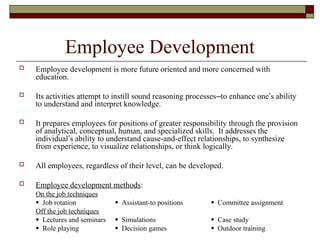
Employee Development
 Employee development is more future oriented and more concerned with
education.
 Its activities attempt to instill sound reasoning processes–to enhance one’s ability
to understand and interpret knowledge.
 It prepares employees for positions of greater responsibility through the provision
of analytical, conceptual, human, and specialized skills. It addresses the
individual’s ability to understand cause-and-effect relationships, to synthesize
from experience, to visualize relationships, or think logically.
 All employees, regardless of their level, can be developed.
 Employee development methods:
On the job techniques
 Job rotation  Assistant-to positions  Committee assignment
Off the job techniques
 Lectures and seminars  Simulations  Case study
 Role playing  Decision games  Outdoor training
III. Organization
III. Organization
Development
Development
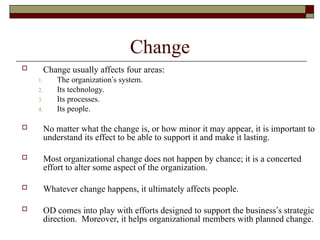
Change
 Change usually affects four areas:
1. The organization’s system.
2. Its technology.
3. Its processes.
4. Its people.
 No matter what the change is, or how minor it may appear, it is important to
understand its effect to be able to support it and make it lasting.
 Most organizational change does not happen by chance; it is a concerted
effort to alter some aspect of the organization.
 Whatever change happens, it ultimately affects people.
 OD comes into play with efforts designed to support the business’s strategic
direction. Moreover, it helps organizational members with planned change.
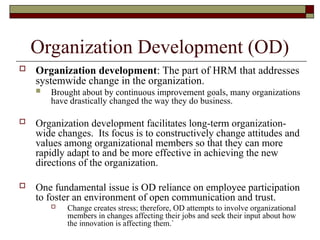
Organization Development (OD)
 Organization development: The part of HRM that addresses
systemwide change in the organization.
 Brought about by continuous improvement goals, many organizations
have drastically changed the way they do business.
 Organization development facilitates long-term organization-
wide changes. Its focus is to constructively change attitudes and
values among organizational members so that they can more
rapidly adapt to and be more effective in achieving the new
directions of the organization.
 One fundamental issue is OD reliance on employee participation
to foster an environment of open communication and trust.
 Change creates stress; therefore, OD attempts to involve organizational
members in changes affecting their jobs and seek their input about how
the innovation is affecting them.`
Change Agent
 Change agent: Individuals responsible for
fostering the change effort and assisting
employees in adapting to change.
 They may be either internal employees, often
associated with the training and development
function of HRM, or external consultants.
OD Techniques
 OD efforts rely heavily on group interactions and cooperation.
 They include:
1. Survey feedback
 It assess employee attitudes about and perceptions of the change they are encountering.
 Employees generally respond to a set of specific questions regarding how they view organizational
aspects. The data the change agent obtains help clarify problems that employees may be facing.
2. Process consultation
 Outside consultants help organizational members to perceive, understand, and act upon process events.
They give organizational members insight into what is going, but they do not solve problems. They
coach managers in diagnosing interpersonal processes that need improvement. If organizational
members can not solve the problem, the consultants help them locate outside experts who the requisite
knowledge.
3. Team building
 Team building helps work groups set goals, develop positive interpersonal relationships, and clarify the
role and responsibilities of each team member. Team building’s primary focus is to increase each
member’s trust and openness toward one another.
4. Intergroup development
 It attempts to achieve a cohesion among different work groups by changing attitudes, stereotypes, and
perceptions that one group may have toward another group. Doing so builds better coordination among
various groups.
Learning Organization
 Learning organization values continued learning and believes a competitive advantage can
be derived from it.
 A learning organization has the capacity to continuously adapt and change.
 Employees practice knowledge management by continually acquiring and sharing new
knowledge and applying that knowledge in making decisions or performing their work. This
requires open communication and extensive information sharing.
 Members share information and collaborate on work activities throughout the entire
organization.
 Teams are important feature.
 Employees are empowered and managers serve as facilitators, supporters, and advocates.
 Everyone agrees on a shared vision and everyone recognizes the inherent relationship among
the organization’s processes, activities, functions, and external environment. There is a
strong sense of community, caring for each other, and trust.
Evaluating Training and
Development Effectiveness
 Any training or development effort must be cost effective.
 The following approach for evaluating programs is usually
generalized. Several managers, HRM representatives, and
group workers who have recently completed a training
program are asked for their opinions. If the comments are
generally positive, the program may receive a favorable
evaluation and it will continue till someone decides, for
whatever reason, it should be eliminated or replaced. Inspite
these reactions are easily obtained, they are the least valid.
 Training must be evaluated in terms of how much the
participants learned, how well they use their new skills on the
job, and whether the training achieved its desired results.
Evaluating Training and
Development Effectiveness (Cont’d)
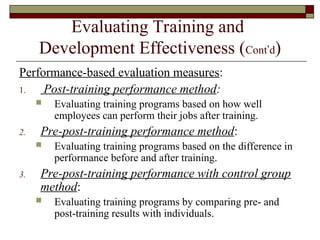
Performance-based evaluation measures:
1. Post-training performance method:
 Evaluating training programs based on how well
employees can perform their jobs after training.
2. Pre-post-training performance method:
 Evaluating training programs based on the difference in
performance before and after training.
3. Pre-post-training performance with control group
method:
 Evaluating training programs by comparing pre- and
post-training results with individuals.
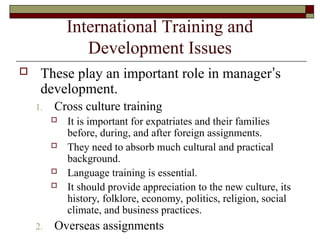
International Training and
Development Issues
 These play an important role in manager’s
development.
1. Cross culture training
 It is important for expatriates and their families
before, during, and after foreign assignments.
 They need to absorb much cultural and practical
background.
 Language training is essential.
 It should provide appreciation to the new culture, its
history, folklore, economy, politics, religion, social
climate, and business practices.
2. Overseas assignments

Chapter 8 Orientation, Socialization and Developing Employees.ppt

  • 1.
    Fundamentals of Human Resource Management Chapter8: Socializing, Orienting, and Developing Employees
  • 2.
     When wetalk about socializing, orienting, and developing employees, we refer to a process of helping new employees adapt to their organization and work responsibilities.  These programs are designed to assist employees to fully understand what working is about in t he organization and to help them become fully productive as soon as possible.
  • 3.
  • 4.
    Socialization  Socialization isthe process of adaptation that takes place as individuals attempt to learn the values and norms of work roles.  Socialization refers to all passages; it is required when: 1. Accepting a new job.→ The focus of this chapter 2. Accepting a lateral transfer. 3. Promoted.
  • 5.
    Assumptions of Employee Socialization Socialization strongly influences employee performance and organizational stability.  Socialization is an important factor in influencing actual job performance and how others perceive it.  Organization’s philosophy and objectives can transfer smoothly from one generation to another, thus increasing loyalty and commitment.  New members suffer from anxiety.  The new member is usually anxious about the new role but motivated to learn the ropes and rapidly become an accepted member of the organization.  Socialization does not occur in a vacuum.  Learning associated with socialization goes beyond comprehending formal job description and the expectations of HR managers. Socialization is influenced by colleagues, management, employees, clients, and other people.  Individuals adjust to new situations in remarkably similar ways.  Every new member goes through a settling-in period that tends to follow a relatively standard form.
  • 6.
    The Socialization Process Socialization is made up of three stages: 1. The prearrival stage  It encompasses learning the new employee has gained before joining the organization. 2. The encounter stage  The new employee gains a clearer understanding and deals with the realization that the expectations and reality may differ. 3. The metamorphosis stage  In this stage, the employee becomes fully trained in their jobs, performs successfully, and fits in with the values and norms of coworkers.  These three stages affect the new employee’s productivity on the job, his/her commitment to the organizational goals, and his/her decision to remain with the organization.  We socialize our employees through the new-employee orientation process.
  • 7.
    Orientation  Orientation coversthe activities involved in introducing the new employee to the organization and to the individuals in his/her work unit.  The purpose of orientation:  It expands on information received during the recruitment and selection stages, and helps to reduce initial anxiety.  It familiarizes the new member with the organization’s objectives, history, philosophy, procedures, and rules; communicates relevant HR policies; reviews the specific duties and responsibilities of new member’s job; provides a tour of the organization’s physical facilities; and introduce the employee to his/her manager and coworkers.  It allows the employee to understand the organization’s culture and its vision.  The responsibility of orientation:  The new employee’s supervisor.  The people in HRM.  Computer-based programs.  Some combination.  The Role of CEO’s:  The CEO first responsibility is to welcome new employees and talk to them about what a good choice they made.  S/he is in a position to inspire new employees by talking about what it is like to work for the organization. In addition, s/he can discuss what really matters in the company.  This shows care for the employee.  The role of HRM:  It explains matters as the overall organizational policies and employee benefits.
  • 8.
  • 9.
    Employee Training  Employeetraining is a learning experience; it seeks a relatively change in employees that improves their job performance.  Training involves changing skills, knowledge, attitudes, or behavior.  Managers, possibly with HRM assistance, decide when employees need training and what form that training should take.
  • 10.
     Employee trainingand employee develop differ in their time frame.  Employee training is more present-day oriented; it focuses on individual’s current job, enhancing those specific skills and abilities to immediately do their jobs.  Employee development focuses on future jobs in the organization. It is oriented to employee personal growth.  They are both similar in their learning methods.
  • 11.
    Determining Training Needs Determining training needs involves generating answers to several questions: 1. What are the organization’s goals? 2. What tasks must be completed to achieve its goals? 3. What behaviors are necessary for each job incumbent to complete his/her tasks? 4. What deficiencies, if any, do incumbents have in the skills, knowledge, or abilities required to exhibit the necessary job behaviors?  There are signals that warn managers that training is needed. Also, evolving workplace, job redesign, or technological throughout may require training.  Here, we are not suggesting that employee’s performance decline is due to lack of effort.  The following step is to establish training goals. Managers should state its desired results for each employee. It must be clarified what to change and how much. These goals should be tangible, verifiable, timely, and measurable.
  • 12.
    Training Methods  On-the-jobtraining techniques:  Job rotation  Understudy assignments (apprenticeship)  Off-the-job training techniques:  Classroom lectures  Films and videos  Simulation exercises  Vestibule training
  • 13.
    Employee Development  Employeedevelopment is more future oriented and more concerned with education.  Its activities attempt to instill sound reasoning processes–to enhance one’s ability to understand and interpret knowledge.  It prepares employees for positions of greater responsibility through the provision of analytical, conceptual, human, and specialized skills. It addresses the individual’s ability to understand cause-and-effect relationships, to synthesize from experience, to visualize relationships, or think logically.  All employees, regardless of their level, can be developed.  Employee development methods: On the job techniques  Job rotation  Assistant-to positions  Committee assignment Off the job techniques  Lectures and seminars  Simulations  Case study  Role playing  Decision games  Outdoor training
  • 14.
  • 15.
    Change  Change usuallyaffects four areas: 1. The organization’s system. 2. Its technology. 3. Its processes. 4. Its people.  No matter what the change is, or how minor it may appear, it is important to understand its effect to be able to support it and make it lasting.  Most organizational change does not happen by chance; it is a concerted effort to alter some aspect of the organization.  Whatever change happens, it ultimately affects people.  OD comes into play with efforts designed to support the business’s strategic direction. Moreover, it helps organizational members with planned change.
  • 16.
    Organization Development (OD) Organization development: The part of HRM that addresses systemwide change in the organization.  Brought about by continuous improvement goals, many organizations have drastically changed the way they do business.  Organization development facilitates long-term organization- wide changes. Its focus is to constructively change attitudes and values among organizational members so that they can more rapidly adapt to and be more effective in achieving the new directions of the organization.  One fundamental issue is OD reliance on employee participation to foster an environment of open communication and trust.  Change creates stress; therefore, OD attempts to involve organizational members in changes affecting their jobs and seek their input about how the innovation is affecting them.`
  • 17.
    Change Agent  Changeagent: Individuals responsible for fostering the change effort and assisting employees in adapting to change.  They may be either internal employees, often associated with the training and development function of HRM, or external consultants.
  • 18.
    OD Techniques  ODefforts rely heavily on group interactions and cooperation.  They include: 1. Survey feedback  It assess employee attitudes about and perceptions of the change they are encountering.  Employees generally respond to a set of specific questions regarding how they view organizational aspects. The data the change agent obtains help clarify problems that employees may be facing. 2. Process consultation  Outside consultants help organizational members to perceive, understand, and act upon process events. They give organizational members insight into what is going, but they do not solve problems. They coach managers in diagnosing interpersonal processes that need improvement. If organizational members can not solve the problem, the consultants help them locate outside experts who the requisite knowledge. 3. Team building  Team building helps work groups set goals, develop positive interpersonal relationships, and clarify the role and responsibilities of each team member. Team building’s primary focus is to increase each member’s trust and openness toward one another. 4. Intergroup development  It attempts to achieve a cohesion among different work groups by changing attitudes, stereotypes, and perceptions that one group may have toward another group. Doing so builds better coordination among various groups.
  • 19.
    Learning Organization  Learningorganization values continued learning and believes a competitive advantage can be derived from it.  A learning organization has the capacity to continuously adapt and change.  Employees practice knowledge management by continually acquiring and sharing new knowledge and applying that knowledge in making decisions or performing their work. This requires open communication and extensive information sharing.  Members share information and collaborate on work activities throughout the entire organization.  Teams are important feature.  Employees are empowered and managers serve as facilitators, supporters, and advocates.  Everyone agrees on a shared vision and everyone recognizes the inherent relationship among the organization’s processes, activities, functions, and external environment. There is a strong sense of community, caring for each other, and trust.
  • 20.
    Evaluating Training and DevelopmentEffectiveness  Any training or development effort must be cost effective.  The following approach for evaluating programs is usually generalized. Several managers, HRM representatives, and group workers who have recently completed a training program are asked for their opinions. If the comments are generally positive, the program may receive a favorable evaluation and it will continue till someone decides, for whatever reason, it should be eliminated or replaced. Inspite these reactions are easily obtained, they are the least valid.  Training must be evaluated in terms of how much the participants learned, how well they use their new skills on the job, and whether the training achieved its desired results.
  • 21.
    Evaluating Training and DevelopmentEffectiveness (Cont’d) Performance-based evaluation measures: 1. Post-training performance method:  Evaluating training programs based on how well employees can perform their jobs after training. 2. Pre-post-training performance method:  Evaluating training programs based on the difference in performance before and after training. 3. Pre-post-training performance with control group method:  Evaluating training programs by comparing pre- and post-training results with individuals.
  • 22.
    International Training and DevelopmentIssues  These play an important role in manager’s development. 1. Cross culture training  It is important for expatriates and their families before, during, and after foreign assignments.  They need to absorb much cultural and practical background.  Language training is essential.  It should provide appreciation to the new culture, its history, folklore, economy, politics, religion, social climate, and business practices. 2. Overseas assignments