Introduction
 Staff development is the process directed
towards the personal and professional
growth of nurses and other personnel
while they are employed by a health care
agency.
 Staff development refers to all training and
education provided by an employee to
improve the occupational and personal
knowledge, skills and attitudes of vested
employees.
Definition
Staff development refers to
the processes, programs and
activities through which every
organization develops,
enhances and improves the
skills, competencies and
overall performance of its
employees and workers.
CONT….
A process consisting of
orientation, in-service education
and continuing education for the
people of promoting the
development of personnel within
any employment setting,
consistent with the goals and
responsibilities of the
employment.( ANA)
Need for staff development:-
 Social change and scientific advancement
 Advancement in the field of science like
medical science and technology.
 To provide the opportunity for nurses to
continually acquire and implement the
knowledge, skills, attitudes, ideals and
valued essentials for the maintenance of
high quality of nursing care:
◦ As part of an individual's long-term career
growth.
◦ To add or improve skills needed in the short
CONT…..
◦ Being necessary to fill gap in the past
performance
◦ To change or correct long-held attitudes of
employee
◦ Need to increase the productivity and quality
of the work.
◦ To motivate employees and to promote
employee loyalty
◦ Fast growing organizations.
Goals
 Assist each employee (nurse) to improve
performance in his/her position.
 Assist each employee (nurse) to acquire
personal and professional abilities that
maximize the possibility of career
advancement.
Objectives
 To increase employee productivity.
 To ensure safe and effective patient
care by nurses.
 To ensure satisfactory job
performance by personnel.
CONT..
 To orient the personnel to care objectives,
job duties, personnel policies, and agency
regulations.
 To help employees cope with new practice
role.
 To help nurses to close the gap between
present abilities and the scientific basis for
nursing practice that is broadening
through research.
Steps of staff development
program:-
 Assess the educational needs of all staff
members
 Set priority
 Develop general objectives for the staff
development program
 Determine the resources needed to reach the
desired objectives
 Develop a master calendar for an entire year
 Develop and maintain staff development record
system
 Establish files on major educational topics
 Regularly evaluate the staff development
program
Resources:-
 Public libraries,
 Audiovisual program in addition to
many books and computers, research
activities and speakers to community
groups.
 Schools and universities
 Association Health and inter service
agency
 Other nursing homes
 Ones own staff
Types of staff development:-
Induction
training
Job
orientation
In-service
education
Continuing
education
Training for
special
function
INDUCTION
TRAINING
Induction training:-
 It is a brief, standardised indoctrination
to an agency’s philosophy, purpose,
policies and regulations given to each
worker during her or his first 2 or 3
days of employment in order to ensure
his or her identification with agency’s
philosophy, goals and norms.
Need of induction training:-
 Increased retention of newly hire
employees,
 Improved employee morale and
Increased productivity.
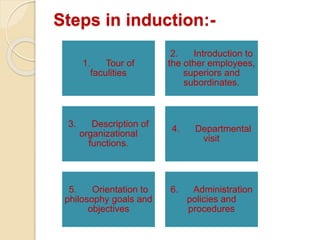
Steps in induction:-
1. Tour of
faculities
2. Introduction to
the other employees,
superiors and
subordinates.
3. Description of
organizational
functions.
4. Departmental
visit
5. Orientation to
philosophy goals and
objectives
6. Administration
policies and
procedures
JOB
ORIENTATION
Job orientation:-
 It is an individualised training
programme intended to acquaint a
newly hired employee with job
responsibilities work place, clients and
co-workers.
 The process of creating awareness
with an individual of his/her roles,
responsibilities and relationships in the
new work situation.
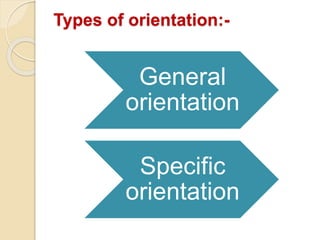
Types of orientation:-
General
orientation
Specific
orientation
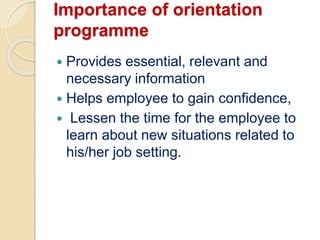
Importance of orientation
programme
 Provides essential, relevant and
necessary information
 Helps employee to gain confidence,
 Lessen the time for the employee to
learn about new situations related to
his/her job setting.
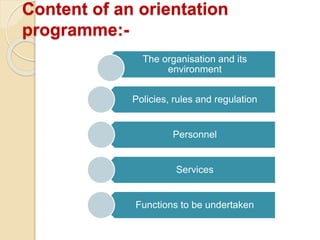
Content of an orientation
programme:-
The organisation and its
environment
Policies, rules and regulation
Personnel
Services
Functions to be undertaken
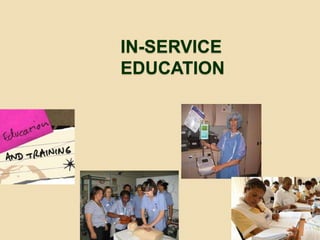
IN-SERVICE
EDUCATION
In-service education:-
Definition:-
 In-service education is a planned
learning experience provided by the
employing agency for employees.
Concept of in-service
education:-
 Closely identified with services
 Help a person’s to improve
performance effectively
 Planned education activities
 Provided in a job setting
Need:-
 Social changes and scientific
advancement
 Changes and advancement in the field
of service
 Increased the demand of nursing
services.
 Consumer demand quality care
CONT..
 Rapid changes in medical and nursing
practice create a need for in service
education. Increase number of the people
seeking health care as the population
enlarges makes it necessary for the
nurses to function at her highest potential
as quickly as possible.
 As health care delivery system become
more complex, the need for continues skill
training also increased.
Aims:-
 Improvement of client through upgrading
the services rendered with scientific
principles.
 To keep in face in changing society to
their needs.
 Acquisition of new knowledge
 Improvement of performance
 To develop specific skills required for
practice.
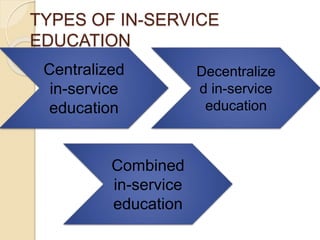
TYPES OF IN-SERVICE
EDUCATION
Centralized
in-service
education
Decentralize
d in-service
education
Combined
in-service
education
CONTINUING
EDUCATION
Continuing education:-
 “Continuing education is all the
learning activities that occur after an
individual has completed his/her basic
education.” (COOPER)
 “The education which builds on
previous education.” (SHANON)
Need for continuing
education:-
 To ensure safe and effective nursing
care as nurses need to keep abreast
with interest, knowledge and technical
advances.
 To meet the needs of population.
 To develop the nurses’ by updating
their knowledge and prepare them for
specialization.
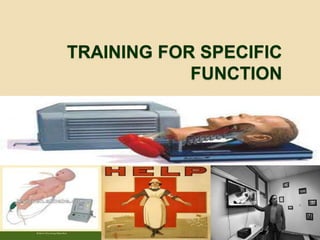
TRAINING FOR SPECIFIC
FUNCTION
Training for specific function :-
Definition:-
 This is concerned with developing
expert technical or manual skills,
communication and helps the
personnel to perform their functions
effectively.
OBJECTIVES:
To help the nursing personnel to
perform correct methods and
procedures with understanding.
Establishing standards and quality of
nursing services.
Need for skill training:-
 Individual nurse needed to have
greater freedom to choose the specific
field of nursing in which she would
work.
 Good work to be recognized and
reward.
 A venues of advancement and
promotion need to be better
development
 Fear of making mistakes
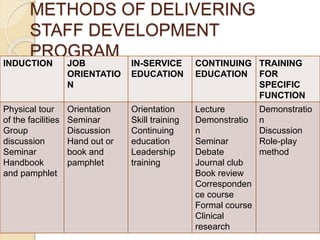
METHODS OF DELIVERING
STAFF DEVELOPMENT
PROGRAM
INDUCTION JOB
ORIENTATIO
N
IN-SERVICE
EDUCATION
CONTINUING
EDUCATION
TRAINING
FOR
SPECIFIC
FUNCTION
Physical tour
of the facilities
Group
discussion
Seminar
Handbook
and pamphlet
Orientation
Seminar
Discussion
Hand out or
book and
pamphlet
Orientation
Skill training
Continuing
education
Leadership
training
Lecture
Demonstratio
n
Seminar
Debate
Journal club
Book review
Corresponden
ce course
Formal course
Clinical
research
Demonstratio
n
Discussion
Role-play
method
Potential difficulties in staff
development & training
activities:-
 Lack of time
 Inadequate resources at disposal
 Under-funded training budgets
 Conflicting priorities
 Lack of Clarity about what should be
done
CONT…
 Failure to identify, or accept the need.
 Shortfall in training skill or experience
 Fear that trained employee will leave
the organization or will be poached by
competitor.
 Cynical attitude to Staff development-
Not directly measurable. Treated as
Cost not investment.
STAFF DEVELOPMENTAL PROGRAM.

STAFF DEVELOPMENTAL PROGRAM.

  • 2.
    Introduction  Staff developmentis the process directed towards the personal and professional growth of nurses and other personnel while they are employed by a health care agency.  Staff development refers to all training and education provided by an employee to improve the occupational and personal knowledge, skills and attitudes of vested employees.
  • 3.
    Definition Staff development refersto the processes, programs and activities through which every organization develops, enhances and improves the skills, competencies and overall performance of its employees and workers.
  • 4.
    CONT…. A process consistingof orientation, in-service education and continuing education for the people of promoting the development of personnel within any employment setting, consistent with the goals and responsibilities of the employment.( ANA)
  • 5.
    Need for staffdevelopment:-  Social change and scientific advancement  Advancement in the field of science like medical science and technology.  To provide the opportunity for nurses to continually acquire and implement the knowledge, skills, attitudes, ideals and valued essentials for the maintenance of high quality of nursing care: ◦ As part of an individual's long-term career growth. ◦ To add or improve skills needed in the short
  • 6.
    CONT….. ◦ Being necessaryto fill gap in the past performance ◦ To change or correct long-held attitudes of employee ◦ Need to increase the productivity and quality of the work. ◦ To motivate employees and to promote employee loyalty ◦ Fast growing organizations.
  • 7.
    Goals  Assist eachemployee (nurse) to improve performance in his/her position.  Assist each employee (nurse) to acquire personal and professional abilities that maximize the possibility of career advancement.
  • 8.
    Objectives  To increaseemployee productivity.  To ensure safe and effective patient care by nurses.  To ensure satisfactory job performance by personnel.
  • 9.
    CONT..  To orientthe personnel to care objectives, job duties, personnel policies, and agency regulations.  To help employees cope with new practice role.  To help nurses to close the gap between present abilities and the scientific basis for nursing practice that is broadening through research.
  • 10.
    Steps of staffdevelopment program:-  Assess the educational needs of all staff members  Set priority  Develop general objectives for the staff development program  Determine the resources needed to reach the desired objectives  Develop a master calendar for an entire year  Develop and maintain staff development record system  Establish files on major educational topics  Regularly evaluate the staff development program
  • 11.
    Resources:-  Public libraries, Audiovisual program in addition to many books and computers, research activities and speakers to community groups.  Schools and universities  Association Health and inter service agency  Other nursing homes  Ones own staff
  • 12.
    Types of staffdevelopment:- Induction training Job orientation In-service education Continuing education Training for special function
  • 13.
  • 14.
    Induction training:-  Itis a brief, standardised indoctrination to an agency’s philosophy, purpose, policies and regulations given to each worker during her or his first 2 or 3 days of employment in order to ensure his or her identification with agency’s philosophy, goals and norms.
  • 15.
    Need of inductiontraining:-  Increased retention of newly hire employees,  Improved employee morale and Increased productivity.
  • 16.
    Steps in induction:- 1.Tour of faculities 2. Introduction to the other employees, superiors and subordinates. 3. Description of organizational functions. 4. Departmental visit 5. Orientation to philosophy goals and objectives 6. Administration policies and procedures
  • 17.
  • 18.
    Job orientation:-  Itis an individualised training programme intended to acquaint a newly hired employee with job responsibilities work place, clients and co-workers.  The process of creating awareness with an individual of his/her roles, responsibilities and relationships in the new work situation.
  • 19.
  • 20.
    Importance of orientation programme Provides essential, relevant and necessary information  Helps employee to gain confidence,  Lessen the time for the employee to learn about new situations related to his/her job setting.
  • 21.
    Content of anorientation programme:- The organisation and its environment Policies, rules and regulation Personnel Services Functions to be undertaken
  • 22.
  • 23.
    In-service education:- Definition:-  In-serviceeducation is a planned learning experience provided by the employing agency for employees.
  • 24.
    Concept of in-service education:- Closely identified with services  Help a person’s to improve performance effectively  Planned education activities  Provided in a job setting
  • 25.
    Need:-  Social changesand scientific advancement  Changes and advancement in the field of service  Increased the demand of nursing services.  Consumer demand quality care
  • 26.
    CONT..  Rapid changesin medical and nursing practice create a need for in service education. Increase number of the people seeking health care as the population enlarges makes it necessary for the nurses to function at her highest potential as quickly as possible.  As health care delivery system become more complex, the need for continues skill training also increased.
  • 27.
    Aims:-  Improvement ofclient through upgrading the services rendered with scientific principles.  To keep in face in changing society to their needs.  Acquisition of new knowledge  Improvement of performance  To develop specific skills required for practice.
  • 28.
  • 29.
  • 30.
    Continuing education:-  “Continuingeducation is all the learning activities that occur after an individual has completed his/her basic education.” (COOPER)  “The education which builds on previous education.” (SHANON)
  • 31.
    Need for continuing education:- To ensure safe and effective nursing care as nurses need to keep abreast with interest, knowledge and technical advances.  To meet the needs of population.  To develop the nurses’ by updating their knowledge and prepare them for specialization.
  • 32.
  • 33.
    Training for specificfunction :- Definition:-  This is concerned with developing expert technical or manual skills, communication and helps the personnel to perform their functions effectively.
  • 34.
    OBJECTIVES: To help thenursing personnel to perform correct methods and procedures with understanding. Establishing standards and quality of nursing services.
  • 35.
    Need for skilltraining:-  Individual nurse needed to have greater freedom to choose the specific field of nursing in which she would work.  Good work to be recognized and reward.  A venues of advancement and promotion need to be better development  Fear of making mistakes
  • 36.
    METHODS OF DELIVERING STAFFDEVELOPMENT PROGRAM INDUCTION JOB ORIENTATIO N IN-SERVICE EDUCATION CONTINUING EDUCATION TRAINING FOR SPECIFIC FUNCTION Physical tour of the facilities Group discussion Seminar Handbook and pamphlet Orientation Seminar Discussion Hand out or book and pamphlet Orientation Skill training Continuing education Leadership training Lecture Demonstratio n Seminar Debate Journal club Book review Corresponden ce course Formal course Clinical research Demonstratio n Discussion Role-play method
  • 37.
    Potential difficulties instaff development & training activities:-  Lack of time  Inadequate resources at disposal  Under-funded training budgets  Conflicting priorities  Lack of Clarity about what should be done
  • 38.
    CONT…  Failure toidentify, or accept the need.  Shortfall in training skill or experience  Fear that trained employee will leave the organization or will be poached by competitor.  Cynical attitude to Staff development- Not directly measurable. Treated as Cost not investment.