BY:
M.PRADEEP
M.Sc Nursing
2nd YEAR
OBJECTIVES:
 Introduction of staff development
programme.
 State the meaning of staff development.
 Define the staff development
programme.
 Objectives of staff development.
 Enumerate the staff development
process.
 Describe the functions of staff
development.
 Discuss the staff development activities.
Cont.,
 Explain the staff development programme
model.
 List out the steps of staff development
programme.
 Mention the resources of staff development
programme.
 Discuss the administrative structure of
SDP.
 Enlist the staff development organization.
 Enumerate the staff development
assessment methods.
 List down the goals of staff development.
Cont.,
 Discuss the standards of staff development
programme.
 List down the potential difficulties in staff
development & training activities.
 Explain the centalization vs
decentralization.
 Enlist the role of nurse in staff
development programme.
 Summary .
 Conclusion.
 Journals.
 Bibliography.
INTRODUCTION:
 Staff development activities consist of the
training and education provided by an
employer to improve employee’s occupational
knowledge , skills and attitudes, and to
provide the employee with the opportunity
to grow professionally.
 Professional nurses won education in a
variety of ways .staff development program
have greater responsibility to develop
characteristics, abolition work assignments
and uptake knowledge among staff.
Meaning of staff development:
 Staff development refers to the continuing
improvement of the nursing personnel. It
also includes setting standards for jobs,
providing on the job growth experiences,
considering potential growth opportunities
in all assignment planning, supervising and
appraising performance proficiency, and
assuming responsibility for reparative or
corrective training measures.
 Staff development program are designed to
motivate learners in the way of the train
and education to improve their knowledge ,
skills and attitudes.
Definitions:
 Staff development program are
designed to motivate learners in the
way of the train and education to
improve their knowledge , skills and
attitudes.
 A process that assists individuals in
an agency or organization in attaining
new skills and knowledge, gaining
increasing levels of competence, and
growing professionally.
Objectives of staff development :
 To assist each employee to improve performance in
present position.
 New development in medical science and technology.
 New diagnostic and treatment techniques.
 To motivate each staff member and create a sense
of security and loyalty.
 To improve work productivity and for promotion.
 To reduce staff turnover , absenteeism and
tardiness.
 To acquire personal and professional abilities that
maximizes the possibility of career advancement.
Staff development process
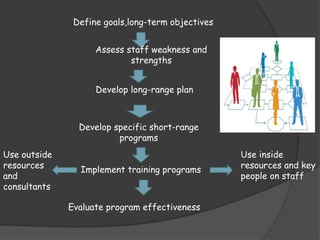
 The major processes involved in the
staff development programs are
presented graphically in the chart
prepared by Silver(1981).
Define goals,long-term objectives
Assess staff weakness and
strengths
Develop long-range plan
Develop specific short-range
programs
Implement training programs
Evaluate program effectiveness
Use inside
resources and key
people on staff
Use outside
resources
and
consultants
Functions of staff development:
 Personnel assigned to staff development should
provide the following consultative functions for
healthcare agency:
- Determination of the administrative structure
of the staff development program.
- Determination and establishment of
organizational methods, policies and procedures
for a staff development program.
- Determination and establishment of lines of
communication for the utilization of facilities
and resources personnel for a staff
development program.
Cont.,
- determination of organizational and individual
staff development needs and priority.
- Development of measurable short and long –
term objectives for staff development
programs.
- Promotion, development, implementation and
evaluation of programs to meet these
objectives.
- Planning, coordination and utilization of
community resources to assist in meeting these
objectives.
- Provision of a consultative service and a
resource for information relative to staff
development.
Staff development activities:
 Staff development includes formal and
informal , group or individual training and
education, staff development activities
include:
- Induction training.
- Orientation.
- In-service education.
- Continuing education.
- Training for special functions such as
management, team building and budgeting
method.
Induction training(3 days):
 It is a brief, standardized indoctrination
to an agency’s philosophy, purpose,
policies and regulations given to each
worker during his/her first 2 or 3 days
of employment in order to ensure
his/her identification with agency’s
philosophy, goals and norms.
Orientation(2-24 weeks):
 It is an individualized training program
intended to acquaint a newly hired
employee with job responsibilities work
place, clients and coworkers.
In-service education(2-8hour):
 It refers to an ongoing on the job
instruction that is given to enhance, the
worker’s performance in their present
job. It is planned educational experience
provided in the job setting and closely
identified with service in order to help
person to perform more effectively as a
person and as a worker [national league
for nursing (NLN)].
Continuing education(1-5days):
 It is any extension of opportunities for reading,
studying and training to any person and adult
following their completion of or withdrawal
from full time school and/ or college
programs.it is there education for adults
provided by specific schools, centres, colleges
or institutions that emphasize flexible rather
than traditional or academic programs.
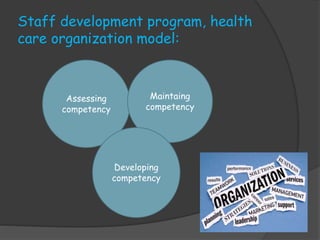
Staff development program, health
care organization model:
Assessing
competency
Maintaing
competency
Developing
competency
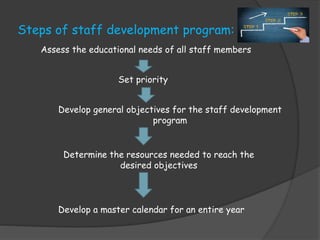
Steps of staff development program:
Assess the educational needs of all staff members
Set priority
Develop general objectives for the staff development
program
Determine the resources needed to reach the
desired objectives
Develop a master calendar for an entire year
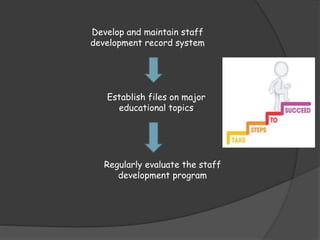
Develop and maintain staff
development record system
Establish files on major
educational topics
Regularly evaluate the staff
development program
Resources:
 Public libraries, audiovisual program in addition
to many books and computers, research
activities and speakers to community groups.
 Schools and universities
 Association
 Health and inter service agency
 Other nursing homes
 One’s own staff
Administrative structure of a staff
development program:
 Administrative philosophy, policies & practices
of health care agency.
 Policies, practices and standards of nursing &
other health professionals.
 Human & material resources .
 Physical facilities Financial resources.
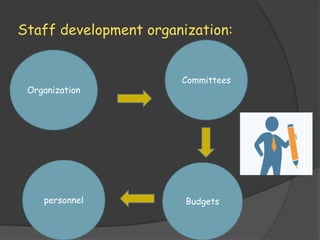
Staff development organization:
Organization
Committees
Budgets
personnel
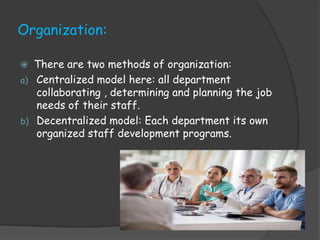
Organization:
 There are two methods of organization:
a) Centralized model here: all department
collaborating , determining and planning the job
needs of their staff.
b) Decentralized model: Each department its own
organized staff development programs.
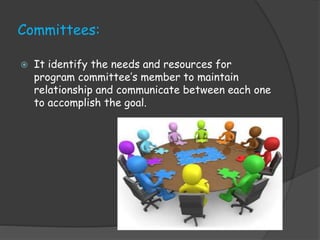
Committees:
 It identify the needs and resources for
program committee’s member to maintain
relationship and communicate between each one
to accomplish the goal.
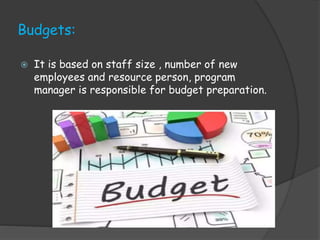
Budgets:
 It is based on staff size , number of new
employees and resource person, program
manager is responsible for budget preparation.
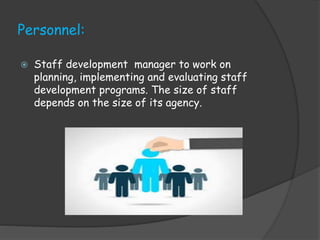
Personnel:
 Staff development manager to work on
planning, implementing and evaluating staff
development programs. The size of staff
depends on the size of its agency.
Staff development assessment
methods
 Staff development planning organizes to
assessment needs of participants. Following
factors should be considered to assess needs of
the program:
- Population
- Time
- Cost/financial
- Analysis time
- objectivity
Various methods of needs assessment:
 Questionnaire method
 Survey
 Interview
 Observation
 Group meeting
 Performance appraisal
 Individual need assessment method
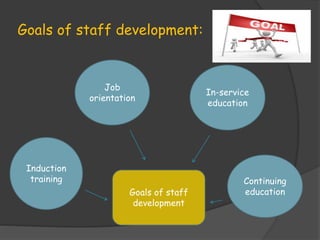
Goals of staff development:
Goals of staff
development
Induction
training
Job
orientation
In-service
education
Continuing
education
Induction training:
 Need of induction training:
- Increased retention of newly hire employees,
Improved employee morale and Increased
productivity.
 Steps in induction:
1) Tour of facilities.
2) Introduction to the other employees, superiors
and subordinates.
3) Description of organizational functions.
4) Departmental visit.
5) Orientation to philosophy goals and objectives .
6) Administration policies and procedures.
Cont.,
 Forms of induction
- Internship
- Preceptorship
- Mentorship
Job orientation:
“A good beginning is half the
battle”
Meaning:
 The process of creating awareness
with an individual of his/her roles,
responsibilities and relationships in
the new work situation.
Components:
 A new employee to his or her job setting
so that he/she is aware of his/her job
responsibility and expectation.
 Present employee to the job
responsibilities of his/her
expanded/enriched role.
 The old employees to the policy changes.
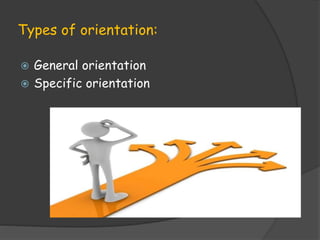
Types of orientation:
 General orientation
 Specific orientation
Importance of orientation programme:
 Provides essential, relevant and necessary information.
 Helps employee to gain confidence.
 Lessen the time for the employee to learn about new situations
related to his/her job setting.
 Helps the new employee to develop a sense of belonging.
 Eliminates:
 Learning by trial and error.
 Passing of incorrect information by old employees and peers.
 Reduces misinterpretation .
 Mistakes and confusion .
 Apprehension.
 Help new employee in solving initial problems and adjust the
new situation/environment.
 Acquaints her with personnel services readily with in the
institution/community.
Content of an orientation programme:
 The origination and its environment.
 Policies, rules and regulation.
 Personnel.
 Services.
 Functions to be undertaken.
In service education:
 In service education is a planned
educational experience provided in the
job setting and closely identified with
services in order to help person perform
more effectively as a person and as a
worker.
Concept of in-service education:
 Planned education activities
 Help a person’s to improve performance
effectively
 Provided in a job setting
 Closely identified with services
Need:
 Social changes and scientific advancement .
 Changes and advancement in the field of service
increased the demand of nursing services.
 Consumer demand quality care .
 Rapid changes in medical and nursing practice
create a need for in service education.
 Increase number of the people seeking health
care as the population enlarges makes it
necessary for the nurses to function at her
highest potential as quickly as possible.
 As health care delivery system become more
complex, the need for continues skill training
also increased.
Objective:
 To provide for and promote the personal growth
and development of the workers .
 To stimulate and develop occupational .
 To prove for job satisfaction .
 Identifying and meeting current bearing needs .
 To disseminate new information from body of
nursing knowledge and health science through
verity of channels.
 To acquire up to date knowledge and to make
confidence among the nurses.
 To retain experience personnel to foster there
continue education.
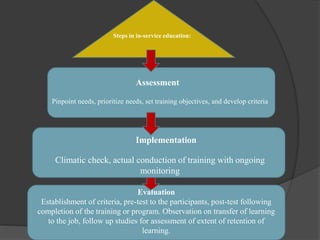
Steps in in-service education:
Assessment
Pinpoint needs, prioritize needs, set training objectives, and develop criteria
Implementation
Climatic check, actual conduction of training with ongoing
monitoring
Evaluation
Establishment of criteria, pre-test to the participants, post-test following
completion of the training or program. Observation on transfer of learning
to the job, follow up studies for assessment of extent of retention of
learning.
Continuing education:
 Continuing education is all the learning activities
that occur after an individual has completed his
basic education . -Cooper
 The education which builds a previous education
is called continues education . -Shannon
Aims of continuing education:
 Improvement of professional practice.
 To motivate the staff to seek the latest
knowledge .
 To keep the nurses with the latest development
of technologies .
 It develops interest, job satisfaction and
confidence.
Purpose of continuing education:
 Enable a worker to move from satisfactory
to excellent performance .
 Provides exposure to new concepts,
procedural refinements, innovative product
applications, or acquisition of increased
expertise.
 Ensure professional development.
 Increase ability in order to solve the
problem in a clinical teaching/
administrative area.
 Improve the ability to communicate or
participate in research work.
Need of continuing education:
 To ensure safe and effective nursing care.
 Changing health care delivery system.
 Development of nurses by updating their
knowledge.
 For career advancement.
 Professional are altered as society changes
and as technologies emerge.
 To acquire specialized skill for professional.
Training for specific function:
 This is concerned with developing expert
technical or manual skills, communication
and helps the personnel to perform their
functions effectively.
 Objectives:
- To help the nursing personnel to perform
correct methods and procedures with
understanding.
- Establishing standards and quality of nursing
services.
- Procedure to skill nurses to skilled nurses.
Types of skills
 Psychomotor skill
 Cognitive skill
 Teaching skills
 Affective skill
 Communication skill
 Supervisory skills
Need for skill training
 Individual nurse needed to have greater
freedom to choose the specific field of
nursing in which she would work.
 Good work to be recognized and reward.
 A venue of advancement and promotion
need to be better development.
 Fear of making mistakes.
Guidelines for skill training:
 Set the stage, using equipment similar to that
the worker in the work situation.
 Create in worker a learning attitude.
 Give reasons why the procedure is carried out in
this way in this agency.
 Break the activities in to logical steps, necessary
to carry out the procedure.
 Demonstrate step by step.
 Make certain that the person has learnt by
requiring a return demonstration.
 Provide written out lines for references.
 Arrange for follow up (supervision).
Standards of staff development
programme (ANA)
 Standard I –
Organization and Administration;
- Nursing service department and the nursing
staff development unit philosophy, purpose and
goals address the staff development needs of
nursing personnel.
 Standard II –
Human Resources;
- Qualified administrative, educational and
support personnel are provided to meet the lear
ning and developmental needs by nursing service
s personnel.
Cont.,
 Standards III –
Learner;
- Nursing staff development educators assist nursing
personnel in identifying their learning needs and
planning learning activities to meet those needs.
 Standard IV –
Program Planning;
- Provides the unit systematically, plans and evaluate the
overall nursing staff development program in response
to health care needs.
Cont.,
 Standard V –
Educational Design;
- Educational offering and learning experience are
designed through the use of educational process and
incorporate adult education and learning principles.
 Standard VI –
Material Resources and Facilities;
- Material sources and facilities are adequate to achieve
the goals and implement the functions of the overall
nursing staff development unit.
 Standard VII –
Records and Reports;
- The nursing staff development unit establishes and
maintains a record keeping and report system.
Cont.,
 Standard VIII –
Evaluation;
Evaluation is an integral ongoing and systematic process ,
Which includes measuring the impact on the learning.
 Standard IX –
Consultation;
Nursing staff development educators use the consultation
process to facilitate and enhance achievement of individual ,
departmental and organizational goals.
 Standard X –
Climate;
Nursing staff development educators foster a climate
which promotes open communication, learning and professional growth.
 Standard XI –
Systematic Enquiring;
Nursing staff development educators encourage systematic inquiry
and applications of the results into nursing practice.
Potential difficulties staff
development & training activities:
 Lack of time.
 Inadequate resources at disposal.
 Under-funded training budgets.
 Conflicting priorities.
 Lack of Clarity about what should be done.
 Failure to identify, or accept the need.
 Shortfall in training skill or experience .
 Fear that trained employee will leave the organization
or will be poached by competitor.
 Cynical attitude to Staff development-
not directly measurable.
 Treated as Cost not investment.
Methods of delivering SDP
 Induction;
- Physical tour of the facilities
- Group discussion
- Seminar
- Hand book and pamphlet
 Job Orientation;
- Orientation
- Seminar
- Discussion
- Hand out or book and pamphlets
Cont.,
 In-service Education;
- Orientation
- Skill training
- Continuing education
- Leadership training
 Continuing Education;
- Lecture
- Demonstration
- Seminar
- Debate
- Journal club
- Book review
- Correspondence course
- Formal course
- Clinical research
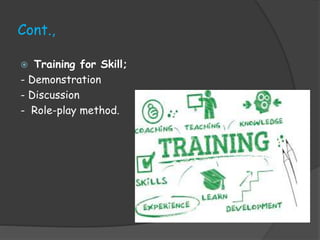
Cont.,
 Training for Skill;
- Demonstration
- Discussion
- Role-play method.
Centralization vs Decentralization :
 In some cases a centralized structure will be more
effective than a decentralized structure . There are
advantages and disadvantages to both type of
structure. Usually, the coordination of staff
development is more readily facilitated in a
centralized structure . However , in a decentralized
structure , it is possible to involve a larger number of
personnel in planning and implementing programs. One
alternative is a centralized structure for an agency-
wide staff development program and decentralized
structure for programs related to learning a specific
job skill. Whatever be the administrative structure, it
is vital to circumvent redundancy, repetition and
ineffective utilization of personnel, and facilities.
Roles of head nurse in staff
development:
 Applies adult learning principles when helping
employees learn new skills or information.
 Coaches employees readily regarding knowledge
and skill deficits.
 Actively seeks out teaching opportunities. Uses
teaching techniques that empower staff.
 Is sensitive to the learning deficits of the staff
and creatively minimizes these deficits.
 Frequently assess learning needs of the unit.
 Allot time for discussions, observations and
questions.
 Set a good example in everyday practice
Summary:
 Staff development is the process
directed towards the personal and
professional growth of nurses and other
personnel while they are employed by a
healthcare agency . Staff development
refers to all training and education
provided by an employee to improve the
occupational and personal knowledge,
skills and attitude of vested employees.
Conclusion:
 Staff development is a cost-effective method of
increasing productivity . Education and training
are two components of staff development that
occur after an employee indoctrination and may
occur either within or outside the organization.
Only since world war II has a systematic program
of education and training became a part of
business and industrial management functions.
Early staff development emphasized orientation
and in service training. In the last 20 years,
however other forms of education have become
common in healthcare organization.
Journal:
 Health care organizations are solely dependent on
the human resources. Staff development
programs go a long way in providing job
satisfaction and staff retention. The aim of the
study was to assess the staff development
programs provided to the nursing staff. A sample
size of 30 nurses working in the private wards of
a selected hospital was considered for the study.
A structured questionnaire was used to gather
data. Data was presented in the form of
Frequency and Percentage scores. The data
revealed that Career planning, job enlargement,
and stress reduction programs need to be
focused.
Bibliography:
 “Essentials of management of Nursing
service and education, Nisha
clement,Jaypee brothers medical
publishers (P) Ltd., First edition
2016,pg no:214-218.
 www.slideshare.com,Staff
development programme in Nursing.
Staff development programme

Staff development programme

  • 1.
  • 2.
    OBJECTIVES:  Introduction ofstaff development programme.  State the meaning of staff development.  Define the staff development programme.  Objectives of staff development.  Enumerate the staff development process.  Describe the functions of staff development.  Discuss the staff development activities.
  • 3.
    Cont.,  Explain thestaff development programme model.  List out the steps of staff development programme.  Mention the resources of staff development programme.  Discuss the administrative structure of SDP.  Enlist the staff development organization.  Enumerate the staff development assessment methods.  List down the goals of staff development.
  • 4.
    Cont.,  Discuss thestandards of staff development programme.  List down the potential difficulties in staff development & training activities.  Explain the centalization vs decentralization.  Enlist the role of nurse in staff development programme.  Summary .  Conclusion.  Journals.  Bibliography.
  • 5.
    INTRODUCTION:  Staff developmentactivities consist of the training and education provided by an employer to improve employee’s occupational knowledge , skills and attitudes, and to provide the employee with the opportunity to grow professionally.  Professional nurses won education in a variety of ways .staff development program have greater responsibility to develop characteristics, abolition work assignments and uptake knowledge among staff.
  • 6.
    Meaning of staffdevelopment:  Staff development refers to the continuing improvement of the nursing personnel. It also includes setting standards for jobs, providing on the job growth experiences, considering potential growth opportunities in all assignment planning, supervising and appraising performance proficiency, and assuming responsibility for reparative or corrective training measures.  Staff development program are designed to motivate learners in the way of the train and education to improve their knowledge , skills and attitudes.
  • 7.
    Definitions:  Staff developmentprogram are designed to motivate learners in the way of the train and education to improve their knowledge , skills and attitudes.  A process that assists individuals in an agency or organization in attaining new skills and knowledge, gaining increasing levels of competence, and growing professionally.
  • 8.
    Objectives of staffdevelopment :  To assist each employee to improve performance in present position.  New development in medical science and technology.  New diagnostic and treatment techniques.  To motivate each staff member and create a sense of security and loyalty.  To improve work productivity and for promotion.  To reduce staff turnover , absenteeism and tardiness.  To acquire personal and professional abilities that maximizes the possibility of career advancement.
  • 9.
    Staff development process The major processes involved in the staff development programs are presented graphically in the chart prepared by Silver(1981).
  • 10.
    Define goals,long-term objectives Assessstaff weakness and strengths Develop long-range plan Develop specific short-range programs Implement training programs Evaluate program effectiveness Use inside resources and key people on staff Use outside resources and consultants
  • 11.
    Functions of staffdevelopment:  Personnel assigned to staff development should provide the following consultative functions for healthcare agency: - Determination of the administrative structure of the staff development program. - Determination and establishment of organizational methods, policies and procedures for a staff development program. - Determination and establishment of lines of communication for the utilization of facilities and resources personnel for a staff development program.
  • 12.
    Cont., - determination oforganizational and individual staff development needs and priority. - Development of measurable short and long – term objectives for staff development programs. - Promotion, development, implementation and evaluation of programs to meet these objectives. - Planning, coordination and utilization of community resources to assist in meeting these objectives. - Provision of a consultative service and a resource for information relative to staff development.
  • 13.
    Staff development activities: Staff development includes formal and informal , group or individual training and education, staff development activities include: - Induction training. - Orientation. - In-service education. - Continuing education. - Training for special functions such as management, team building and budgeting method.
  • 14.
    Induction training(3 days): It is a brief, standardized indoctrination to an agency’s philosophy, purpose, policies and regulations given to each worker during his/her first 2 or 3 days of employment in order to ensure his/her identification with agency’s philosophy, goals and norms.
  • 15.
    Orientation(2-24 weeks):  Itis an individualized training program intended to acquaint a newly hired employee with job responsibilities work place, clients and coworkers.
  • 16.
    In-service education(2-8hour):  Itrefers to an ongoing on the job instruction that is given to enhance, the worker’s performance in their present job. It is planned educational experience provided in the job setting and closely identified with service in order to help person to perform more effectively as a person and as a worker [national league for nursing (NLN)].
  • 17.
    Continuing education(1-5days):  Itis any extension of opportunities for reading, studying and training to any person and adult following their completion of or withdrawal from full time school and/ or college programs.it is there education for adults provided by specific schools, centres, colleges or institutions that emphasize flexible rather than traditional or academic programs.
  • 18.
    Staff development program,health care organization model: Assessing competency Maintaing competency Developing competency
  • 19.
    Steps of staffdevelopment program: Assess the educational needs of all staff members Set priority Develop general objectives for the staff development program Determine the resources needed to reach the desired objectives Develop a master calendar for an entire year
  • 20.
    Develop and maintainstaff development record system Establish files on major educational topics Regularly evaluate the staff development program
  • 21.
    Resources:  Public libraries,audiovisual program in addition to many books and computers, research activities and speakers to community groups.  Schools and universities  Association  Health and inter service agency  Other nursing homes  One’s own staff
  • 22.
    Administrative structure ofa staff development program:  Administrative philosophy, policies & practices of health care agency.  Policies, practices and standards of nursing & other health professionals.  Human & material resources .  Physical facilities Financial resources.
  • 23.
  • 24.
    Organization:  There aretwo methods of organization: a) Centralized model here: all department collaborating , determining and planning the job needs of their staff. b) Decentralized model: Each department its own organized staff development programs.
  • 25.
    Committees:  It identifythe needs and resources for program committee’s member to maintain relationship and communicate between each one to accomplish the goal.
  • 26.
    Budgets:  It isbased on staff size , number of new employees and resource person, program manager is responsible for budget preparation.
  • 27.
    Personnel:  Staff developmentmanager to work on planning, implementing and evaluating staff development programs. The size of staff depends on the size of its agency.
  • 28.
    Staff development assessment methods Staff development planning organizes to assessment needs of participants. Following factors should be considered to assess needs of the program: - Population - Time - Cost/financial - Analysis time - objectivity
  • 29.
    Various methods ofneeds assessment:  Questionnaire method  Survey  Interview  Observation  Group meeting  Performance appraisal  Individual need assessment method
  • 30.
    Goals of staffdevelopment: Goals of staff development Induction training Job orientation In-service education Continuing education
  • 31.
    Induction training:  Needof induction training: - Increased retention of newly hire employees, Improved employee morale and Increased productivity.  Steps in induction: 1) Tour of facilities. 2) Introduction to the other employees, superiors and subordinates. 3) Description of organizational functions. 4) Departmental visit. 5) Orientation to philosophy goals and objectives . 6) Administration policies and procedures.
  • 32.
    Cont.,  Forms ofinduction - Internship - Preceptorship - Mentorship
  • 33.
    Job orientation: “A goodbeginning is half the battle”
  • 34.
    Meaning:  The processof creating awareness with an individual of his/her roles, responsibilities and relationships in the new work situation.
  • 35.
    Components:  A newemployee to his or her job setting so that he/she is aware of his/her job responsibility and expectation.  Present employee to the job responsibilities of his/her expanded/enriched role.  The old employees to the policy changes.
  • 36.
    Types of orientation: General orientation  Specific orientation
  • 37.
    Importance of orientationprogramme:  Provides essential, relevant and necessary information.  Helps employee to gain confidence.  Lessen the time for the employee to learn about new situations related to his/her job setting.  Helps the new employee to develop a sense of belonging.  Eliminates:  Learning by trial and error.  Passing of incorrect information by old employees and peers.  Reduces misinterpretation .  Mistakes and confusion .  Apprehension.  Help new employee in solving initial problems and adjust the new situation/environment.  Acquaints her with personnel services readily with in the institution/community.
  • 38.
    Content of anorientation programme:  The origination and its environment.  Policies, rules and regulation.  Personnel.  Services.  Functions to be undertaken.
  • 39.
    In service education: In service education is a planned educational experience provided in the job setting and closely identified with services in order to help person perform more effectively as a person and as a worker.
  • 40.
    Concept of in-serviceeducation:  Planned education activities  Help a person’s to improve performance effectively  Provided in a job setting  Closely identified with services
  • 41.
    Need:  Social changesand scientific advancement .  Changes and advancement in the field of service increased the demand of nursing services.  Consumer demand quality care .  Rapid changes in medical and nursing practice create a need for in service education.  Increase number of the people seeking health care as the population enlarges makes it necessary for the nurses to function at her highest potential as quickly as possible.  As health care delivery system become more complex, the need for continues skill training also increased.
  • 42.
    Objective:  To providefor and promote the personal growth and development of the workers .  To stimulate and develop occupational .  To prove for job satisfaction .  Identifying and meeting current bearing needs .  To disseminate new information from body of nursing knowledge and health science through verity of channels.  To acquire up to date knowledge and to make confidence among the nurses.  To retain experience personnel to foster there continue education.
  • 43.
    Steps in in-serviceeducation: Assessment Pinpoint needs, prioritize needs, set training objectives, and develop criteria Implementation Climatic check, actual conduction of training with ongoing monitoring Evaluation Establishment of criteria, pre-test to the participants, post-test following completion of the training or program. Observation on transfer of learning to the job, follow up studies for assessment of extent of retention of learning.
  • 44.
    Continuing education:  Continuingeducation is all the learning activities that occur after an individual has completed his basic education . -Cooper  The education which builds a previous education is called continues education . -Shannon
  • 45.
    Aims of continuingeducation:  Improvement of professional practice.  To motivate the staff to seek the latest knowledge .  To keep the nurses with the latest development of technologies .  It develops interest, job satisfaction and confidence.
  • 46.
    Purpose of continuingeducation:  Enable a worker to move from satisfactory to excellent performance .  Provides exposure to new concepts, procedural refinements, innovative product applications, or acquisition of increased expertise.  Ensure professional development.  Increase ability in order to solve the problem in a clinical teaching/ administrative area.  Improve the ability to communicate or participate in research work.
  • 47.
    Need of continuingeducation:  To ensure safe and effective nursing care.  Changing health care delivery system.  Development of nurses by updating their knowledge.  For career advancement.  Professional are altered as society changes and as technologies emerge.  To acquire specialized skill for professional.
  • 48.
    Training for specificfunction:  This is concerned with developing expert technical or manual skills, communication and helps the personnel to perform their functions effectively.  Objectives: - To help the nursing personnel to perform correct methods and procedures with understanding. - Establishing standards and quality of nursing services. - Procedure to skill nurses to skilled nurses.
  • 49.
    Types of skills Psychomotor skill  Cognitive skill  Teaching skills  Affective skill  Communication skill  Supervisory skills
  • 50.
    Need for skilltraining  Individual nurse needed to have greater freedom to choose the specific field of nursing in which she would work.  Good work to be recognized and reward.  A venue of advancement and promotion need to be better development.  Fear of making mistakes.
  • 51.
    Guidelines for skilltraining:  Set the stage, using equipment similar to that the worker in the work situation.  Create in worker a learning attitude.  Give reasons why the procedure is carried out in this way in this agency.  Break the activities in to logical steps, necessary to carry out the procedure.  Demonstrate step by step.  Make certain that the person has learnt by requiring a return demonstration.  Provide written out lines for references.  Arrange for follow up (supervision).
  • 52.
    Standards of staffdevelopment programme (ANA)  Standard I – Organization and Administration; - Nursing service department and the nursing staff development unit philosophy, purpose and goals address the staff development needs of nursing personnel.  Standard II – Human Resources; - Qualified administrative, educational and support personnel are provided to meet the lear ning and developmental needs by nursing service s personnel.
  • 53.
    Cont.,  Standards III– Learner; - Nursing staff development educators assist nursing personnel in identifying their learning needs and planning learning activities to meet those needs.  Standard IV – Program Planning; - Provides the unit systematically, plans and evaluate the overall nursing staff development program in response to health care needs.
  • 54.
    Cont.,  Standard V– Educational Design; - Educational offering and learning experience are designed through the use of educational process and incorporate adult education and learning principles.  Standard VI – Material Resources and Facilities; - Material sources and facilities are adequate to achieve the goals and implement the functions of the overall nursing staff development unit.  Standard VII – Records and Reports; - The nursing staff development unit establishes and maintains a record keeping and report system.
  • 55.
    Cont.,  Standard VIII– Evaluation; Evaluation is an integral ongoing and systematic process , Which includes measuring the impact on the learning.  Standard IX – Consultation; Nursing staff development educators use the consultation process to facilitate and enhance achievement of individual , departmental and organizational goals.  Standard X – Climate; Nursing staff development educators foster a climate which promotes open communication, learning and professional growth.  Standard XI – Systematic Enquiring; Nursing staff development educators encourage systematic inquiry and applications of the results into nursing practice.
  • 56.
    Potential difficulties staff development& training activities:  Lack of time.  Inadequate resources at disposal.  Under-funded training budgets.  Conflicting priorities.  Lack of Clarity about what should be done.  Failure to identify, or accept the need.  Shortfall in training skill or experience .  Fear that trained employee will leave the organization or will be poached by competitor.  Cynical attitude to Staff development- not directly measurable.  Treated as Cost not investment.
  • 57.
    Methods of deliveringSDP  Induction; - Physical tour of the facilities - Group discussion - Seminar - Hand book and pamphlet  Job Orientation; - Orientation - Seminar - Discussion - Hand out or book and pamphlets
  • 58.
    Cont.,  In-service Education; -Orientation - Skill training - Continuing education - Leadership training  Continuing Education; - Lecture - Demonstration - Seminar - Debate - Journal club - Book review - Correspondence course - Formal course - Clinical research
  • 59.
    Cont.,  Training forSkill; - Demonstration - Discussion - Role-play method.
  • 60.
    Centralization vs Decentralization:  In some cases a centralized structure will be more effective than a decentralized structure . There are advantages and disadvantages to both type of structure. Usually, the coordination of staff development is more readily facilitated in a centralized structure . However , in a decentralized structure , it is possible to involve a larger number of personnel in planning and implementing programs. One alternative is a centralized structure for an agency- wide staff development program and decentralized structure for programs related to learning a specific job skill. Whatever be the administrative structure, it is vital to circumvent redundancy, repetition and ineffective utilization of personnel, and facilities.
  • 61.
    Roles of headnurse in staff development:  Applies adult learning principles when helping employees learn new skills or information.  Coaches employees readily regarding knowledge and skill deficits.  Actively seeks out teaching opportunities. Uses teaching techniques that empower staff.  Is sensitive to the learning deficits of the staff and creatively minimizes these deficits.  Frequently assess learning needs of the unit.  Allot time for discussions, observations and questions.  Set a good example in everyday practice
  • 62.
    Summary:  Staff developmentis the process directed towards the personal and professional growth of nurses and other personnel while they are employed by a healthcare agency . Staff development refers to all training and education provided by an employee to improve the occupational and personal knowledge, skills and attitude of vested employees.
  • 63.
    Conclusion:  Staff developmentis a cost-effective method of increasing productivity . Education and training are two components of staff development that occur after an employee indoctrination and may occur either within or outside the organization. Only since world war II has a systematic program of education and training became a part of business and industrial management functions. Early staff development emphasized orientation and in service training. In the last 20 years, however other forms of education have become common in healthcare organization.
  • 64.
    Journal:  Health careorganizations are solely dependent on the human resources. Staff development programs go a long way in providing job satisfaction and staff retention. The aim of the study was to assess the staff development programs provided to the nursing staff. A sample size of 30 nurses working in the private wards of a selected hospital was considered for the study. A structured questionnaire was used to gather data. Data was presented in the form of Frequency and Percentage scores. The data revealed that Career planning, job enlargement, and stress reduction programs need to be focused.
  • 65.
    Bibliography:  “Essentials ofmanagement of Nursing service and education, Nisha clement,Jaypee brothers medical publishers (P) Ltd., First edition 2016,pg no:214-218.  www.slideshare.com,Staff development programme in Nursing.