Function and Structure
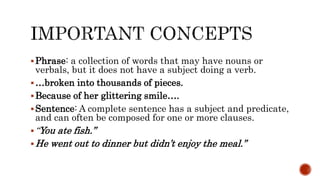
Phrase: a collection of words that may have nouns or
verbals, but it does not have a subject doing a verb.
…broken into thousands of pieces.
Because of her glittering smile….
Sentence: A complete sentence has a subject and predicate,
and can often be composed for one or more clauses.
“You ate fish.”
He went out to dinner but didn’t enjoy the meal.”
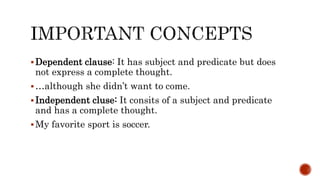
Dependent clause: It has subject and predicate but does
not express a complete thought.
…although she didn’t want to come.
Independent cluse: It consits of a subject and predicate
and has a complete thought.
My favorite sport is soccer.
Coordinating Conjunctions
 Or Coordinators: join words,
phrases or independent
clauses.
 Ex: for, and, not, but, or, yet,
so.
Subordinating Conjunctions
 Or Subordinators: join
dependent clauses to main
clause (independent clauses)
 Ex: although, because, if,
before, after, since, when, once,
since, until, when, as son as,
wheter, even if, even though,
unles, so that.
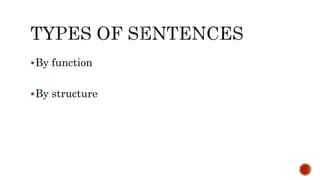
By function
By structure
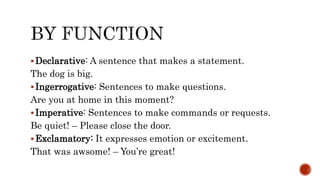
Declarative: A sentence that makes a statement.
The dog is big.
Ingerrogative: Sentences to make questions.
Are you at home in this moment?
Imperative: Sentences to make commands or requests.
Be quiet! – Please close the door.
Exclamatory: It expresses emotion or excitement.
That was awsome! – You’re great!
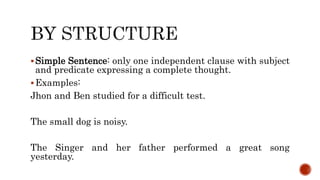
Simple Sentence: only one independent clause with subject
and predicate expressing a complete thought.
Examples:
Jhon and Ben studied for a difficult test.
The small dog is noisy.
The Singer and her father performed a great song
yesterday.
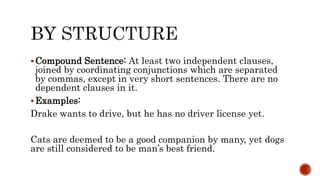
Compound Sentence: At least two independent clauses,
joined by coordinating conjunctions which are separated
by commas, except in very short sentences. There are no
dependent clauses in it.
Examples:
Drake wants to drive, but he has no driver license yet.
Cats are deemed to be a good companion by many, yet dogs
are still considered to be man’s best friend.
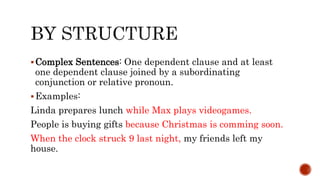
Complex Sentences: One dependent clause and at least
one dependent clause joined by a subordinating
conjunction or relative pronoun.
Examples:
Linda prepares lunch while Max plays videogames.
People is buying gifts because Christmas is comming soon.
When the clock struck 9 last night, my friends left my
house.
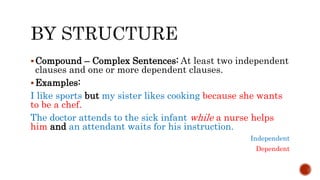
Compound – Complex Sentences: At least two independent
clauses and one or more dependent clauses.
Examples:
I like sports but my sister likes cooking because she wants
to be a chef.
The doctor attends to the sick infant while a nurse helps
him and an attendant waits for his instruction.
Independent
Dependent
https://sites.google.com/site/englishgrammarguide/Home/s
entence-structure--part-4----sentence-types
http://studyandexam.com/sentence-types.html
http://www.worldenglishclub.com/kinds-of-sentences-
according-to-structure

Types of sentences

  • 1.
  • 2.
    Phrase: a collectionof words that may have nouns or verbals, but it does not have a subject doing a verb. …broken into thousands of pieces. Because of her glittering smile…. Sentence: A complete sentence has a subject and predicate, and can often be composed for one or more clauses. “You ate fish.” He went out to dinner but didn’t enjoy the meal.”
  • 3.
    Dependent clause: Ithas subject and predicate but does not express a complete thought. …although she didn’t want to come. Independent cluse: It consits of a subject and predicate and has a complete thought. My favorite sport is soccer.
  • 4.
    Coordinating Conjunctions  OrCoordinators: join words, phrases or independent clauses.  Ex: for, and, not, but, or, yet, so. Subordinating Conjunctions  Or Subordinators: join dependent clauses to main clause (independent clauses)  Ex: although, because, if, before, after, since, when, once, since, until, when, as son as, wheter, even if, even though, unles, so that.
  • 5.
  • 6.
    Declarative: A sentencethat makes a statement. The dog is big. Ingerrogative: Sentences to make questions. Are you at home in this moment? Imperative: Sentences to make commands or requests. Be quiet! – Please close the door. Exclamatory: It expresses emotion or excitement. That was awsome! – You’re great!
  • 7.
    Simple Sentence: onlyone independent clause with subject and predicate expressing a complete thought. Examples: Jhon and Ben studied for a difficult test. The small dog is noisy. The Singer and her father performed a great song yesterday.
  • 8.
    Compound Sentence: Atleast two independent clauses, joined by coordinating conjunctions which are separated by commas, except in very short sentences. There are no dependent clauses in it. Examples: Drake wants to drive, but he has no driver license yet. Cats are deemed to be a good companion by many, yet dogs are still considered to be man’s best friend.
  • 9.
    Complex Sentences: Onedependent clause and at least one dependent clause joined by a subordinating conjunction or relative pronoun. Examples: Linda prepares lunch while Max plays videogames. People is buying gifts because Christmas is comming soon. When the clock struck 9 last night, my friends left my house.
  • 10.
    Compound – ComplexSentences: At least two independent clauses and one or more dependent clauses. Examples: I like sports but my sister likes cooking because she wants to be a chef. The doctor attends to the sick infant while a nurse helps him and an attendant waits for his instruction. Independent Dependent
  • 11.