Perfect Progressive
Tenses
GRAMMAR TENSES
Present Perfect Progressive
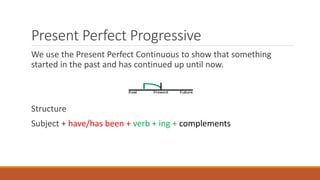
We use the Present Perfect Continuous to show that something
started in the past and has continued up until now.
Structure
Subject + have/has been + verb + ing + complements
Present Perfect Progressive
Negative statement
Subject + have/has NOT been + verb + ing + complements
Present Perfect Progressive
Question
Have/has + Subject + been + verb + ing + complements?
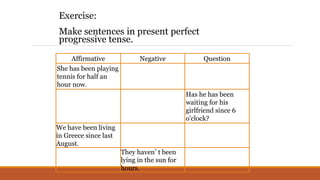
Exercise:
Make sentences in present perfect
progressive tense.
Affirmative Negative Question
She has been playing
tennis for half an
hour now.
Has he has been
waiting for his
girlfriend since 6
o'clock?
We have been living
in Greece since last
August.
They haven’t been
lying in the sun for
hours.
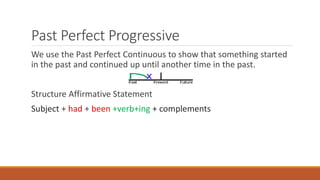
Past Perfect Progressive
We use the Past Perfect Continuous to show that something started
in the past and continued up until another time in the past.
Structure Affirmative Statement
Subject + had + been +verb+ing + complements
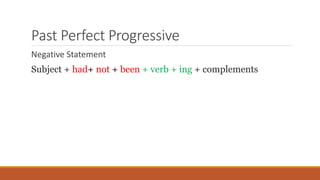
Past Perfect Progressive
Negative Statement
Subject + had+ not + been + verb + ing + complements
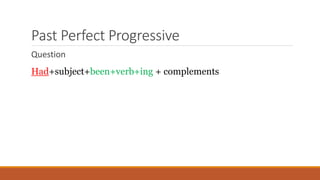
Past Perfect Progressive
Question
Had+subject+been+verb+ing + complements
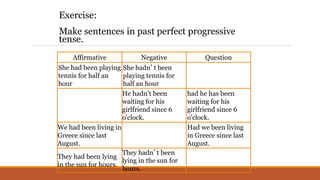
Exercise:
Make sentences in past perfect progressive
tense.
Affirmative Negative Question
She had been playing
tennis for half an
hour
She hadn’t been
playing tennis for
half an hour
He hadn’t been
waiting for his
girlfriend since 6
o'clock.
had he has been
waiting for his
girlfriend since 6
o'clock.
We had been living in
Greece since last
August.
Had we been living
in Greece since last
August.
They had been lying
in the sun for hours.
They hadn’t been
lying in the sun for
hours.
Future Perfect Progressive
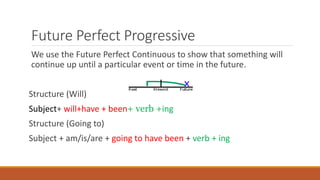
We use the Future Perfect Continuous to show that something will
continue up until a particular event or time in the future.
Structure (Will)
Subject+ will+have + been+ verb +ing
Structure (Going to)
Subject + am/is/are + going to have been + verb + ing
Future Perfect Progressive
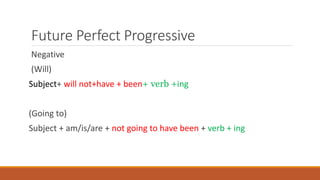
Negative
(Will)
Subject+ will not+have + been+ verb +ing
(Going to)
Subject + am/is/are + not going to have been + verb + ing
Future Perfect Progressive
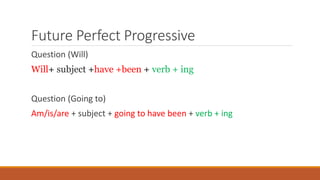
Question (Will)
Will+ subject +have +been + verb + ing
Question (Going to)
Am/is/are + subject + going to have been + verb + ing
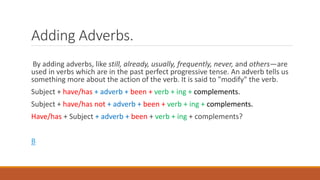
Adding Adverbs.
By adding adverbs, like still, already, usually, frequently, never, and others—are
used in verbs which are in the past perfect progressive tense. An adverb tells us
something more about the action of the verb. It is said to "modify" the verb.
Subject + have/has + adverb + been + verb + ing + complements.
Subject + have/has not + adverb + been + verb + ing + complements.
Have/has + Subject + adverb + been + verb + ing + complements?
B

Perfect progressive tenses

  • 1.
  • 2.
    Present Perfect Progressive Weuse the Present Perfect Continuous to show that something started in the past and has continued up until now. Structure Subject + have/has been + verb + ing + complements
  • 3.
    Present Perfect Progressive Negativestatement Subject + have/has NOT been + verb + ing + complements
  • 4.
    Present Perfect Progressive Question Have/has+ Subject + been + verb + ing + complements?
  • 5.
    Exercise: Make sentences inpresent perfect progressive tense. Affirmative Negative Question She has been playing tennis for half an hour now. Has he has been waiting for his girlfriend since 6 o'clock? We have been living in Greece since last August. They haven’t been lying in the sun for hours.
  • 6.
    Past Perfect Progressive Weuse the Past Perfect Continuous to show that something started in the past and continued up until another time in the past. Structure Affirmative Statement Subject + had + been +verb+ing + complements
  • 7.
    Past Perfect Progressive NegativeStatement Subject + had+ not + been + verb + ing + complements
  • 8.
  • 9.
    Exercise: Make sentences inpast perfect progressive tense. Affirmative Negative Question She had been playing tennis for half an hour She hadn’t been playing tennis for half an hour He hadn’t been waiting for his girlfriend since 6 o'clock. had he has been waiting for his girlfriend since 6 o'clock. We had been living in Greece since last August. Had we been living in Greece since last August. They had been lying in the sun for hours. They hadn’t been lying in the sun for hours.
  • 10.
    Future Perfect Progressive Weuse the Future Perfect Continuous to show that something will continue up until a particular event or time in the future. Structure (Will) Subject+ will+have + been+ verb +ing Structure (Going to) Subject + am/is/are + going to have been + verb + ing
  • 11.
    Future Perfect Progressive Negative (Will) Subject+will not+have + been+ verb +ing (Going to) Subject + am/is/are + not going to have been + verb + ing
  • 12.
    Future Perfect Progressive Question(Will) Will+ subject +have +been + verb + ing Question (Going to) Am/is/are + subject + going to have been + verb + ing
  • 13.
    Adding Adverbs. By addingadverbs, like still, already, usually, frequently, never, and others—are used in verbs which are in the past perfect progressive tense. An adverb tells us something more about the action of the verb. It is said to "modify" the verb. Subject + have/has + adverb + been + verb + ing + complements. Subject + have/has not + adverb + been + verb + ing + complements. Have/has + Subject + adverb + been + verb + ing + complements? B