 CONJUNCTION
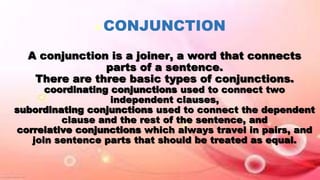
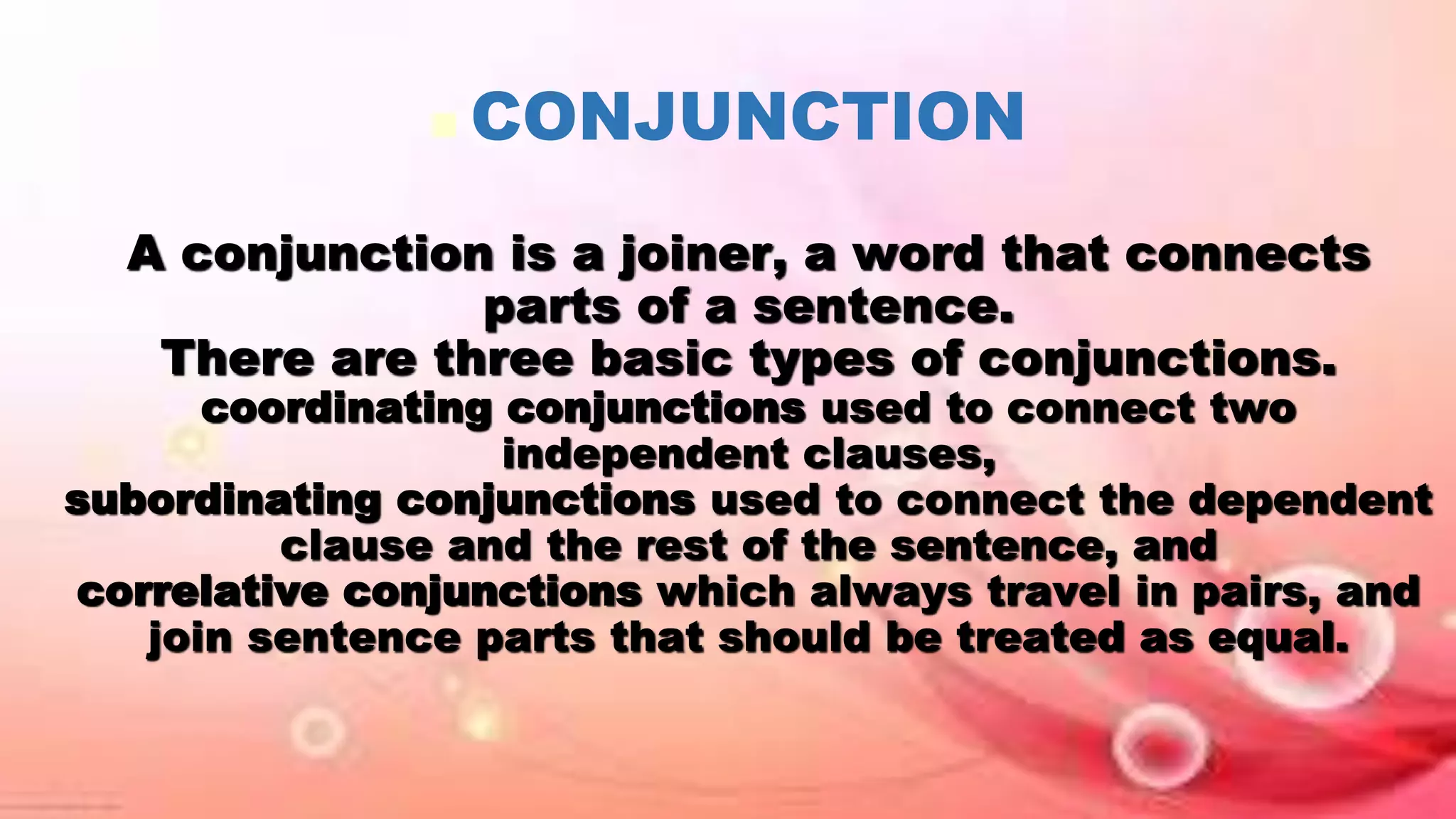
A conjunction is a joiner, a word that connects
parts of a sentence.
There are three basic types of conjunctions.
coordinating conjunctions used to connect two
independent clauses,
subordinating conjunctions used to connect the dependent
clause and the rest of the sentence, and
correlative conjunctions which always travel in pairs, and
join sentence parts that should be treated as equal.
COORDINATING
CONJUNCTIONS
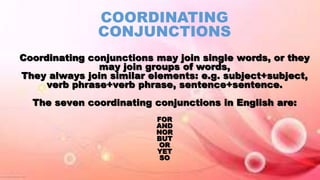
Coordinating conjunctions may join single words, or they
may join groups of words,
They always join similar elements: e.g. subject+subject,
verb phrase+verb phrase, sentence+sentence.
The seven coordinating conjunctions in English are:
FOR
AND
NOR
BUT
OR
YET
SO
 EASY REMINDER
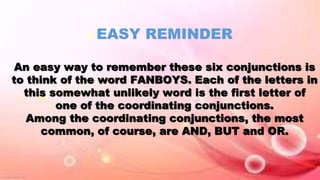
An easy way to remember these six conjunctions is
to think of the word FANBOYS. Each of the letters in
this somewhat unlikely word is the first letter of
one of the coordinating conjunctions.
Among the coordinating conjunctions, the most
common, of course, are AND, BUT and OR.
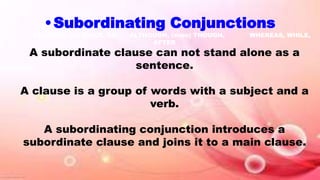
•Subordinating Conjunctions
BECAUSE, AS, SINCE, SO, ALTHOUGH, (even) THOUGH, WHEREAS, WHILE,
AFTER
A subordinate clause can not stand alone as a
sentence.
A clause is a group of words with a subject and a
verb.
A subordinating conjunction introduces a
subordinate clause and joins it to a main clause.
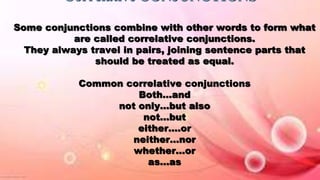
Correlative CONJUNCTIONS
Some conjunctions combine with other words to form what
are called correlative conjunctions.
They always travel in pairs, joining sentence parts that
should be treated as equal.
Common correlative conjunctions
Both…and
not only…but also
not…but
either….or
neither…nor
whether…or
as…as
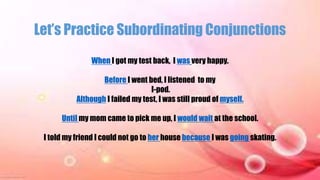
Let’s Practice Subordinating Conjunctions
When I got my test back, I was very happy.
Before I went bed, I listened to my
I-pod.
Although I failed my test, I was still proud of myself.
Until my mom came to pick me up, I would wait at the school.
I told my friend I could not go to her house because I was going skating.
Let’s Practice Coordinating Conjunctions
I wanted to get a huge TV, but I only got a flat screen.
Billy Bob and Robert went to get ice-cream, but it was all sold out.
Aine got scared when she saw a ghost, so Aine ran far, far,
far away.
Ben thought he was being funny, but he got a detention.
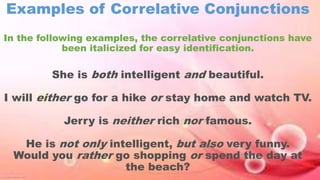
Examples of Correlative Conjunctions
In the following examples, the correlative conjunctions have
been italicized for easy identification.
She is both intelligent and beautiful.
I will either go for a hike or stay home and watch TV.
Jerry is neither rich nor famous.
He is not only intelligent, but also very funny.
Would you rather go shopping or spend the day at
the beach?
When using correlative conjunctions, ensure verbs agree so your
sentences make sense.
For example: Every night, either loud music or fighting neighbors wake
John from his sleep.
When you use a correlative conjunction, you must be sure
that pronouns agree.
For example:Neither Debra nor Sally expressed her annoyance when
the cat broke the antique lamp.
When using correlative conjunctions, be sure to keep parallel structure
intact.
Equal grammatical units need to be incorporated into the entire
sentence. For example: Not only did Mary grill burgers for
Michael, but she also fixed a steak for her dog, Vinny.
Reference. http://www.gingersoftware.com/content/grammar-rules/conjunctions/correlative-conjunctions/

Conjunction by NOELA

  • 1.
     CONJUNCTION A conjunctionis a joiner, a word that connects parts of a sentence. There are three basic types of conjunctions. coordinating conjunctions used to connect two independent clauses, subordinating conjunctions used to connect the dependent clause and the rest of the sentence, and correlative conjunctions which always travel in pairs, and join sentence parts that should be treated as equal.
  • 2.
    COORDINATING CONJUNCTIONS Coordinating conjunctions mayjoin single words, or they may join groups of words, They always join similar elements: e.g. subject+subject, verb phrase+verb phrase, sentence+sentence. The seven coordinating conjunctions in English are: FOR AND NOR BUT OR YET SO
  • 3.
     EASY REMINDER Aneasy way to remember these six conjunctions is to think of the word FANBOYS. Each of the letters in this somewhat unlikely word is the first letter of one of the coordinating conjunctions. Among the coordinating conjunctions, the most common, of course, are AND, BUT and OR.
  • 4.
    •Subordinating Conjunctions BECAUSE, AS,SINCE, SO, ALTHOUGH, (even) THOUGH, WHEREAS, WHILE, AFTER A subordinate clause can not stand alone as a sentence. A clause is a group of words with a subject and a verb. A subordinating conjunction introduces a subordinate clause and joins it to a main clause.
  • 5.
    Correlative CONJUNCTIONS Some conjunctionscombine with other words to form what are called correlative conjunctions. They always travel in pairs, joining sentence parts that should be treated as equal. Common correlative conjunctions Both…and not only…but also not…but either….or neither…nor whether…or as…as
  • 6.
    Let’s Practice SubordinatingConjunctions When I got my test back, I was very happy. Before I went bed, I listened to my I-pod. Although I failed my test, I was still proud of myself. Until my mom came to pick me up, I would wait at the school. I told my friend I could not go to her house because I was going skating.
  • 7.
    Let’s Practice CoordinatingConjunctions I wanted to get a huge TV, but I only got a flat screen. Billy Bob and Robert went to get ice-cream, but it was all sold out. Aine got scared when she saw a ghost, so Aine ran far, far, far away. Ben thought he was being funny, but he got a detention.
  • 8.
    Examples of CorrelativeConjunctions In the following examples, the correlative conjunctions have been italicized for easy identification. She is both intelligent and beautiful. I will either go for a hike or stay home and watch TV. Jerry is neither rich nor famous. He is not only intelligent, but also very funny. Would you rather go shopping or spend the day at the beach?
  • 9.
    When using correlativeconjunctions, ensure verbs agree so your sentences make sense. For example: Every night, either loud music or fighting neighbors wake John from his sleep. When you use a correlative conjunction, you must be sure that pronouns agree. For example:Neither Debra nor Sally expressed her annoyance when the cat broke the antique lamp. When using correlative conjunctions, be sure to keep parallel structure intact. Equal grammatical units need to be incorporated into the entire sentence. For example: Not only did Mary grill burgers for Michael, but she also fixed a steak for her dog, Vinny. Reference. http://www.gingersoftware.com/content/grammar-rules/conjunctions/correlative-conjunctions/