






STEPS IN THE RESEARCH
       PROCESS
Understanding Your Project


 OK- at this point, you have your assignment and
 you’re thinking about how you’ll meet the
 requirements. It helps to read the assignment
 carefully.
Determining Scope


 Now, you decide how widely or narrowly you want
 to address your topic. Keep in mind that a topic
 that is too broad will give you too many resources
 to look through.
Finding a Research Question


 Not every paper requires a research question, but
 sometimes asking a question can help you think
 about how to find sources and determine an
 approach.
Determining Keywords

 Keywords are just general terms (like the ones you
 type into Google). Good keywords are also useful
 in he library catalog or databases.
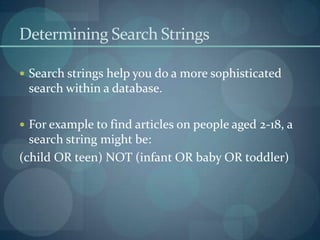
Determining Search Strings

 Search strings help you do a more sophisticated
 search within a database.

 For example to find articles on people aged 2-18, a
  search string might be:
(child OR teen) NOT (infant OR baby OR toddler)
Identifying Types of Searches

 Thinking about what types of library sources make
 the most sense.
Locating Sources


 You’ll find your sources: electronically, in print or
 through Interlibrary Loan.
Evaluating Sources

 Determine if your source is trustworthy and if it
 can contribute to your research.
Organizing Sources

 Creating a record of your sources so you can create
 a bibliography and properly cite your sources.
Writing

 In this step, you synthesize your findings and
 compose your paper.
Citing

 You should cite sources in your paper, whether you
 quote or paraphrase someone else’s ideas. You can
 do this parenthetically or by using footnotes.
Bibliography

 Create a list of sources you used in your paper.
Proofreading

 Read your paper before turning it in!

Steps in the research process

  • 1.
    STEPS IN THERESEARCH PROCESS
  • 2.
    Understanding Your Project OK- at this point, you have your assignment and you’re thinking about how you’ll meet the requirements. It helps to read the assignment carefully.
  • 3.
    Determining Scope  Now,you decide how widely or narrowly you want to address your topic. Keep in mind that a topic that is too broad will give you too many resources to look through.
  • 4.
    Finding a ResearchQuestion  Not every paper requires a research question, but sometimes asking a question can help you think about how to find sources and determine an approach.
  • 5.
    Determining Keywords  Keywordsare just general terms (like the ones you type into Google). Good keywords are also useful in he library catalog or databases.
  • 6.
    Determining Search Strings Search strings help you do a more sophisticated search within a database.  For example to find articles on people aged 2-18, a search string might be: (child OR teen) NOT (infant OR baby OR toddler)
  • 7.
    Identifying Types ofSearches  Thinking about what types of library sources make the most sense.
  • 8.
    Locating Sources  You’llfind your sources: electronically, in print or through Interlibrary Loan.
  • 9.
    Evaluating Sources  Determineif your source is trustworthy and if it can contribute to your research.
  • 10.
    Organizing Sources  Creatinga record of your sources so you can create a bibliography and properly cite your sources.
  • 11.
    Writing  In thisstep, you synthesize your findings and compose your paper.
  • 12.
    Citing  You shouldcite sources in your paper, whether you quote or paraphrase someone else’s ideas. You can do this parenthetically or by using footnotes.
  • 13.
    Bibliography  Create alist of sources you used in your paper.
  • 14.
    Proofreading  Read yourpaper before turning it in!