TYPES OF
MICROSTRIP
ANTENNA
Types of microstrip antennas are
based on :-
 Feeding mechanism (Inset feed, CPW feed,
coupling feed etc.)
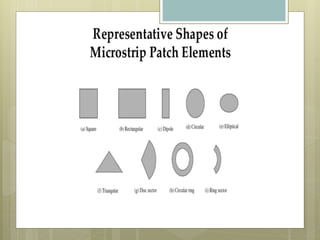
 Shape of patch (square, circular, hexagonal,
fractal etc.)
 Operating frequency
 Band(s) of operation i.e. wideband, Multiband,
single band, dual, tri band and so on.
Types of microstrip antenna :-
 Microstrip patch antenna
 Microstrip dipoles antenna
 Printed slot antenna
 Microstrip travelling wave antenna
Printed slot antenna :-
 Printed slot antennas comprises of a slot in the
ground plane of grounded substrate. Virtually the
slot can have any shape. Theoretically most of the
patch shapes can be realised in the form of
printed slot.
 Like MSA the slot antennas can be fed either by
MS line or coplaner waveguide.
 Generally bidirectional radiators, unidirectional
radiation is obtained by using reflected plate on
one side of the slot.
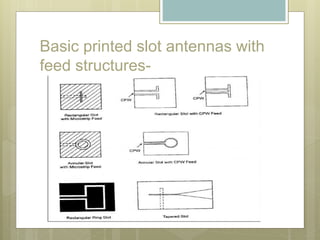
Basic printed slot antennas with
feed structures-
Printed slot antenna
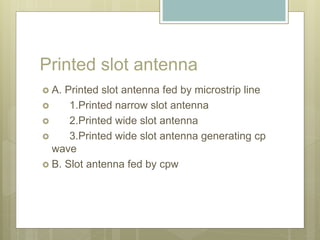
 A. Printed slot antenna fed by microstrip line
 1.Printed narrow slot antenna
 2.Printed wide slot antenna
 3.Printed wide slot antenna generating cp
wave
 B. Slot antenna fed by cpw
Printed Dipole Antenna
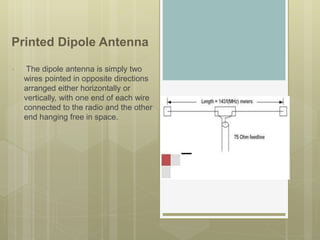
• The dipole antenna is simply two
wires pointed in opposite directions
arranged either horizontally or
vertically, with one end of each wire
connected to the radio and the other
end hanging free in space.
 The transmission line is often known as a feed
element. When the waves reach the antenna, they
oscillate along the length of the antenna and back.
Each oscillation pushes electromagnetic energy
from the antenna, emitting the energy through free
space as radio waves.
Properties of dipole Antenna
A Dipole antenna’s size and shape depend on the intended
frequency or wavelength of the radio waves being sent or
received. The design of a transmitting antenna is usually not
different from that of a receiving antenna. Some devices use the
same antenna for both purposes.
 Size : The electrical size of an antenna depends on the
wavelength of the radio waves being sent or received. An
antenna radiates energy most efficiently when its length is a
particular fraction of the wavelength.
 Shape : Antennas come in a wide variety of shapes. One of the
simplest types of antennas is called a dipole. The two lengths
of metal are usually arranged end to end, with the cable from
the transmitter or receiver feeding each length of the dipole in
the middle.
The Dipole Antenna Parameter
There are several critical parameters that affect an
Dipole antenna's performance and can be adjusted
during the design process.
 Resonant frequency
 Impedance
 Gain
 Polarisation
 Efficiency
 Bandwidth
Common application of Dipole
Antenna
 Set top TV antenna - The most common dipole
antenna is the "rabbit ears" type used with televisions.
These are adjustable in length and angle.
 Folded dipoles - Another common place one can see
dipoles are as antennas for the FM band - these are
folded dipoles.
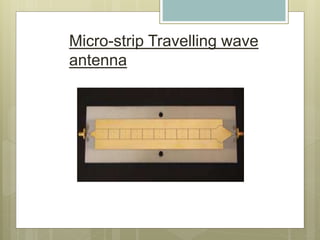
Micro-strip Travelling wave
antenna
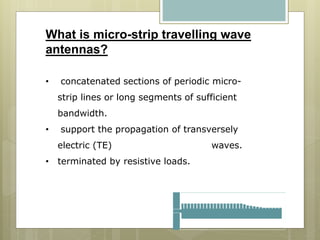
What is micro-strip travelling wave
antennas?
• concatenated sections of periodic micro-
strip lines or long segments of sufficient
bandwidth.
• support the propagation of transversely
electric (TE) waves.
• terminated by resistive loads.
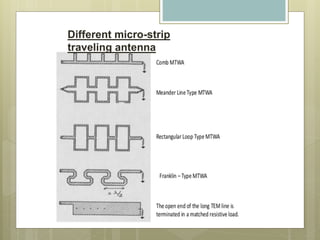
Different micro-strip
traveling antenna
Advantages :-
1. Low cost
2.light weight
3.operation medium frequency
range(300kHz to 3Mhz) and higher
frequency range(3Mhz to 30M hz)
Disadvantages:-
1.low directivity
2.low power at short lobes
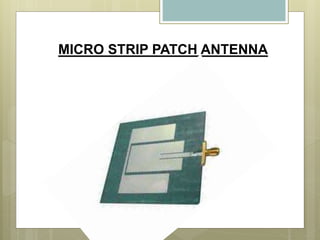
MICRO STRIP PATCH ANTENNA
WHAT IS MICRO-STRIP
PATCH ANTENNA ?
 A Micro-strip patch Antenna (MSPA) in its simplest form
consists of a radiating patch on one side of a dielectric
substrate and a ground plane on the other side.
 MSPAs are also known as “patch antennas” or “printed
antennas” or “planar antennas”.
 formally proposed by Grieg and Engleman in 1952
 Deschamps devised in 1953.
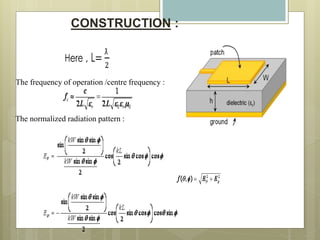
CONSTRUCTION :
The normalized radiation pattern :
The frequency of operation /centre frequency :
Advantages:-
1.Low cost
2. light weight
3.Easy fabrication
4.Linear and circular form
5.Compatible with modular designs
6.Easily mountable on space vehicles, missiles etc.
Types of microstrip antenna

Types of microstrip antenna

  • 1.
  • 2.
    Types of microstripantennas are based on :-  Feeding mechanism (Inset feed, CPW feed, coupling feed etc.)  Shape of patch (square, circular, hexagonal, fractal etc.)  Operating frequency  Band(s) of operation i.e. wideband, Multiband, single band, dual, tri band and so on.
  • 3.
    Types of microstripantenna :-  Microstrip patch antenna  Microstrip dipoles antenna  Printed slot antenna  Microstrip travelling wave antenna
  • 4.
    Printed slot antenna:-  Printed slot antennas comprises of a slot in the ground plane of grounded substrate. Virtually the slot can have any shape. Theoretically most of the patch shapes can be realised in the form of printed slot.  Like MSA the slot antennas can be fed either by MS line or coplaner waveguide.  Generally bidirectional radiators, unidirectional radiation is obtained by using reflected plate on one side of the slot.
  • 5.
    Basic printed slotantennas with feed structures-
  • 6.
    Printed slot antenna A. Printed slot antenna fed by microstrip line  1.Printed narrow slot antenna  2.Printed wide slot antenna  3.Printed wide slot antenna generating cp wave  B. Slot antenna fed by cpw
  • 7.
    Printed Dipole Antenna •The dipole antenna is simply two wires pointed in opposite directions arranged either horizontally or vertically, with one end of each wire connected to the radio and the other end hanging free in space.
  • 8.
     The transmissionline is often known as a feed element. When the waves reach the antenna, they oscillate along the length of the antenna and back. Each oscillation pushes electromagnetic energy from the antenna, emitting the energy through free space as radio waves.
  • 9.
    Properties of dipoleAntenna A Dipole antenna’s size and shape depend on the intended frequency or wavelength of the radio waves being sent or received. The design of a transmitting antenna is usually not different from that of a receiving antenna. Some devices use the same antenna for both purposes.  Size : The electrical size of an antenna depends on the wavelength of the radio waves being sent or received. An antenna radiates energy most efficiently when its length is a particular fraction of the wavelength.  Shape : Antennas come in a wide variety of shapes. One of the simplest types of antennas is called a dipole. The two lengths of metal are usually arranged end to end, with the cable from the transmitter or receiver feeding each length of the dipole in the middle.
  • 10.
    The Dipole AntennaParameter There are several critical parameters that affect an Dipole antenna's performance and can be adjusted during the design process.  Resonant frequency  Impedance  Gain  Polarisation  Efficiency  Bandwidth
  • 11.
    Common application ofDipole Antenna  Set top TV antenna - The most common dipole antenna is the "rabbit ears" type used with televisions. These are adjustable in length and angle.  Folded dipoles - Another common place one can see dipoles are as antennas for the FM band - these are folded dipoles.
  • 12.
  • 13.
    What is micro-striptravelling wave antennas? • concatenated sections of periodic micro- strip lines or long segments of sufficient bandwidth. • support the propagation of transversely electric (TE) waves. • terminated by resistive loads.
  • 14.
  • 15.
    Advantages :- 1. Lowcost 2.light weight 3.operation medium frequency range(300kHz to 3Mhz) and higher frequency range(3Mhz to 30M hz) Disadvantages:- 1.low directivity 2.low power at short lobes
  • 16.
  • 17.
    WHAT IS MICRO-STRIP PATCHANTENNA ?  A Micro-strip patch Antenna (MSPA) in its simplest form consists of a radiating patch on one side of a dielectric substrate and a ground plane on the other side.  MSPAs are also known as “patch antennas” or “printed antennas” or “planar antennas”.  formally proposed by Grieg and Engleman in 1952  Deschamps devised in 1953.
  • 18.
    CONSTRUCTION : The normalizedradiation pattern : The frequency of operation /centre frequency :
  • 20.
    Advantages:- 1.Low cost 2. lightweight 3.Easy fabrication 4.Linear and circular form 5.Compatible with modular designs 6.Easily mountable on space vehicles, missiles etc.