TYPES OF KNOWLEDGE
Ringgit E. Aguilar
BSEd-II English
Various types of knowledge are
received and processed through
senses.
Knowledge should be integrated
between old and ne facts to
maintain equilibrium.
EPISODIC KNOWLEDGE
 Refers to our biological memory
reflecting not only what happened, but
also where and when it happened.
 It means that the memories of our
childhood days, our first day in school
or cell phone number of our loved ones
are all example of episodic knowledge.
SEMANTIC KNOWLEDGE
 In contras to episodic knowledge, deals
with memories and information that are
not tied to our personal biographies.
 The organized knowledge about facts,
concepts and generalizations including
their associations form part of our
semantic knowledge.
TYPES OF SEMANTIC KNOWLEDGE
DECLARATIVE KNOWLEDGE- deals with the
statement of truth, it also deals with what we
know about the world.
PROCEDURAL KNOWLEDGE- is the knowledge
about how things are to be done.
CONDITIONAL KNOWLEDGE- if the declarative
knowledge accounts for knowing what and
procedural knowledge accounts for knowing
how then, conditional knowledge account for
knowing when.
DECLARATIVE KNOWLEDGE IS ORGANIZED
ACCORDING TO VARIOUS LEVEL
 Description
 Time elements
 Process
 Causal relationship
 Episodes
 Generalizations
 Principles
 Concepts
THE LEGITIMATE POWER OF KNOWLEDGE
 Knowledge that is true and legitimate
can be used meaningfully and can work
for our most honest human endeavors.
Dealing with its legitimate power
equates with understanding its process.
 Rational
 Empirical
 Pragmatic
ORGANIZATION OF SEMANTIC KNOWLEDGE
 Learning task in classroom should be
arranged according to how these can be
facilitataed.
 Facts- specific bits of information that
relate to specific event, person, object or
situation.
Data- are things gathered trough
process of research.
 Information- definite knowledge.
 Ideas- maybe suggestion, impression or
opinion.
 Wisdom- gained through expirience.
 Concepts- basic units of thinking.
Tree different structures of concept:
 Properties
 Signs
 Referents
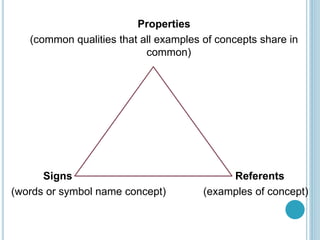
Properties
(common qualities that all examples of concepts share in
common)
Signs Referents
(words or symbol name concept) (examples of concept)
 Categories- do not only provide basic
knowledge about certain objects but also
give an idea about some properties of
things belong to other categories.
Types of Categories
 Natural
 Artifact
 Nominal
 Generalizations- are statement that contain
the if-then or predictive characteristics.
END.
Thankyou! 
God bless!

Types of knowledge.-Facilitating Learning

  • 1.
    TYPES OF KNOWLEDGE RinggitE. Aguilar BSEd-II English
  • 2.
    Various types ofknowledge are received and processed through senses. Knowledge should be integrated between old and ne facts to maintain equilibrium.
  • 3.
    EPISODIC KNOWLEDGE  Refersto our biological memory reflecting not only what happened, but also where and when it happened.  It means that the memories of our childhood days, our first day in school or cell phone number of our loved ones are all example of episodic knowledge.
  • 4.
    SEMANTIC KNOWLEDGE  Incontras to episodic knowledge, deals with memories and information that are not tied to our personal biographies.  The organized knowledge about facts, concepts and generalizations including their associations form part of our semantic knowledge.
  • 5.
    TYPES OF SEMANTICKNOWLEDGE DECLARATIVE KNOWLEDGE- deals with the statement of truth, it also deals with what we know about the world. PROCEDURAL KNOWLEDGE- is the knowledge about how things are to be done. CONDITIONAL KNOWLEDGE- if the declarative knowledge accounts for knowing what and procedural knowledge accounts for knowing how then, conditional knowledge account for knowing when.
  • 6.
    DECLARATIVE KNOWLEDGE ISORGANIZED ACCORDING TO VARIOUS LEVEL  Description  Time elements  Process  Causal relationship  Episodes  Generalizations  Principles  Concepts
  • 7.
    THE LEGITIMATE POWEROF KNOWLEDGE  Knowledge that is true and legitimate can be used meaningfully and can work for our most honest human endeavors. Dealing with its legitimate power equates with understanding its process.  Rational  Empirical  Pragmatic
  • 8.
    ORGANIZATION OF SEMANTICKNOWLEDGE  Learning task in classroom should be arranged according to how these can be facilitataed.  Facts- specific bits of information that relate to specific event, person, object or situation.
  • 9.
    Data- are thingsgathered trough process of research.  Information- definite knowledge.  Ideas- maybe suggestion, impression or opinion.  Wisdom- gained through expirience.
  • 10.
     Concepts- basicunits of thinking. Tree different structures of concept:  Properties  Signs  Referents
  • 11.
    Properties (common qualities thatall examples of concepts share in common) Signs Referents (words or symbol name concept) (examples of concept)
  • 12.
     Categories- donot only provide basic knowledge about certain objects but also give an idea about some properties of things belong to other categories. Types of Categories  Natural  Artifact  Nominal
  • 13.
     Generalizations- arestatement that contain the if-then or predictive characteristics.
  • 14.