Energizer
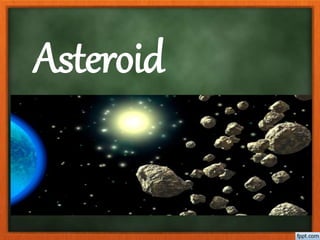
Asteroid
What is Asteroid?
•Asteroids are minor planets,
especially those of the inner Solar
System.
•They are also known as planetoids
or minor planets.
• The mass of all the asteroids is
less than that of Earth's moon.
But despite their size, asteroids
can be dangerous.
Where we can find Asteroids in our
Solar System?
Asteroids can be found anywhere in the
Solar System.
Asteroids are also can be found
between Mars and Jupiter known as the
“asteroid belt”...
Composition of Asteroids
• Most of Asteroids are made of
rock, but some are composed of
metals and other materials.
Type Composition
Percentage of
Asteroids
Albedo
(Reflectivity)
Carbon
(C-type) Carbon over 75 percent
0.03-0.09 (Very
dark)
Silicate
(S-type)
Metallic iron
mixed with iron-
silicates and
magnesium-
silicates
17 percent 0.10 -0.22
(Relatively bright)
Metallic
(M-type) Iron/ nickel less than 7 percent
0.10-0.18
(Relatively bright)
Dark
(D-type)
Water
ice/frozen
carbon monoxide
mixed with rock
less than 1 percent
0.05 (Relatively
dark and reddish)
Exceptional
Asteroids
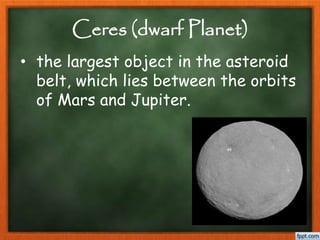
Ceres (dwarf Planet)
• the largest object in the asteroid
belt, which lies between the orbits
of Mars and Jupiter.
2 Pallas
• the second asteroid to have been
discovered (after Ceres), and it is one of the
largest asteroids in the Solar System. With
an estimated 7% of the mass of the asteroid
belt, it is the third-most-massive asteroid,
being 10–30% less massive than Vesta.
4 Vesta
• Vesta is the brightest asteroid visible
from Earth. Its maximum distance
from the Sun is slightly greater than
the minimum distance of Ceres from
the Sun,though its orbit lies entirely
within that of Ceres.
10 Hygeia
• it is the largest of the class of
dark C-type asteroids with
a carbonaceous surface.
704 Interamnia
• it is a very little-studied body. It is easily
the largest of the F-type asteroids, but
there exist very few details of its internal
composition or shape, and no light
curve analysis has yet been done to
determine the ecliptic coordinates of
Interamnia's poles (and hence its axial
tilt).
52 Europa
• is the 6th-largest asteroid in
the asteroid belt, having an average
diameter of around 315 km. It is not
round but is shaped like a triaxial
ellipsoid of approximately
380x330x250 km.
511 Davida
• It is a C-type asteroid, which means that it
is dark in colouring with a carbonaceous
chondrite composition.
• Davida is one of the few main-belt asteroids
whose shape has been determined by ground-
based visual observation.
87 Sylvia
• the 8th-largest asteroid in
the asteroid belt. It is a member of
the Cybele group located beyond the
core of the belt (see minor-planet
groups). Sylvia is the first asteroid
known to possess more than one moon.
65 Cybele
• is one of the largest asteroids in the Solar
System and is located in the outer asteroid
belt. It gives its name to the Cybele family
of asteroids that orbit outward from the
Sun from the 2:1 orbital
resonance with Jupiter.
• Cybele is a X-type asteroid, meaning that it
is dark in color and carbonaceous in
composition.
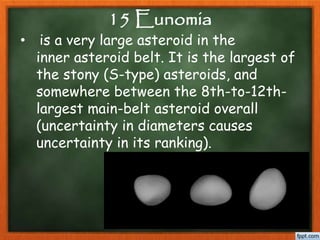
15 Eunomia
• is a very large asteroid in the
inner asteroid belt. It is the largest of
the stony (S-type) asteroids, and
somewhere between the 8th-to-12th-
largest main-belt asteroid overall
(uncertainty in diameters causes
uncertainty in its ranking).
Uses of Asteroid in astronomy.
1. They will tell us about the origins
of our solar system.
2. They will help us understand more
about the origin of life.
3. We may want to mine near-earth
asteroids for metals.
4. They may someday threaten to
collide with Earth. (Future Study)
Quiz
• 1. These are the minor planets,
they are also known as
planetoids.
• 2. The place which can be
found most of the asteroids.
• 3-4. Between what Planets
asteroid can be found?
• 5. The C-type of asteroid is
composed of?
• 6. It is composed of Iron and Nickel,
what type of asteroid is this?
• 7. It is the largest asteroid, also
known as dwarf planet.
• 8. It is known as the 6th-
largest asteroid, having an
average diameter of around
315 km.
• 9-10. Give two (2) uses of Asteroid
in astronomy.
Video Link
• https://youtu.be/mQHfGP5kpr8
• https://youtu.be/Jzyugh0dXRc
• https://youtu.be/PENT_hnyO-o
The END.
Thank you! 
Prepared by:
Ringgit Espiritu Aguilar

Asteroid

  • 2.
  • 5.
  • 6.
    What is Asteroid? •Asteroidsare minor planets, especially those of the inner Solar System. •They are also known as planetoids or minor planets.
  • 7.
    • The massof all the asteroids is less than that of Earth's moon. But despite their size, asteroids can be dangerous.
  • 8.
    Where we canfind Asteroids in our Solar System? Asteroids can be found anywhere in the Solar System. Asteroids are also can be found between Mars and Jupiter known as the “asteroid belt”...
  • 12.
    Composition of Asteroids •Most of Asteroids are made of rock, but some are composed of metals and other materials.
  • 13.
    Type Composition Percentage of Asteroids Albedo (Reflectivity) Carbon (C-type)Carbon over 75 percent 0.03-0.09 (Very dark) Silicate (S-type) Metallic iron mixed with iron- silicates and magnesium- silicates 17 percent 0.10 -0.22 (Relatively bright) Metallic (M-type) Iron/ nickel less than 7 percent 0.10-0.18 (Relatively bright) Dark (D-type) Water ice/frozen carbon monoxide mixed with rock less than 1 percent 0.05 (Relatively dark and reddish)
  • 14.
  • 15.
    Ceres (dwarf Planet) •the largest object in the asteroid belt, which lies between the orbits of Mars and Jupiter.
  • 16.
    2 Pallas • thesecond asteroid to have been discovered (after Ceres), and it is one of the largest asteroids in the Solar System. With an estimated 7% of the mass of the asteroid belt, it is the third-most-massive asteroid, being 10–30% less massive than Vesta.
  • 17.
    4 Vesta • Vestais the brightest asteroid visible from Earth. Its maximum distance from the Sun is slightly greater than the minimum distance of Ceres from the Sun,though its orbit lies entirely within that of Ceres.
  • 18.
    10 Hygeia • itis the largest of the class of dark C-type asteroids with a carbonaceous surface.
  • 19.
    704 Interamnia • itis a very little-studied body. It is easily the largest of the F-type asteroids, but there exist very few details of its internal composition or shape, and no light curve analysis has yet been done to determine the ecliptic coordinates of Interamnia's poles (and hence its axial tilt).
  • 20.
    52 Europa • isthe 6th-largest asteroid in the asteroid belt, having an average diameter of around 315 km. It is not round but is shaped like a triaxial ellipsoid of approximately 380x330x250 km.
  • 21.
    511 Davida • Itis a C-type asteroid, which means that it is dark in colouring with a carbonaceous chondrite composition. • Davida is one of the few main-belt asteroids whose shape has been determined by ground- based visual observation.
  • 22.
    87 Sylvia • the8th-largest asteroid in the asteroid belt. It is a member of the Cybele group located beyond the core of the belt (see minor-planet groups). Sylvia is the first asteroid known to possess more than one moon.
  • 23.
    65 Cybele • isone of the largest asteroids in the Solar System and is located in the outer asteroid belt. It gives its name to the Cybele family of asteroids that orbit outward from the Sun from the 2:1 orbital resonance with Jupiter. • Cybele is a X-type asteroid, meaning that it is dark in color and carbonaceous in composition.
  • 24.
    15 Eunomia • isa very large asteroid in the inner asteroid belt. It is the largest of the stony (S-type) asteroids, and somewhere between the 8th-to-12th- largest main-belt asteroid overall (uncertainty in diameters causes uncertainty in its ranking).
  • 25.
    Uses of Asteroidin astronomy. 1. They will tell us about the origins of our solar system. 2. They will help us understand more about the origin of life. 3. We may want to mine near-earth asteroids for metals. 4. They may someday threaten to collide with Earth. (Future Study)
  • 26.
  • 27.
    • 1. Theseare the minor planets, they are also known as planetoids. • 2. The place which can be found most of the asteroids. • 3-4. Between what Planets asteroid can be found? • 5. The C-type of asteroid is composed of?
  • 28.
    • 6. Itis composed of Iron and Nickel, what type of asteroid is this? • 7. It is the largest asteroid, also known as dwarf planet. • 8. It is known as the 6th- largest asteroid, having an average diameter of around 315 km. • 9-10. Give two (2) uses of Asteroid in astronomy.
  • 29.
    Video Link • https://youtu.be/mQHfGP5kpr8 •https://youtu.be/Jzyugh0dXRc • https://youtu.be/PENT_hnyO-o
  • 30.
    The END. Thank you! Prepared by: Ringgit Espiritu Aguilar