SANTROCK’S
DEVELOPMENTAL STAGES
(with Developmental Tasks)
8 Developmental Stages (Santrock)
• Prenatal
• Infancy
• Early childhood
• Middle & late childhood
• Adolescence
• Early adulthood
• Middle adulthood
• Late adulthood
PRENATAL PERIOD
• Development happens quickly during this stage
(tremendous growth from a single cell to an
organism complete with brain and behavioral
capabilities)
• Time between conception and birth
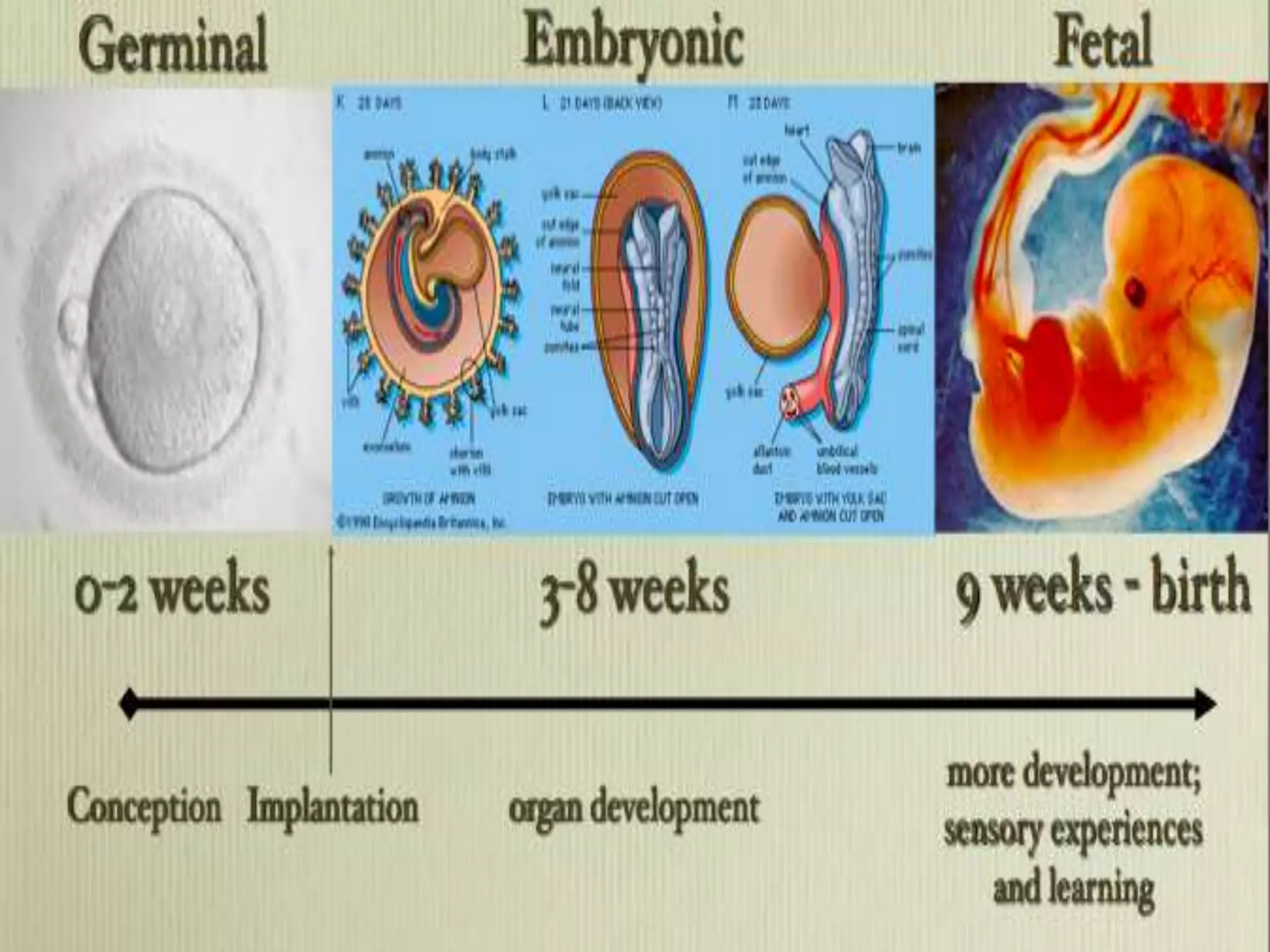
• Divided into 3 stages:
-germinal
-embryonic
-fetal
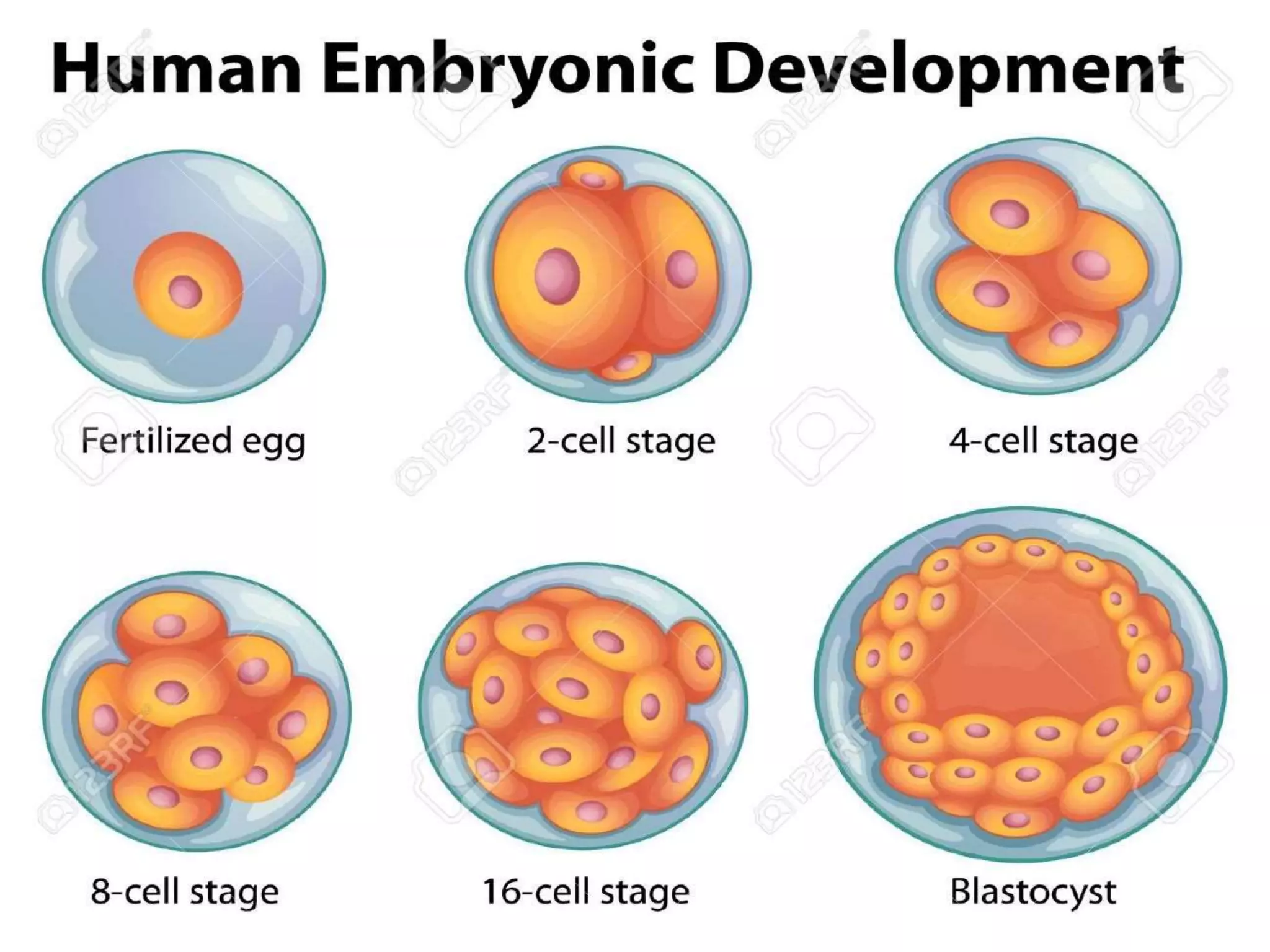
Germinal Stage
• 2 week period after conception
Conception occurs when a sperm cell combines
with an egg cell to form a zygote.
(about 36 hours after conception) zygote begins
to divide quickly. The resulting ball of cells
moves along the mother’s fallopian tube to
the uterus.
(around 7 days after conception) the ball of cells
starts to become embedded in the wall of the
uterus. This process is called implantation and
takes about a week to complete. If
implantation fails, as is quite common, the
pregnancy terminates. One key feature of the
germinal stage is the formation of a tissue
called the placenta.
2 important functions of placenta:
• Passing oxygen and nutrients from the
mother’s blood into the embryo or fetus
• Removing waste materials from the embryo or
fetus
Embryonic Stage
• lasts from the end of the germinal stage to
two months after conception. The developing
ball of cells is now called an embryo. In this
stage, all the major organs form, and the
embryo becomes very fragile. The biggest
dangers are teratogens, which are agents such
as viruses, drugs, or radiation that can cause
deformities in an embryo or fetus. At the end
of the embryonic period, the embryo is only
about an inch long.
Fetal Stage
• lasts from two months after conception until
birth. About one month into this stage, the sex
organs of the fetus begin to form. The fetus
quickly grows as bones and muscles form, and it
begins to move inside the uterus. Organ systems
develop further and start to function. During the
last three months, the brain increases rapidly in
size, an insulating layer of fat forms under the
skin, and the respiratory and digestive systems
start to work independently.
Fetal Viability
• Around twenty-two to twenty-six weeks after
conception, the fetus reaches the age of
viability, after which it has some chance of
surviving out-side the womb if it is born
prematurely. The chances of a premature
baby’s survival increase significantly with each
additional week it remains in the mother’s
uterus.
Adverse factors affecting fetal dev’t
• Poor nutrition
• Use of alcohol
• Smoking
• Use of certain prescription or over-the-counter drugs
• Use of recreational drugs such as cocaine, sedatives,
and narcotics
• X-rays and other kinds of radiation
• Ingested toxins, such as lead
• Illnesses such as AIDS, German measles, syphilis,
cholera, smallpox, mumps, or severe flu
Fetal Alcohol Syndrome
• Mothers who drink heavily during pregnancy
may have babies with fetal alcohol syndrome.
Babies with this syndrome may have problems
such as small head size, heart defects,
irritability, hyperactivity, mental retardation,
or slowed motor development. Fetal alcohol
syndrome is incurable.
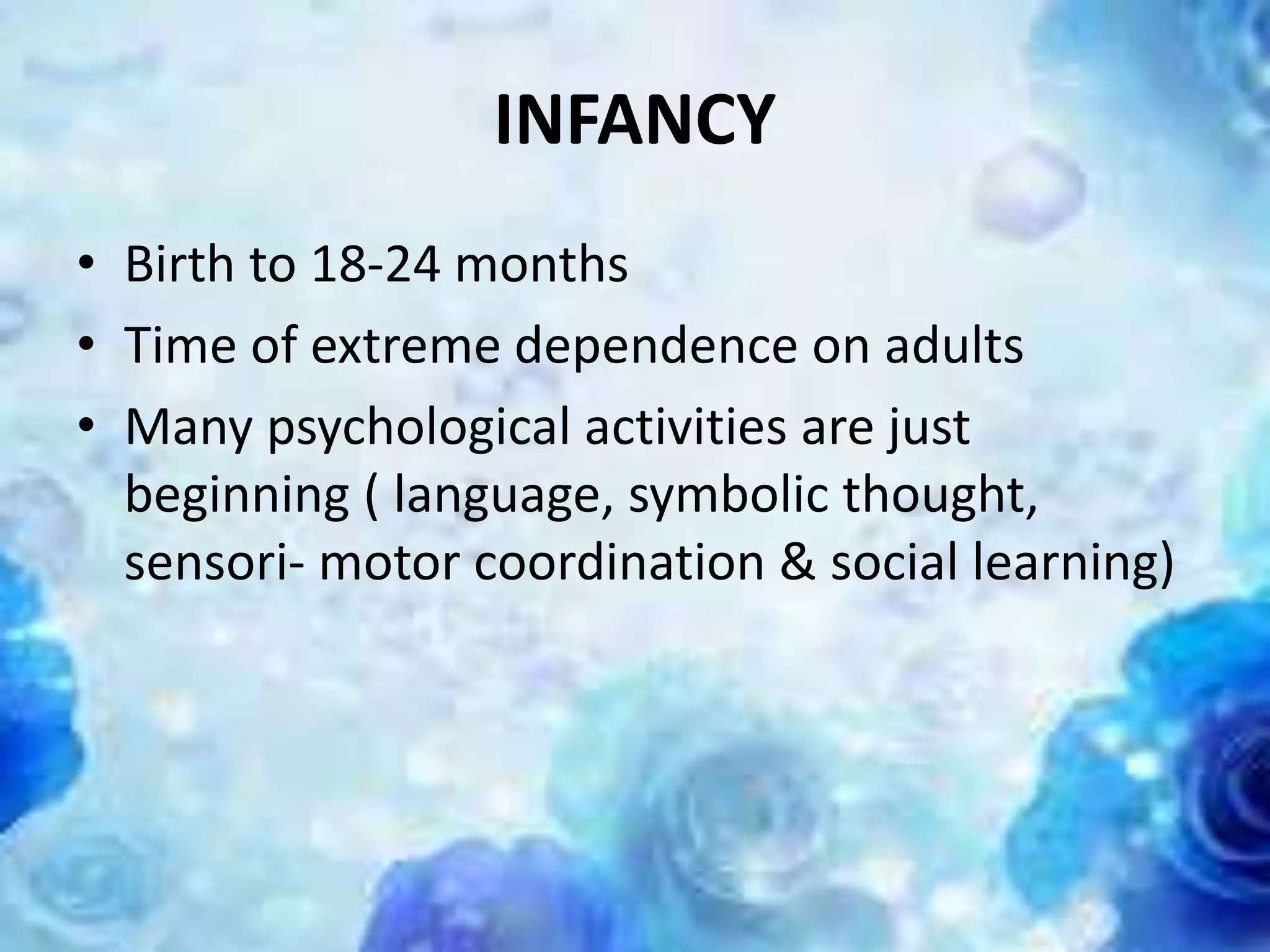
INFANCY
• Birth to 18-24 months
• Time of extreme dependence on adults
• Many psychological activities are just
beginning ( language, symbolic thought,
sensori- motor coordination & social learning)
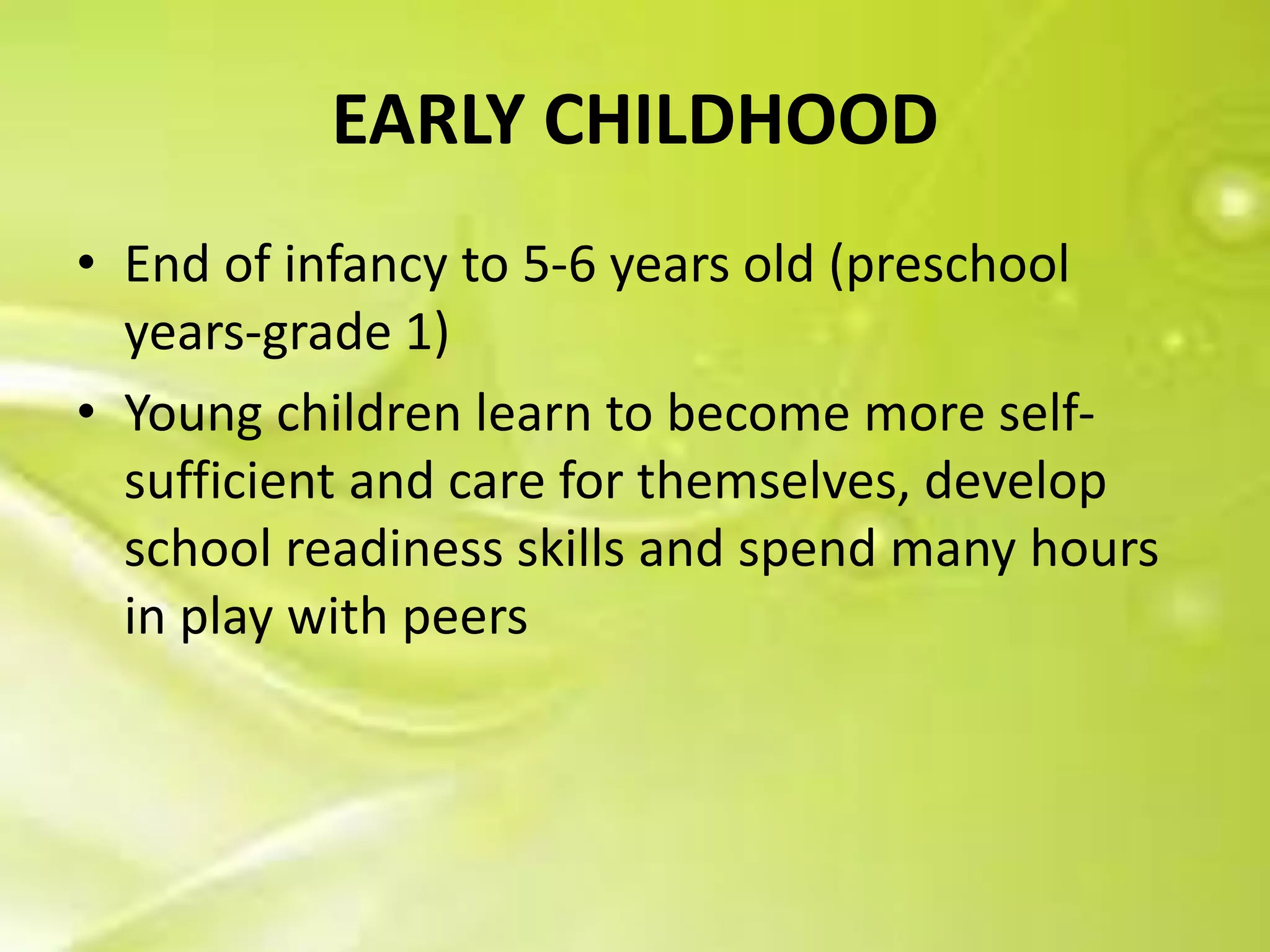
EARLY CHILDHOOD
• End of infancy to 5-6 years old (preschool
years-grade 1)
• Young children learn to become more self-
sufficient and care for themselves, develop
school readiness skills and spend many hours
in play with peers
MIDDLE & LATE CHILDHOOD
• 6-11 years old (elementary school years)
• Fundamental skills of reading, writing, and
arithmetic are mastered
• Child is formally exposed to larger world and
its culture
• Achievement becomes a more central theme
of the child’s world and self-control increases
ADOLESCENCE
• 10-12 years old to 18-22 years old
• Begins with rapid physical changes (dramatic
gains in height in weight, changes in body
contour, and development of sexual
characteristics such as enlargement of breasts,
development of pubic and facial hair, deepening
of voice)
• Pursuit of independence & identity are
prominent
• Thought is more logical, abstract & idealistic
• More time is spent outside family
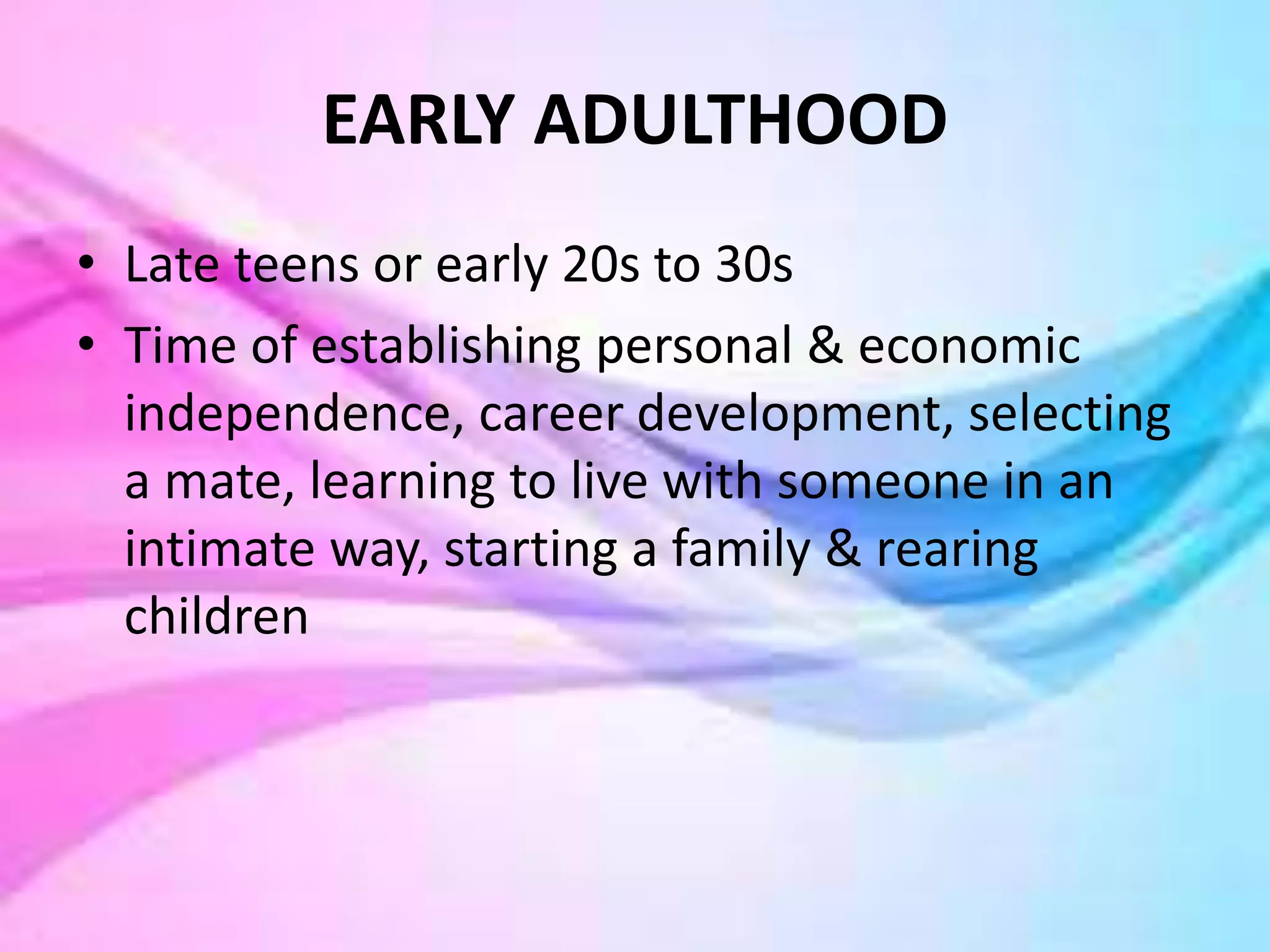
EARLY ADULTHOOD
• Late teens or early 20s to 30s
• Time of establishing personal & economic
independence, career development, selecting
a mate, learning to live with someone in an
intimate way, starting a family & rearing
children
MIDDLE ADULTHOOD
• 40 to 60 years old
• Time of expanding personal & social
involvement & responsibility
• Assisting next generation in becoming
competent & mature individuals, reaching &
maintaining satisfaction in a career
LATE ADULTHOOD
• 60s and above
• Time for adjustment to decreasing strength
and health, life review, retirement and
adjustment to new social roles
HAVIGHURST’S
DEVELOPMENTAL STAGES
(with Developmental Tasks)
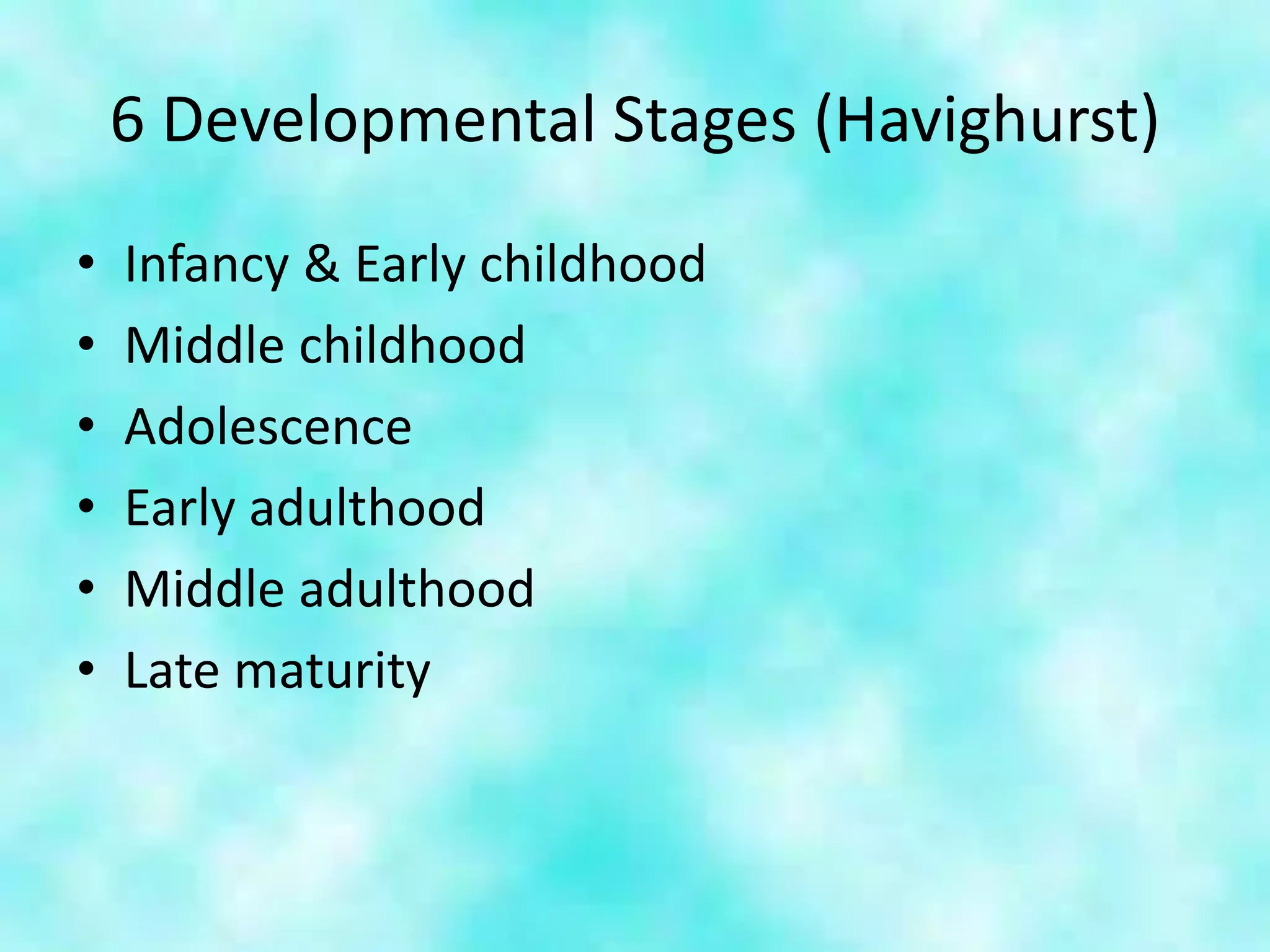
6 Developmental Stages (Havighurst)
• Infancy & Early childhood
• Middle childhood
• Adolescence
• Early adulthood
• Middle adulthood
• Late maturity
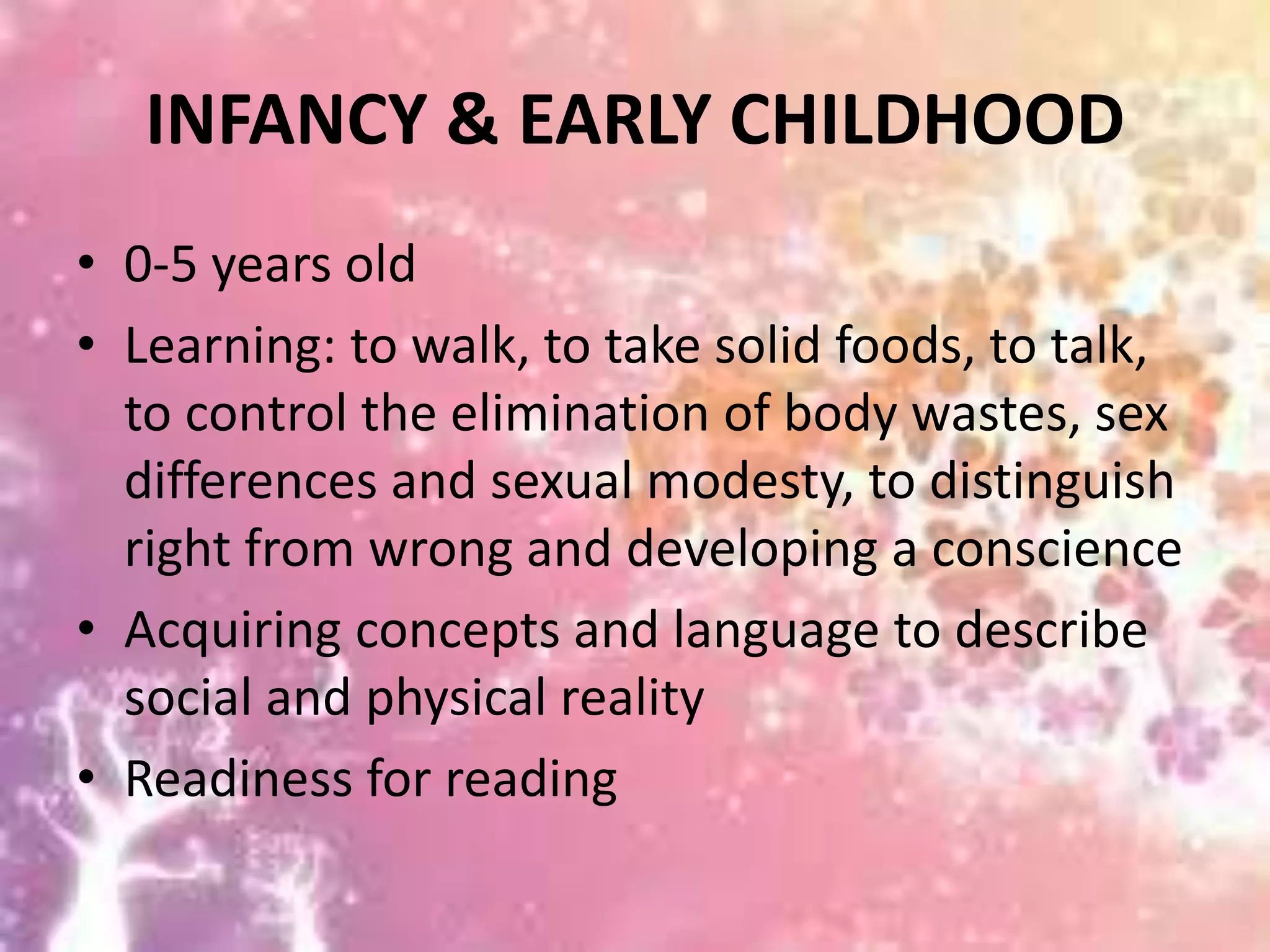
INFANCY & EARLY CHILDHOOD
• 0-5 years old
• Learning: to walk, to take solid foods, to talk,
to control the elimination of body wastes, sex
differences and sexual modesty, to distinguish
right from wrong and developing a conscience
• Acquiring concepts and language to describe
social and physical reality
• Readiness for reading
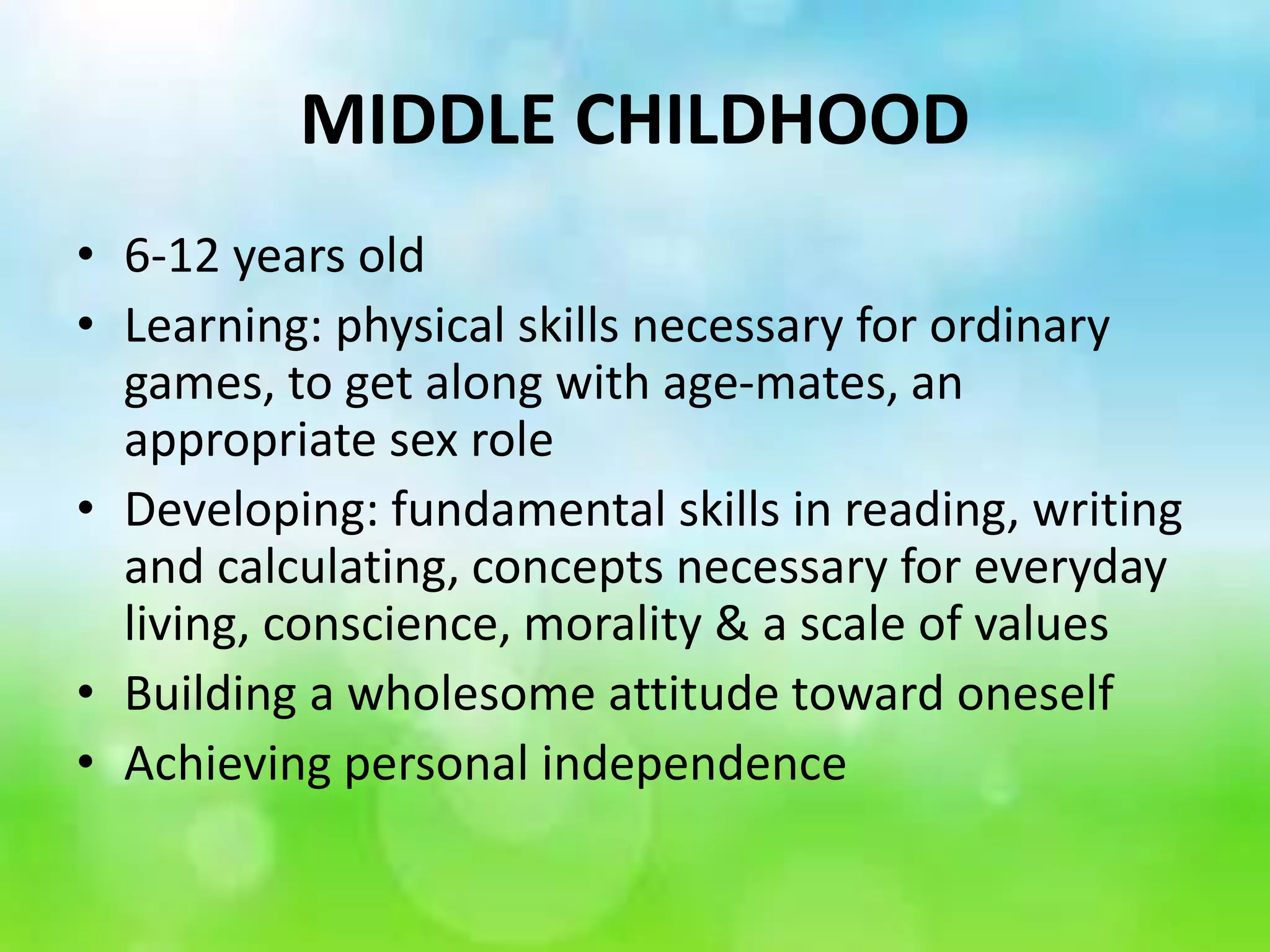
MIDDLE CHILDHOOD
• 6-12 years old
• Learning: physical skills necessary for ordinary
games, to get along with age-mates, an
appropriate sex role
• Developing: fundamental skills in reading, writing
and calculating, concepts necessary for everyday
living, conscience, morality & a scale of values
• Building a wholesome attitude toward oneself
• Achieving personal independence
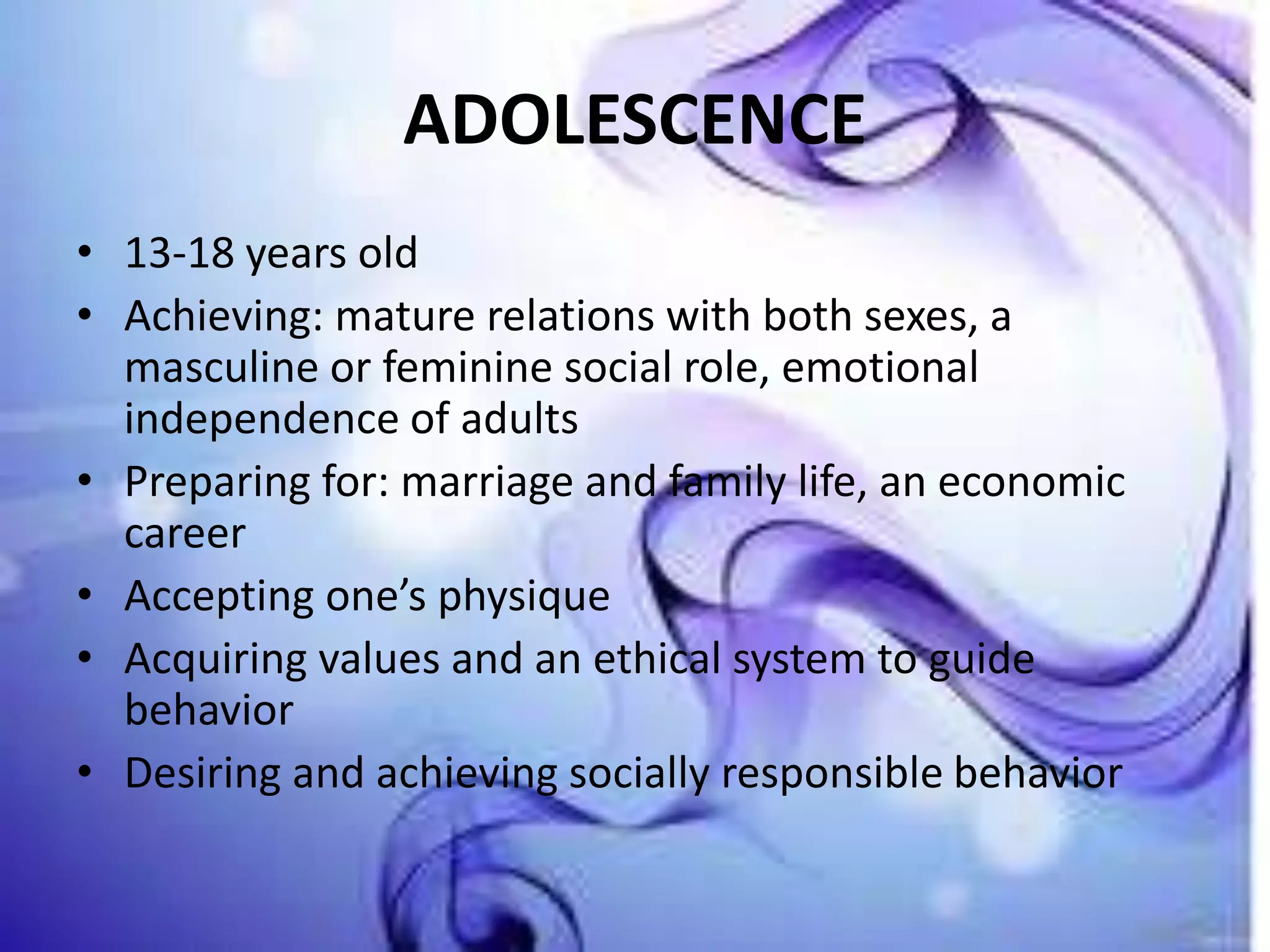
ADOLESCENCE
• 13-18 years old
• Achieving: mature relations with both sexes, a
masculine or feminine social role, emotional
independence of adults
• Preparing for: marriage and family life, an economic
career
• Accepting one’s physique
• Acquiring values and an ethical system to guide
behavior
• Desiring and achieving socially responsible behavior
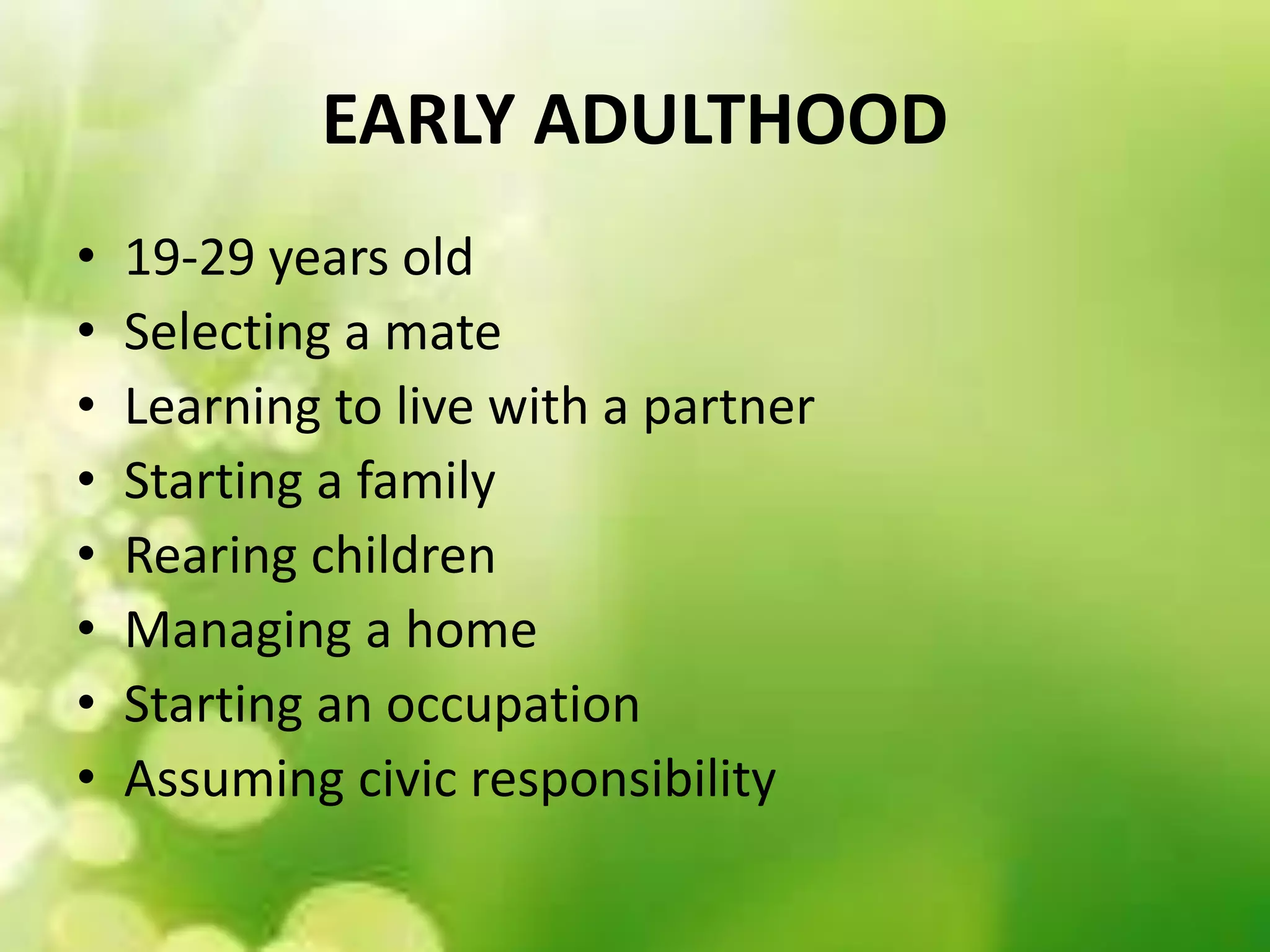
EARLY ADULTHOOD
• 19-29 years old
• Selecting a mate
• Learning to live with a partner
• Starting a family
• Rearing children
• Managing a home
• Starting an occupation
• Assuming civic responsibility
MIDDLE ADULTHOOD
• 30 to 60 years old
• Helping teenage children to become happy and
responsible adults
• Achieving adult social and civic responsibility
• Satisfactory career achievement
• Developing adult leisure time activities
• Relating one’s spouse as a person
• Accepting the physiological changes of middle
age
• Adjusting to aging parents
LATE MATURITY
• 61 and over
• Adjusting to: decreasing strength and health,
retirement and reduced income, death of
spouse
• Establishing: relations with one’s own age
group, satisfactory living quarters
• Meeting social and civic obligations
Santrock and Havighurst's Developmental Stages

Santrock and Havighurst's Developmental Stages

  • 1.
  • 2.
    8 Developmental Stages(Santrock) • Prenatal • Infancy • Early childhood • Middle & late childhood • Adolescence • Early adulthood • Middle adulthood • Late adulthood
  • 3.
    PRENATAL PERIOD • Developmenthappens quickly during this stage (tremendous growth from a single cell to an organism complete with brain and behavioral capabilities) • Time between conception and birth • Divided into 3 stages: -germinal -embryonic -fetal
  • 4.
    Germinal Stage • 2week period after conception Conception occurs when a sperm cell combines with an egg cell to form a zygote. (about 36 hours after conception) zygote begins to divide quickly. The resulting ball of cells moves along the mother’s fallopian tube to the uterus.
  • 5.
    (around 7 daysafter conception) the ball of cells starts to become embedded in the wall of the uterus. This process is called implantation and takes about a week to complete. If implantation fails, as is quite common, the pregnancy terminates. One key feature of the germinal stage is the formation of a tissue called the placenta.
  • 6.
    2 important functionsof placenta: • Passing oxygen and nutrients from the mother’s blood into the embryo or fetus • Removing waste materials from the embryo or fetus
  • 8.
    Embryonic Stage • lastsfrom the end of the germinal stage to two months after conception. The developing ball of cells is now called an embryo. In this stage, all the major organs form, and the embryo becomes very fragile. The biggest dangers are teratogens, which are agents such as viruses, drugs, or radiation that can cause deformities in an embryo or fetus. At the end of the embryonic period, the embryo is only about an inch long.
  • 11.
    Fetal Stage • lastsfrom two months after conception until birth. About one month into this stage, the sex organs of the fetus begin to form. The fetus quickly grows as bones and muscles form, and it begins to move inside the uterus. Organ systems develop further and start to function. During the last three months, the brain increases rapidly in size, an insulating layer of fat forms under the skin, and the respiratory and digestive systems start to work independently.
  • 13.
    Fetal Viability • Aroundtwenty-two to twenty-six weeks after conception, the fetus reaches the age of viability, after which it has some chance of surviving out-side the womb if it is born prematurely. The chances of a premature baby’s survival increase significantly with each additional week it remains in the mother’s uterus.
  • 14.
    Adverse factors affectingfetal dev’t • Poor nutrition • Use of alcohol • Smoking • Use of certain prescription or over-the-counter drugs • Use of recreational drugs such as cocaine, sedatives, and narcotics • X-rays and other kinds of radiation • Ingested toxins, such as lead • Illnesses such as AIDS, German measles, syphilis, cholera, smallpox, mumps, or severe flu
  • 15.
    Fetal Alcohol Syndrome •Mothers who drink heavily during pregnancy may have babies with fetal alcohol syndrome. Babies with this syndrome may have problems such as small head size, heart defects, irritability, hyperactivity, mental retardation, or slowed motor development. Fetal alcohol syndrome is incurable.
  • 17.
    INFANCY • Birth to18-24 months • Time of extreme dependence on adults • Many psychological activities are just beginning ( language, symbolic thought, sensori- motor coordination & social learning)
  • 22.
    EARLY CHILDHOOD • Endof infancy to 5-6 years old (preschool years-grade 1) • Young children learn to become more self- sufficient and care for themselves, develop school readiness skills and spend many hours in play with peers
  • 25.
    MIDDLE & LATECHILDHOOD • 6-11 years old (elementary school years) • Fundamental skills of reading, writing, and arithmetic are mastered • Child is formally exposed to larger world and its culture • Achievement becomes a more central theme of the child’s world and self-control increases
  • 30.
    ADOLESCENCE • 10-12 yearsold to 18-22 years old • Begins with rapid physical changes (dramatic gains in height in weight, changes in body contour, and development of sexual characteristics such as enlargement of breasts, development of pubic and facial hair, deepening of voice) • Pursuit of independence & identity are prominent • Thought is more logical, abstract & idealistic • More time is spent outside family
  • 33.
    EARLY ADULTHOOD • Lateteens or early 20s to 30s • Time of establishing personal & economic independence, career development, selecting a mate, learning to live with someone in an intimate way, starting a family & rearing children
  • 38.
    MIDDLE ADULTHOOD • 40to 60 years old • Time of expanding personal & social involvement & responsibility • Assisting next generation in becoming competent & mature individuals, reaching & maintaining satisfaction in a career
  • 41.
    LATE ADULTHOOD • 60sand above • Time for adjustment to decreasing strength and health, life review, retirement and adjustment to new social roles
  • 45.
  • 46.
    6 Developmental Stages(Havighurst) • Infancy & Early childhood • Middle childhood • Adolescence • Early adulthood • Middle adulthood • Late maturity
  • 47.
    INFANCY & EARLYCHILDHOOD • 0-5 years old • Learning: to walk, to take solid foods, to talk, to control the elimination of body wastes, sex differences and sexual modesty, to distinguish right from wrong and developing a conscience • Acquiring concepts and language to describe social and physical reality • Readiness for reading
  • 49.
    MIDDLE CHILDHOOD • 6-12years old • Learning: physical skills necessary for ordinary games, to get along with age-mates, an appropriate sex role • Developing: fundamental skills in reading, writing and calculating, concepts necessary for everyday living, conscience, morality & a scale of values • Building a wholesome attitude toward oneself • Achieving personal independence
  • 54.
    ADOLESCENCE • 13-18 yearsold • Achieving: mature relations with both sexes, a masculine or feminine social role, emotional independence of adults • Preparing for: marriage and family life, an economic career • Accepting one’s physique • Acquiring values and an ethical system to guide behavior • Desiring and achieving socially responsible behavior
  • 60.
    EARLY ADULTHOOD • 19-29years old • Selecting a mate • Learning to live with a partner • Starting a family • Rearing children • Managing a home • Starting an occupation • Assuming civic responsibility
  • 65.
    MIDDLE ADULTHOOD • 30to 60 years old • Helping teenage children to become happy and responsible adults • Achieving adult social and civic responsibility • Satisfactory career achievement • Developing adult leisure time activities • Relating one’s spouse as a person • Accepting the physiological changes of middle age • Adjusting to aging parents
  • 67.
    LATE MATURITY • 61and over • Adjusting to: decreasing strength and health, retirement and reduced income, death of spouse • Establishing: relations with one’s own age group, satisfactory living quarters • Meeting social and civic obligations