SACRED TEXTS


                     Year 11 SOR
                        Term 3


    Ryan,M & Goldberg P. (2001). "Recognising Religion". Social Science Press:katoomba
What are Sacred Texts?

 All religious traditions have certain
 texts that are considered sacred.
 Believers attach significance to texts
 Texts may offer insight into life
 Guidance for living
 Express a relationship between a
 people and their God or gods.

          Ryan,M & Goldberg P. (2001). "Recognising Religion". Social Science Press:katoomba
What is sacred?
 It may manifest itself so that the
 believer responds
 A person who is invested with
 authority may impart the sacred. He
 or she sets aside an object, person or
 place as sacred
 Sacred can be derived from
 association with something already
 sacred
          Ryan,M & Goldberg P. (2001). "Recognising Religion". Social Science Press:katoomba
Which of these examples link to
which of the previous statements?
  A chalice used for the Eucharist
  Moses encounter with the burning bush
  An indigenous person painting on a rock
  wall
_____________________________
 The sacred is usually believed to be
  connected with powers of the “other” world
  and this power may break into our world or
  be mediated by others. It is mysterious,
  suggesting a deeper reality.
            Ryan,M & Goldberg P. (2001). "Recognising Religion". Social Science Press:katoomba
How are sacred texts kept?
 In memory
 Enacted in art, dance, song, sculpture or
 totems (religious objects are texts)
 Oral recitations
 Written history, letters and stories
 Qur’an and Vedas are passed orally.
 Qur’an means “recitation
 They are divinely inspired eg. Buddhist
 texts are enshrined in the speeches of the
 Buddha
           Ryan,M & Goldberg P. (2001). "Recognising Religion". Social Science Press:katoomba
Analysing written texts (Habel
(1996)
Most written sacred texts can be analysed
 using the following headings
 Time – “in the beginning” or it may be timeless
 World – Historical, heavenly or fantasy
 Performers – people involved (gods, animals, people,
  ancestors)
  Actions – plot and significance- told by reenacting
  Context and Intention – place and time help
  create significance

               Ryan,M & Goldberg P. (2001). "Recognising Religion". Social Science Press:katoomba
Authority of sacred texts
 Most Christians consider the Bible to be
 the word of God but accept that there is
 authorship of human writers who set the
 words on the page.
 A minority of Christians take the Bible
 literally as the Word of God as though it
 came directly from the hand of God.
 Inspiration is the influence of the Divine on
 texts therefore these texts have authority.

            Ryan,M & Goldberg P. (2001). "Recognising Religion". Social Science Press:katoomba
Inerrancy
 Inerrancy is the belief that Sacred Scripture
 is immune from fundamental error about
 God ( in the case of Christians) and things
 of God.
 For Protestants the inerrancy of the
 scripture is one of their most basic beliefs.
 The role of the human authors is
 completely overshadowed by the idea of
 divine power.

           Ryan,M & Goldberg P. (2001). "Recognising Religion". Social Science Press:katoomba
Inerrancy continued…Most scholars
agree on the following principles-
 The words of the Bible are only true in the sense
 that the human writers conveyed them. What
 influenced the writers?
 “Human authors are not without error”. Their
 personal opinions may be wrong but these do not
 affect the message of scripture itself.
 Inerrancy should take into account literary forms
 such as poetry, folklore, legend and song
 Human authors wrote from a different mindset
 than Western Scholasticism
 This principle applies to essential proclamations
 regarding salvation.
             Ryan,M & Goldberg P. (2001). "Recognising Religion". Social Science Press:katoomba
The Canon
 The biblical canon (official list of
 sacred texts) was selected by men
 who selected writings that they found
 valuable for male experience and
 interests.
 Some feminist scholars suggested
 that this needs to be expanded to
 include more writings about women
 eg. Mary Magdalene and Thecla.
          Ryan,M & Goldberg P. (2001). "Recognising Religion". Social Science Press:katoomba
Revelation
 “God’s unveiling or self-disclosure to
 people through creation, sacred writings,
 people and for Christians, the person of
 Jesus
 Human expression can be limited in its
 expression and prone to bias.
 Feminist scholars question whether the
 entire Bible can be considered revelatory
 because of patriarchal bias
 They argue that a new discussion needs to
 take place about which texts should be
 included. Some non-biblical texts might be
 worthy.
           Ryan,M & Goldberg P. (2001). "Recognising Religion". Social Science Press:katoomba
Judges 19:22-30 – Rape and murder of
concubines
Sexist images of the comparison of Israel to
an unfaithful prostitute in Hosea
   Many people are now asking- “How
   can a text that contains so much that
   is damaging to women and some
   men function authoritatively in the
   Christian community as what is
   normal in one’s faith and life?”

              Ryan,M & Goldberg P. (2001). "Recognising Religion". Social Science Press:katoomba
THINKING FOR YOURSELF

 Discuss in pairs this statement from
 your experience/reading so far…


          Ryan,M & Goldberg P. (2001). "Recognising Religion". Social Science Press:katoomba
How are texts considered sacred?

 There must be a community of
 believers who accept the text as
 sacred.
 Some groups read their texts aloud
 Other read them for instruction
 Others use them as a basis for
 meditation and devotional reflection.
 They are foundational to religious
 ethics ritual and practices
          Ryan,M & Goldberg P. (2001). "Recognising Religion". Social Science Press:katoomba
Moral codes, practices and laws
 Some sacred texts are only passed
 on or allowed to be read after
 reaching a certain age or passed
 certain tests. (eg. Aboriginal people’s
 artwork)
 Texts such as the Ten
 Commandments, the Code of
 Hammurabi set out moral codes and
 ways of living one’s life.
          Ryan,M & Goldberg P. (2001). "Recognising Religion". Social Science Press:katoomba
GENRES OF TEXTS
Legends- confirm the life of authority figures of religions,
traditions and a way of life
Myth – powerful sacred stories which provide believers
with a sense that religion and religious belief is meaningful.
Help us explore the human condition
Psalms – songs, laments for community worship
Proverbs – a pithy statement expressing some
truth in a striking but memorable way
Prophecy- not a prediction of the future but a meditation
or interpretation of the will of the Divine
Gospel – good news - various literary styles
(narratives, miracles, parables)
                Ryan,M & Goldberg P. (2001). "Recognising Religion". Social Science Press:katoomba
Techniques of Interpretation
 All interpretations of scripture are made
 through a cultural and historical lens:
 Australian, Asian, American, black, white,
 male, female.
 People’s experience links biblical times to
 their lives. Eg. The Exodus story became a
 metaphor for American slaves as they
 struggled to free themselves…Promised
 Land image

           Ryan,M & Goldberg P. (2001). "Recognising Religion". Social Science Press:katoomba
Techniques of Interpretation cont’d

 Scriptures indicate the values of the time –
 social patterns and cultural influences of a
 semi- nomadic people, settled peasants
 and city dwellers
 Different political views
 Eg. Early Hebrews had slaves and
 concubines. These values are not ones
 considered “Christian” today. Therefore we
 should take into account the values and
 aspirations of that time and this present
 time,
           Ryan,M & Goldberg P. (2001). "Recognising Religion". Social Science Press:katoomba
Technique 1– HERMENEUTICS
 Hermeneutics – understanding religious texts within
 their own historical, cultural and social milieu to define
 meaning.
 Impossible today as we cannot replicate these
 cosmologies in which the texts were produced.
 In late 1700s this was re-evaluated as the art of
 understanding the sense of the text, allowing the text to
 speak for itself.
 The Hermeneutic tradition attempts to confront the complex
 issues of interpretation and the role the “reader” and
 interpretative community play in deriving meaning from the
 text.

                Ryan,M & Goldberg P. (2001). "Recognising Religion". Social Science Press:katoomba
Source criticism
 Since the 19th Century biblical
 scholars have asked,” What did the
 text mean?”
 This source criticism is a method that
 seeks to determine the sources of
 sacred texts and to explain the literary
 relationship between them.
 Which gospel was written first?
 Which gospel was the historical
 source for others?

           Ryan,M & Goldberg P. (2001). "Recognising Religion". Social Science Press:katoomba
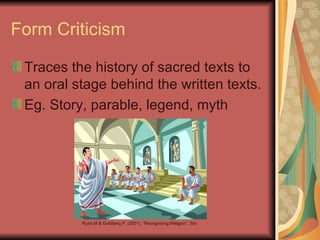
Form Criticism

 Traces the history of sacred texts to
 an oral stage behind the written texts.
 Eg. Story, parable, legend, myth


          Ryan,M & Goldberg P. (2001). "Recognising Religion". Social Science Press:katoomba
Redaction Criticism

 Seeks to separate tradition, materials
 the writer inherited from the
 “redaction” – how the sender, editor ir
 author shaped the message.
 What is the intent of the author?
 Shaping message according to the
 individual and community concerns


          Ryan,M & Goldberg P. (2001). "Recognising Religion". Social Science Press:katoomba
Social criticism
    Draws on all the information we have from
    the ancient world such as:
-literature
-archaeological excavations
-art
-coins
-inscriptions
in order to understand the daily culture and
    customs of people at the time of the
    writings.
            Ryan,M & Goldberg P. (2001). "Recognising Religion". Social Science Press:katoomba
Reader response criticism
Focuses on the reader or receiver of
the text.
Whatever the meaning is and wherever
it is found the reader is ultimately
responsible for determining the
meaning.
Meaning is not considered a given.
Who determines the meaning? – this is
often questioned by critics of this
method.
         Ryan,M & Goldberg P. (2001). "Recognising Religion". Social Science Press:katoomba
Deconstructive criticism (Jacques
Derrida)
 Readers read with an eye and ear for
 the excluded, the marginalised, the
 gaps and silences.
 They highlight seemingly unimportant
 details in a text that traditional
 readings have ignored or failed to
 notice but yield important insights.


         Ryan,M & Goldberg P. (2001). "Recognising Religion". Social Science Press:katoomba
Feminist interpretation
 Each feminist critic is shaped by their
 unique class, education, race, religion and
 personal experience.
 All are aware, however, that scholarship is
 always “interested” and never neutral.
 Gender shapes the reading of texts just as
 it has shaped the texts themselves.
 How does the social construction of gender
 shape and has shaped lives past and
 present.
 What cultures produced sacred texts?

           Ryan,M & Goldberg P. (2001). "Recognising Religion". Social Science Press:katoomba
Feminist interpretation cont’d
 The Christian Bible for example is an
 androcentric (male centred) text that rose
 out of a patriarchal culture.
 There are women in the bible but their
 voice has been limited in places and
 references to them are often suppressed or
 omitted from some teaching and
 discussion.
 Biblical references to God are as lord,
 master, king, leader of armies.

           Ryan,M & Goldberg P. (2001). "Recognising Religion". Social Science Press:katoomba
Conclusion
 Texts are read by people of their time.
 Even the notion of what is a text requires
 some clarification and refinement
 In the Western world many people want to
 question what they read, argue about
 meanings and come to some personal
 understanding of the text in the light of their
 own personal situation.


            Ryan,M & Goldberg P. (2001). "Recognising Religion". Social Science Press:katoomba

Sacred Texts

  • 1.
    SACRED TEXTS Year 11 SOR Term 3 Ryan,M & Goldberg P. (2001). "Recognising Religion". Social Science Press:katoomba
  • 2.
    What are SacredTexts? All religious traditions have certain texts that are considered sacred. Believers attach significance to texts Texts may offer insight into life Guidance for living Express a relationship between a people and their God or gods. Ryan,M & Goldberg P. (2001). "Recognising Religion". Social Science Press:katoomba
  • 3.
    What is sacred? It may manifest itself so that the believer responds A person who is invested with authority may impart the sacred. He or she sets aside an object, person or place as sacred Sacred can be derived from association with something already sacred Ryan,M & Goldberg P. (2001). "Recognising Religion". Social Science Press:katoomba
  • 4.
    Which of theseexamples link to which of the previous statements? A chalice used for the Eucharist Moses encounter with the burning bush An indigenous person painting on a rock wall _____________________________ The sacred is usually believed to be connected with powers of the “other” world and this power may break into our world or be mediated by others. It is mysterious, suggesting a deeper reality. Ryan,M & Goldberg P. (2001). "Recognising Religion". Social Science Press:katoomba
  • 5.
    How are sacredtexts kept? In memory Enacted in art, dance, song, sculpture or totems (religious objects are texts) Oral recitations Written history, letters and stories Qur’an and Vedas are passed orally. Qur’an means “recitation They are divinely inspired eg. Buddhist texts are enshrined in the speeches of the Buddha Ryan,M & Goldberg P. (2001). "Recognising Religion". Social Science Press:katoomba
  • 6.
    Analysing written texts(Habel (1996) Most written sacred texts can be analysed using the following headings Time – “in the beginning” or it may be timeless World – Historical, heavenly or fantasy Performers – people involved (gods, animals, people, ancestors) Actions – plot and significance- told by reenacting Context and Intention – place and time help create significance Ryan,M & Goldberg P. (2001). "Recognising Religion". Social Science Press:katoomba
  • 7.
    Authority of sacredtexts Most Christians consider the Bible to be the word of God but accept that there is authorship of human writers who set the words on the page. A minority of Christians take the Bible literally as the Word of God as though it came directly from the hand of God. Inspiration is the influence of the Divine on texts therefore these texts have authority. Ryan,M & Goldberg P. (2001). "Recognising Religion". Social Science Press:katoomba
  • 8.
    Inerrancy Inerrancy isthe belief that Sacred Scripture is immune from fundamental error about God ( in the case of Christians) and things of God. For Protestants the inerrancy of the scripture is one of their most basic beliefs. The role of the human authors is completely overshadowed by the idea of divine power. Ryan,M & Goldberg P. (2001). "Recognising Religion". Social Science Press:katoomba
  • 9.
    Inerrancy continued…Most scholars agreeon the following principles- The words of the Bible are only true in the sense that the human writers conveyed them. What influenced the writers? “Human authors are not without error”. Their personal opinions may be wrong but these do not affect the message of scripture itself. Inerrancy should take into account literary forms such as poetry, folklore, legend and song Human authors wrote from a different mindset than Western Scholasticism This principle applies to essential proclamations regarding salvation. Ryan,M & Goldberg P. (2001). "Recognising Religion". Social Science Press:katoomba
  • 10.
    The Canon Thebiblical canon (official list of sacred texts) was selected by men who selected writings that they found valuable for male experience and interests. Some feminist scholars suggested that this needs to be expanded to include more writings about women eg. Mary Magdalene and Thecla. Ryan,M & Goldberg P. (2001). "Recognising Religion". Social Science Press:katoomba
  • 11.
    Revelation “God’s unveilingor self-disclosure to people through creation, sacred writings, people and for Christians, the person of Jesus Human expression can be limited in its expression and prone to bias. Feminist scholars question whether the entire Bible can be considered revelatory because of patriarchal bias They argue that a new discussion needs to take place about which texts should be included. Some non-biblical texts might be worthy. Ryan,M & Goldberg P. (2001). "Recognising Religion". Social Science Press:katoomba
  • 12.
    Judges 19:22-30 –Rape and murder of concubines Sexist images of the comparison of Israel to an unfaithful prostitute in Hosea Many people are now asking- “How can a text that contains so much that is damaging to women and some men function authoritatively in the Christian community as what is normal in one’s faith and life?” Ryan,M & Goldberg P. (2001). "Recognising Religion". Social Science Press:katoomba
  • 13.
    THINKING FOR YOURSELF Discuss in pairs this statement from your experience/reading so far… Ryan,M & Goldberg P. (2001). "Recognising Religion". Social Science Press:katoomba
  • 14.
    How are textsconsidered sacred? There must be a community of believers who accept the text as sacred. Some groups read their texts aloud Other read them for instruction Others use them as a basis for meditation and devotional reflection. They are foundational to religious ethics ritual and practices Ryan,M & Goldberg P. (2001). "Recognising Religion". Social Science Press:katoomba
  • 15.
    Moral codes, practicesand laws Some sacred texts are only passed on or allowed to be read after reaching a certain age or passed certain tests. (eg. Aboriginal people’s artwork) Texts such as the Ten Commandments, the Code of Hammurabi set out moral codes and ways of living one’s life. Ryan,M & Goldberg P. (2001). "Recognising Religion". Social Science Press:katoomba
  • 16.
    GENRES OF TEXTS Legends-confirm the life of authority figures of religions, traditions and a way of life Myth – powerful sacred stories which provide believers with a sense that religion and religious belief is meaningful. Help us explore the human condition Psalms – songs, laments for community worship Proverbs – a pithy statement expressing some truth in a striking but memorable way Prophecy- not a prediction of the future but a meditation or interpretation of the will of the Divine Gospel – good news - various literary styles (narratives, miracles, parables) Ryan,M & Goldberg P. (2001). "Recognising Religion". Social Science Press:katoomba
  • 17.
    Techniques of Interpretation All interpretations of scripture are made through a cultural and historical lens: Australian, Asian, American, black, white, male, female. People’s experience links biblical times to their lives. Eg. The Exodus story became a metaphor for American slaves as they struggled to free themselves…Promised Land image Ryan,M & Goldberg P. (2001). "Recognising Religion". Social Science Press:katoomba
  • 18.
    Techniques of Interpretationcont’d Scriptures indicate the values of the time – social patterns and cultural influences of a semi- nomadic people, settled peasants and city dwellers Different political views Eg. Early Hebrews had slaves and concubines. These values are not ones considered “Christian” today. Therefore we should take into account the values and aspirations of that time and this present time, Ryan,M & Goldberg P. (2001). "Recognising Religion". Social Science Press:katoomba
  • 19.
    Technique 1– HERMENEUTICS Hermeneutics – understanding religious texts within their own historical, cultural and social milieu to define meaning. Impossible today as we cannot replicate these cosmologies in which the texts were produced. In late 1700s this was re-evaluated as the art of understanding the sense of the text, allowing the text to speak for itself. The Hermeneutic tradition attempts to confront the complex issues of interpretation and the role the “reader” and interpretative community play in deriving meaning from the text. Ryan,M & Goldberg P. (2001). "Recognising Religion". Social Science Press:katoomba
  • 20.
    Source criticism Sincethe 19th Century biblical scholars have asked,” What did the text mean?” This source criticism is a method that seeks to determine the sources of sacred texts and to explain the literary relationship between them. Which gospel was written first? Which gospel was the historical source for others? Ryan,M & Goldberg P. (2001). "Recognising Religion". Social Science Press:katoomba
  • 21.
    Form Criticism Tracesthe history of sacred texts to an oral stage behind the written texts. Eg. Story, parable, legend, myth Ryan,M & Goldberg P. (2001). "Recognising Religion". Social Science Press:katoomba
  • 22.
    Redaction Criticism Seeksto separate tradition, materials the writer inherited from the “redaction” – how the sender, editor ir author shaped the message. What is the intent of the author? Shaping message according to the individual and community concerns Ryan,M & Goldberg P. (2001). "Recognising Religion". Social Science Press:katoomba
  • 23.
    Social criticism Draws on all the information we have from the ancient world such as: -literature -archaeological excavations -art -coins -inscriptions in order to understand the daily culture and customs of people at the time of the writings. Ryan,M & Goldberg P. (2001). "Recognising Religion". Social Science Press:katoomba
  • 24.
    Reader response criticism Focuseson the reader or receiver of the text. Whatever the meaning is and wherever it is found the reader is ultimately responsible for determining the meaning. Meaning is not considered a given. Who determines the meaning? – this is often questioned by critics of this method. Ryan,M & Goldberg P. (2001). "Recognising Religion". Social Science Press:katoomba
  • 25.
    Deconstructive criticism (Jacques Derrida) Readers read with an eye and ear for the excluded, the marginalised, the gaps and silences. They highlight seemingly unimportant details in a text that traditional readings have ignored or failed to notice but yield important insights. Ryan,M & Goldberg P. (2001). "Recognising Religion". Social Science Press:katoomba
  • 26.
    Feminist interpretation Eachfeminist critic is shaped by their unique class, education, race, religion and personal experience. All are aware, however, that scholarship is always “interested” and never neutral. Gender shapes the reading of texts just as it has shaped the texts themselves. How does the social construction of gender shape and has shaped lives past and present. What cultures produced sacred texts? Ryan,M & Goldberg P. (2001). "Recognising Religion". Social Science Press:katoomba
  • 27.
    Feminist interpretation cont’d The Christian Bible for example is an androcentric (male centred) text that rose out of a patriarchal culture. There are women in the bible but their voice has been limited in places and references to them are often suppressed or omitted from some teaching and discussion. Biblical references to God are as lord, master, king, leader of armies. Ryan,M & Goldberg P. (2001). "Recognising Religion". Social Science Press:katoomba
  • 28.
    Conclusion Texts areread by people of their time. Even the notion of what is a text requires some clarification and refinement In the Western world many people want to question what they read, argue about meanings and come to some personal understanding of the text in the light of their own personal situation. Ryan,M & Goldberg P. (2001). "Recognising Religion". Social Science Press:katoomba