Historical
Foundations of
Education
CHERIE ANN P. BAUTISTA
MAEd
Foundations
of Education
Ancient
The belief and experiences of education rest
on the history of the field of endeavor. By knowing
what accomplishments of leaders in the past, today’s
educators attempt to build on their achievements.
Ancient
A.1 – Education During the Ancient Period
• Also known as PRIMITIVE EDUCATION
• Life was very simple and their means of livelihood were
hunting & gathering wild fruits and vegetables.
• Organization was tribal and usually headed by the oldest or
wisest among members - There was no reading or writing.
• Information was transmitted through word of mouth, songs,
gestures, ceremonial rites and the like.
Ancient
A.1 – Education During the Ancient Period
• Education was acquired during primitive by
‘enculturation’
is the process of learning the culture and
acquiring the values and knowledge of a society.
• Aims to help a primitive person in learning his culture,
developing his behavior in the ways of adulthood and
guiding him toward eventual role in the society.
Ancient
Purpose of primitive education
• Is to shape children to becoming good members of the tribe.
• Training for citizenship is essential to primitive people because
they are primary concerned with the growth of individuals as tribe
members.
Ancient
2 Types Of Primitive Education
1. PRACTICAL – included the simple forms of domestic,
vocational, physical, moral and military training.
2. THEORETICAL – covered the religious, musical and
literary.
Oriental
A.2 ORIENTAL EDUCATION
• Oriental System of learning is the traditional method of
learning practiced in India during British times. In this
method of learning, knowledge was imparted orally.
• There were no textbooks and proper curriculum. Students
were taught at the house of the teacher.
Sumerian Civilization – is the Oldest Recorded
Civilization Known To Man.
- Existed in the present day area of Iraq starting from
4500 B.C.
- They invented the CUNEIFORM WRITING which
later became the modern day Alphabet System.
- They were the first to advocate Individual Freedom
and that’s why they started the first codification of
laws to set the limits of the state.
SUMERIAN
SUMERIAN EDUCATION
• The Sumerians were the first to develop the school system known to
man.
• Schools were called
• Edubba ( Tablet House ) as the teaching & writing were on tablets (
dried clay)
SUMERIAN
SUMERIAN EDUCATION
• The students were called “School- Sons”
• Sumerian school system had concept
of Alumni / Alumnus system. They were
called as “ school- sons of the days past”
SUMMERIAN
SUMERIAN EDUCATION
• The Sumerian schooling system had basically two streams - Science
and Arts stream
• The Sumerians were very clear in their
approach to education system. The Sumerians
describe their schools and the purpose of
schooling & education system in the following
beautiful verse which is now immortal.
SUMERIAN
Motto of Sumerian Schooling
and Education System
“He whose eyes are not open enters it,
He whose eyes are wide open comes out of it”
EGYPTIAN
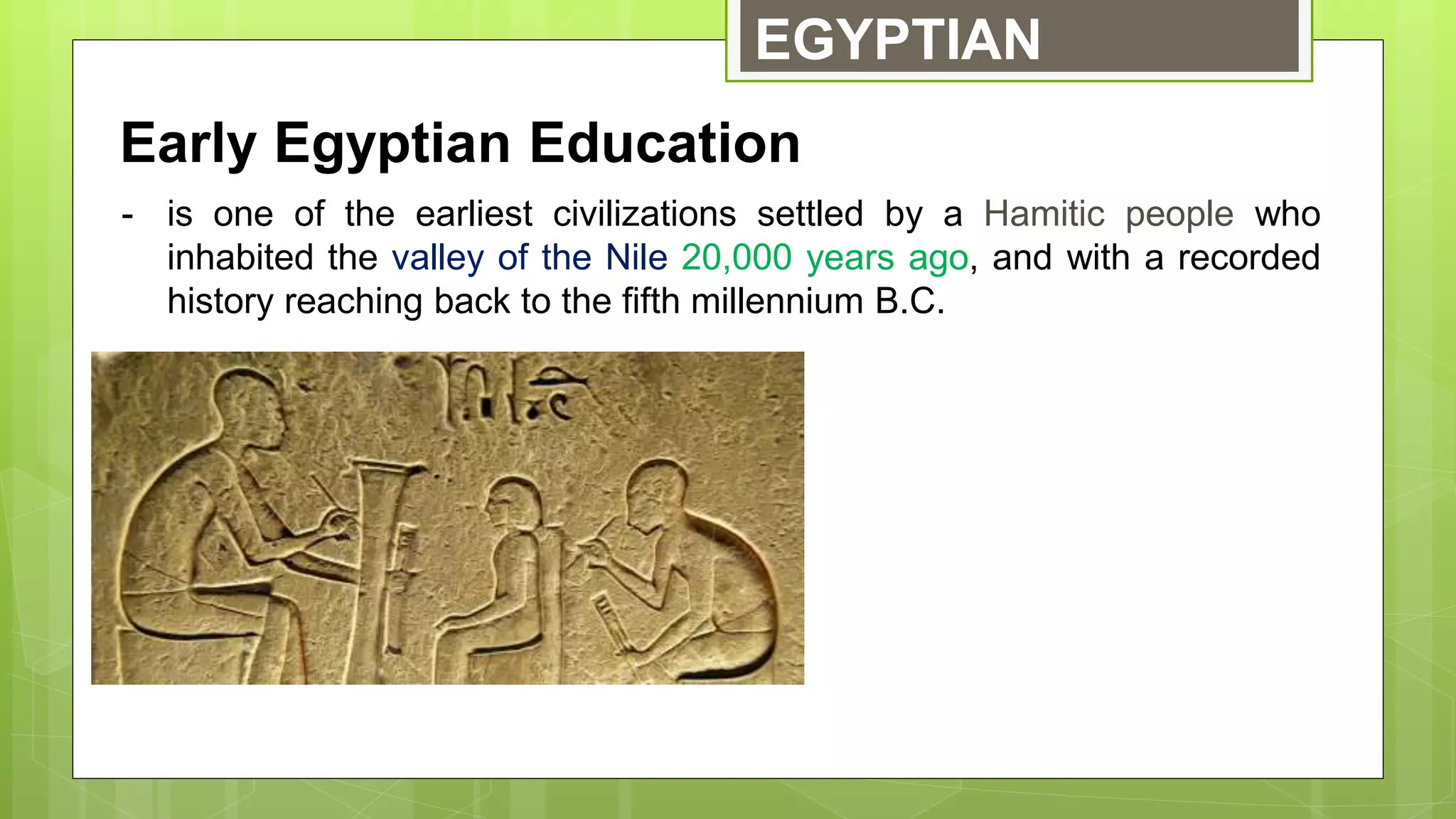
Early Egyptian Education
- is one of the earliest civilizations settled by a Hamitic people who
inhabited the valley of the Nile 20,000 years ago, and with a recorded
history reaching back to the fifth millennium B.C.
EGYPTIAN
Early Egyptian Education
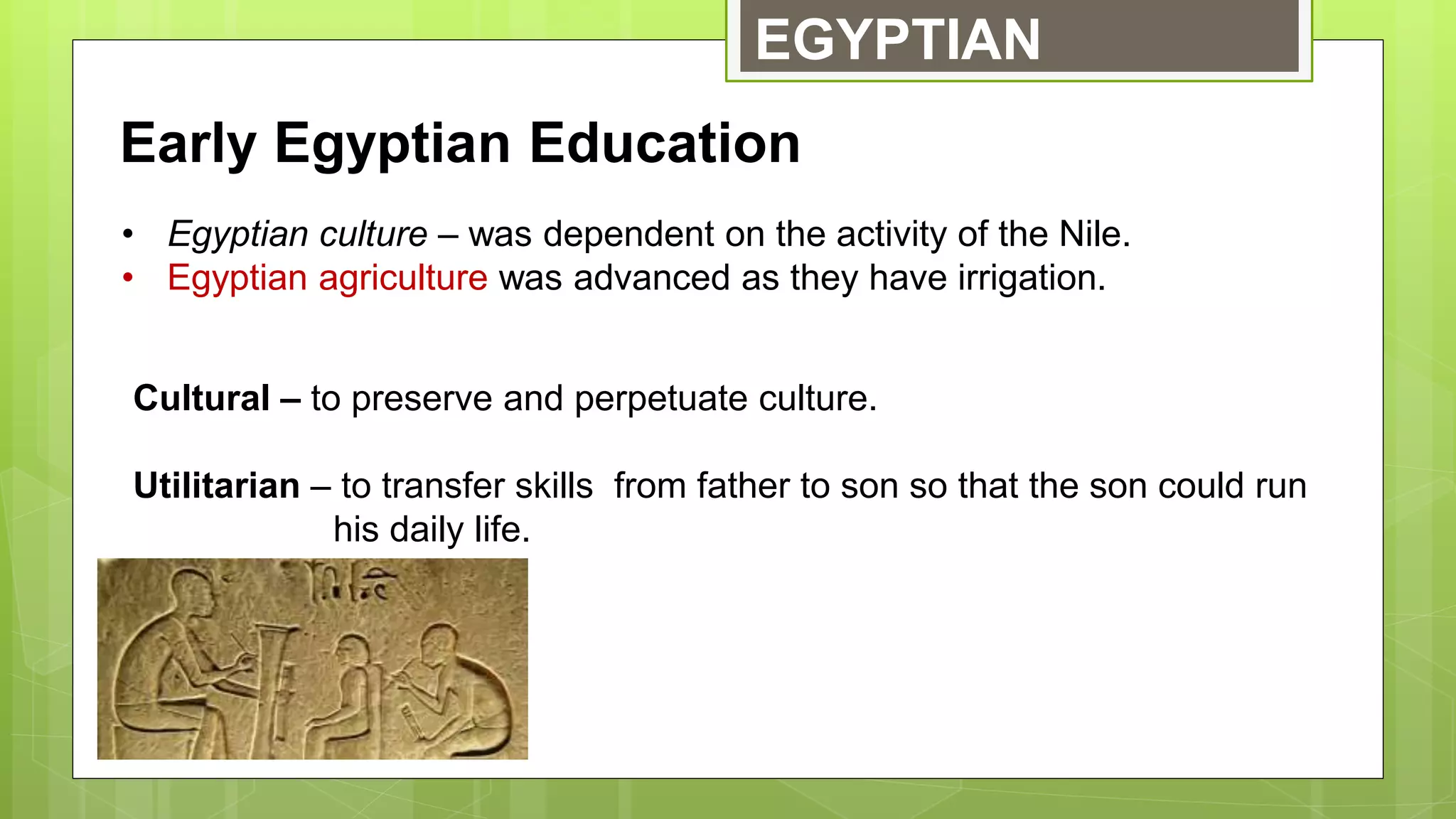
• Egyptian culture – was dependent on the activity of the Nile.
• Egyptian agriculture was advanced as they have irrigation.
Cultural – to preserve and perpetuate culture.
Utilitarian – to transfer skills from father to son so that the son could run
his daily life.
EGYPTIAN
Early Egyptian Education
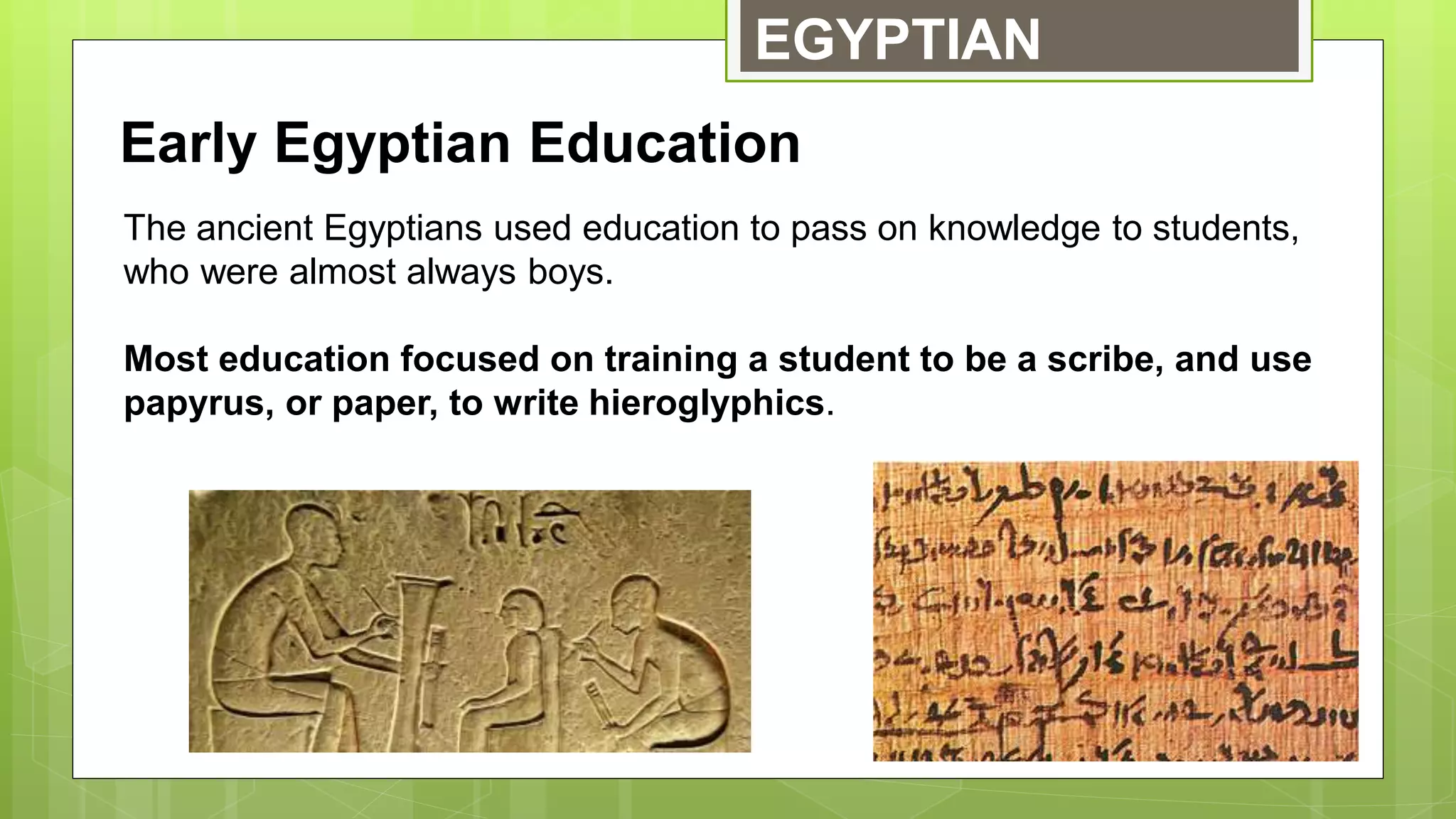
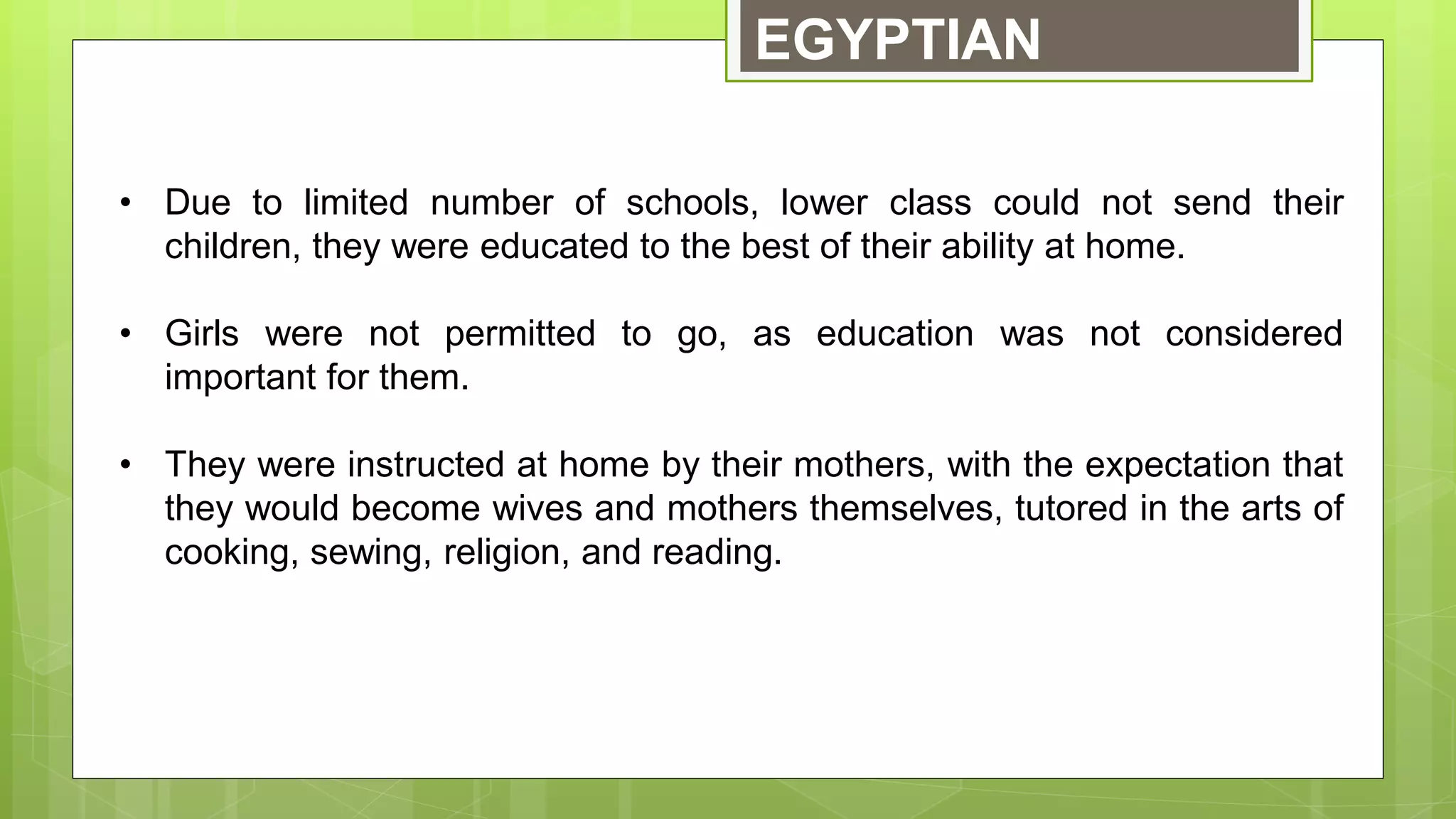
The ancient Egyptians used education to pass on knowledge to students,
who were almost always boys.
Most education focused on training a student to be a scribe, and use
papyrus, or paper, to write hieroglyphics.
EGYPTIAN
• their actual curriculum was not unfamiliar, consisting of common subjects
with particular attention paid to: mathematics, astronomy, geometry,
reading, writing, geography, music, sports, manners, medicine, and
moral instruction.
.
EGYPTIAN
• Due to limited number of schools, lower class could not send their
children, they were educated to the best of their ability at home.
• Girls were not permitted to go, as education was not considered
important for them.
• They were instructed at home by their mothers, with the expectation that
they would become wives and mothers themselves, tutored in the arts of
cooking, sewing, religion, and reading.
JEWISH
JEWISH EDUCATION
• Jewish education has been valued since the birth
of Judaism. Abraham is lauded for instructing his offspring in God's ways.
• learning was regarded as compulsory by Simeon ben Shetah as early as
75 BCE and Joshua ben Gamla in 64 CE.
• Joshua ben Gamla was a Jewish high priest in about 64-65
CE.
• The education of older boys and men in a beit midrash goes back to
the Second Temple period.
• A beth midrash is hall dedicated for Torah study, often
translated as a "study hall."
JEWISH
JEWISH EDUCATION
• The importance of education is stressed in the Talmud, which states that
children should begin school at six.
• The rabbis stated that they should not be beaten with a stick or cane,
that older students should help those who were younger, and that
children should not be kept from their lessons by other duties.
JEWISH
JEWISH EDUCATION
• The term "Talmud" used is a method of study.
• In keeping with this tradition, Jews established their own schools or hired
private tutors for their children until the end of the 18th century.
• Schools were housed in annexes or separate buildings close to the
synagogue.
B. Ancient Chinese Education, Early Hindu Education & Early Hebrew
Education
B.1 Ancient Chinese Education
• Education in ancient China was originally only for boys from rich,
important families.
• Boys learned about government, religion, and war, as well as important
ceremonies in their culture, music, and how to drive a chariot.
ANCIENT CHINESE EDUCATION
• Beginning from the time of the Xia dynasty (2070-1600 BC), it was
traditional for ancient kings and emperors to select well-educated
officials to assist them in administering their kingdoms.
ANCIENT CHINESE EDUCATION
The History of Ancient Education
- In primitive society, knowledge was passed on orally by elders to their
children.
- As hieroglyphic writings emerged 3,000 years or so ago, professional
institutions emerged aiming to teach knowledge.
Classification of Ancient Chinese Education
Generally speaking, ancient Chinese education was divided into
- official school education and
- private school education.
ANCIENT CHINESE EDUCATION
Ancient official school education - refers to a whole set of education
systems sponsored by central and local governments of slave and feudal
societies.
ANCIENT CHINESE EDUCATION
Ancient private school education - also played an important part in the
educational history of China.
It was first initiated by Confucius in the Spring and Autumn Period
(770-476 BC) and exercised a great influence on the Chinese people.
Private school education prospered during the Wei (220-265), Jin
(265-420), and Northern and Southern (420-589) dynasties.
EARLY HINDU EDUCATION
B.2 EARLY HINDU EDUCATION
- The civilization of Early Hindu are among the earliest civilization of the
world.
- In Hinduism Education is an important means to achieve the four aims of
human life, namely DHARMA(virtue), ARTHA(wealth), KAMA(pleasure)
and MOKSHA(liberation)
- Knowledge is a double edged sword.
EARLY HINDU EDUCATION
AIMS OF EDUCATION
1. Intellectual
- for excellent intellectual development through knowledge and
contemplation of philosophical truth.
2. Religious
- for the future life and seek perfection to hasten absorption into the
infinite and universal spirit.
3. Cultural
- through the use of precedent, history and strict observance of
customs and traditions.
EARLY HINDU EDUCATION
Types of Education
RELIGIOUS Education – Concerned mainly with the development of spiritual and
emotional attitudes.
INTELECTUAL Education – Only for priest and teachers. They needed knowledge in
ancient religious literature so that they could impart the religious tenets, hymns and
prayers.
VOCATIONAL Education – for artisans, agriculturists or farmers and the laborers .
DOMESTIC Education – for women whose roles were only to serve their husbands
and to bear their children.
MILITARY Education – For the military caste.
EARLY GREEK & ROMAN
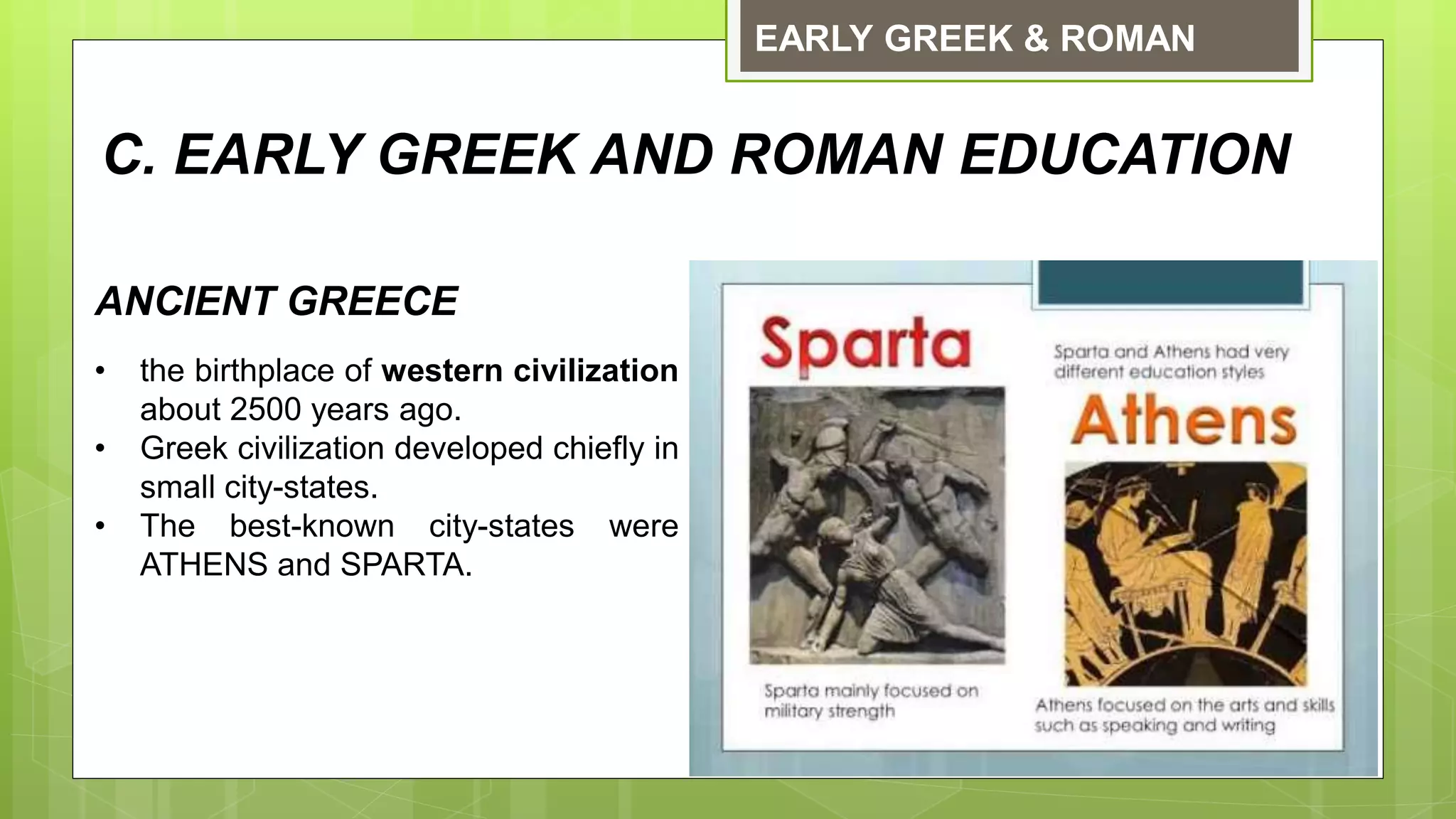
ANCIENT GREECE
• the birthplace of western civilization
about 2500 years ago.
• Greek civilization developed chiefly in
small city-states.
• The best-known city-states were
ATHENS and SPARTA.
C. EARLY GREEK AND ROMAN EDUCATION
SPARTAN EDUCATION
SPARTA – also called Lacedaemon, the capital of Laconia, was at
one time the most powerful city-state of an ancient Greece.
- It was famous for its military power and its loyal soldiers.
The People belong to 3 classes
• Dorians
• Helots
• Perioeci
SPARTAN EDUCATION
AIMS of Education
• The aims of education for the Spartans is military and
discipline.
• this is to make every citizens invincible in war, possessing
physical perfection and complete obedience of the state.
• The state is the sole agency of education.
SPARTAN EDUCATION
TYPES of Education
• PHYSICAL Education – was rigid to make the Spartan strong,
especially in combat.
• MILITARY Education – was rigid. All the skills in combat known
at that time were learned to the utmost..
• MORAL Training – was taken in connection with group living.
Stealing was not a crime but if caught, the thief was severely
punished.
• MUSIC education – to arouse patriotism.
• GYMNASTIC Education – for the girls to make them strong to
bear children.
ATHENIAN EDUCATION
AIMS of Education
• Good citizenship was the foremost aim of Athenian Education.
• There was a stress on individual excellence in wisdom, beauty and
strength for public usefulness.
• The primary purpose of Athenian education was to produce thinkers,
people well-trained in arts and sciences, people prepared for peace
or war.
ATHENIAN EDUCATION
THE Difference between Man and Woman of ATHENS
MAN WOMAN
They started school at the age of
7..
(Reading, writing, mathematics,
gymnastics, poetry)
Expected to be good wives and mothers.
They are not valued and respected.
Little freedom
Did not formally attend schools
Rarely left the house and responsible for
weaving and domestic arts.
ATHENIAN EDUCATION
TYPES of Education
• CIVIC Training – dominant aim because of the desire to serve the state.
• MORAL Training – an emphasis on the virtues of Homeric heroes as well
as those for service of the state.
• PHYSICAL Education – Taken not to develop strength but to develop
grace and harmony of the body.
• INTELLECTUAL Education – needed in the particpation in the assembly
and in discussion in the market place.
GREEK EDUCATIONAL THEORISTS
SOCRATES
– the ultimate goal of education is TRUTH
PLATO
– the ultimate goal of education is JUSTICE
ARISTOTLE
– the ultimate goal of education is HAPPINESS.
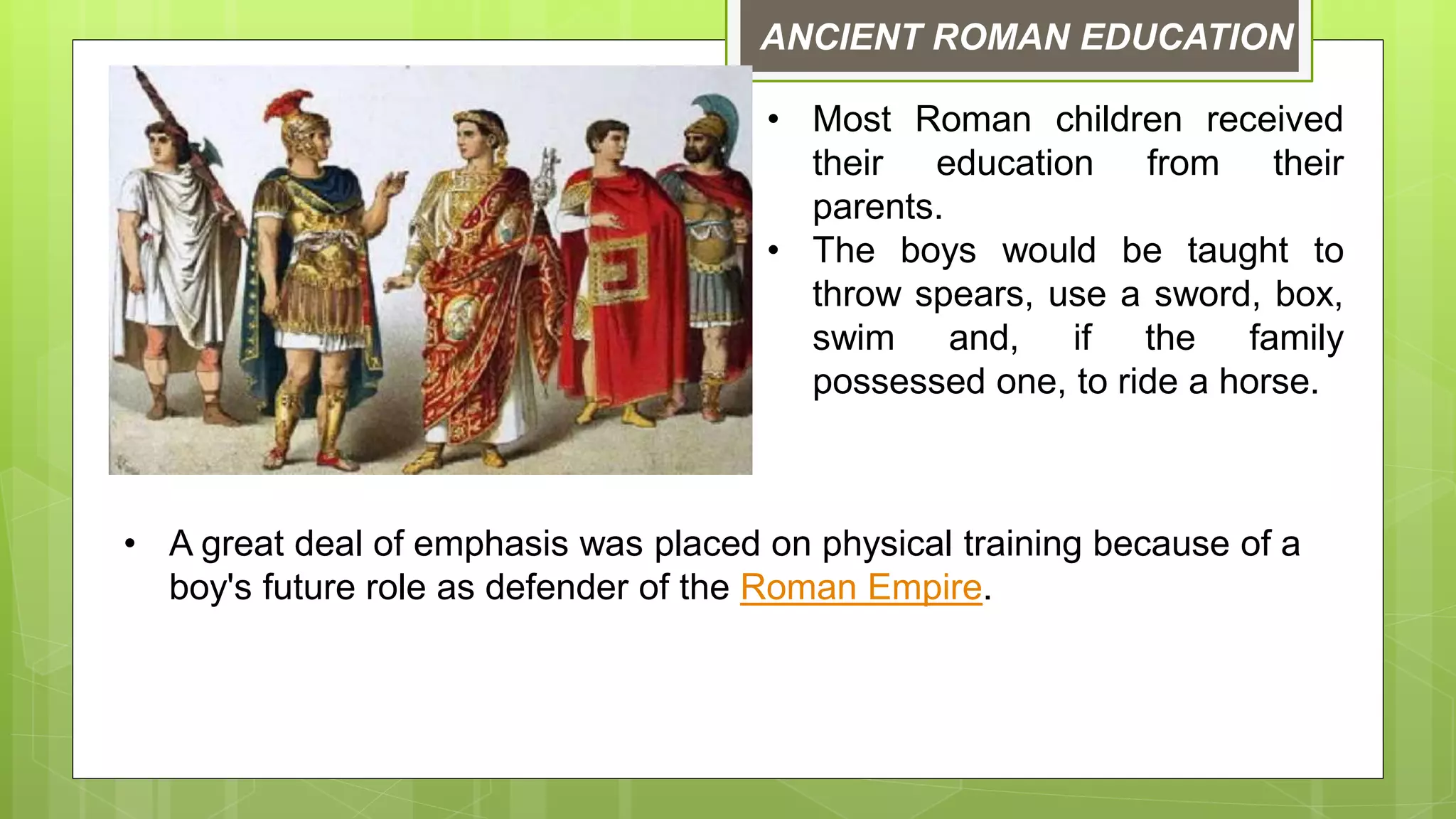
ANCIENT ROMAN EDUCATION
• Most Roman children received
their education from their
parents.
• The boys would be taught to
throw spears, use a sword, box,
swim and, if the family
possessed one, to ride a horse.
• A great deal of emphasis was placed on physical training because of a
boy's future role as defender of the Roman Empire.
ANCIENT ROMAN EDUCATION
What is the goal of Education in Ancient Rome?
• The goal of education in ancient Rome was to be an effective speaker.
• At age 12 or 13, the boys of the upper classes attended "grammar"
school, where they studied Latin, Greek, grammar, and literature.
• At age 16, some boys went on to study public speaking at the rhetoric
school, to prepare for a life as an orator.
ANCIENT ROMAN EDUCATION
Types of Education
• Physical and Military Training – was imperative for soldiers who would
be conquerors in war.
• Civic Training – to make men know their rights and obligations to the
states so that they could participate wisely in politics.
• Moral Training – was for the development of moral virtues.
• Religious Training – was tied up to moral and civic training. Children
were trained in religious ceremonies and usages.
• Vocational Training – for livelihood was very important to the Romans.
ANCIENT ROMAN EDUCATION
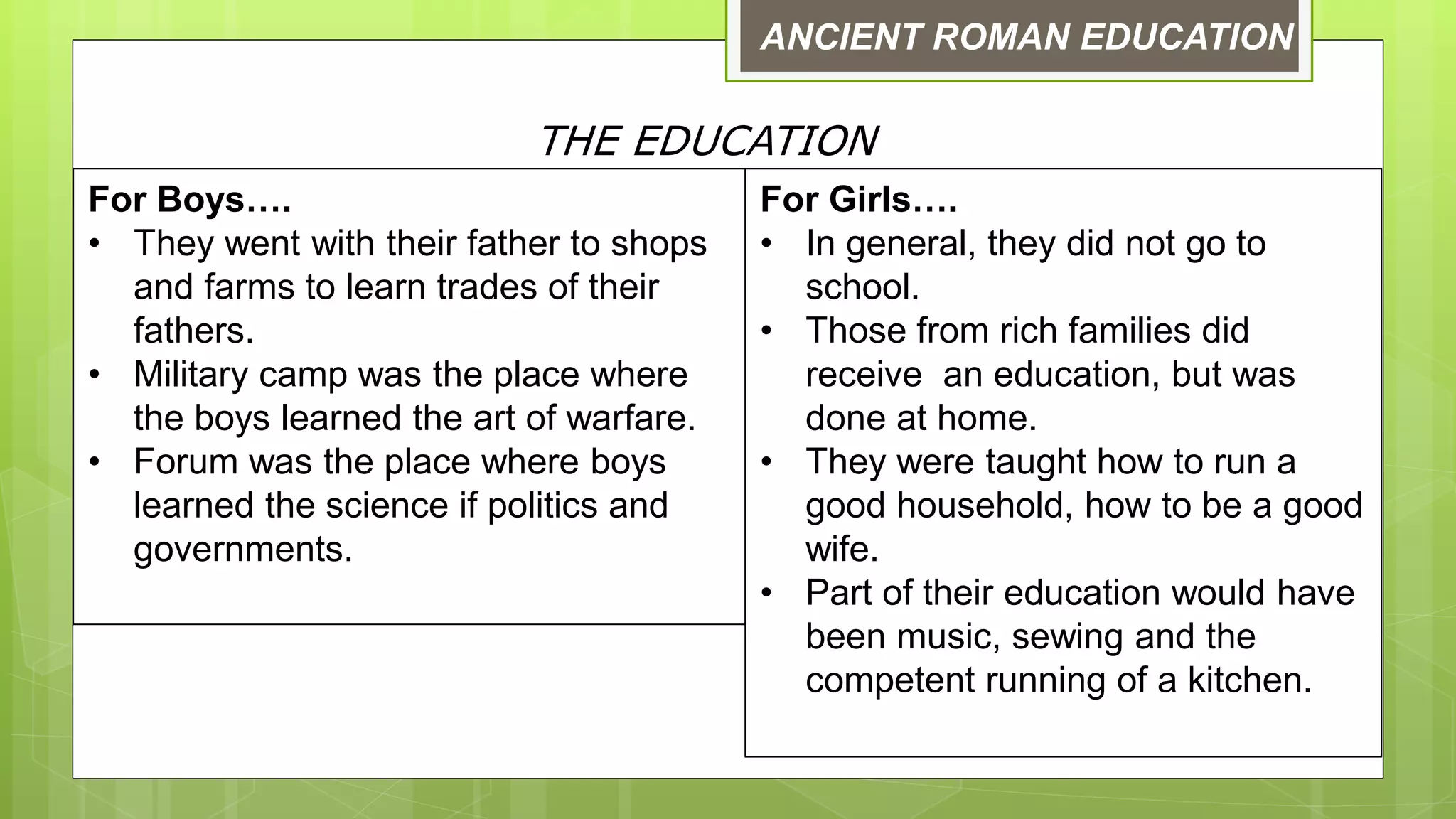
THE EDUCATION
For Girls….
• In general, they did not go to
school.
• Those from rich families did
receive an education, but was
done at home.
• They were taught how to run a
good household, how to be a good
wife.
• Part of their education would have
been music, sewing and the
competent running of a kitchen.
For Boys….
• They went with their father to shops
and farms to learn trades of their
fathers.
• Military camp was the place where
the boys learned the art of warfare.
• Forum was the place where boys
learned the science if politics and
governments.
ANCIENT ROMAN EDUCATION
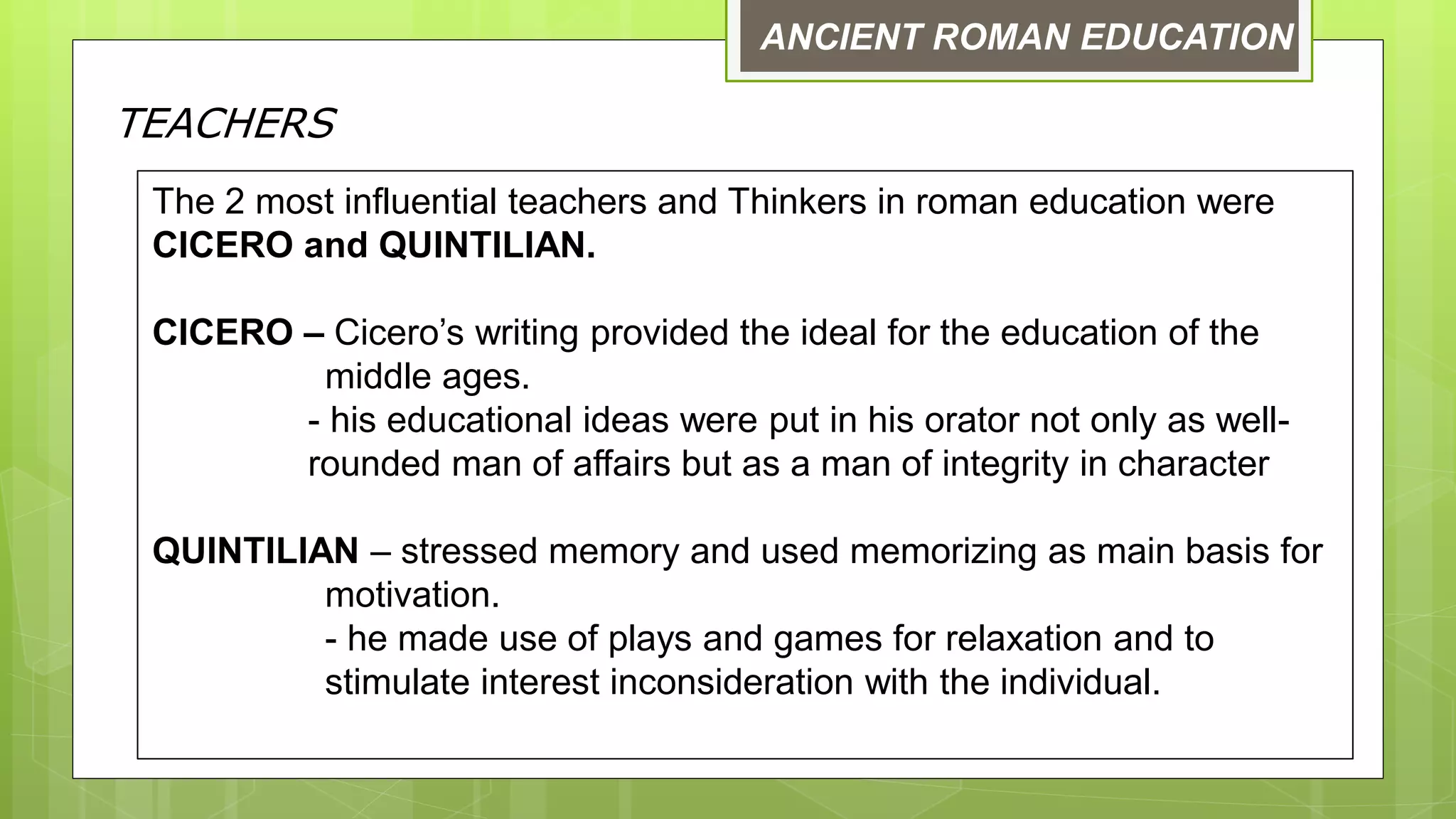
TEACHERS
The 2 most influential teachers and Thinkers in roman education were
CICERO and QUINTILIAN.
CICERO – Cicero’s writing provided the ideal for the education of the
middle ages.
- his educational ideas were put in his orator not only as well-
rounded man of affairs but as a man of integrity in character
QUINTILIAN – stressed memory and used memorizing as main basis for
motivation.
- he made use of plays and games for relaxation and to
stimulate interest inconsideration with the individual.
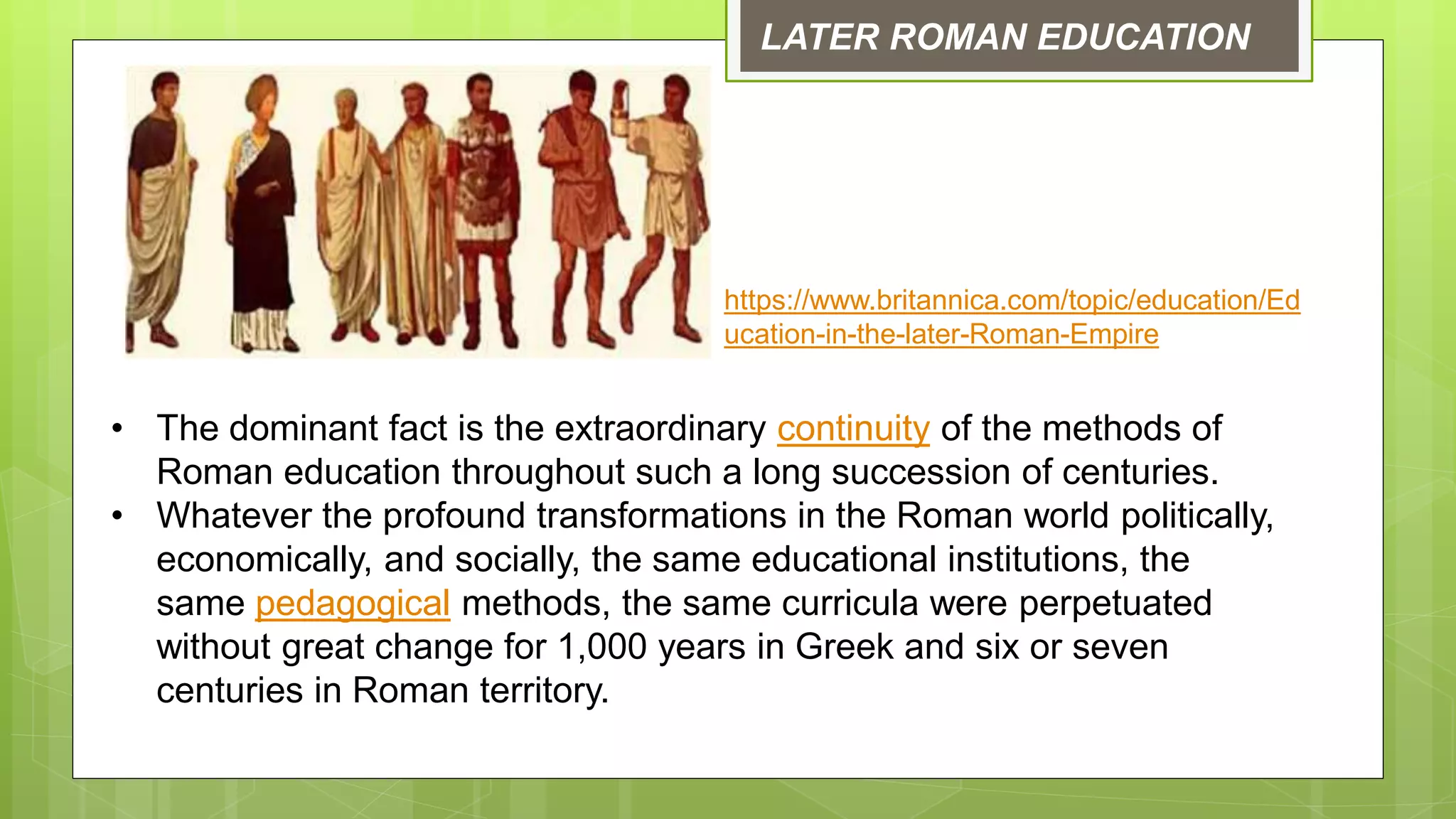
LATER ROMAN EDUCATION
• The dominant fact is the extraordinary continuity of the methods of
Roman education throughout such a long succession of centuries.
• Whatever the profound transformations in the Roman world politically,
economically, and socially, the same educational institutions, the
same pedagogical methods, the same curricula were perpetuated
without great change for 1,000 years in Greek and six or seven
centuries in Roman territory.
https://www.britannica.com/topic/education/Ed
ucation-in-the-later-Roman-Empire
CHRISTIAN and MUSLIM
EARLY CHRISTIAN EDUCATION
• The ROMAN Catholic Church – was the “Center of Education and
Literacy”
AIMS OF EDUCATION
- The primary aim of Early Christian Education was the moral
regeneration of the individual.
TYPES of Education
1. MORAL TRAINING – Teaches the values and virtues in life
2. RELIGIOUS TRAINING – Teaches all about Christianity
CHRISTIAN and MUSLIM
Content….
Church Doctrines – it is the written body of teachings of a religious
group that are generally accepted in the group.
Church Rituals – is any repetitive and patterned behavior that is
prescribed by or tied to religious institutions.
Moral values of Christlike Living – are the great checklist to understand
the different moral, values and virtues that you could cultivate
or restrain in your life.
MUSLIM Education
MUSLIM
EDUCATION
MUSLIM Education
ISLAM
• 600 years after the birth of Christ, a new religion, founded by
Mohammed, took root in Arabia.
• ISLAM means Submission to the will of God.
• Followers of Islam are called MUSLIMS.
• Education in Islam is twofold:
a. acquiring intellectual knowledge (through the application of reason
and logic) and
b. developing spiritual knowledge (derived from divine revelation and
spiritual experience).
MUSLIM Education
What is MUSLIM EDUCATION
SYSTEM?
Primarily Islamic Education was Divided
into 2 Stages:
• MAKTAB (primary Grade)
• MADRASHA (higher grade)
The term ‘MAKTAB’ is derived from
Arabic ‘KULUB’ mid means a place
where writing is taught.
MUSLIM Education
AIMS of EDUCATION
• Primarily a search for knowledge and an application of scientific
facts to the affairs of daily life.
• Religious knowledge for salvation.
• Propagation of religious knowledge
• Propagation of Islamic Law and Islamic Value System.
MUSLIM Education
ROLE OF A TEACHER….
Teachers were used to be holy persons.
Teachers used to develop a personality of the students using different
methods.
They used to follow the principles of reward and punishment.
Medium of instruction used by teachers was Arabic and priest.
Student-teacher relationship were harmonious. Teachers used to
behave like parents.
MUSLIM Education
EDUCATIONAL IMPLICATIONS:
• Education is sacred as it was Allah himself who educated the
first man.
• More emphasis on reading and writing.
• Education is a continuous process.
• Education is not restricted to what went within the school.
• No gender restriction in education.
The Medieval Concept of Spiritual,
Intellectual, Political
and Economic Education
Monasticism
The word Monasticism is derived from the
Greek monachos (living alone).
The term monasticism implies celibacy, or
living alone in the sense of lacking a spouse,
which became a socially and historically
crucial feature of the monastic life.
Nature and Significance
Monastics have been instrumental in creating,
preserving, and enhancing institutions of religious
and secular learning and in transmitting cultural
goods, artifacts, and intellectual skills down through the
generations.
Monastic institutions have also fulfilled medical,
political, and military functions, though since 1500 the
latter two have become completely secularized in most
societies.
TYPES OF MONASTECISM
EREMITIC CENOBITIC
• They were called eremites, a
Greek word meaning “dwellers in
the dessert”.
• Other religions, notably Jainism
and Hinduism also have had hermit
monks..
• Common to all true hermits is a
persistence in living alone and
following a strict discipline of
medication and self-mortification.
• Form of monasticism based on “life
in common” Greek (Koinobion),
characterized by strict discipline,
regular worship, and manual work.
• Communal form of monasticism
exists in a number of religious
traditions, particularly Christianity
and Buddism.
SCHOLASTICISM
• the system of theology and philosophy taught in medieval European
universities, based on Aristotelian logic and the writings of the early
Church Fathers and having a strong emphasis on tradition and dogma.
• is a way of thinking and teaching knowledge. It was developed in the
Middle Ages.
• The term “scholastic” is derived from Latin word “scholasticus” and the
Greek “skolastikos” (meaning literally devoting ones leisure to learning or
scholar) and the Greek scholeion (meaning “school”). The term
schoolmen is also common used to described scholastics.
CHIVALRY & THE AGE OF FEUDALISM
• Chivalry The knightly class of feudal times. The primary sense of
the term in Europe in the Middle Ages is “knights,” or “fully armed
and mounted fighting men.”
• In English Law “chivalry” meant the tenure of land by knights’
service.
FEUDALISM
The general term to describe the political and military system
od Western Europe.
• no central government
• Little security
• Fulfilled the basic need for justice and protection
• Has a system of land tenure on allegiance and service to
nobleman or lord.
LORD – owned the land, called fief, let it out to a subordinate
who called a vassal.
Two careers of the son of noblemen.
1. CLERGY - were the religious people of the Middle Ages.
Following the pope, in order of rank, there were bishops, priests,
monks and nuns. In the latter part of the Middle Ages, the pope,
as head of the church, had much influence over the king and total
control of the clergy.
2. Chivalry – an education that was physical, social, military, in
nature.
- More appeal than the church.
CHIVALRY
- comes from the old French word chevalerie meaning “horse
soldiery”
- the term came to mean the code of behavior and ethics that
knights were expected to follow.
AIMS OF CHIVALRIC EDUCATION
• MORALITY – to inculcate in the minds of the young nobles the virtues of
honor, bravery, courtesy.
• RESPONSIBILTY – to get the young nobles to assume their
responsibilities, how to manage their own estates, and how to deal with the
lower class of people.
• HORSEMANSHIP – to train the young nobles in horseback warfare,
hunting and tournaments.
• GALLANTRY - to train the young nobles how to deal gallantry to the ladies
of nobility and to protect the weak.
• RELIGIOSITY - to train the young nobles to be devoted to the service of
God
• SOCIAL GRACES - to train the young girls in the social graces and manner
fit for the ladies.
• GUILDS – were associations of people who had common interest, or who
engaged in the same work.
-People perform charitable, religious and social guilds.
• RELIGIOUS GUILDS – paid money into common fund
A guild was often associated with a patron saint, and a local guild
would maintain a chapel in the parish church to be used by its
members. Guilds performed charitable work, not only among the poor
and indigent among their own members but among the community at
large.
ALMS - A relief that was given to members who needed help because of
sickness or old age.
MASS – guilds arranged to be offered for members who died.
THE GUILD SYSTEM EDUCATION
The Religious Guilds were suppress in England in 1500’s, these guilds
are known as Merchant Guilds and Craft Guilds
Merchant guilds were associations of all or most of the merchants in a
particular town or city; these men might be local or long-distance
traders, wholesale or retail sellers, and might deal in various
categories of goods.
Craft guilds were made up of craftsmen and artisans in the same
occupation, such as hatters, carpenters, bakers, blacksmiths,
weav- ers and masons.
THE GUILD SYSTEM EDUCATION
A Person could become a member of guild in one of
three ways:
Patrimony (succeeding parent)
Redemption (buying membership)
Apprenticeship (serving a term of training in a craft)
THE GUILD SYSTEM EDUCATION
F. RENAISSANCE PERIOD
1. Humanism
2. Reformation
3. Catholic Counter Reformation
RENAISSANCE
PERIOD
Renaissance was a fervent period of European cultural, artistic, political
and economic “rebirth” following the Middle Ages.
Generally described as taking place from the 14th century to the 17th
century, the Renaissance promoted the rediscovery of classical,
philosophy, literature and art.
Some of the greatest thinkers, authors, statesmen, scientist and artists in
human history thrived during this era, while global exploration
opened up new lands and cultures to European Commerce.
RENAISSANCE
PERIOD
Renaissance was from the Latin word “Renascere” means rebirth
Renaissance also called the rebirth of learning.
FACTORS THAT PROPELLED RENAISSANCE
• Scholastism
• Invention of printing press
• Findings of exploration and scientific discoveries
• The degeneration of the church
• The rise of free cities and rich middle class
HUMANISM
HUMANISM
• During the 14th century, a cultural movement called humanism
began to gain momentum in Italy.
• Humanism promoted the idea that man was the center of his own
universe, and people should embrace human achievements in
education, classical arts, literature and science.
Humanists
proponents or practitioners of Humanism during the
renaissance.
HUMANISM
Role in Education
• During the Renaissance, Humanism played a major role in
education.
• Humanists – sought to create a citizenry able to speak and write
with eloquence and clarity.
- believed that human beings could be dramatically changed by
education.
- The Humanists of the Renaissance created schools to teach
their ideas and wrote books all about education.
HUMANISM
PURPOSE of HUMANISM
- was to create a universal man whose person combined intellectual and
physical excellence and who was capable of functioning honorably in
virtually any situation.
- This ideology was referred to as the uomo universale, an ancient Greco-
Roman ideal.
- Education during the Renaissance was mainly composed of ancient
literature and history.
HUMANISM
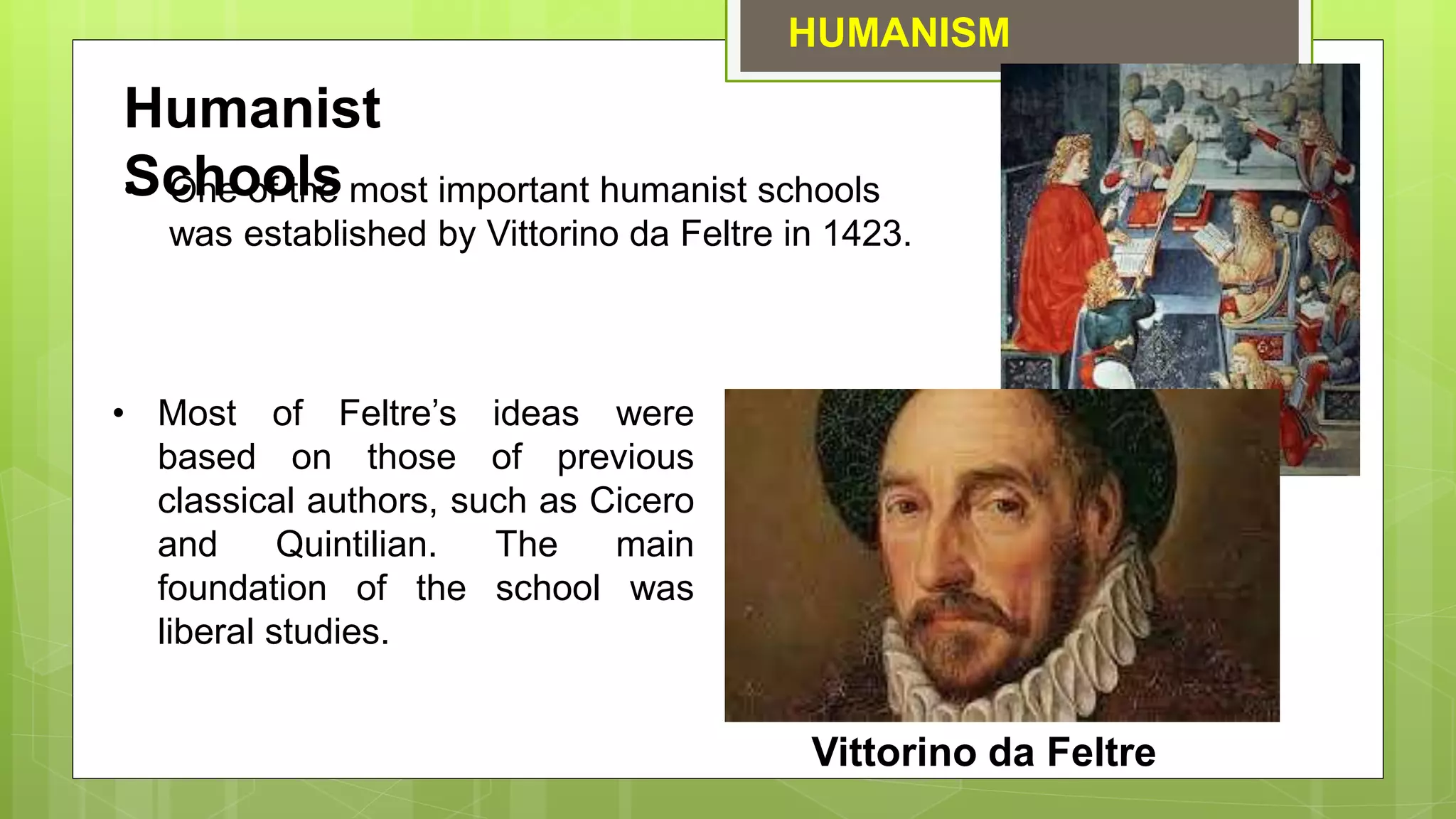
Vittorino da Feltre
Humanist
Schools
• One of the most important humanist schools
was established by Vittorino da Feltre in 1423.
• Most of Feltre’s ideas were
based on those of previous
classical authors, such as Cicero
and Quintilian. The main
foundation of the school was
liberal studies.
REFORMATION
REFORMATION
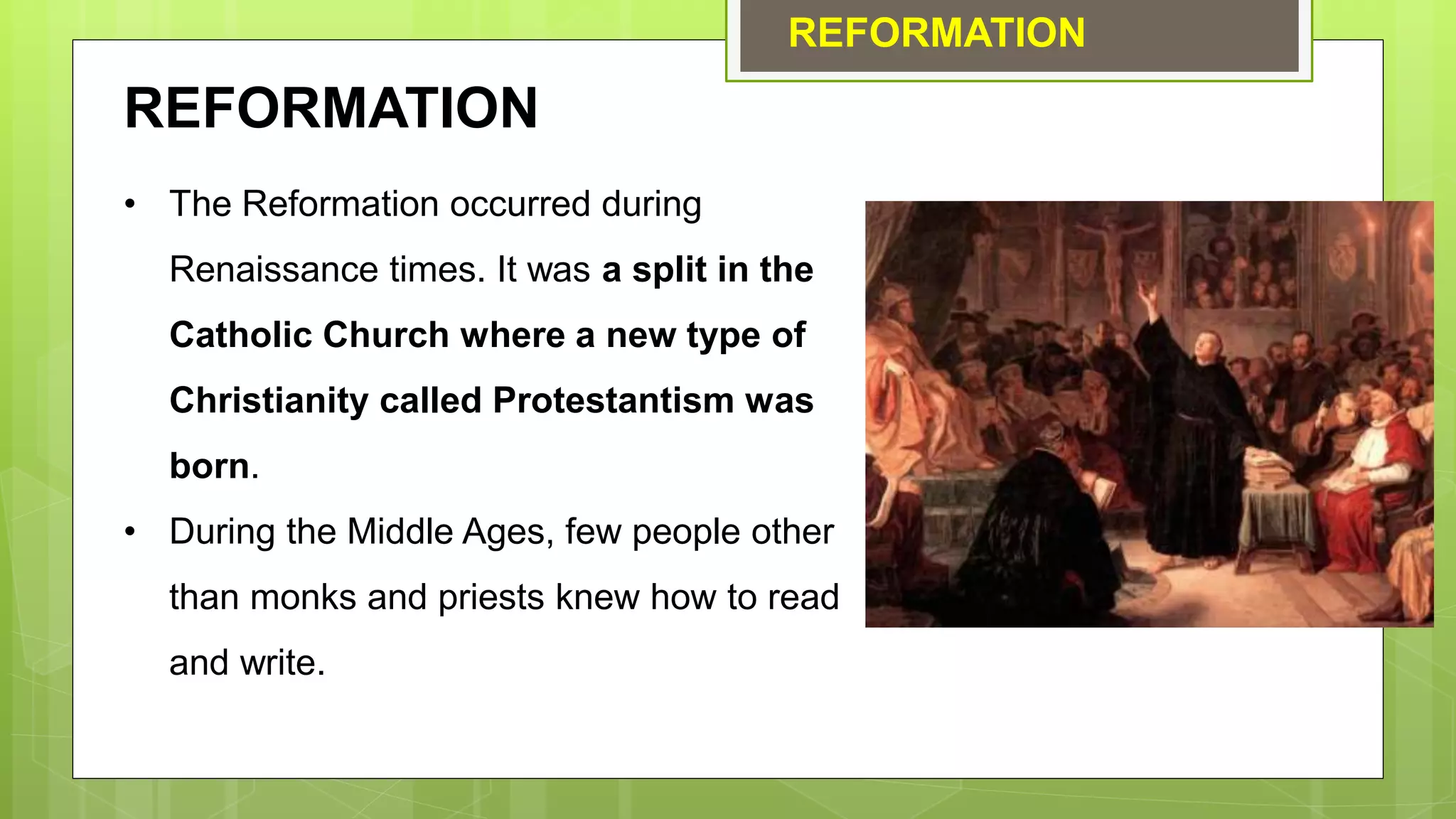
• The Reformation occurred during
Renaissance times. It was a split in the
Catholic Church where a new type of
Christianity called Protestantism was
born.
• During the Middle Ages, few people other
than monks and priests knew how to read
and write.
REFORMATION
REFORMATION
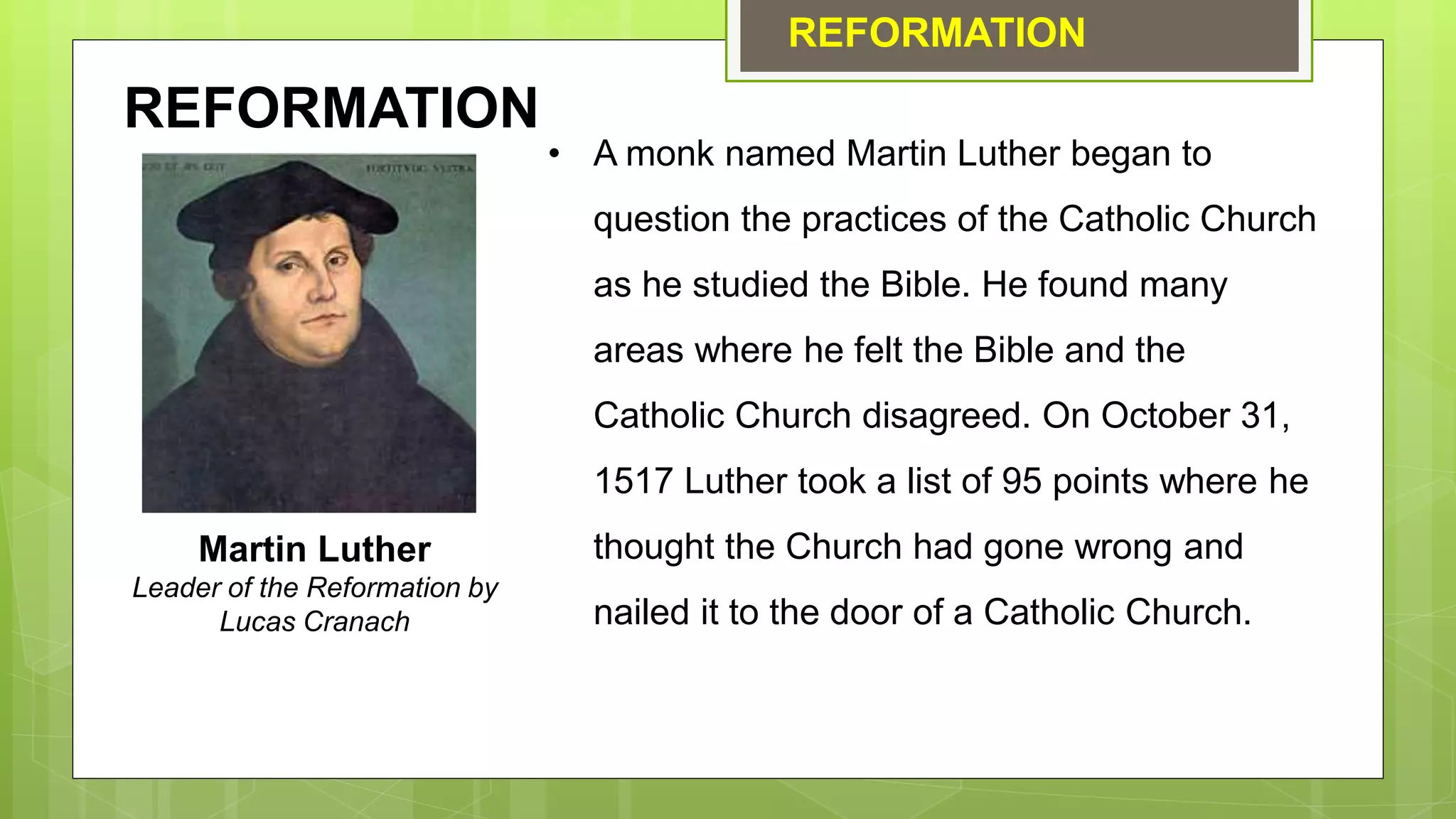
• A monk named Martin Luther began to
question the practices of the Catholic Church
as he studied the Bible. He found many
areas where he felt the Bible and the
Catholic Church disagreed. On October 31,
1517 Luther took a list of 95 points where he
thought the Church had gone wrong and
nailed it to the door of a Catholic Church.
Martin Luther
Leader of the Reformation by
Lucas Cranach
REFORMATION
REFORMATION
Reformed Education
• Established vernacular primary schools that offered a basic
curriculum of reading, writing, arithmetic and religion for children in
their own language.
The Protestant reformers retained the dual-class school system that
had developed in the Renaissance.
REFORMATION
REFORMATION
Reformed Education
• Established vernacular primary schools that offered a basic
curriculum of reading, writing, arithmetic and religion for children in
their own language.
The Protestant reformers retained the dual-class school system that
had developed in the Renaissance.
References: The Sumerians by Samuel Noah Kramer
https://studylib.net/doc/25636329/early-hindu-education
https://www.socialstudies.org/system/files/publications/articles/se_77021364.pdf
https://courses.lumenlearning.com/atd-herkimer-westerncivilization/chapter/education-and-
humanism/#:~:text=During%20the%20Renaissance%2C%20Humanism%20played,wrote%20boo
ks%20all%20about%20education.
https://www.ducksters.com/history/renaissance_reformation.php

Part 1 - Historical Foundations of Education.pptx

  • 1.
    Historical Foundations of Education CHERIE ANNP. BAUTISTA MAEd Foundations of Education
  • 2.
    Ancient The belief andexperiences of education rest on the history of the field of endeavor. By knowing what accomplishments of leaders in the past, today’s educators attempt to build on their achievements.
  • 3.
    Ancient A.1 – EducationDuring the Ancient Period • Also known as PRIMITIVE EDUCATION • Life was very simple and their means of livelihood were hunting & gathering wild fruits and vegetables. • Organization was tribal and usually headed by the oldest or wisest among members - There was no reading or writing. • Information was transmitted through word of mouth, songs, gestures, ceremonial rites and the like.
  • 4.
    Ancient A.1 – EducationDuring the Ancient Period • Education was acquired during primitive by ‘enculturation’ is the process of learning the culture and acquiring the values and knowledge of a society. • Aims to help a primitive person in learning his culture, developing his behavior in the ways of adulthood and guiding him toward eventual role in the society.
  • 5.
    Ancient Purpose of primitiveeducation • Is to shape children to becoming good members of the tribe. • Training for citizenship is essential to primitive people because they are primary concerned with the growth of individuals as tribe members.
  • 6.
    Ancient 2 Types OfPrimitive Education 1. PRACTICAL – included the simple forms of domestic, vocational, physical, moral and military training. 2. THEORETICAL – covered the religious, musical and literary.
  • 7.
    Oriental A.2 ORIENTAL EDUCATION •Oriental System of learning is the traditional method of learning practiced in India during British times. In this method of learning, knowledge was imparted orally. • There were no textbooks and proper curriculum. Students were taught at the house of the teacher.
  • 8.
    Sumerian Civilization –is the Oldest Recorded Civilization Known To Man. - Existed in the present day area of Iraq starting from 4500 B.C. - They invented the CUNEIFORM WRITING which later became the modern day Alphabet System. - They were the first to advocate Individual Freedom and that’s why they started the first codification of laws to set the limits of the state. SUMERIAN SUMERIAN EDUCATION
  • 9.
    • The Sumerianswere the first to develop the school system known to man. • Schools were called • Edubba ( Tablet House ) as the teaching & writing were on tablets ( dried clay) SUMERIAN SUMERIAN EDUCATION
  • 10.
    • The studentswere called “School- Sons” • Sumerian school system had concept of Alumni / Alumnus system. They were called as “ school- sons of the days past” SUMMERIAN SUMERIAN EDUCATION • The Sumerian schooling system had basically two streams - Science and Arts stream
  • 11.
    • The Sumerianswere very clear in their approach to education system. The Sumerians describe their schools and the purpose of schooling & education system in the following beautiful verse which is now immortal. SUMERIAN Motto of Sumerian Schooling and Education System “He whose eyes are not open enters it, He whose eyes are wide open comes out of it”
  • 12.
    EGYPTIAN Early Egyptian Education -is one of the earliest civilizations settled by a Hamitic people who inhabited the valley of the Nile 20,000 years ago, and with a recorded history reaching back to the fifth millennium B.C.
  • 13.
    EGYPTIAN Early Egyptian Education •Egyptian culture – was dependent on the activity of the Nile. • Egyptian agriculture was advanced as they have irrigation. Cultural – to preserve and perpetuate culture. Utilitarian – to transfer skills from father to son so that the son could run his daily life.
  • 14.
    EGYPTIAN Early Egyptian Education Theancient Egyptians used education to pass on knowledge to students, who were almost always boys. Most education focused on training a student to be a scribe, and use papyrus, or paper, to write hieroglyphics.
  • 15.
    EGYPTIAN • their actualcurriculum was not unfamiliar, consisting of common subjects with particular attention paid to: mathematics, astronomy, geometry, reading, writing, geography, music, sports, manners, medicine, and moral instruction. .
  • 16.
    EGYPTIAN • Due tolimited number of schools, lower class could not send their children, they were educated to the best of their ability at home. • Girls were not permitted to go, as education was not considered important for them. • They were instructed at home by their mothers, with the expectation that they would become wives and mothers themselves, tutored in the arts of cooking, sewing, religion, and reading.
  • 17.
    JEWISH JEWISH EDUCATION • Jewisheducation has been valued since the birth of Judaism. Abraham is lauded for instructing his offspring in God's ways. • learning was regarded as compulsory by Simeon ben Shetah as early as 75 BCE and Joshua ben Gamla in 64 CE. • Joshua ben Gamla was a Jewish high priest in about 64-65 CE. • The education of older boys and men in a beit midrash goes back to the Second Temple period. • A beth midrash is hall dedicated for Torah study, often translated as a "study hall."
  • 18.
    JEWISH JEWISH EDUCATION • Theimportance of education is stressed in the Talmud, which states that children should begin school at six. • The rabbis stated that they should not be beaten with a stick or cane, that older students should help those who were younger, and that children should not be kept from their lessons by other duties.
  • 19.
    JEWISH JEWISH EDUCATION • Theterm "Talmud" used is a method of study. • In keeping with this tradition, Jews established their own schools or hired private tutors for their children until the end of the 18th century. • Schools were housed in annexes or separate buildings close to the synagogue.
  • 20.
    B. Ancient ChineseEducation, Early Hindu Education & Early Hebrew Education B.1 Ancient Chinese Education • Education in ancient China was originally only for boys from rich, important families. • Boys learned about government, religion, and war, as well as important ceremonies in their culture, music, and how to drive a chariot. ANCIENT CHINESE EDUCATION
  • 21.
    • Beginning fromthe time of the Xia dynasty (2070-1600 BC), it was traditional for ancient kings and emperors to select well-educated officials to assist them in administering their kingdoms. ANCIENT CHINESE EDUCATION The History of Ancient Education - In primitive society, knowledge was passed on orally by elders to their children. - As hieroglyphic writings emerged 3,000 years or so ago, professional institutions emerged aiming to teach knowledge.
  • 22.
    Classification of AncientChinese Education Generally speaking, ancient Chinese education was divided into - official school education and - private school education. ANCIENT CHINESE EDUCATION Ancient official school education - refers to a whole set of education systems sponsored by central and local governments of slave and feudal societies.
  • 23.
    ANCIENT CHINESE EDUCATION Ancientprivate school education - also played an important part in the educational history of China. It was first initiated by Confucius in the Spring and Autumn Period (770-476 BC) and exercised a great influence on the Chinese people. Private school education prospered during the Wei (220-265), Jin (265-420), and Northern and Southern (420-589) dynasties.
  • 24.
    EARLY HINDU EDUCATION B.2EARLY HINDU EDUCATION - The civilization of Early Hindu are among the earliest civilization of the world. - In Hinduism Education is an important means to achieve the four aims of human life, namely DHARMA(virtue), ARTHA(wealth), KAMA(pleasure) and MOKSHA(liberation) - Knowledge is a double edged sword.
  • 25.
    EARLY HINDU EDUCATION AIMSOF EDUCATION 1. Intellectual - for excellent intellectual development through knowledge and contemplation of philosophical truth. 2. Religious - for the future life and seek perfection to hasten absorption into the infinite and universal spirit. 3. Cultural - through the use of precedent, history and strict observance of customs and traditions.
  • 26.
    EARLY HINDU EDUCATION Typesof Education RELIGIOUS Education – Concerned mainly with the development of spiritual and emotional attitudes. INTELECTUAL Education – Only for priest and teachers. They needed knowledge in ancient religious literature so that they could impart the religious tenets, hymns and prayers. VOCATIONAL Education – for artisans, agriculturists or farmers and the laborers . DOMESTIC Education – for women whose roles were only to serve their husbands and to bear their children. MILITARY Education – For the military caste.
  • 27.
    EARLY GREEK &ROMAN ANCIENT GREECE • the birthplace of western civilization about 2500 years ago. • Greek civilization developed chiefly in small city-states. • The best-known city-states were ATHENS and SPARTA. C. EARLY GREEK AND ROMAN EDUCATION
  • 28.
    SPARTAN EDUCATION SPARTA –also called Lacedaemon, the capital of Laconia, was at one time the most powerful city-state of an ancient Greece. - It was famous for its military power and its loyal soldiers. The People belong to 3 classes • Dorians • Helots • Perioeci
  • 29.
    SPARTAN EDUCATION AIMS ofEducation • The aims of education for the Spartans is military and discipline. • this is to make every citizens invincible in war, possessing physical perfection and complete obedience of the state. • The state is the sole agency of education.
  • 30.
    SPARTAN EDUCATION TYPES ofEducation • PHYSICAL Education – was rigid to make the Spartan strong, especially in combat. • MILITARY Education – was rigid. All the skills in combat known at that time were learned to the utmost.. • MORAL Training – was taken in connection with group living. Stealing was not a crime but if caught, the thief was severely punished. • MUSIC education – to arouse patriotism. • GYMNASTIC Education – for the girls to make them strong to bear children.
  • 31.
    ATHENIAN EDUCATION AIMS ofEducation • Good citizenship was the foremost aim of Athenian Education. • There was a stress on individual excellence in wisdom, beauty and strength for public usefulness. • The primary purpose of Athenian education was to produce thinkers, people well-trained in arts and sciences, people prepared for peace or war.
  • 32.
    ATHENIAN EDUCATION THE Differencebetween Man and Woman of ATHENS MAN WOMAN They started school at the age of 7.. (Reading, writing, mathematics, gymnastics, poetry) Expected to be good wives and mothers. They are not valued and respected. Little freedom Did not formally attend schools Rarely left the house and responsible for weaving and domestic arts.
  • 33.
    ATHENIAN EDUCATION TYPES ofEducation • CIVIC Training – dominant aim because of the desire to serve the state. • MORAL Training – an emphasis on the virtues of Homeric heroes as well as those for service of the state. • PHYSICAL Education – Taken not to develop strength but to develop grace and harmony of the body. • INTELLECTUAL Education – needed in the particpation in the assembly and in discussion in the market place.
  • 34.
    GREEK EDUCATIONAL THEORISTS SOCRATES –the ultimate goal of education is TRUTH PLATO – the ultimate goal of education is JUSTICE ARISTOTLE – the ultimate goal of education is HAPPINESS.
  • 35.
    ANCIENT ROMAN EDUCATION •Most Roman children received their education from their parents. • The boys would be taught to throw spears, use a sword, box, swim and, if the family possessed one, to ride a horse. • A great deal of emphasis was placed on physical training because of a boy's future role as defender of the Roman Empire.
  • 36.
    ANCIENT ROMAN EDUCATION Whatis the goal of Education in Ancient Rome? • The goal of education in ancient Rome was to be an effective speaker. • At age 12 or 13, the boys of the upper classes attended "grammar" school, where they studied Latin, Greek, grammar, and literature. • At age 16, some boys went on to study public speaking at the rhetoric school, to prepare for a life as an orator.
  • 37.
    ANCIENT ROMAN EDUCATION Typesof Education • Physical and Military Training – was imperative for soldiers who would be conquerors in war. • Civic Training – to make men know their rights and obligations to the states so that they could participate wisely in politics. • Moral Training – was for the development of moral virtues. • Religious Training – was tied up to moral and civic training. Children were trained in religious ceremonies and usages. • Vocational Training – for livelihood was very important to the Romans.
  • 38.
    ANCIENT ROMAN EDUCATION THEEDUCATION For Girls…. • In general, they did not go to school. • Those from rich families did receive an education, but was done at home. • They were taught how to run a good household, how to be a good wife. • Part of their education would have been music, sewing and the competent running of a kitchen. For Boys…. • They went with their father to shops and farms to learn trades of their fathers. • Military camp was the place where the boys learned the art of warfare. • Forum was the place where boys learned the science if politics and governments.
  • 39.
    ANCIENT ROMAN EDUCATION TEACHERS The2 most influential teachers and Thinkers in roman education were CICERO and QUINTILIAN. CICERO – Cicero’s writing provided the ideal for the education of the middle ages. - his educational ideas were put in his orator not only as well- rounded man of affairs but as a man of integrity in character QUINTILIAN – stressed memory and used memorizing as main basis for motivation. - he made use of plays and games for relaxation and to stimulate interest inconsideration with the individual.
  • 40.
    LATER ROMAN EDUCATION •The dominant fact is the extraordinary continuity of the methods of Roman education throughout such a long succession of centuries. • Whatever the profound transformations in the Roman world politically, economically, and socially, the same educational institutions, the same pedagogical methods, the same curricula were perpetuated without great change for 1,000 years in Greek and six or seven centuries in Roman territory. https://www.britannica.com/topic/education/Ed ucation-in-the-later-Roman-Empire
  • 41.
    CHRISTIAN and MUSLIM EARLYCHRISTIAN EDUCATION • The ROMAN Catholic Church – was the “Center of Education and Literacy” AIMS OF EDUCATION - The primary aim of Early Christian Education was the moral regeneration of the individual. TYPES of Education 1. MORAL TRAINING – Teaches the values and virtues in life 2. RELIGIOUS TRAINING – Teaches all about Christianity
  • 42.
    CHRISTIAN and MUSLIM Content…. ChurchDoctrines – it is the written body of teachings of a religious group that are generally accepted in the group. Church Rituals – is any repetitive and patterned behavior that is prescribed by or tied to religious institutions. Moral values of Christlike Living – are the great checklist to understand the different moral, values and virtues that you could cultivate or restrain in your life.
  • 43.
  • 44.
    MUSLIM Education ISLAM • 600years after the birth of Christ, a new religion, founded by Mohammed, took root in Arabia. • ISLAM means Submission to the will of God. • Followers of Islam are called MUSLIMS. • Education in Islam is twofold: a. acquiring intellectual knowledge (through the application of reason and logic) and b. developing spiritual knowledge (derived from divine revelation and spiritual experience).
  • 45.
    MUSLIM Education What isMUSLIM EDUCATION SYSTEM? Primarily Islamic Education was Divided into 2 Stages: • MAKTAB (primary Grade) • MADRASHA (higher grade) The term ‘MAKTAB’ is derived from Arabic ‘KULUB’ mid means a place where writing is taught.
  • 46.
    MUSLIM Education AIMS ofEDUCATION • Primarily a search for knowledge and an application of scientific facts to the affairs of daily life. • Religious knowledge for salvation. • Propagation of religious knowledge • Propagation of Islamic Law and Islamic Value System.
  • 47.
    MUSLIM Education ROLE OFA TEACHER…. Teachers were used to be holy persons. Teachers used to develop a personality of the students using different methods. They used to follow the principles of reward and punishment. Medium of instruction used by teachers was Arabic and priest. Student-teacher relationship were harmonious. Teachers used to behave like parents.
  • 48.
    MUSLIM Education EDUCATIONAL IMPLICATIONS: •Education is sacred as it was Allah himself who educated the first man. • More emphasis on reading and writing. • Education is a continuous process. • Education is not restricted to what went within the school. • No gender restriction in education.
  • 49.
    The Medieval Conceptof Spiritual, Intellectual, Political and Economic Education
  • 50.
    Monasticism The word Monasticismis derived from the Greek monachos (living alone). The term monasticism implies celibacy, or living alone in the sense of lacking a spouse, which became a socially and historically crucial feature of the monastic life.
  • 51.
    Nature and Significance Monasticshave been instrumental in creating, preserving, and enhancing institutions of religious and secular learning and in transmitting cultural goods, artifacts, and intellectual skills down through the generations. Monastic institutions have also fulfilled medical, political, and military functions, though since 1500 the latter two have become completely secularized in most societies.
  • 52.
    TYPES OF MONASTECISM EREMITICCENOBITIC • They were called eremites, a Greek word meaning “dwellers in the dessert”. • Other religions, notably Jainism and Hinduism also have had hermit monks.. • Common to all true hermits is a persistence in living alone and following a strict discipline of medication and self-mortification. • Form of monasticism based on “life in common” Greek (Koinobion), characterized by strict discipline, regular worship, and manual work. • Communal form of monasticism exists in a number of religious traditions, particularly Christianity and Buddism.
  • 53.
    SCHOLASTICISM • the systemof theology and philosophy taught in medieval European universities, based on Aristotelian logic and the writings of the early Church Fathers and having a strong emphasis on tradition and dogma. • is a way of thinking and teaching knowledge. It was developed in the Middle Ages. • The term “scholastic” is derived from Latin word “scholasticus” and the Greek “skolastikos” (meaning literally devoting ones leisure to learning or scholar) and the Greek scholeion (meaning “school”). The term schoolmen is also common used to described scholastics.
  • 54.
    CHIVALRY & THEAGE OF FEUDALISM • Chivalry The knightly class of feudal times. The primary sense of the term in Europe in the Middle Ages is “knights,” or “fully armed and mounted fighting men.” • In English Law “chivalry” meant the tenure of land by knights’ service.
  • 55.
    FEUDALISM The general termto describe the political and military system od Western Europe. • no central government • Little security • Fulfilled the basic need for justice and protection • Has a system of land tenure on allegiance and service to nobleman or lord. LORD – owned the land, called fief, let it out to a subordinate who called a vassal.
  • 56.
    Two careers ofthe son of noblemen. 1. CLERGY - were the religious people of the Middle Ages. Following the pope, in order of rank, there were bishops, priests, monks and nuns. In the latter part of the Middle Ages, the pope, as head of the church, had much influence over the king and total control of the clergy. 2. Chivalry – an education that was physical, social, military, in nature. - More appeal than the church.
  • 57.
    CHIVALRY - comes fromthe old French word chevalerie meaning “horse soldiery” - the term came to mean the code of behavior and ethics that knights were expected to follow.
  • 58.
    AIMS OF CHIVALRICEDUCATION • MORALITY – to inculcate in the minds of the young nobles the virtues of honor, bravery, courtesy. • RESPONSIBILTY – to get the young nobles to assume their responsibilities, how to manage their own estates, and how to deal with the lower class of people. • HORSEMANSHIP – to train the young nobles in horseback warfare, hunting and tournaments. • GALLANTRY - to train the young nobles how to deal gallantry to the ladies of nobility and to protect the weak. • RELIGIOSITY - to train the young nobles to be devoted to the service of God • SOCIAL GRACES - to train the young girls in the social graces and manner fit for the ladies.
  • 59.
    • GUILDS –were associations of people who had common interest, or who engaged in the same work. -People perform charitable, religious and social guilds. • RELIGIOUS GUILDS – paid money into common fund A guild was often associated with a patron saint, and a local guild would maintain a chapel in the parish church to be used by its members. Guilds performed charitable work, not only among the poor and indigent among their own members but among the community at large. ALMS - A relief that was given to members who needed help because of sickness or old age. MASS – guilds arranged to be offered for members who died. THE GUILD SYSTEM EDUCATION
  • 60.
    The Religious Guildswere suppress in England in 1500’s, these guilds are known as Merchant Guilds and Craft Guilds Merchant guilds were associations of all or most of the merchants in a particular town or city; these men might be local or long-distance traders, wholesale or retail sellers, and might deal in various categories of goods. Craft guilds were made up of craftsmen and artisans in the same occupation, such as hatters, carpenters, bakers, blacksmiths, weav- ers and masons. THE GUILD SYSTEM EDUCATION
  • 61.
    A Person couldbecome a member of guild in one of three ways: Patrimony (succeeding parent) Redemption (buying membership) Apprenticeship (serving a term of training in a craft) THE GUILD SYSTEM EDUCATION
  • 62.
    F. RENAISSANCE PERIOD 1.Humanism 2. Reformation 3. Catholic Counter Reformation
  • 63.
    RENAISSANCE PERIOD Renaissance was afervent period of European cultural, artistic, political and economic “rebirth” following the Middle Ages. Generally described as taking place from the 14th century to the 17th century, the Renaissance promoted the rediscovery of classical, philosophy, literature and art. Some of the greatest thinkers, authors, statesmen, scientist and artists in human history thrived during this era, while global exploration opened up new lands and cultures to European Commerce.
  • 64.
    RENAISSANCE PERIOD Renaissance was fromthe Latin word “Renascere” means rebirth Renaissance also called the rebirth of learning. FACTORS THAT PROPELLED RENAISSANCE • Scholastism • Invention of printing press • Findings of exploration and scientific discoveries • The degeneration of the church • The rise of free cities and rich middle class
  • 65.
    HUMANISM HUMANISM • During the14th century, a cultural movement called humanism began to gain momentum in Italy. • Humanism promoted the idea that man was the center of his own universe, and people should embrace human achievements in education, classical arts, literature and science. Humanists proponents or practitioners of Humanism during the renaissance.
  • 66.
    HUMANISM Role in Education •During the Renaissance, Humanism played a major role in education. • Humanists – sought to create a citizenry able to speak and write with eloquence and clarity. - believed that human beings could be dramatically changed by education. - The Humanists of the Renaissance created schools to teach their ideas and wrote books all about education.
  • 67.
    HUMANISM PURPOSE of HUMANISM -was to create a universal man whose person combined intellectual and physical excellence and who was capable of functioning honorably in virtually any situation. - This ideology was referred to as the uomo universale, an ancient Greco- Roman ideal. - Education during the Renaissance was mainly composed of ancient literature and history.
  • 68.
    HUMANISM Vittorino da Feltre Humanist Schools •One of the most important humanist schools was established by Vittorino da Feltre in 1423. • Most of Feltre’s ideas were based on those of previous classical authors, such as Cicero and Quintilian. The main foundation of the school was liberal studies.
  • 69.
    REFORMATION REFORMATION • The Reformationoccurred during Renaissance times. It was a split in the Catholic Church where a new type of Christianity called Protestantism was born. • During the Middle Ages, few people other than monks and priests knew how to read and write.
  • 70.
    REFORMATION REFORMATION • A monknamed Martin Luther began to question the practices of the Catholic Church as he studied the Bible. He found many areas where he felt the Bible and the Catholic Church disagreed. On October 31, 1517 Luther took a list of 95 points where he thought the Church had gone wrong and nailed it to the door of a Catholic Church. Martin Luther Leader of the Reformation by Lucas Cranach
  • 71.
    REFORMATION REFORMATION Reformed Education • Establishedvernacular primary schools that offered a basic curriculum of reading, writing, arithmetic and religion for children in their own language. The Protestant reformers retained the dual-class school system that had developed in the Renaissance.
  • 72.
    REFORMATION REFORMATION Reformed Education • Establishedvernacular primary schools that offered a basic curriculum of reading, writing, arithmetic and religion for children in their own language. The Protestant reformers retained the dual-class school system that had developed in the Renaissance.
  • 73.
    References: The Sumeriansby Samuel Noah Kramer https://studylib.net/doc/25636329/early-hindu-education https://www.socialstudies.org/system/files/publications/articles/se_77021364.pdf https://courses.lumenlearning.com/atd-herkimer-westerncivilization/chapter/education-and- humanism/#:~:text=During%20the%20Renaissance%2C%20Humanism%20played,wrote%20boo ks%20all%20about%20education. https://www.ducksters.com/history/renaissance_reformation.php