Suez university 
Faculty of pet. &min. engineering 
Department of metallurgy&mat.science eng. 
Name :- Emad Saeed Mostafa Ali 
Yaer:- 4th year 
Report in :- types of grain boundry
Why are grain boundaries interesting? 
• Grain boundaries vary a great deal in their characteristics (energy, mobility, 
chemistry). 
• Many properties of a material - and also processes of microstructural evolution - 
depend on the nature of the grain boundaries. 
• Materials can be made to have good or bad corrosion properties, mechanical 
properties (creep) depending on the type of grain boundaries present. 
• Some grain boundaries exhibit good atomic fit and are therefore resistant to 
sliding, show low diffusion rates, low energy, etc. 
What is a Grain Boundary? 
• Boundary between two grains. 
• Regular atomic packing disrupted at the boundary. 
• In most crystalline solids, a grain boundary is very thin (one/two atoms). 
• Disorder (broken bonds) unavoidable for geometrical reasons; therefore large 
excess free energy (0.1 - 1 J.m-2). 
Boundary Type 
• There are several ways of describing grain boundaries. 
• A traditional method (in materials science) uses the tilt-twist description. 
• A twist boundary is one in which one crystal has been twisted about an axis 
perpendicular to the boundary plane, relative to the other crystal. 
• A tilt boundary is one in which one crystal has been twisted about an axis that 
lies in the boundary plane, relative to the other crystal. 
• More general boundaries have a combination of tilt and twist. 
• The approach specifies all five degrees of freedom. 
• Contrast with more recent (EBSD inspired) method that describes only the 
misorientation between the two crystals.
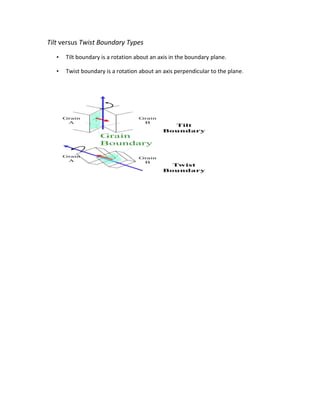
Tilt versus Twist Boundary Types 
• Tilt boundary is a rotation about an axis in the boundary plane. 
• Twist boundary is a rotation about an axis perpendicular to the plane.
9 Rotations at a Grain 
Boundary 
x 
z 
y 
gA 
-1 
gB In terms of orientations: 
rotate back from position A 
to the reference position. 
Then rotate to position B. 
Compound (“compose”) 
the two rotations to arrive 
at the net rotation between 
reference the two grains. 
position: 
(001)[100] 
-1 
Net rotation = gBgA 
NB: these are passive rotations 
10 
Alternate Diagram 
-1 
gA 
gB 
gC 
gD 
TJABC 
TJACB 
gBgA

Types of grain boundry

  • 1.
    Suez university Facultyof pet. &min. engineering Department of metallurgy&mat.science eng. Name :- Emad Saeed Mostafa Ali Yaer:- 4th year Report in :- types of grain boundry
  • 2.
    Why are grainboundaries interesting? • Grain boundaries vary a great deal in their characteristics (energy, mobility, chemistry). • Many properties of a material - and also processes of microstructural evolution - depend on the nature of the grain boundaries. • Materials can be made to have good or bad corrosion properties, mechanical properties (creep) depending on the type of grain boundaries present. • Some grain boundaries exhibit good atomic fit and are therefore resistant to sliding, show low diffusion rates, low energy, etc. What is a Grain Boundary? • Boundary between two grains. • Regular atomic packing disrupted at the boundary. • In most crystalline solids, a grain boundary is very thin (one/two atoms). • Disorder (broken bonds) unavoidable for geometrical reasons; therefore large excess free energy (0.1 - 1 J.m-2). Boundary Type • There are several ways of describing grain boundaries. • A traditional method (in materials science) uses the tilt-twist description. • A twist boundary is one in which one crystal has been twisted about an axis perpendicular to the boundary plane, relative to the other crystal. • A tilt boundary is one in which one crystal has been twisted about an axis that lies in the boundary plane, relative to the other crystal. • More general boundaries have a combination of tilt and twist. • The approach specifies all five degrees of freedom. • Contrast with more recent (EBSD inspired) method that describes only the misorientation between the two crystals.
  • 3.
    Tilt versus TwistBoundary Types • Tilt boundary is a rotation about an axis in the boundary plane. • Twist boundary is a rotation about an axis perpendicular to the plane.
  • 4.
    9 Rotations ata Grain Boundary x z y gA -1 gB In terms of orientations: rotate back from position A to the reference position. Then rotate to position B. Compound (“compose”) the two rotations to arrive at the net rotation between reference the two grains. position: (001)[100] -1 Net rotation = gBgA NB: these are passive rotations 10 Alternate Diagram -1 gA gB gC gD TJABC TJACB gBgA