Textbook: Phase transformations in metals and alloys
(Third Edition), By: Porter, Easterling, and Sherif (CRC
Press, 2009).
Diffusion and Kinetics
Lecture: Crystal Interfaces and Microstructure
Nikolai V. Priezjev
Crystal Interfaces and Microstructure
► Interfacial Free Energy
► Solid-Vapor Interfaces
► Boundaries in Single-Phase Solids
(1) Low- & High-Angle Boundaries (2) Special Boundaries (3) Kinetics
► Interphase Interfaces in Solids
► Interface Migration
Reading: Chapter 3 of Porter, Easterling, Sherif
https://www.slideshare.net/NikolaiPriezjev
Basic Interface Types
https://www.slideshare.net/NikolaiPriezjev
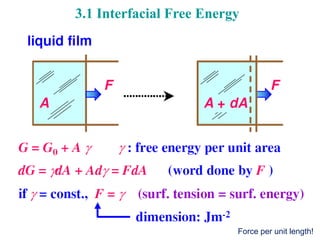
3.1 Interfacial Free Energy
Force per unit length!
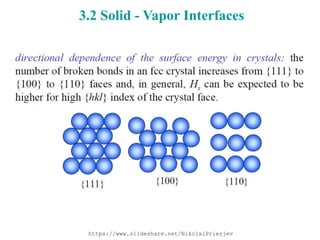
3.2 Solid - Vapor Interfaces
https://www.slideshare.net/NikolaiPriezjev
3.2 Solid - Vapor Interfaces
https://www.slideshare.net/NikolaiPriezjev
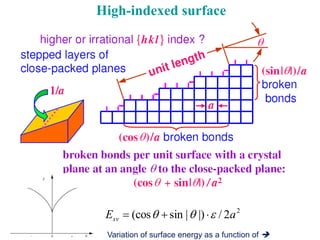
High-indexed surface
2
2/|)|sin(cos aEsv  
Variation of surface energy as a function of 
High-indexed surface:  - plot
Equilibrium Crystal Surfaces
Heating up to the roughening transition.
A salt crystal (NaCl),
at 710 C. The six faces
along the crystal lattice
directions are flat
A gold crystal
at about 1000 C
3.3 Boundaries in Single-Phase Solids: Tilt boundaries
https://www.slideshare.net/NikolaiPriezjev
3.3 Low-angle tilt boundaries
Top view:
https://www.slideshare.net/NikolaiPriezjev
3.3 Boundaries in Single-Phase Solids: Twist boundaries
https://www.slideshare.net/NikolaiPriezjev
3.3 Low-Angle Twist boundaries
low-angle twist boundary:
⚬ atoms in crystal below
boundary, • atoms in
crystal above boundary.
Screw dislocation
Large-angle grain boundaries
Disordered grain boundary structure (schematic).
Large- & low-angle boundaries
Rafts of soap bubbles showing several grains of varying misorientation. Note that the boundary with the
smallest misorientation is made up of a row of dislocations, whereas the high-angle boundaries have a
disordered structure in which individual dislocations cannot be identified.
3.3 Misorientation and boundary energy
Variation of grain boundary energy with misorientation (schematic).
random high-angle GBs
for low-angle
grain
boundaries
~ density of
dislocations
1/D~
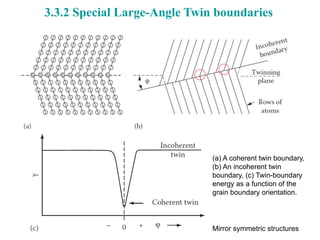
3.3.2 Special Large-Angle Twin boundaries
Twinned pyrite crystal group
Mirror symmetric structures
Nanotwin-governed toughening mechanism in hierarchically
structured biological materials. Shin et al. Nature 2016
Nanotwin-governed toughening mechanism in hierarchically
structured biological materials. Shin et al. Nature 2016
crack tip
opening
displacement
(CTOD)
transmission
electron
microscope
(TEM) images
aragonite
single crystal:
CaCO3
3.3.2 Special Large-Angle Twin boundaries
(a) A coherent twin boundary,
(b) An incoherent twin
boundary, (c) Twin-boundary
energy as a function of the
grain boundary orientation.
Mirror symmetric structures
3.3.2 Special Large-Angle Twin boundaries
Measured grain boundary energies for symmetric tilt boundaries in Al FCC (a) when
the rotation axis is parallel to 〈100〉, (b) when the rotation axis is parallel to 〈110〉.
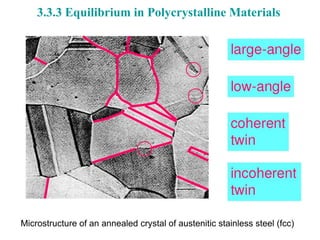
3.3.3 Equilibrium in Polycrystalline Materials
Microstructure of an annealed crystal of austenitic stainless steel (fcc)
3.3.3 Grains and grain boundaries
https://www.slideshare.net/NikolaiPriezjev
3.3.3 Grains and grain boundaries
https://www.slideshare.net/NikolaiPriezjev
3.3.3 Grains and grain boundaries
https://www.slideshare.net/NikolaiPriezjev
3.3.3 Grains and grain boundaries
3.3.3 Grains and grain boundaries: Curvature
Two-dimensional grain boundary configurations. The arrows indicate the
directions boundaries will migrate during grain growth. Grain coarsening.
R
P
4

 = const
 = 120
3.3.3 Grains and grain boundaries: Curvature
Two-dimensional cells of a soap solution illustrating the process of grain growth.
Air molecules in smaller cells diffuse through film into the larger cells. Numbers
are time in minutes.
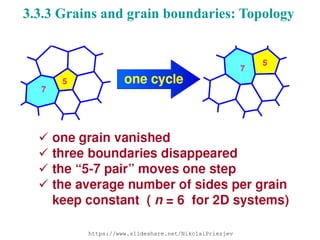
3.3.3 Grains and grain boundaries: Topology
https://www.slideshare.net/NikolaiPriezjev
3.3.3 Grains and grain boundaries: Topology
https://www.slideshare.net/NikolaiPriezjev
3.3.4 Thermally Activated Migration of GB
The atomic mechanism of boundary migration.
The boundary migrates to the left if the jump
rate from grain 1 → 2 is greater than 2 → 1.
Note that the free volume within the boundary
has been exaggerated for clarity.
The free energy of an atom during the
process of jumping from one grain to the
other.
r
V
G m

2

Gibbs-Thomson effect
mVGMv /
3.3.5 Kinetics of Grain Growth
https://www.slideshare.net/NikolaiPriezjev
3.3.5 Kinetics of Grain Growth
https://www.slideshare.net/NikolaiPriezjev
3.3.5 Kinetics of Grain Growth
Pure Me, high T
3.3.5 Kinetics of Grain Growth (in the presence of a second phase)
The effect of spherical particles on grain boundary migration.
Effect of second-phase particles on grain growth
Force from particle:
)45(sin)cos2( o
  rr
Dr
f
r
r
f
P



2
2
3
2
3
2

f
r
D
3
4
max 
particlesof
fractionvolumef
f
r
r
3
34
211
#



3.4 Interphase Interfaces in Solids
Strain-free coherent interfaces. (a) Each crystal has a different chemical composition
but the same crystal structure. (b) The two phases have different lattices. Interfacial
plane has the same atomic configuration in both phases, e.g., (111) fcc & (0001) hcp.
ch (coherent) A-B bonds
3.4 Interphase Interfaces in Solids
A coherent interface with slight mismatch
leads to coherency strains (or lattice
distortions) in the adjoining
lattices.
A semicoherent interface. The misfit
parallel to the interface is
accommodated by a series of edge
dislocations.



d
dd 


d
D 
mmJ500-200~
energylInterfacia
2-
A-B bonds
stch  ent)(semicoher
misfit dislocation
  Dst /1Interfacial energy:
3.4 Interphase Interfaces in Solids
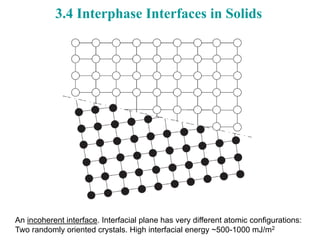
An incoherent interface. Interfacial plane has very different atomic configurations:
Two randomly oriented crystals. High interfacial energy ~500-1000 mJ/m2
3.4.2 Fully Coherent Precipitates
(a) A zone with no misfit (O Al, • Ag, for example), (b) Electron micrograph of Ag-rich
zones in an Al-4 atomic % Ag alloy (× 300 000), (After R.B. Nicholson, G. Thomas and
J. Nutting, Journal of the Institute of Metals, 87 (1958-1959) 431.)
Ag rich ~10nm fcc regions
https://www.slideshare.net/NikolaiPriezjev
3.4.2 Interphase Interfaces
A precipitate at a grain boundary triple point in an - Cu-In
alloy. Interfaces A and B are incoherent while C is semicoherent
(× 310). (After G.A. Chadwick, Metallography of Phase
Transformations, Butterworths, London, 1972.)
3.4.3 Second Phase Shape: Misfit Strain Effects
The origin of coherency strains. The number of lattice points in the hole is conserved..
minimum sii GA
Fully coherent precipitates
Elastic strain energy
Condition for mechanical equilibrium
VGs  2
4 
shear modulus of matrix unconstrained misfit
Interfacial energy
3.4.3 Second Phase Shape: Misfit Strain Effects
incoherent precipitates =
no coherency strains
The origin of misfit strain for an incoherent inclusion (no
lattice matching).
Volume misfit:
V
V

)/(
3
2 2
acfVGs  
shear modulus of matrix
The variation of misfit strain energy with ellipsoid shape
a
c
minimum sii GA
No coherency strains
3.4.3 Second Phase Shape: Coherency Loss
The total energy of matrix + precipitate versus
precipitate radius for spherical coherent and non-
coherent (semicoherent or incoherent) precipitates.
chs rrG   232
4
3
4
4
Coherent precipitates:
Non-coherent precipitates:
)(40 2
stchs rG  
Critical radius:
2
4
3

st
critr 
chemical
interfacial
energy
structural
interfacial
energy
(due to misfit
dislocations)
Assuming:  st

1
critr
coherency strains
3.4.4 Coherency Loss: Dislocation loop
Coherency loss for a spherical precipitate, (a) Coherent, (b) Coherency strains replaced
by dislocation loop, (c) In perspective.
semicoherent interfacecoherent interface
https://www.slideshare.net/NikolaiPriezjev
Lecture: Crystal Interfaces and Microstructure

Lecture: Crystal Interfaces and Microstructure

  • 1.
    Textbook: Phase transformationsin metals and alloys (Third Edition), By: Porter, Easterling, and Sherif (CRC Press, 2009). Diffusion and Kinetics Lecture: Crystal Interfaces and Microstructure Nikolai V. Priezjev
  • 2.
    Crystal Interfaces andMicrostructure ► Interfacial Free Energy ► Solid-Vapor Interfaces ► Boundaries in Single-Phase Solids (1) Low- & High-Angle Boundaries (2) Special Boundaries (3) Kinetics ► Interphase Interfaces in Solids ► Interface Migration Reading: Chapter 3 of Porter, Easterling, Sherif https://www.slideshare.net/NikolaiPriezjev
  • 3.
  • 4.
    3.1 Interfacial FreeEnergy Force per unit length!
  • 5.
    3.2 Solid -Vapor Interfaces https://www.slideshare.net/NikolaiPriezjev
  • 6.
    3.2 Solid -Vapor Interfaces https://www.slideshare.net/NikolaiPriezjev
  • 7.
    High-indexed surface 2 2/|)|sin(cos aEsv  Variation of surface energy as a function of 
  • 8.
  • 9.
    Equilibrium Crystal Surfaces Heatingup to the roughening transition. A salt crystal (NaCl), at 710 C. The six faces along the crystal lattice directions are flat A gold crystal at about 1000 C
  • 10.
    3.3 Boundaries inSingle-Phase Solids: Tilt boundaries https://www.slideshare.net/NikolaiPriezjev
  • 11.
    3.3 Low-angle tiltboundaries Top view: https://www.slideshare.net/NikolaiPriezjev
  • 12.
    3.3 Boundaries inSingle-Phase Solids: Twist boundaries https://www.slideshare.net/NikolaiPriezjev
  • 13.
    3.3 Low-Angle Twistboundaries low-angle twist boundary: ⚬ atoms in crystal below boundary, • atoms in crystal above boundary. Screw dislocation
  • 14.
    Large-angle grain boundaries Disorderedgrain boundary structure (schematic).
  • 15.
    Large- & low-angleboundaries Rafts of soap bubbles showing several grains of varying misorientation. Note that the boundary with the smallest misorientation is made up of a row of dislocations, whereas the high-angle boundaries have a disordered structure in which individual dislocations cannot be identified.
  • 16.
    3.3 Misorientation andboundary energy Variation of grain boundary energy with misorientation (schematic). random high-angle GBs for low-angle grain boundaries ~ density of dislocations 1/D~
  • 17.
    3.3.2 Special Large-AngleTwin boundaries Twinned pyrite crystal group Mirror symmetric structures
  • 18.
    Nanotwin-governed toughening mechanismin hierarchically structured biological materials. Shin et al. Nature 2016
  • 19.
    Nanotwin-governed toughening mechanismin hierarchically structured biological materials. Shin et al. Nature 2016 crack tip opening displacement (CTOD) transmission electron microscope (TEM) images aragonite single crystal: CaCO3
  • 20.
    3.3.2 Special Large-AngleTwin boundaries (a) A coherent twin boundary, (b) An incoherent twin boundary, (c) Twin-boundary energy as a function of the grain boundary orientation. Mirror symmetric structures
  • 21.
    3.3.2 Special Large-AngleTwin boundaries Measured grain boundary energies for symmetric tilt boundaries in Al FCC (a) when the rotation axis is parallel to 〈100〉, (b) when the rotation axis is parallel to 〈110〉.
  • 22.
    3.3.3 Equilibrium inPolycrystalline Materials Microstructure of an annealed crystal of austenitic stainless steel (fcc)
  • 23.
    3.3.3 Grains andgrain boundaries https://www.slideshare.net/NikolaiPriezjev
  • 24.
    3.3.3 Grains andgrain boundaries https://www.slideshare.net/NikolaiPriezjev
  • 25.
    3.3.3 Grains andgrain boundaries https://www.slideshare.net/NikolaiPriezjev
  • 26.
    3.3.3 Grains andgrain boundaries
  • 27.
    3.3.3 Grains andgrain boundaries: Curvature Two-dimensional grain boundary configurations. The arrows indicate the directions boundaries will migrate during grain growth. Grain coarsening. R P 4   = const  = 120
  • 28.
    3.3.3 Grains andgrain boundaries: Curvature Two-dimensional cells of a soap solution illustrating the process of grain growth. Air molecules in smaller cells diffuse through film into the larger cells. Numbers are time in minutes.
  • 29.
    3.3.3 Grains andgrain boundaries: Topology https://www.slideshare.net/NikolaiPriezjev
  • 30.
    3.3.3 Grains andgrain boundaries: Topology https://www.slideshare.net/NikolaiPriezjev
  • 31.
    3.3.4 Thermally ActivatedMigration of GB The atomic mechanism of boundary migration. The boundary migrates to the left if the jump rate from grain 1 → 2 is greater than 2 → 1. Note that the free volume within the boundary has been exaggerated for clarity. The free energy of an atom during the process of jumping from one grain to the other. r V G m  2  Gibbs-Thomson effect mVGMv /
  • 32.
    3.3.5 Kinetics ofGrain Growth https://www.slideshare.net/NikolaiPriezjev
  • 33.
    3.3.5 Kinetics ofGrain Growth https://www.slideshare.net/NikolaiPriezjev
  • 34.
    3.3.5 Kinetics ofGrain Growth Pure Me, high T
  • 35.
    3.3.5 Kinetics ofGrain Growth (in the presence of a second phase) The effect of spherical particles on grain boundary migration. Effect of second-phase particles on grain growth Force from particle: )45(sin)cos2( o   rr Dr f r r f P    2 2 3 2 3 2  f r D 3 4 max  particlesof fractionvolumef f r r 3 34 211 #   
  • 36.
    3.4 Interphase Interfacesin Solids Strain-free coherent interfaces. (a) Each crystal has a different chemical composition but the same crystal structure. (b) The two phases have different lattices. Interfacial plane has the same atomic configuration in both phases, e.g., (111) fcc & (0001) hcp. ch (coherent) A-B bonds
  • 37.
    3.4 Interphase Interfacesin Solids A coherent interface with slight mismatch leads to coherency strains (or lattice distortions) in the adjoining lattices. A semicoherent interface. The misfit parallel to the interface is accommodated by a series of edge dislocations.    d dd    d D  mmJ500-200~ energylInterfacia 2- A-B bonds stch  ent)(semicoher misfit dislocation   Dst /1Interfacial energy:
  • 38.
    3.4 Interphase Interfacesin Solids An incoherent interface. Interfacial plane has very different atomic configurations: Two randomly oriented crystals. High interfacial energy ~500-1000 mJ/m2
  • 39.
    3.4.2 Fully CoherentPrecipitates (a) A zone with no misfit (O Al, • Ag, for example), (b) Electron micrograph of Ag-rich zones in an Al-4 atomic % Ag alloy (× 300 000), (After R.B. Nicholson, G. Thomas and J. Nutting, Journal of the Institute of Metals, 87 (1958-1959) 431.) Ag rich ~10nm fcc regions https://www.slideshare.net/NikolaiPriezjev
  • 40.
    3.4.2 Interphase Interfaces Aprecipitate at a grain boundary triple point in an - Cu-In alloy. Interfaces A and B are incoherent while C is semicoherent (× 310). (After G.A. Chadwick, Metallography of Phase Transformations, Butterworths, London, 1972.)
  • 41.
    3.4.3 Second PhaseShape: Misfit Strain Effects The origin of coherency strains. The number of lattice points in the hole is conserved.. minimum sii GA Fully coherent precipitates Elastic strain energy Condition for mechanical equilibrium VGs  2 4  shear modulus of matrix unconstrained misfit Interfacial energy
  • 42.
    3.4.3 Second PhaseShape: Misfit Strain Effects incoherent precipitates = no coherency strains The origin of misfit strain for an incoherent inclusion (no lattice matching). Volume misfit: V V  )/( 3 2 2 acfVGs   shear modulus of matrix The variation of misfit strain energy with ellipsoid shape a c minimum sii GA No coherency strains
  • 43.
    3.4.3 Second PhaseShape: Coherency Loss The total energy of matrix + precipitate versus precipitate radius for spherical coherent and non- coherent (semicoherent or incoherent) precipitates. chs rrG   232 4 3 4 4 Coherent precipitates: Non-coherent precipitates: )(40 2 stchs rG   Critical radius: 2 4 3  st critr  chemical interfacial energy structural interfacial energy (due to misfit dislocations) Assuming:  st  1 critr coherency strains
  • 44.
    3.4.4 Coherency Loss:Dislocation loop Coherency loss for a spherical precipitate, (a) Coherent, (b) Coherency strains replaced by dislocation loop, (c) In perspective. semicoherent interfacecoherent interface https://www.slideshare.net/NikolaiPriezjev