NAMING & IMPORTANCE OF
BRANDS,TYPES OF BRANDS
PRESENTED BY-
VAISHALI SEHRAWAT
MBA 4 SEM
02811403918
Why Brand?
Why do companies such as Coca-Cola,
Microsoft, IBM and Disney seem to achieve
global marketing success so easily? Why
does it seem such an effort for others?
Why do we, as consumers, feel loyal to
such brands that the mere sight of their
logo has us reaching into our pockets to
buy their products?
The meaning of brands
Brands are a means of differentiating a
company’s products and services from those of
its competitors.
There is plenty of evidence to prove that
customers will pay a substantial price
premium for a good brand and remain
loyal to that brand. It is important,
therefore, to understand what brands are
and why they are important.
n
The Importance of Brands
 McDonalds sums this up nicely in the
following quote emphasizing the
importance of brands:
 “…it is not factories that make profits, but
relationships with customers, and it is company and
brand names which secure thoserelationships”
 Businesses that invest in and sustain leading
brands prosper whereas those that fail are left to
fight for the lower profits available in commodity
markets.
Coca-Cola
“If Coca-Cola were to lose all of its production-
related assets in a disaster, the company would
survive. By contrast, if all consumers were to
have a sudden lapse of memory and forget
everything related to Coca-Cola the company
would go out ofbusiness.”
What is a brand?
One definition of a brand is as follows:
“A name, term, sign, symbol or design, or a
combination of these, that is intended to identify
the goods and services of one business or group of
businesses and to differentiate them from thoseof
competitors”.
Interbrand - a leading branding consultancy -
define a brand in this way:
“A mixture of tangible and intangible attributes
symbolized in a trademark, which, ifproperly
managed, creates influence and generatesvalue”.
“Brand equity” refers to the value of a
brand. Brand equity is based on the
extent to which the brand has high
brand
loyalty, name awareness, perceived quality
and strong product associations. Brand
equity also includes other “intangible”assets
such as patents, trademarks and channel
relationships.
Brand Equity
Brand image
“Brand image” refers to the set of
beliefs that customers hold
about a particular brand. These
are important to develop well
since a negative brand image
can be very difficult to shake off.
Brand extension
“Brand extension” refers to the use of a
successful brand name to launch a new or
modified product in a new market. Virgin is
perhaps the best example of how brand
extension can be applied into quite diverse
and distinct markets.
Branding gives the SELLER
several advantages
Seller’s brand name and trademark provide
legal protection of unique product features
Branding gives the seller the opportunity to
attract a loyal and profitable set of customers.
Branding helps the seller segment markets.
Strong brands help build corporate image,
making it easier to launch new brands and gain
acceptance by distributors and consumers.
Benefits of Branding to A BUYER
Help buyers identify the product that they
like/dislike.
Identify marketer
Helps reduce the time needed for purchase.
Helps buyers evaluate quality of products
especially if unable to judge a products
characteristics.
Helps reduce buyers perceived risk of purchase.
Buyer may derive a psychological reward from
owning the brand, i.e. Rolex or Mercedes.
An Effective Brand Name
● Is easy to pronounce
● Is easy to recognize and
remember
● Is short, distinctive, and unique
● Has a positive connotation
● Reinforces the product image
● Is legally protectable
Types of brands
There are two main types of brand –manufacturer
brands and own-label brands.
Manufacturer brands
Manufacturer brands are created by producers and
bear their chosen brand name. The producer is
responsible for marketing the brand. The brand is owned
by the producer.
By building their brand names, manufacturers can
gain widespread distribution (for example by
retailers who want to sell the brand) and build customer
loyalty (think about the manufacturer brands that you feel
“loyal”to).
Advantages of Manufacturers’Brands
Develop customer loyalty
Attract new customers
Enhance prestige
Ensure dealer loyalty
Private Label brands
Own-label brands are created and owned by
businesses that operate in the distribution
channel – often referred to as“distributors”.
Often these distributors are retailers, but not
exclusively. Sometimes the retailer’s entire product
range will be own- label. Own-label branding – if
well carried out – can often offer the consumer
excellent value for money and provide the
distributor with additional bargaining power when it
comes to negotiating prices and terms with
manufacturer brands.
Manufacturers’ Brands
Versus Private Brands
Private
Brand
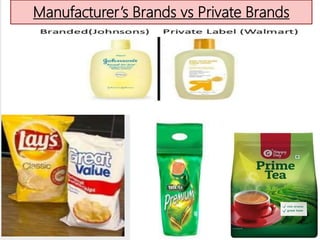
The brand name of a
manufacturer. Eg TATA tea
A brand name owned by a
wholesaler or a retailer.Also
known as a private label or store
brand.Eg Grofers tea
Manufacturer’s
Brand
Advantages of Private Brands
 Earn higher profits
 Less pressure to mark down
prices
 Ties customer to wholesaler
or retailer
Manufacturer’s Brands vs Private Brands
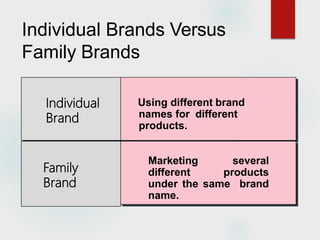
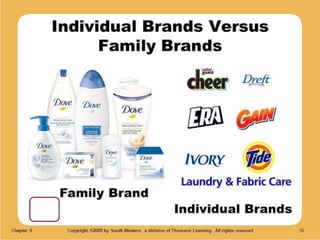
Individual Brands Versus
Family Brands
Using different brand
names for different
products.
Marketing several
different products
under the same brand
name.
Individual
Brand
Family
Brand
Branding Policies
First question is whether to brand or not to
brand. Homogenous products are difficult to
brand Branding policies are:
Individual Branding: Naming each product differently
P&G, facilitates market segmentation and no overlap.
Overall Family Branding: All products are branded with
the same name, or part of a name, IE Nokia,
promotion of one item also promotes other items.
Line Family Branding: Within one product line.
Brand Extension Branding: Use one of its existing
brand names as part of a brand for an improved or
new product, usually in the same product category.
75% new products are brand extensions!!
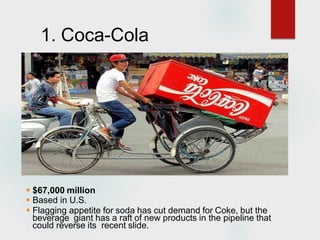
1. Coca-Cola
 $67,000 million
 Based in U.S.
 Flagging appetite for soda has cut demand for Coke, but the
beverage giant has a raft of new products in the pipeline that
could reverse its recent slide.
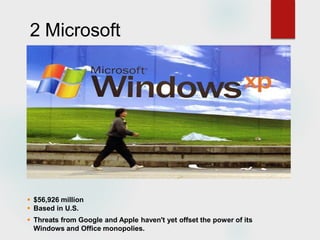
2 Microsoft
 $56,926 million
 Based in U.S.
 Threats from Google and Apple haven't yet offset the power of its
Windows and Office monopolies.
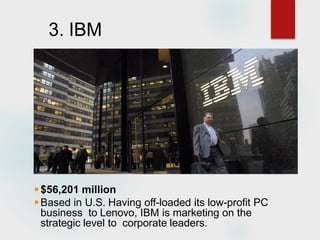
3. IBM
$56,201 million
Based in U.S. Having off-loaded its low-profit PC
business to Lenovo, IBM is marketing on the
strategic level to corporate leaders.
Brand ppt

Brand ppt

  • 1.
    NAMING & IMPORTANCEOF BRANDS,TYPES OF BRANDS PRESENTED BY- VAISHALI SEHRAWAT MBA 4 SEM 02811403918
  • 2.
    Why Brand? Why docompanies such as Coca-Cola, Microsoft, IBM and Disney seem to achieve global marketing success so easily? Why does it seem such an effort for others? Why do we, as consumers, feel loyal to such brands that the mere sight of their logo has us reaching into our pockets to buy their products?
  • 3.
    The meaning ofbrands Brands are a means of differentiating a company’s products and services from those of its competitors. There is plenty of evidence to prove that customers will pay a substantial price premium for a good brand and remain loyal to that brand. It is important, therefore, to understand what brands are and why they are important.
  • 5.
  • 7.
    The Importance ofBrands  McDonalds sums this up nicely in the following quote emphasizing the importance of brands:  “…it is not factories that make profits, but relationships with customers, and it is company and brand names which secure thoserelationships”  Businesses that invest in and sustain leading brands prosper whereas those that fail are left to fight for the lower profits available in commodity markets.
  • 8.
    Coca-Cola “If Coca-Cola wereto lose all of its production- related assets in a disaster, the company would survive. By contrast, if all consumers were to have a sudden lapse of memory and forget everything related to Coca-Cola the company would go out ofbusiness.”
  • 9.
    What is abrand? One definition of a brand is as follows: “A name, term, sign, symbol or design, or a combination of these, that is intended to identify the goods and services of one business or group of businesses and to differentiate them from thoseof competitors”. Interbrand - a leading branding consultancy - define a brand in this way: “A mixture of tangible and intangible attributes symbolized in a trademark, which, ifproperly managed, creates influence and generatesvalue”.
  • 10.
    “Brand equity” refersto the value of a brand. Brand equity is based on the extent to which the brand has high brand loyalty, name awareness, perceived quality and strong product associations. Brand equity also includes other “intangible”assets such as patents, trademarks and channel relationships. Brand Equity
  • 11.
    Brand image “Brand image”refers to the set of beliefs that customers hold about a particular brand. These are important to develop well since a negative brand image can be very difficult to shake off.
  • 12.
    Brand extension “Brand extension”refers to the use of a successful brand name to launch a new or modified product in a new market. Virgin is perhaps the best example of how brand extension can be applied into quite diverse and distinct markets.
  • 13.
    Branding gives theSELLER several advantages Seller’s brand name and trademark provide legal protection of unique product features Branding gives the seller the opportunity to attract a loyal and profitable set of customers. Branding helps the seller segment markets. Strong brands help build corporate image, making it easier to launch new brands and gain acceptance by distributors and consumers.
  • 14.
    Benefits of Brandingto A BUYER Help buyers identify the product that they like/dislike. Identify marketer Helps reduce the time needed for purchase. Helps buyers evaluate quality of products especially if unable to judge a products characteristics. Helps reduce buyers perceived risk of purchase. Buyer may derive a psychological reward from owning the brand, i.e. Rolex or Mercedes.
  • 15.
    An Effective BrandName ● Is easy to pronounce ● Is easy to recognize and remember ● Is short, distinctive, and unique ● Has a positive connotation ● Reinforces the product image ● Is legally protectable
  • 16.
    Types of brands Thereare two main types of brand –manufacturer brands and own-label brands. Manufacturer brands Manufacturer brands are created by producers and bear their chosen brand name. The producer is responsible for marketing the brand. The brand is owned by the producer. By building their brand names, manufacturers can gain widespread distribution (for example by retailers who want to sell the brand) and build customer loyalty (think about the manufacturer brands that you feel “loyal”to).
  • 17.
    Advantages of Manufacturers’Brands Developcustomer loyalty Attract new customers Enhance prestige Ensure dealer loyalty
  • 18.
    Private Label brands Own-labelbrands are created and owned by businesses that operate in the distribution channel – often referred to as“distributors”. Often these distributors are retailers, but not exclusively. Sometimes the retailer’s entire product range will be own- label. Own-label branding – if well carried out – can often offer the consumer excellent value for money and provide the distributor with additional bargaining power when it comes to negotiating prices and terms with manufacturer brands.
  • 19.
    Manufacturers’ Brands Versus PrivateBrands Private Brand The brand name of a manufacturer. Eg TATA tea A brand name owned by a wholesaler or a retailer.Also known as a private label or store brand.Eg Grofers tea Manufacturer’s Brand
  • 20.
    Advantages of PrivateBrands  Earn higher profits  Less pressure to mark down prices  Ties customer to wholesaler or retailer
  • 21.
  • 22.
    Individual Brands Versus FamilyBrands Using different brand names for different products. Marketing several different products under the same brand name. Individual Brand Family Brand
  • 26.
    Branding Policies First questionis whether to brand or not to brand. Homogenous products are difficult to brand Branding policies are: Individual Branding: Naming each product differently P&G, facilitates market segmentation and no overlap. Overall Family Branding: All products are branded with the same name, or part of a name, IE Nokia, promotion of one item also promotes other items. Line Family Branding: Within one product line. Brand Extension Branding: Use one of its existing brand names as part of a brand for an improved or new product, usually in the same product category. 75% new products are brand extensions!!
  • 27.
    1. Coca-Cola  $67,000million  Based in U.S.  Flagging appetite for soda has cut demand for Coke, but the beverage giant has a raft of new products in the pipeline that could reverse its recent slide.
  • 28.
    2 Microsoft  $56,926million  Based in U.S.  Threats from Google and Apple haven't yet offset the power of its Windows and Office monopolies.
  • 29.
    3. IBM $56,201 million Basedin U.S. Having off-loaded its low-profit PC business to Lenovo, IBM is marketing on the strategic level to corporate leaders.