Submitted by :Amanpreet kaur
1.Logos
2.Branding
How to Build a strong Brand
3.Why consumers buy brands
4.Branding strategy
5.Features of Branding
6.Advantages of Branding6.Advantages of Branding
• Benefit to marketers
• Benefit to customers
7.Brand Strategy7.Brand Strategy
1.Single Brand Strategy.
2.Multi Brand Strategy.
3.Distributor or private brand Strategy.
4.Mixed Brand Strategy.
5.Trading Up and Trading down strategy
8.What Is Brand Equity?
9..Brand equity and Brand Loyalty.
• Simply put, your brand
strategy will help define how
your customers see your
business and product.
• Branding your business is one ofyour business is one of
the most important steps inthe most important steps in
building a companybuilding a company. It gives your
company a unique personality, and
establishes a differentiated position in
the market that attracts the right
customers.
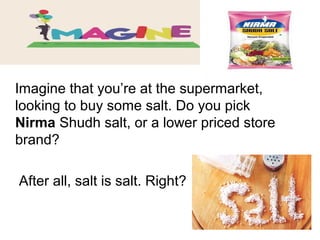
Imagine that you’re at the supermarket,
looking to buy some salt. Do you pick
Nirma Shudh salt, or a lower priced store
brand?
After all, salt is salt. Right?
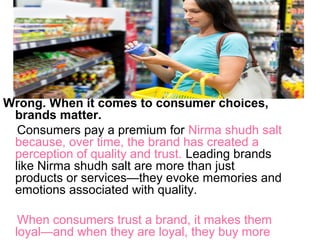
Wrong. When it comes to consumer choices,
brands matter.
Consumers pay a premium for Nirma shudh salt
because, over time, the brand has created a
perception of quality and trust. Leading brands
like Nirma shudh salt are more than just
products or services—they evoke memories and
emotions associated with quality.
When consumers trust a brand, it makes them
loyal—and when they are loyal, they buy more
How to Build a strong Brand
• 1. Determine your brand’s target
audience.
2. Define a brand mission
statement.
• Before you can build a brand that your
target audience trusts, you need to know
what value your business provides.
We all know the Nike tagline: Just Do It.
Nike’s mission is: “To bring inspiration
and innovation to every athlete in the
world“
• Nike goes even further with their brand
mission, by adding a footnote to the
statement: “If you have a body, you are
an athlete“. Think about how wide their
target audience becomes with a disclaimer
like that!
• The company has built up such a
reputation and brand following, that they
are able to increase their target to
accommodate every “body”.
3. Research brands within your
industry niche.
• The goal is to differentiate from the
competition. Convince a customer to
purchase from you over them!
• Research your main competitors or
benchmark brands. Study how they have
effectively, and ineffectively gone about
building a brand name
•Is the
competitor
consistent
with
messaging
and visual
identity
across
channels?
•What is
the quality
of the
competitor’
s products
or
services?
•Does the
competitor
have custo
mer
reviews
you can
read, or
social
mentions
about
them?
•In what
ways does
the
competitor
market
their
business,
both online
and
offline?
4. Outline the key qualities &
benefits your brand offers.
• Focus on the qualities and benefits that
make your company branding
unique
• Assuming you know exactly who your
target audience is (see Step 1), give
them a reason to choose your brand
over another.
• From unique packaging to their
announcement events, Apple always
reminds customers that its
products can be used right out of
the box.
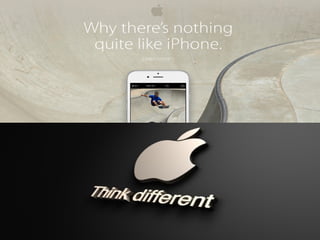
• Do you remember Apple’s slogan back in
1997-2002? It was “Think Different“.
This notion continues to exist, today.
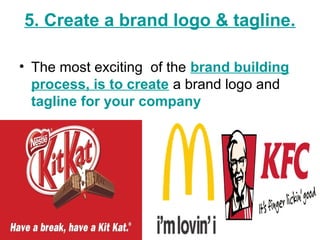
5. Create a brand logo & tagline.
• The most exciting of the brand building
process, is to create a brand logo and
tagline for your company
6.Build a brand message and
elevator pitch.
• Most importantly: when creating a
brand message, address not what
your product can do…but why it is
important to your customer.
• Make it simple and clear.
7.Stay true to your brand
building.
• Don’t constantly change your branding. The
inconsistency will confuse your customers, and make
long-term brand building more difficult.
• Starbucks is the world’s leading specialty coffee
retailer, and their brand has always promised to bring
people together.
• The Starbucks mission?
• “To inspire and nurture the human spirit – one person,
one cup and one neighborhood at a time.”
• Even despite a logo change in 2011 (removing the
company name!), the Starbucks brand perception
remains strong.
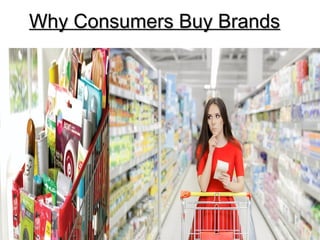
Why Consumers Buy BrandsWhy Consumers Buy Brands
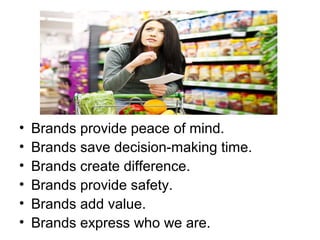
• Brands provide peace of mind.
• Brands save decision-making time.
• Brands create difference.
• Brands provide safety.
• Brands add value.
• Brands express who we are.
• The process involved in creating a unique
name and image for a product in the
consumers' mind, mainly through
advertising campaigns with a consistent
theme. Branding aims to establish a
significant and differentiated presence in
the market that attracts and retains loyal
customers.
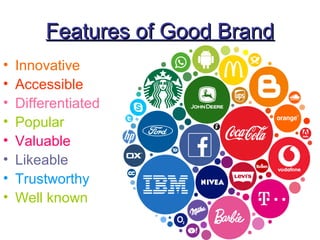
Features of Good BrandFeatures of Good Brand
• Innovative
• Accessible
• Differentiated
• Popular
• Valuable
• Likeable
• Trustworthy
• Well known
Advantages of BrandingAdvantages of Branding
Benefits to MarketersBenefits to Marketers
• A strong brand offers many advantages for marketersA strong brand offers many advantages for marketers
includingincluding:
• Enhances Product RecognitionEnhances Product Recognition – Brands provide multiple sensory stimuli
to enhance customer recognition. For example, a brand can be visually
recognizable from its packaging, logo, shape, etc. It can also be
recognizable via sound, such as hearing the name on a radio advertisement
or talking with someone who mentions the product.
• Helps Build Brand LoyaltyHelps Build Brand Loyalty – Customers who are frequent and enthusiastic
purchasers of a particular brand are likely to become Brand Loyal.
Cultivating brand loyalty among customers is the ultimate reward for
successful marketers since these customers are far less likely to be enticed
to switch to other brands compared to non-loyal customers.
• Helps With Product PositioningHelps With Product Positioning – Well-developed and promoted brands
make product positioning efforts more effective. The result is that upon
exposure to a brand (e.g., hearing it, seeing it) customers conjure up mental
images or feelings of the benefits they receive from using that brand. The
reverse is even better. When customers associate benefits with a particular
brand, the brand may have attained a significant competitive advantage. In
these situations the customer who recognizes he needs a solution to a
problem (e.g., needs to bleach clothes) may automatically think of one
brand that offers the solution to the problem (e.g., Clorox). This “benefit =
brand” association provides a significant advantage for the brand that the
customer associates with the benefit sought.
• Aids in Introduction of New ProductsAids in Introduction of New Products – Firms that establish a successful
brand can extend the brand by adding new products under the same
“family” brand. Such branding may allow companies to introduce new
products more easily since the brand is already recognized within the
market.
Benefits to ProducerBenefits to Producer
• i) Brand name helps in advertising in an easier way.
• (ii) Brand name establishes the permanent identity of
the product.
• (iii) Brand name promotes repurchasing.
• (iv) Competition becomes easier with the help of
brand loyalty.
Benefits to customerBenefits to customer
• (i) Shopping consumes lesser time as
branded products can be easily identified.
• (ii) The quality of branded product is
undoubtedly better.
• (iii) Prices of branded products are fixed
by the companies themselves and there
are no frequent changes.
• (iv) It helps in an easy identification of
products
BRAND STRATEGIBRAND STRATEGI
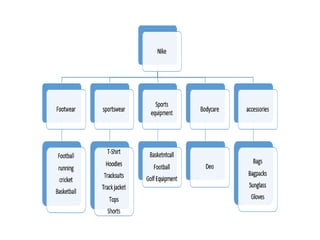
• Single Brand Products strategySingle Brand Products strategy
Single brand retail, as the name suggests is
selling all products under a single brand
name only. Easy examples could be names
like Nike, Sony, Maruti, Mother Diary, Wills
lifestyle etc.
Multi Brand StrategyMulti Brand Strategy
• Marketing of more than two competing
and almost identical products, that
belongs to a single organization and is
filled under different and unrelated brands,
is called multi-branding
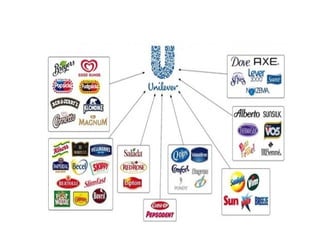
Unilever – Is the biggest manufacturer of ice-cream and
a multinational consumer goods company, that also
produces several worldwide brands. For instance ,pears,
lifeboy, Rexona, Sunsilk, Dove, Lipton and many more.
Distributor’s or Private BrandDistributor’s or Private Brand
StrategyStrategy
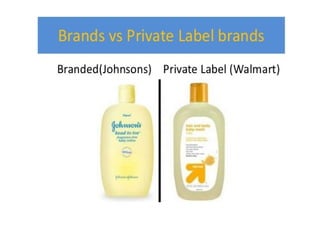
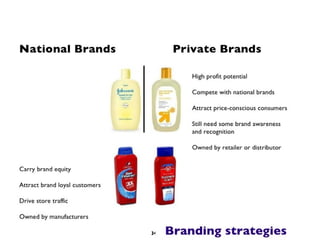
• A private or distributor brand, or own label
brand refers to a brand that is
designated,owned and used by a
wholesaler or retailer.
The manufacturer could also sell to resellers who give the
product a private brand. This is also called a store brand, a
distributor brand or an own-label. Recent tougher economic
times have created a real store-brand boom. As consumers
become more price-conscious, they also become less brand-
conscious, and are willing to choose private brands instead of
established and often more expensive manufacturer’s brands.
Licensed Brand strategyLicensed Brand strategy
• manufacturers can choose licensed brands. Instead of
spending millions to create own brand names, some
companies license names or symbols previously created
by other manufacturers. This can also involve names of
well-known celebrities or characters from popular movies
and books. For a fee, they can provide an instant and
proven brand name.
• For example, sellers of children’s products often attach
character names to clothing, toys and so on. These
licensed character names include Disney, Star Wars,
Hello Kitty and many more.
Co Brand Strategy and MixedCo Brand Strategy and Mixed
brand strategybrand strategy
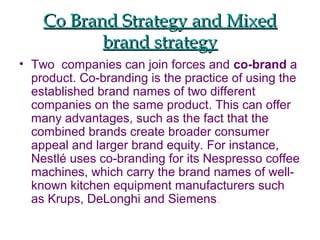
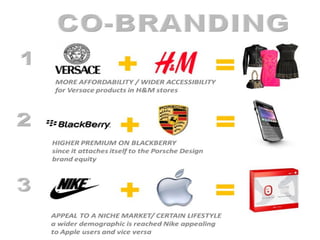
• Two companies can join forces and co-brand a
product. Co-branding is the practice of using the
established brand names of two different
companies on the same product. This can offer
many advantages, such as the fact that the
combined brands create broader consumer
appeal and larger brand equity. For instance,
Nestlé uses co-branding for its Nespresso coffee
machines, which carry the brand names of well-
known kitchen equipment manufacturers such
as Krups, DeLonghi and Siemens.
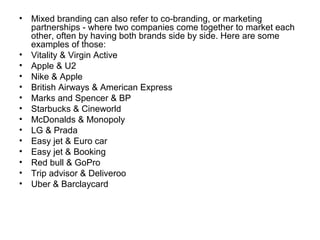
• Mixed branding can also refer to co-branding, or marketing
partnerships - where two companies come together to market each
other, often by having both brands side by side. Here are some
examples of those:
• Vitality & Virgin Active
• Apple & U2
• Nike & Apple
• British Airways & American Express
• Marks and Spencer & BP
• Starbucks & Cineworld
• McDonalds & Monopoly
• LG & Prada
• Easy jet & Euro car
• Easy jet & Booking
• Red bull & GoPro
• Trip advisor & Deliveroo
• Uber & Barclaycard
Trading Up and Trading down strategyTrading Up and Trading down strategy
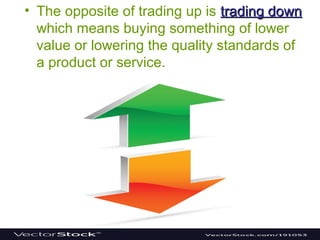
• Trading UpTrading Up refers to buying something superior
than what one already has. It also means
improving the quality, increasing the number of
features or providing superior level of service
which could justify higher price. It also means
increasing the features of a product, enhancing
its quality or supporting it with better quality of
service to support its increased price
• The opposite of trading up is trading downtrading down
which means buying something of lower
value or lowering the quality standards of
a product or service.
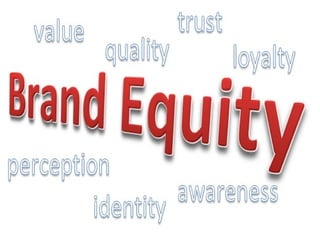
What Is Brand Equity?
• The American Marketing Association
defines brand equity this way: from a
consumer perspective, brand equity isbrand equity is
based on consumer attitudes aboutbased on consumer attitudes about
positive brand attributes and favorablepositive brand attributes and favorable
consequences of brand useconsequences of brand use.
• Brand equity in the positive form can help
a company in many ways. A common
benefit that typically results is the financial
benefit, which allows for a company to
demand a premium price for its product.
• The outcome from this is that marketing
budgets have more strategic flexibility and
require less investment. A company withA company with
positive brand equity finds itself betterpositive brand equity finds itself better
positioned for success because customerspositioned for success because customers
have special connections and loyalties tohave special connections and loyalties to
its brand.its brand. This enables companies to
maneuver through dynamic market
challenges better than companies with
less equity in their brands.
Examples of Positive Brand
Equity
• Apple, ranked by one organization as “the world’s most
popular brand” in 2015, is a classic example of a brand
with positive equity. The company built its positive
reputation with Mac computers before extending the
brand to iPhones, which deliver on the brand promise
expected by Apple’s computer customers.
• On a smaller scale, regional supermarket chain
Wegmans has so much brand equity that when stores
open in new territories, the brand reputation generates
crowds so large that police have to direct traffic in and
out of store parking lots
Negative
Examples of Negative Brand
Equity
• Financial brand Goldman Sachs lost brand value when
the public learned of its role in the 2008 financial crisis,
automaker Toyota suffered in 2009 when it had to
recall more than 8 million vehicles because of
unintended acceleration, and oil and gas company BP
lost significant brand equity after the U.S. Gulf of Mexico
oil spill in 2010.
• Achieving positive brand equity is half the job;
maintaining it consistently is the other half. As
Chipotle’s 2015 food poisoning crisis indicates, one
negative incident can nearly eliminate years of
favorable brand equity.
How Brand Equity Develops
Brand equity develops and
grows as a result of a
customer’s experiences with
the brand. The process
typically involves that
customer or consumer’s
natural relationship with the
brand that unfolds following a
predictable model:
• Awareness – The brand is introduced to its
target audience – often with advertising – in a
way that gets it noticed.
• Recognition – Customers become familiar with
the brand and recognize it in a store or
elsewhere.
• Trial – Now that they recognize the brand and
know what it is or stands for, they try it.
• Preference – When the consumer has a good
experience with the brand, it becomes the
preferred choice.
• Loyalty – After a series of good brand
experiences, users not only recommend it to
others, it becomes the only one they will buy and
use in that category. They think so highly of it
that any product associated with the brand
benefits from its positive glow.
The most important components
of brand equity are the following
• Brand Recognition
• Brand Awareness
• Customer Experience
• Customer Preference
• Customer Retention
• Perceived Quality
• USP
Brand RecognitionBrand Recognition
When you mention a brand like Lexus, Google, Kraft, or
Microsoft, you instantly recognize it. Those brands
have become household names and
therefore carry significant brand equity.
Of course, you don’t need to become a household name
to have brand equity. In Knowledge Commerce, you
need brand recognition among your target
audience rather than society as a whole.
Brand Awareness
• Many people confused brand recognition
and brand awareness. The latter is similar
to the former, but takes the concept a step
further.
• You might recognize many brands, from
car manufacturers to housecleaning
companies. However, you might not know
exactly what those businesses provide or
what makes them special.
Customer Experience
• Negative customer experience can have
significant repercussions for a business's brand
equity, just as a positive customer experience
can improve brand equity. Customer experience
refers to the customer's perception of the
product or service.
• A good customer experience typically involves
easy operation or usage of the product as well
as positive results after interaction with the
product.
Consumer Preference
• When your customers routinely choose your
products over those of your competitors, your
brand equity skyrockets. Customer preference
plays a big role in how a company is perceived
by the general public and by a specific target
market.
• For instance, maybe you like Lucky Charms, but
You also like Raisin Bran. If you buy Lucky
Charms more often than Raisin Bran, you are
showing preference for Lucky Charms.
Customer Retention
• Customer retention follows customer preference.
If your customers prefer your products over
those of your competitors, they will keep coming
back for more.
• Each time you release a new online course or
other digital product, your customers will want to
take advantage of the offer and find out what
benefits they can glean from the product. That's
good news when it comes to brand equity.
Perceived Quality
• Perceived quality refers to the amount of money
a customer believes that a product is worth
rather than the actual price tag on the product.
You might have heard someone say, for
example, "I would buy that if it were $20 less
expensive."
• That's an example of negative brand equity. The
customer does not believe that the cost
assigned to the product by the company is
appropriate for the product's ability to deliver
value.
USP
• A company isn't worth much without a USP. A
unique selling proposition is a differentiating
factor that sets apart one product from its
competitors.
• Many entrepreneurs mistake a USP for a feature
or benefit. That's not what a USP should be.
• Instead, your USP should represent your raison
d'être — the reason your company and products
exist. It's the motivation that drives you to work
on your digital products day in and day out and
to consistently deliver value to your customers.
Brand equity and Brand LoyaltyBrand equity and Brand Loyalty
• Brand equity refers to the value of a brand
• Brand equity' is a phrase used in the marketing
industry which describes the value of having a
well-known brand name, based on the idea that
the owner of a well-known brand name can
generate more revenue simply from
brand recognition; that is from products with that
brand name than from products with a less well
known name, as consumers believe that a
product with a well-known name is better than
products with less well-known names
Branding

Branding

  • 1.
  • 2.
    1.Logos 2.Branding How to Builda strong Brand 3.Why consumers buy brands 4.Branding strategy 5.Features of Branding 6.Advantages of Branding6.Advantages of Branding • Benefit to marketers • Benefit to customers 7.Brand Strategy7.Brand Strategy 1.Single Brand Strategy. 2.Multi Brand Strategy. 3.Distributor or private brand Strategy. 4.Mixed Brand Strategy. 5.Trading Up and Trading down strategy 8.What Is Brand Equity? 9..Brand equity and Brand Loyalty.
  • 6.
    • Simply put,your brand strategy will help define how your customers see your business and product.
  • 7.
    • Branding yourbusiness is one ofyour business is one of the most important steps inthe most important steps in building a companybuilding a company. It gives your company a unique personality, and establishes a differentiated position in the market that attracts the right customers.
  • 8.
    Imagine that you’reat the supermarket, looking to buy some salt. Do you pick Nirma Shudh salt, or a lower priced store brand? After all, salt is salt. Right?
  • 9.
    Wrong. When itcomes to consumer choices, brands matter. Consumers pay a premium for Nirma shudh salt because, over time, the brand has created a perception of quality and trust. Leading brands like Nirma shudh salt are more than just products or services—they evoke memories and emotions associated with quality. When consumers trust a brand, it makes them loyal—and when they are loyal, they buy more
  • 11.
    How to Builda strong Brand • 1. Determine your brand’s target audience.
  • 15.
    2. Define abrand mission statement. • Before you can build a brand that your target audience trusts, you need to know what value your business provides. We all know the Nike tagline: Just Do It. Nike’s mission is: “To bring inspiration and innovation to every athlete in the world“
  • 16.
    • Nike goeseven further with their brand mission, by adding a footnote to the statement: “If you have a body, you are an athlete“. Think about how wide their target audience becomes with a disclaimer like that! • The company has built up such a reputation and brand following, that they are able to increase their target to accommodate every “body”.
  • 17.
    3. Research brandswithin your industry niche. • The goal is to differentiate from the competition. Convince a customer to purchase from you over them! • Research your main competitors or benchmark brands. Study how they have effectively, and ineffectively gone about building a brand name
  • 18.
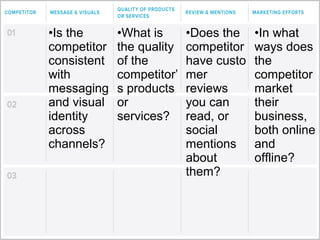
    •Is the competitor consistent with messaging and visual identity across channels? •Whatis the quality of the competitor’ s products or services? •Does the competitor have custo mer reviews you can read, or social mentions about them? •In what ways does the competitor market their business, both online and offline?
  • 19.
    4. Outline thekey qualities & benefits your brand offers. • Focus on the qualities and benefits that make your company branding unique • Assuming you know exactly who your target audience is (see Step 1), give them a reason to choose your brand over another.
  • 21.
    • From uniquepackaging to their announcement events, Apple always reminds customers that its products can be used right out of the box. • Do you remember Apple’s slogan back in 1997-2002? It was “Think Different“. This notion continues to exist, today.
  • 22.
    5. Create abrand logo & tagline. • The most exciting of the brand building process, is to create a brand logo and tagline for your company
  • 23.
    6.Build a brandmessage and elevator pitch. • Most importantly: when creating a brand message, address not what your product can do…but why it is important to your customer. • Make it simple and clear.
  • 24.
    7.Stay true toyour brand building. • Don’t constantly change your branding. The inconsistency will confuse your customers, and make long-term brand building more difficult. • Starbucks is the world’s leading specialty coffee retailer, and their brand has always promised to bring people together. • The Starbucks mission? • “To inspire and nurture the human spirit – one person, one cup and one neighborhood at a time.” • Even despite a logo change in 2011 (removing the company name!), the Starbucks brand perception remains strong.
  • 25.
    Why Consumers BuyBrandsWhy Consumers Buy Brands
  • 26.
    • Brands providepeace of mind. • Brands save decision-making time. • Brands create difference. • Brands provide safety. • Brands add value. • Brands express who we are.
  • 27.
    • The processinvolved in creating a unique name and image for a product in the consumers' mind, mainly through advertising campaigns with a consistent theme. Branding aims to establish a significant and differentiated presence in the market that attracts and retains loyal customers.
  • 29.
    Features of GoodBrandFeatures of Good Brand • Innovative • Accessible • Differentiated • Popular • Valuable • Likeable • Trustworthy • Well known
  • 30.
    Advantages of BrandingAdvantagesof Branding Benefits to MarketersBenefits to Marketers
  • 31.
    • A strongbrand offers many advantages for marketersA strong brand offers many advantages for marketers includingincluding: • Enhances Product RecognitionEnhances Product Recognition – Brands provide multiple sensory stimuli to enhance customer recognition. For example, a brand can be visually recognizable from its packaging, logo, shape, etc. It can also be recognizable via sound, such as hearing the name on a radio advertisement or talking with someone who mentions the product. • Helps Build Brand LoyaltyHelps Build Brand Loyalty – Customers who are frequent and enthusiastic purchasers of a particular brand are likely to become Brand Loyal. Cultivating brand loyalty among customers is the ultimate reward for successful marketers since these customers are far less likely to be enticed to switch to other brands compared to non-loyal customers. • Helps With Product PositioningHelps With Product Positioning – Well-developed and promoted brands make product positioning efforts more effective. The result is that upon exposure to a brand (e.g., hearing it, seeing it) customers conjure up mental images or feelings of the benefits they receive from using that brand. The reverse is even better. When customers associate benefits with a particular brand, the brand may have attained a significant competitive advantage. In these situations the customer who recognizes he needs a solution to a problem (e.g., needs to bleach clothes) may automatically think of one brand that offers the solution to the problem (e.g., Clorox). This “benefit = brand” association provides a significant advantage for the brand that the customer associates with the benefit sought. • Aids in Introduction of New ProductsAids in Introduction of New Products – Firms that establish a successful brand can extend the brand by adding new products under the same “family” brand. Such branding may allow companies to introduce new products more easily since the brand is already recognized within the market.
  • 32.
    Benefits to ProducerBenefitsto Producer • i) Brand name helps in advertising in an easier way. • (ii) Brand name establishes the permanent identity of the product. • (iii) Brand name promotes repurchasing. • (iv) Competition becomes easier with the help of brand loyalty.
  • 33.
  • 34.
    • (i) Shoppingconsumes lesser time as branded products can be easily identified. • (ii) The quality of branded product is undoubtedly better. • (iii) Prices of branded products are fixed by the companies themselves and there are no frequent changes. • (iv) It helps in an easy identification of products
  • 35.
    BRAND STRATEGIBRAND STRATEGI •Single Brand Products strategySingle Brand Products strategy Single brand retail, as the name suggests is selling all products under a single brand name only. Easy examples could be names like Nike, Sony, Maruti, Mother Diary, Wills lifestyle etc.
  • 37.
    Multi Brand StrategyMultiBrand Strategy • Marketing of more than two competing and almost identical products, that belongs to a single organization and is filled under different and unrelated brands, is called multi-branding Unilever – Is the biggest manufacturer of ice-cream and a multinational consumer goods company, that also produces several worldwide brands. For instance ,pears, lifeboy, Rexona, Sunsilk, Dove, Lipton and many more.
  • 39.
    Distributor’s or PrivateBrandDistributor’s or Private Brand StrategyStrategy • A private or distributor brand, or own label brand refers to a brand that is designated,owned and used by a wholesaler or retailer. The manufacturer could also sell to resellers who give the product a private brand. This is also called a store brand, a distributor brand or an own-label. Recent tougher economic times have created a real store-brand boom. As consumers become more price-conscious, they also become less brand- conscious, and are willing to choose private brands instead of established and often more expensive manufacturer’s brands.
  • 42.
    Licensed Brand strategyLicensedBrand strategy • manufacturers can choose licensed brands. Instead of spending millions to create own brand names, some companies license names or symbols previously created by other manufacturers. This can also involve names of well-known celebrities or characters from popular movies and books. For a fee, they can provide an instant and proven brand name. • For example, sellers of children’s products often attach character names to clothing, toys and so on. These licensed character names include Disney, Star Wars, Hello Kitty and many more.
  • 44.
    Co Brand Strategyand MixedCo Brand Strategy and Mixed brand strategybrand strategy • Two companies can join forces and co-brand a product. Co-branding is the practice of using the established brand names of two different companies on the same product. This can offer many advantages, such as the fact that the combined brands create broader consumer appeal and larger brand equity. For instance, Nestlé uses co-branding for its Nespresso coffee machines, which carry the brand names of well- known kitchen equipment manufacturers such as Krups, DeLonghi and Siemens.
  • 46.
    • Mixed brandingcan also refer to co-branding, or marketing partnerships - where two companies come together to market each other, often by having both brands side by side. Here are some examples of those: • Vitality & Virgin Active • Apple & U2 • Nike & Apple • British Airways & American Express • Marks and Spencer & BP • Starbucks & Cineworld • McDonalds & Monopoly • LG & Prada • Easy jet & Euro car • Easy jet & Booking • Red bull & GoPro • Trip advisor & Deliveroo • Uber & Barclaycard
  • 47.
    Trading Up andTrading down strategyTrading Up and Trading down strategy • Trading UpTrading Up refers to buying something superior than what one already has. It also means improving the quality, increasing the number of features or providing superior level of service which could justify higher price. It also means increasing the features of a product, enhancing its quality or supporting it with better quality of service to support its increased price
  • 48.
    • The oppositeof trading up is trading downtrading down which means buying something of lower value or lowering the quality standards of a product or service.
  • 50.
    What Is BrandEquity? • The American Marketing Association defines brand equity this way: from a consumer perspective, brand equity isbrand equity is based on consumer attitudes aboutbased on consumer attitudes about positive brand attributes and favorablepositive brand attributes and favorable consequences of brand useconsequences of brand use. • Brand equity in the positive form can help a company in many ways. A common benefit that typically results is the financial benefit, which allows for a company to demand a premium price for its product.
  • 51.
    • The outcomefrom this is that marketing budgets have more strategic flexibility and require less investment. A company withA company with positive brand equity finds itself betterpositive brand equity finds itself better positioned for success because customerspositioned for success because customers have special connections and loyalties tohave special connections and loyalties to its brand.its brand. This enables companies to maneuver through dynamic market challenges better than companies with less equity in their brands.
  • 53.
    Examples of PositiveBrand Equity • Apple, ranked by one organization as “the world’s most popular brand” in 2015, is a classic example of a brand with positive equity. The company built its positive reputation with Mac computers before extending the brand to iPhones, which deliver on the brand promise expected by Apple’s computer customers. • On a smaller scale, regional supermarket chain Wegmans has so much brand equity that when stores open in new territories, the brand reputation generates crowds so large that police have to direct traffic in and out of store parking lots
  • 54.
  • 55.
    Examples of NegativeBrand Equity • Financial brand Goldman Sachs lost brand value when the public learned of its role in the 2008 financial crisis, automaker Toyota suffered in 2009 when it had to recall more than 8 million vehicles because of unintended acceleration, and oil and gas company BP lost significant brand equity after the U.S. Gulf of Mexico oil spill in 2010. • Achieving positive brand equity is half the job; maintaining it consistently is the other half. As Chipotle’s 2015 food poisoning crisis indicates, one negative incident can nearly eliminate years of favorable brand equity.
  • 56.
    How Brand EquityDevelops Brand equity develops and grows as a result of a customer’s experiences with the brand. The process typically involves that customer or consumer’s natural relationship with the brand that unfolds following a predictable model:
  • 57.
    • Awareness –The brand is introduced to its target audience – often with advertising – in a way that gets it noticed. • Recognition – Customers become familiar with the brand and recognize it in a store or elsewhere. • Trial – Now that they recognize the brand and know what it is or stands for, they try it. • Preference – When the consumer has a good experience with the brand, it becomes the preferred choice. • Loyalty – After a series of good brand experiences, users not only recommend it to others, it becomes the only one they will buy and use in that category. They think so highly of it that any product associated with the brand benefits from its positive glow.
  • 58.
    The most importantcomponents of brand equity are the following • Brand Recognition • Brand Awareness • Customer Experience • Customer Preference • Customer Retention • Perceived Quality • USP
  • 59.
    Brand RecognitionBrand Recognition Whenyou mention a brand like Lexus, Google, Kraft, or Microsoft, you instantly recognize it. Those brands have become household names and therefore carry significant brand equity. Of course, you don’t need to become a household name to have brand equity. In Knowledge Commerce, you need brand recognition among your target audience rather than society as a whole.
  • 60.
    Brand Awareness • Manypeople confused brand recognition and brand awareness. The latter is similar to the former, but takes the concept a step further. • You might recognize many brands, from car manufacturers to housecleaning companies. However, you might not know exactly what those businesses provide or what makes them special.
  • 61.
    Customer Experience • Negativecustomer experience can have significant repercussions for a business's brand equity, just as a positive customer experience can improve brand equity. Customer experience refers to the customer's perception of the product or service. • A good customer experience typically involves easy operation or usage of the product as well as positive results after interaction with the product.
  • 62.
    Consumer Preference • Whenyour customers routinely choose your products over those of your competitors, your brand equity skyrockets. Customer preference plays a big role in how a company is perceived by the general public and by a specific target market. • For instance, maybe you like Lucky Charms, but You also like Raisin Bran. If you buy Lucky Charms more often than Raisin Bran, you are showing preference for Lucky Charms.
  • 63.
    Customer Retention • Customerretention follows customer preference. If your customers prefer your products over those of your competitors, they will keep coming back for more. • Each time you release a new online course or other digital product, your customers will want to take advantage of the offer and find out what benefits they can glean from the product. That's good news when it comes to brand equity.
  • 64.
    Perceived Quality • Perceivedquality refers to the amount of money a customer believes that a product is worth rather than the actual price tag on the product. You might have heard someone say, for example, "I would buy that if it were $20 less expensive." • That's an example of negative brand equity. The customer does not believe that the cost assigned to the product by the company is appropriate for the product's ability to deliver value.
  • 65.
    USP • A companyisn't worth much without a USP. A unique selling proposition is a differentiating factor that sets apart one product from its competitors. • Many entrepreneurs mistake a USP for a feature or benefit. That's not what a USP should be. • Instead, your USP should represent your raison d'être — the reason your company and products exist. It's the motivation that drives you to work on your digital products day in and day out and to consistently deliver value to your customers.
  • 66.
    Brand equity andBrand LoyaltyBrand equity and Brand Loyalty • Brand equity refers to the value of a brand • Brand equity' is a phrase used in the marketing industry which describes the value of having a well-known brand name, based on the idea that the owner of a well-known brand name can generate more revenue simply from brand recognition; that is from products with that brand name than from products with a less well known name, as consumers believe that a product with a well-known name is better than products with less well-known names