

CHAPTER 1 BRANDS & BRAND MANAGEMENT
What is a Brand? A  brand  is a name, term, sign, symbol, or design which is intended to  identify  the goods or services of one seller or group of sellers and to  differentiate  them from those of competitors.
What is  X ? Product + X = BRAND A brand is a product, which adds other dimensions that differentiate it in some way from other products designed to satisfy the same need.
Creating Competitive Advantage through… Gillette, Sony, 3M Coca-Cola, Calvin Klein, Marlboro
What Does a Brand Do? For Consumers? For a Company?
New Branding Challenges  Brands are important as ever Consumer need for simplification Consumer need for risk reduction Brand management is as difficult as ever Well informed  consumers Increased competition Decreased effectiveness of traditional marketing tools and emergence of new marketing tools Increased costs Complex brand and product portfolios Organizational pressures
The Concept of Brand Equity T he importance of the brand in marketing strategies. M arketing effects uniquely attributable to the brand. Brand equity relates to the fact that different outcomes result in the marketing of a product or service because of its brand name, as compared to if the same product or service did not have that name.
The Concept of  Customer-Based Brand Equity Customer-based brand equity Differential effect Customer brand knowledge Customer response to brand marketing
Determinants of  Customer-Based Brand Equity Customer is  aware  of and  familiar  with the brand Customer holds some  strong, favorable, and unique brand associations  in memory
What is a Brand? A  brand  is a name, term, sign, symbol, or design which is intended to  identify  the goods or services of one seller or group of sellers and to  differentiate  them from those of competitors.
The Key to Branding Perception  of Meaningful Differences among Brands in a Category Creating mental structures
Building  Customer-Based Brand Equity Brand knowledge structures depend on . . . The initial choices for the brand elements  The supporting marketing program and the manner by which the brand is integrated into it Other associations indirectly transferred to the brand by linking it to some other entities
Benefits of  Customer-Based Brand Equity Enjoy greater brand loyalty, usage, and affinity Command larger price premiums Receive greater trade cooperation & support Increase marketing communication efficiency & effectiveness Yield licensing opportunities Support brand extensions.
Customer-Based Brand Equity as a “Bridge” Past investments  Future marketing activities
Strategic Brand Management Strategic brand management  involves the design and implementation of marketing programs and activities to build, measure, and manage brand equity.
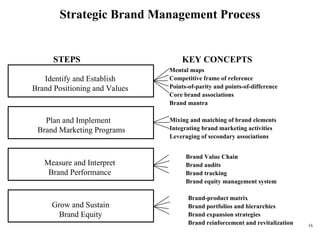
Strategic Brand Management Process Mental maps Competitive frame of reference Points-of-parity and points-of-difference Core brand associations Brand mantra Mixing and matching of brand elements Integrating brand marketing activities Leveraging of secondary associations Brand Value Chain Brand audits Brand tracking Brand equity management system Brand-product matrix Brand portfolios and hierarchies Brand expansion strategies Brand reinforcement and revitalization KEY CONCEPTS STEPS Grow and Sustain Brand Equity Identify and Establish Brand Positioning and Values Plan and Implement  Brand Marketing Programs Measure and Interpret Brand Performance

Brands & Brand Management

  • 1.
    CHAPTER 1 BRANDS& BRAND MANAGEMENT
  • 2.
    What is aBrand? A brand is a name, term, sign, symbol, or design which is intended to identify the goods or services of one seller or group of sellers and to differentiate them from those of competitors.
  • 3.
    What is X ? Product + X = BRAND A brand is a product, which adds other dimensions that differentiate it in some way from other products designed to satisfy the same need.
  • 4.
    Creating Competitive Advantagethrough… Gillette, Sony, 3M Coca-Cola, Calvin Klein, Marlboro
  • 5.
    What Does aBrand Do? For Consumers? For a Company?
  • 6.
    New Branding Challenges Brands are important as ever Consumer need for simplification Consumer need for risk reduction Brand management is as difficult as ever Well informed consumers Increased competition Decreased effectiveness of traditional marketing tools and emergence of new marketing tools Increased costs Complex brand and product portfolios Organizational pressures
  • 7.
    The Concept ofBrand Equity T he importance of the brand in marketing strategies. M arketing effects uniquely attributable to the brand. Brand equity relates to the fact that different outcomes result in the marketing of a product or service because of its brand name, as compared to if the same product or service did not have that name.
  • 8.
    The Concept of Customer-Based Brand Equity Customer-based brand equity Differential effect Customer brand knowledge Customer response to brand marketing
  • 9.
    Determinants of Customer-Based Brand Equity Customer is aware of and familiar with the brand Customer holds some strong, favorable, and unique brand associations in memory
  • 10.
    What is aBrand? A brand is a name, term, sign, symbol, or design which is intended to identify the goods or services of one seller or group of sellers and to differentiate them from those of competitors.
  • 11.
    The Key toBranding Perception of Meaningful Differences among Brands in a Category Creating mental structures
  • 12.
    Building Customer-BasedBrand Equity Brand knowledge structures depend on . . . The initial choices for the brand elements The supporting marketing program and the manner by which the brand is integrated into it Other associations indirectly transferred to the brand by linking it to some other entities
  • 13.
    Benefits of Customer-Based Brand Equity Enjoy greater brand loyalty, usage, and affinity Command larger price premiums Receive greater trade cooperation & support Increase marketing communication efficiency & effectiveness Yield licensing opportunities Support brand extensions.
  • 14.
    Customer-Based Brand Equityas a “Bridge” Past investments Future marketing activities
  • 15.
    Strategic Brand ManagementStrategic brand management involves the design and implementation of marketing programs and activities to build, measure, and manage brand equity.
  • 16.
    Strategic Brand ManagementProcess Mental maps Competitive frame of reference Points-of-parity and points-of-difference Core brand associations Brand mantra Mixing and matching of brand elements Integrating brand marketing activities Leveraging of secondary associations Brand Value Chain Brand audits Brand tracking Brand equity management system Brand-product matrix Brand portfolios and hierarchies Brand expansion strategies Brand reinforcement and revitalization KEY CONCEPTS STEPS Grow and Sustain Brand Equity Identify and Establish Brand Positioning and Values Plan and Implement Brand Marketing Programs Measure and Interpret Brand Performance

Editor's Notes