
BRAND EQUITY
Tanibhra Datta(199)
Satyam Singh (168)
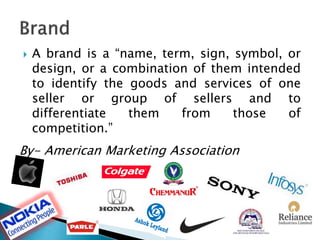
 A brand is a “name, term, sign, symbol, or
design, or a combination of them intended
to identify the goods and services of one
seller or group of sellers and to
differentiate them from those of
competition.”
By- American Marketing Association
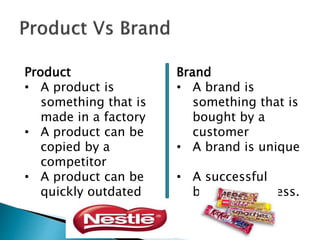
Product
• A product is
something that is
made in a factory
• A product can be
copied by a
competitor
• A product can be
quickly outdated
Brand
• A brand is
something that is
bought by a
customer
• A brand is unique
• A successful
brand is timeless.
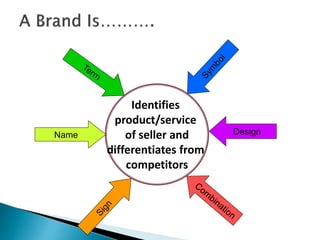
Name Design
Identifies
product/service
of seller and
differentiates from
competitors
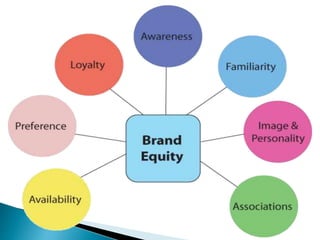
 Brand equity is the added value that endowed
to products and services.
 This value may be reflected in how
consumers think, feel, and act with respect to
the brand, as well as the prices, market share
and profitability that the brand commands for
the firm.
 Brand equity is an important intangible asset
that has psychological and financial value to
the firm
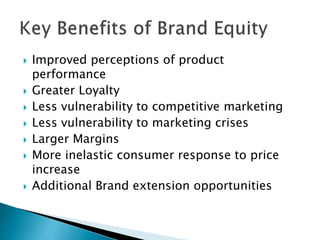
 Improved perceptions of product
performance
 Greater Loyalty
 Less vulnerability to competitive marketing
 Less vulnerability to marketing crises
 Larger Margins
 More inelastic consumer response to price
increase
 Additional Brand extension opportunities
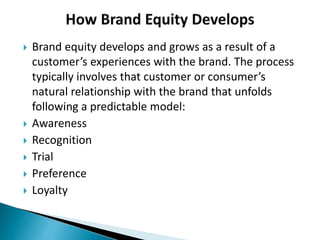
 Brand equity develops and grows as a result of a
customer’s experiences with the brand. The process
typically involves that customer or consumer’s
natural relationship with the brand that unfolds
following a predictable model:
 Awareness
 Recognition
 Trial
 Preference
 Loyalty
Brand equity is a marketing term that describes
a brand’s value. That value is--
 Determined by consumer perception of and
experiences with the brand.
 If people think highly of a brand, it has
positive brand equity.
 When a brand consistently under-delivers
and disappoints to the point where people
recommend that others
 avoid it, it has negative brand equity.
 Apple, ranked by one organization as “the
world’s most popular brand” in 2015, is a
classic example of a brand with positive
equity.
 On a smaller scale, regional supermarket
chain Wegmans
 Financial brand Goldman Sachs lost brand
value when the public learned of its role in
the 2008 financial crisis
 Automaker Toyota suffered in 2009 when it
had to recall more than 8 million vehicles
because of unintended acceleration
 Oil and gas company BP lost significant brand
equity after the U.S. Gulf of Mexico oil spill in
2010.
1. BRAND ASSET
VALUATOR
2. AAKER MODEL
3. BRANDZ
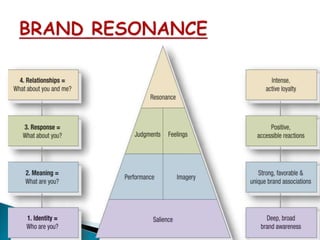
4. BRAND RESONANCE
 Developed by Advertising agency Young and
Rubicam (Y&R) .
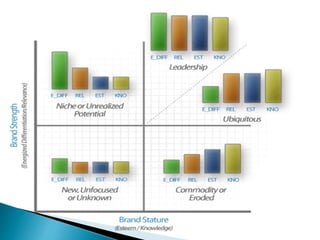
There are four key components—or pillars—of
brand
equity, according to BAV:
 Differentiation measures the degree to which a
brand is seen as different from others.
 Relevance measures the breadth of a brand’s
appeal.
 Esteem measures how well the brand is regarded
and respected.
 Knowledge measures how familiar and intimate
consumers are with the brand.
Former UC-Berkeley marketing professor David
Aaker views brand equity as a set of five
categories of brand assets and liabilities.
 Brand loyalty
 Brand Awareness
 Perceived Quality
 Brand Associations
 Other proprietary assets such as patents,
trademarks, and channel relationships
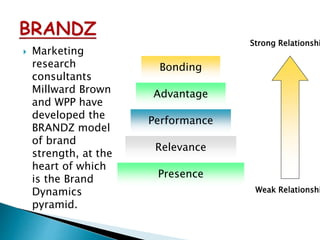
 Marketing
research
consultants
Millward Brown
and WPP have
developed the
BRANDZ model
of brand
strength, at the
heart of which
is the Brand
Dynamics
pyramid.
Presence
Relevance
Performance
Advantage
Bonding
Strong Relationshi
Weak Relationshi
 Brand Audit:
 - is a consumer-focused exercise that
involves a series of procedures to access
the heath of the brand, uncover its sources
of equity and suggest ways to improve and
leverage its equity.
Measuring Brand Equity:
• There are two approaches for measuring
brand equity.
• Indirect approach and direct approach.
 Brand Audits consist of two steps:
 Brand inventory and brand explanatory
 The purpose of brand inventory is to provide
a current, comprehensive profile of how all
the products and services sold by a company
are marketed and branded.
 The brand explanatory is research activity
conducted to understand what consumers
think and its corresponding product category
to identify sources of brand equity.
 Tracking studies collect information from the
consumers on a routine basis over time.
Tracking studies employ quantitative
study methods.
 It provides a basis for decision making
 It provides insights to marketing activities
 It is concerned of estimating the total
financial value of the brand.
 Determined by consumer perception of and
experiences with the brand
Brand equity

Brand equity

  • 1.
  • 2.
     A brandis a “name, term, sign, symbol, or design, or a combination of them intended to identify the goods and services of one seller or group of sellers and to differentiate them from those of competition.” By- American Marketing Association
  • 3.
    Product • A productis something that is made in a factory • A product can be copied by a competitor • A product can be quickly outdated Brand • A brand is something that is bought by a customer • A brand is unique • A successful brand is timeless.
  • 4.
    Name Design Identifies product/service of sellerand differentiates from competitors
  • 5.
     Brand equityis the added value that endowed to products and services.  This value may be reflected in how consumers think, feel, and act with respect to the brand, as well as the prices, market share and profitability that the brand commands for the firm.  Brand equity is an important intangible asset that has psychological and financial value to the firm
  • 7.
     Improved perceptionsof product performance  Greater Loyalty  Less vulnerability to competitive marketing  Less vulnerability to marketing crises  Larger Margins  More inelastic consumer response to price increase  Additional Brand extension opportunities
  • 8.
     Brand equitydevelops and grows as a result of a customer’s experiences with the brand. The process typically involves that customer or consumer’s natural relationship with the brand that unfolds following a predictable model:  Awareness  Recognition  Trial  Preference  Loyalty
  • 9.
    Brand equity isa marketing term that describes a brand’s value. That value is--  Determined by consumer perception of and experiences with the brand.  If people think highly of a brand, it has positive brand equity.  When a brand consistently under-delivers and disappoints to the point where people recommend that others  avoid it, it has negative brand equity.
  • 10.
     Apple, rankedby one organization as “the world’s most popular brand” in 2015, is a classic example of a brand with positive equity.  On a smaller scale, regional supermarket chain Wegmans
  • 11.
     Financial brandGoldman Sachs lost brand value when the public learned of its role in the 2008 financial crisis  Automaker Toyota suffered in 2009 when it had to recall more than 8 million vehicles because of unintended acceleration  Oil and gas company BP lost significant brand equity after the U.S. Gulf of Mexico oil spill in 2010.
  • 12.
    1. BRAND ASSET VALUATOR 2.AAKER MODEL 3. BRANDZ 4. BRAND RESONANCE
  • 13.
     Developed byAdvertising agency Young and Rubicam (Y&R) . There are four key components—or pillars—of brand equity, according to BAV:  Differentiation measures the degree to which a brand is seen as different from others.  Relevance measures the breadth of a brand’s appeal.  Esteem measures how well the brand is regarded and respected.  Knowledge measures how familiar and intimate consumers are with the brand.
  • 15.
    Former UC-Berkeley marketingprofessor David Aaker views brand equity as a set of five categories of brand assets and liabilities.  Brand loyalty  Brand Awareness  Perceived Quality  Brand Associations  Other proprietary assets such as patents, trademarks, and channel relationships
  • 16.
     Marketing research consultants Millward Brown andWPP have developed the BRANDZ model of brand strength, at the heart of which is the Brand Dynamics pyramid. Presence Relevance Performance Advantage Bonding Strong Relationshi Weak Relationshi
  • 18.
     Brand Audit: - is a consumer-focused exercise that involves a series of procedures to access the heath of the brand, uncover its sources of equity and suggest ways to improve and leverage its equity. Measuring Brand Equity: • There are two approaches for measuring brand equity. • Indirect approach and direct approach.
  • 19.
     Brand Auditsconsist of two steps:  Brand inventory and brand explanatory  The purpose of brand inventory is to provide a current, comprehensive profile of how all the products and services sold by a company are marketed and branded.  The brand explanatory is research activity conducted to understand what consumers think and its corresponding product category to identify sources of brand equity.
  • 20.
     Tracking studiescollect information from the consumers on a routine basis over time. Tracking studies employ quantitative study methods.  It provides a basis for decision making  It provides insights to marketing activities
  • 21.
     It isconcerned of estimating the total financial value of the brand.
  • 22.
     Determined byconsumer perception of and experiences with the brand