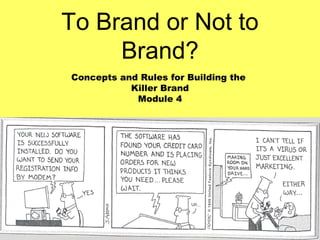
To Brand or Not to
     Brand?
Concepts and Rules for Building the
           Killer Brand
            Module 4
Some Important Concepts…
• Brand Name: The part of a brand that can be
  spoken including letters, words and numbers.
• Brand Mark: The elements of a brand that cannot
  be spoken
• Brand Equity: The value of company and brands
  names.
• Master Brand: A brand so dominant that it comes
  to mind immediately when a product category,
  use, attributes or benefit is mentioned.
A look at Master Brands

Baking Soda
Baking Soda         Arm & Hammer
                    Arm & Hammer
Adhesive Bandages
Adhesive Bandages      Band-Aid
                       Band-Aid
Rum
Rum                    Bacardi
                       Bacardi
Gelatin
Gelatin                 Jell-O
                        Jell-O
Soup
Soup                 Campbell’s
                     Campbell’s
Cream Cheese
Cream Cheese         Philadelphia
                     Philadelphia
Crayons
Crayons                Crayola
                       Crayola
Petroleum Jelly
Petroleum Jelly       Vaseline
                      Vaseline
Brand Mark
Logo/Name
So what is it exactly…
• Attributes, benefits, values, culture,
  personality and user
• Research techniques: word
  associations, personifying the brand,
  laddering up the brand essence
Benefits of Branding
• Branding distinguishes products from
  competition
• Product Identification
• Aids in repeat sales
• Aids in new product sales
• Aids in attracting loyal customers and
  segments
• It is the image, baby!
What is Brand Equity??
          A set of assets and
liabilities linked to a brand’s name
  and symbol that add or subtract
   from the value provided by a
product or service to a firm and/ or
         that firm’s customers.
Aaker, David A. (1991), Managing Brand Equity: Capitalizing on
the Value of a Brand Name, The Free Press, New York
ss
                      e               lty
                 en                 a
            ar               L oy
      A   w


               e Brand
        i t i v e Equity                ed
      et ag                         e iv y
    p                             rc alit
  m ant
Co dv                           Pe u
                                   Q
  A

             Associations       For more see:
                                Aaker, David A. (1995), Strategic
                                Market Management,
                                4th ed., Wiley, NY
The World’s 10 Most Valuable
          Brands – Interbrand 8/5/02
Rank   Brand                Value (billions)
1      Coca Cola            $69.6
2      Microsoft            $64.1
3      IBM                  $51.2
4      GE                   $41.3
5      Intel                $30.9
6      Nokia                $30
7      Disney               $29.3
8      McDonald’s           $26.4
9      Marlboro             $24.2
10     Mercedes             $21
Benefits of Brand Equity
• Leverage when bargaining with distributors
  and retailers
• Charge higher price for product
• Launch extensions
• Some defense against price wars
• Brand valuation
Faithful or Fickle?
           A look at brand loyalty
•   Cigarettes             71%
•   Mayonnaise             65%
•   Toothpaste             61%
•   Coffee                 58%
•   Athletic shoes         27%
•   Canned veggies         25%
•   Garbage bags           23%
Branding Decisions
•   Brand or not to brand?
•   Brand sponsor decision
•   Brand name decision
•   Brand strategy decision
•   Brand repositioning decision
Branding Strategies
                  Brand
                  Brand              No Brand
                                     No Brand


          Manufacturer’s
          Manufacturer’s                 Private Brand
                                         Private Brand
             Brand
              Brand


Individual
 Individual   Family
              Family   Combi-
                       Combi-   Individual
                                 Individual   Family
                                              Family     Combi-
                                                         Combi-
   Brand
   Brand      Brand
               Brand   nation
                       nation      Brand
                                   Brand      Brand
                                               Brand     nation
                                                          nation
Brand Strategy Decisions
• Line extensions –    • Multibrands –
  existing brand to      flanker brands
  new sizes, forms,    • Cobranding –
  flavors etc.           combination of two
• Brand extensions –     or more brands
  brand names          • New brands
  extended to new
  product categories
Three Questions to Ask
• Krispy Kreme
• Starbucks
So How do You Do This??
 Some tips from “Brand Warfare:
  10 Rules for Building the Killer
  Brand” by David D’Alessandro
R1: It’s The Brand, Stupid
• Brand arrogance was once
  commonplace
  – Brands that were once invincible are shadows of
    their former selves (ABC, CBS, NBC)
• The consumer revolution
  – Consumer attitudes changed – don’t trust “big”
  – Cheaper to enter business and create brands
    (amazon - $300,000)
  – Information access for consumers
• When the consumer rules, arrogance
  kills
  – The power of choice & importance of
    differentiation
R2: Co dependency can be
            Beautiful…
• People pay attention to brands – they
  need them
• Brands save time
  – Think OTC drugs
• Brands project the right image
  – “No one can fault you for buying an IBM”
• Brands provide an identity
  – Brand communities (Harley; Ebay); comfort
    levels
R3: A Great Brand Message is Like a
      Bucking Bronco – once you are on, don’t
                       let go…
•   Brand New? Who is it going to be. Brand
    Old? What is it and where should it go.
    Which is easier??
•   Its not the idea that rules, it’s the execution
•   Brand message has to speak to consumers
•   Keep it relevant and consistent
R4: If you want Great advertising, be
          prepared to fight for it
• Beware of flatterers
• It is not necessarily good advertising that the
  client is after
• Be memorable
• Don’t change the advertising because you
  are bored with it.
R5: When it comes to sponsorships,
  there is a sucker born every 30
              seconds
• Get in for the right reasons
• Understand the players
  – The event organizer, TV Networks, the
    athletes and their entourages
• Look for a balance of power
R6: Don’t Confuse Sponsorship
     with a Spectator Sport

• Use the sponsorship every day in every
  way
• Set the right expectations
• Make sure you achieve something
  measurable and real
R7: Do not allow scandal to destroy
  in 30 days a brand that took 100
           years to build
• Brand is destiny
• Do not allow your enemies to define you
• Do not stall. Do not allow the lawyers to
  stall.
• You can run – but you cannot hide
Branding chapter 16

Branding chapter 16

  • 1.
    To Brand orNot to Brand? Concepts and Rules for Building the Killer Brand Module 4
  • 2.
    Some Important Concepts… •Brand Name: The part of a brand that can be spoken including letters, words and numbers. • Brand Mark: The elements of a brand that cannot be spoken • Brand Equity: The value of company and brands names. • Master Brand: A brand so dominant that it comes to mind immediately when a product category, use, attributes or benefit is mentioned.
  • 3.
    A look atMaster Brands Baking Soda Baking Soda Arm & Hammer Arm & Hammer Adhesive Bandages Adhesive Bandages Band-Aid Band-Aid Rum Rum Bacardi Bacardi Gelatin Gelatin Jell-O Jell-O Soup Soup Campbell’s Campbell’s Cream Cheese Cream Cheese Philadelphia Philadelphia Crayons Crayons Crayola Crayola Petroleum Jelly Petroleum Jelly Vaseline Vaseline
  • 4.
  • 5.
  • 7.
    So what isit exactly… • Attributes, benefits, values, culture, personality and user • Research techniques: word associations, personifying the brand, laddering up the brand essence
  • 8.
    Benefits of Branding •Branding distinguishes products from competition • Product Identification • Aids in repeat sales • Aids in new product sales • Aids in attracting loyal customers and segments • It is the image, baby!
  • 9.
    What is BrandEquity?? A set of assets and liabilities linked to a brand’s name and symbol that add or subtract from the value provided by a product or service to a firm and/ or that firm’s customers. Aaker, David A. (1991), Managing Brand Equity: Capitalizing on the Value of a Brand Name, The Free Press, New York
  • 10.
    ss e lty en a ar L oy A w e Brand i t i v e Equity ed et ag e iv y p rc alit m ant Co dv Pe u Q A Associations For more see: Aaker, David A. (1995), Strategic Market Management, 4th ed., Wiley, NY
  • 11.
    The World’s 10Most Valuable Brands – Interbrand 8/5/02 Rank Brand Value (billions) 1 Coca Cola $69.6 2 Microsoft $64.1 3 IBM $51.2 4 GE $41.3 5 Intel $30.9 6 Nokia $30 7 Disney $29.3 8 McDonald’s $26.4 9 Marlboro $24.2 10 Mercedes $21
  • 13.
    Benefits of BrandEquity • Leverage when bargaining with distributors and retailers • Charge higher price for product • Launch extensions • Some defense against price wars • Brand valuation
  • 14.
    Faithful or Fickle? A look at brand loyalty • Cigarettes 71% • Mayonnaise 65% • Toothpaste 61% • Coffee 58% • Athletic shoes 27% • Canned veggies 25% • Garbage bags 23%
  • 15.
    Branding Decisions • Brand or not to brand? • Brand sponsor decision • Brand name decision • Brand strategy decision • Brand repositioning decision
  • 16.
    Branding Strategies Brand Brand No Brand No Brand Manufacturer’s Manufacturer’s Private Brand Private Brand Brand Brand Individual Individual Family Family Combi- Combi- Individual Individual Family Family Combi- Combi- Brand Brand Brand Brand nation nation Brand Brand Brand Brand nation nation
  • 17.
    Brand Strategy Decisions •Line extensions – • Multibrands – existing brand to flanker brands new sizes, forms, • Cobranding – flavors etc. combination of two • Brand extensions – or more brands brand names • New brands extended to new product categories
  • 18.
    Three Questions toAsk • Krispy Kreme • Starbucks
  • 19.
    So How doYou Do This?? Some tips from “Brand Warfare: 10 Rules for Building the Killer Brand” by David D’Alessandro
  • 20.
    R1: It’s TheBrand, Stupid • Brand arrogance was once commonplace – Brands that were once invincible are shadows of their former selves (ABC, CBS, NBC) • The consumer revolution – Consumer attitudes changed – don’t trust “big” – Cheaper to enter business and create brands (amazon - $300,000) – Information access for consumers • When the consumer rules, arrogance kills – The power of choice & importance of differentiation
  • 21.
    R2: Co dependencycan be Beautiful… • People pay attention to brands – they need them • Brands save time – Think OTC drugs • Brands project the right image – “No one can fault you for buying an IBM” • Brands provide an identity – Brand communities (Harley; Ebay); comfort levels
  • 22.
    R3: A GreatBrand Message is Like a Bucking Bronco – once you are on, don’t let go… • Brand New? Who is it going to be. Brand Old? What is it and where should it go. Which is easier?? • Its not the idea that rules, it’s the execution • Brand message has to speak to consumers • Keep it relevant and consistent
  • 23.
    R4: If youwant Great advertising, be prepared to fight for it • Beware of flatterers • It is not necessarily good advertising that the client is after • Be memorable • Don’t change the advertising because you are bored with it.
  • 24.
    R5: When itcomes to sponsorships, there is a sucker born every 30 seconds • Get in for the right reasons • Understand the players – The event organizer, TV Networks, the athletes and their entourages • Look for a balance of power
  • 25.
    R6: Don’t ConfuseSponsorship with a Spectator Sport • Use the sponsorship every day in every way • Set the right expectations • Make sure you achieve something measurable and real
  • 26.
    R7: Do notallow scandal to destroy in 30 days a brand that took 100 years to build • Brand is destiny • Do not allow your enemies to define you • Do not stall. Do not allow the lawyers to stall. • You can run – but you cannot hide