






International Marketing
Prof. Dr. Mustafa Tanyeri
Gönenç DALGIÇ
Yaşar University
PhD in Business Administration
Contents
 BRAND AND BASIC CONCEPTS
 Brands Versus Products
 Importance of Brands
 Local – International - Global Brands
 BECOMING GLOBAL
 Global Brands’ Competition Strategies
 Standardization
 Adaptation / Customization
 Country Of Origin Effect
 GLOBAL BRANDING
 Building a Global Brand
 Global Brand Positioning
 Brand Name Selection
 Global Brand Name Strategies
 Global Brand Development Strategies
 Global Brand Management
 Advantages of Strong Global Brands
14.05.2013 2
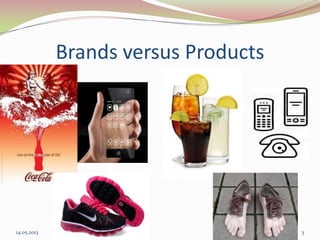
Brands versus Products
14.05.2013 3
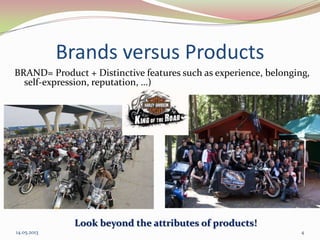
Brands versus Products
BRAND= Product + Distinctive features such as experience, belonging,
self-expression, reputation, …)
Look beyond the attributes of products!
14.05.2013 4
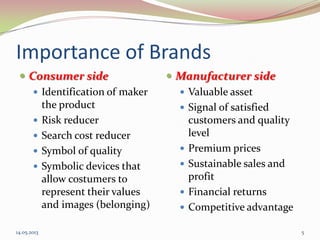
Importance of Brands
 Consumer side
 Identification of maker
the product
 Risk reducer
 Search cost reducer
 Symbol of quality
 Symbolic devices that
allow costumers to
represent their values
and images (belonging)
 Manufacturer side
 Valuable asset
 Signal of satisfied
customers and quality
level
 Premium prices
 Sustainable sales and
profit
 Financial returns
 Competitive advantage
14.05.2013 5
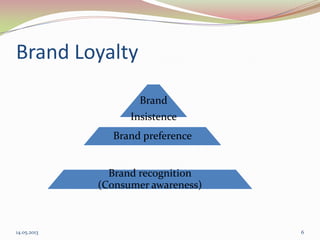
Brand Loyalty
Brand
Insistence
Brand preference
Brand recognition
(Consumer awareness)
14.05.2013 6
Brand Equity
 1- Positive differential effect that knowing the brand name
has on customer response to the product or service.
 2- It represents the total value of a product is acquired as a
result of company’s cumulative investments in the
marketing of the brand.
 Advantages:
 greater loyalty,
 less vulnerability to marketing actions,
 less vulnerability to marketing crises,
 more inelastic consumer response to price increases,
 more profits and stock returns.
14.05.2013 7
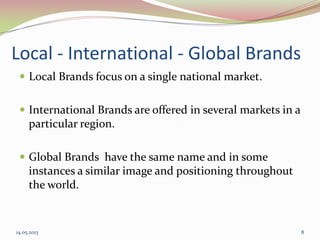
Local - International - Global Brands
 Local Brands focus on a single national market.
 International Brands are offered in several markets in a
particular region.
 Global Brands have the same name and in some
instances a similar image and positioning throughout
the world.
14.05.2013 8
Becoming Global
 Many of well known global brands have derived much of
their sales and profits from nondomestic markets for years
 Future growth for most companies will likely come from
foreign markets.
 In 2002, developed countries in North America, Europe,
and East Asia accounted for 15% of the world’s population
of 6.3 billion. By 2030, according to the World Bank, the
planet’s population will rise to 9 billion, with 90% of
people living in developing countries.
14.05.2013 9
Becoming Global
 Several forces lead to global marketing:
 Perception of slow growth and increased competition in
domestic markets
 Perception of building a global profile as a prerequisite
for success
 Expectation of enhanced overseas growth and profit
opportunities
 Desire to reduce costs from economies of scale
 Need to diversify risk
 Recognition of global mobility of customers
14.05.2013 10
Becoming Global
 Theodore Levitt (1983) “The Globalization of Markets”
 He suggests a global market for uniform products and
services The idea was very popular in 1980s.
 Corporations should exploit the “economics of simplicity”
and grow by selling standardized products all over the
world.
 Although Levitt did not explicitly discuss branding,
managers interpreted his ideas to mean that transnational
companies should standardize products, packaging, and
communication to achieve a least-common-denominator
positioning that would be effective across cultures.
11
Becoming Global
Anti-globalization protests
&
Cross-cultural failures
How consumers perceive global brands ???
14.05.2013 12
Global Brands’ Competition Strategies
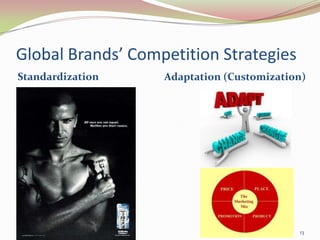
Standardization Adaptation (Customization)
14.05.2013 13
Global Brands’ Competition Strategies
Standardization
 It refers to a tendency that the company prefers to
make its marketing program elements uniform, with
similar products.
 Standardization strategies seek to capture benefits by
minimising variations in the marketing mix between
countries.
14.05.2013 14
Global Brands’ Competition Strategies
Standardization
 This approach is appropriate when:
 Similar market segments exist across countries
 Customer seek similar features
 Products have universal specifications
 Business customers have converging expectations
 This approach is more likely to be pursued in global
industries such as aircraft manufacturing,
pharmaceuticals, credit cards.
14.05.2013 15
Global Brands’ Competition Strategies
Adaptation
 Adaptation of an international marketing program
represents local responsiveness in terms of brand
name, product, or positioning.
 Adaptation strategies seek to maximise responsiveness
to local variations in preferences by varying the
marketing mix.
 Adaptation strategies let companies to meet needs of
customers more certainly as well as governmental
regulations on health or technical standards.
14.05.2013 16
Global Brands’ Competition Strategies
Adaptation
 Adaptation can be pursed when there are distinct:
 national preferences
 laws and regulations
 living standards and economic conditions
 national infrastructure
 Under these circumstances, companies focus on local
preferences, thoughts, and cultural attributes in some
degree. Balancing these contradicting subjects is a complex
and comprehensive process.
14.05.2013 17
Global Brands’ Competition Strategies
 BALANCING ACT ;
 Rather than a choice either standardization or
adaptation another approach
 = to make a decision with some variation in between
 Balancing act is also called the contingency approach.
14.05.2013 18
Country of Origin Effect
 = any influence (positive or negative) that the
manufacturer country has on consumers’ perception of a
product.
 It refers to the image of the country which makes me to
think in this way. Therefore the label of “Made in…” on the
branded product: affects customer choice.
 Many factors such as business history, economic and
technological conditions are influential on image of a
country.
 Dutch cheese, French wines, Chinese silk, Japan electronics,
German car, Italian pasta…
14.05.2013 19
Global Branding
Building a Global Brand
 Global marketers talk about products, brands, markets but
not about people.
 However, there may be global products, but there are no
global people. Different languages that people from
different countries speak represent different worldviews.
 There may be global brands, but there are no global
motivations for buying those brands.
 Although there are different motivations of people but it is
not a drawback to using the same global product. In some
cases people prefer the same brand with different
viewpoints.
14.05.2013 20
Global Branding
Building a Global Brand
 “The Sony Walkman is often used as an example of a
global product, developed for global consumers with
global needs, who would use it with similar motives.
That is not true: There are two distinctly different
motives for using that product.
 In the Western world, the motive is to enjoy music
without being disturbed by others.
 This was not the motive for Masaru Ibuka – cofounder
with Akio Morita of the Sony Corporation – for
inventing the Walkman. He wanted to listen to music
without disturbing others.”
14.05.2013 21
Global Branding
Building a Global Brand
Keller (2003) - “Ten Commandments of Global Branding”:
 Understand similarities and differences in the global
branding landscape.
 Don’t take shortcuts in brand building.
 Establish marketing infrastructure.
 Embrace integrated marketing communications.
 Cultivate brand partnerships.
 Balance standardization and adaptation.
 Balance global and local control.
 Establish operable guidelines.
 Implement a global brand equity measurement system.
 Leverage brand elements.
14.05.2013 22
Global Branding
Global Brand Positioning
 This stage refers to position the brand clearly in target
costumers’ minds.
 Attributes, benefits or experiences that the brand
provides can be expressed in brand positioning.
 The company may have to reposition its brands due to
a competitor in response or changing customer wants
or demand conditions.
14.05.2013 23
 This stage involves creating mental maps, defining core brand
values, and identifying points of difference. Thus, three key
questions should be asked and answered:
 How appropriate is the positioning? What is the existing brand
awareness? How valuable are the core brand values, and points of
difference?
 What changes need to be made to the positioning? Do existing
associations need to be modified? Do any new associations need to be
created?
 Do existing marketing activities need to be changed? What new
marketing activities need to be created regarding different consumer
perceptions, tastes, and environments?
14.05.2013 24
Global Branding
Global Brand Positioning
Global Branding
Global Brand Name Selection
 Some important points that should be considered in
brand name selection are as follows:
 It should be easy to pronounce, recognize, and
remember in foreign languages. E.g.: Dove, Google.
 It should suggest something about the product’s
benefits and qualities. E.g.: Kinder Surprise, Nescafé: My
Coffee, Volkswagen: Das Auto.
 It should be distinctive. E.g.: Shell, Apple, Blackberry.
 It should be capable of registration and legal protection.
14.05.2013 25
Global Branding
Global Brand Name Strategies
 Company Name as a Brand Name (Corporate Umbrella Approach): Nike
Shoes, Nike clothing, Nike athletic gear are all offered under the overall
Nike brand.
 One Product Name Worldwide: Coca Cola produces only non-alcohol
beverages and it is marketed all around the world with the same brand
name.
 Modifying Brand Names for Each Market: Nescafé introduced its soluble
coffee in Germany under the name Nescafé Gold, but in Britain under the
name Nescafé Gold Blend.
 Different Brand Names for Different Markets: Langnese ice cream is sold
under different names around the world: Algida (Greece, Italy, Poland,
Russia, Slovakia, Turkey, Hungary, Croatia), Eskimo (Slovenia, Croatia,
Austria, Czech Republic), Frigo (Spain), Frisko (Denmark), Holanda (Mexico
&Latin America), Langnese (Germany), Miko (France, Morocco), Ola
(Belgium, Luxembourg, Portugal, Netherlands &South-Africa)… 26
Global Branding
Global Brand Development Strategies
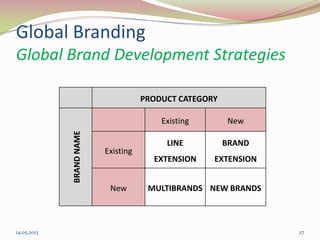
14.05.2013 27
PRODUCT CATEGORY
BRANDNAME
Existing New
Existing
LINE
EXTENSION
BRAND
EXTENSION
New MULTIBRANDS NEW BRANDS
Global Branding
Global Brand Development Strategies
 Line extension (Existing product X Existing brand)
• Introduction of additional items in a given product
category under the same and already successful
brand name, with new forms, colors, flavors, or
package sizes.
• (+) tool for a company to deliver new products with
low-cost, low risk or to use excess capacity, or to
meet customer desires of variety.
• (-) overextension may lead to lose brand’s specific
meaning or heavily extended brands may cause
consumer confusion or frustration.
14.05.2013 28
Global Branding
Global Brand Development Strategies
 Brand extension (New product X Existing brand)
• Company uses its successful brand name in order to
launch a new or modified product in a new category.
• (+) It gives the new product instant recognition and
faster acceptance in the market due to the positive
image that the brand has already have.
• (-) It involves a risk that some brand extensions face
early deaths and it damages the image of the main
brand
14.05.2013 29
Global Branding
Global Brand Development Strategies
 Multibrands (Existing product X New brand)
 Introduction of additional brands in the same category.
 (+) It offers a way to set up different features and enables to attract different
buying motives of the customers.
 (-) There is a risk that each brand might obtain only a small market share and
none may be very profitable.
14.05.2013 30
Global Branding
Global Brand Development Strategies
 New Brands (New product X New brand)
 A company may create a new brand name when it enters a new
product category for which none of the company’s current brand
names is appropriate.
 (+) a company applies to it when it believes the power of the existing
brand name is decreasing and thus a new brand name is needed.
14.05.2013 31
Global Branding
Global Brand Management Strategies
 Brands should be managed professionally, because:
 Brands are not only names or symbols.
 They are used as external cues to quality, performance,
prestige, experience, value, design, taste and so on.
 Consumers associate the value of the product with the
brand.
 The brand conveys either a positive or negative message
about the product to the consumer and it is affected by
past advertising and promotion, product experience,
evaluation and reputation.
14.05.2013 32
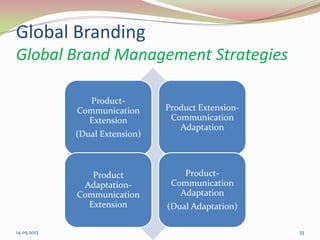
Product-
Communication
Extension
(Dual Extension)
Product Extension-
Communication
Adaptation
Product
Adaptation-
Communication
Extension
Product-
Communication
Adaptation
(Dual Adaptation)
14.05.2013 33
Global Branding
Global Brand Management Strategies
14.05.2013 34
Global Branding
Global Brand Management Strategies
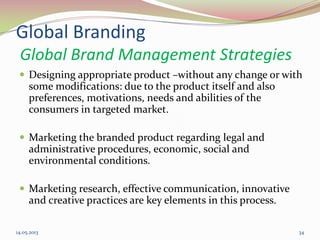
 Designing appropriate product –without any change or with
some modifications: due to the product itself and also
preferences, motivations, needs and abilities of the
consumers in targeted market.
 Marketing the branded product regarding legal and
administrative procedures, economic, social and
environmental conditions.
 Marketing research, effective communication, innovative
and creative practices are key elements in this process.
Global Branding
Advantages of Strong Brands
 Powerful brands achieve global status through high levels
of investment in R&D, innovation, technology, and
marketing mix elements.
 These investments and consistent management across the
world last a long period of time.
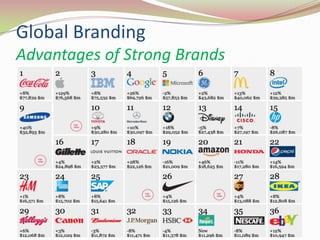
 Then, in return, a strong global brand;
 generates a valuable financial asset
 stimulates brand loyalty and brand equity
14.05.2013 35
Global Branding
Advantages of Strong Brands
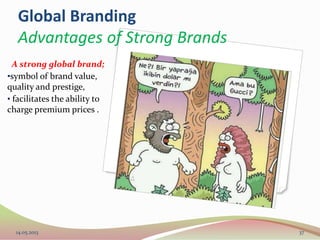
A strong global brand;
•symbol of brand value,
quality and prestige,
• facilitates the ability to
charge premium prices .
14.05.2013 37
Global Branding
Advantages of Strong Brands
Thank you for your attention.
14.05.2013 38

Global branding

  • 1.
    International Marketing Prof. Dr.Mustafa Tanyeri Gönenç DALGIÇ Yaşar University PhD in Business Administration
  • 2.
    Contents  BRAND ANDBASIC CONCEPTS  Brands Versus Products  Importance of Brands  Local – International - Global Brands  BECOMING GLOBAL  Global Brands’ Competition Strategies  Standardization  Adaptation / Customization  Country Of Origin Effect  GLOBAL BRANDING  Building a Global Brand  Global Brand Positioning  Brand Name Selection  Global Brand Name Strategies  Global Brand Development Strategies  Global Brand Management  Advantages of Strong Global Brands 14.05.2013 2
  • 3.
  • 4.
    Brands versus Products BRAND=Product + Distinctive features such as experience, belonging, self-expression, reputation, …) Look beyond the attributes of products! 14.05.2013 4
  • 5.
    Importance of Brands Consumer side  Identification of maker the product  Risk reducer  Search cost reducer  Symbol of quality  Symbolic devices that allow costumers to represent their values and images (belonging)  Manufacturer side  Valuable asset  Signal of satisfied customers and quality level  Premium prices  Sustainable sales and profit  Financial returns  Competitive advantage 14.05.2013 5
  • 6.
    Brand Loyalty Brand Insistence Brand preference Brandrecognition (Consumer awareness) 14.05.2013 6
  • 7.
    Brand Equity  1-Positive differential effect that knowing the brand name has on customer response to the product or service.  2- It represents the total value of a product is acquired as a result of company’s cumulative investments in the marketing of the brand.  Advantages:  greater loyalty,  less vulnerability to marketing actions,  less vulnerability to marketing crises,  more inelastic consumer response to price increases,  more profits and stock returns. 14.05.2013 7
  • 8.
    Local - International- Global Brands  Local Brands focus on a single national market.  International Brands are offered in several markets in a particular region.  Global Brands have the same name and in some instances a similar image and positioning throughout the world. 14.05.2013 8
  • 9.
    Becoming Global  Manyof well known global brands have derived much of their sales and profits from nondomestic markets for years  Future growth for most companies will likely come from foreign markets.  In 2002, developed countries in North America, Europe, and East Asia accounted for 15% of the world’s population of 6.3 billion. By 2030, according to the World Bank, the planet’s population will rise to 9 billion, with 90% of people living in developing countries. 14.05.2013 9
  • 10.
    Becoming Global  Severalforces lead to global marketing:  Perception of slow growth and increased competition in domestic markets  Perception of building a global profile as a prerequisite for success  Expectation of enhanced overseas growth and profit opportunities  Desire to reduce costs from economies of scale  Need to diversify risk  Recognition of global mobility of customers 14.05.2013 10
  • 11.
    Becoming Global  TheodoreLevitt (1983) “The Globalization of Markets”  He suggests a global market for uniform products and services The idea was very popular in 1980s.  Corporations should exploit the “economics of simplicity” and grow by selling standardized products all over the world.  Although Levitt did not explicitly discuss branding, managers interpreted his ideas to mean that transnational companies should standardize products, packaging, and communication to achieve a least-common-denominator positioning that would be effective across cultures. 11
  • 12.
    Becoming Global Anti-globalization protests & Cross-culturalfailures How consumers perceive global brands ??? 14.05.2013 12
  • 13.
    Global Brands’ CompetitionStrategies Standardization Adaptation (Customization) 14.05.2013 13
  • 14.
    Global Brands’ CompetitionStrategies Standardization  It refers to a tendency that the company prefers to make its marketing program elements uniform, with similar products.  Standardization strategies seek to capture benefits by minimising variations in the marketing mix between countries. 14.05.2013 14
  • 15.
    Global Brands’ CompetitionStrategies Standardization  This approach is appropriate when:  Similar market segments exist across countries  Customer seek similar features  Products have universal specifications  Business customers have converging expectations  This approach is more likely to be pursued in global industries such as aircraft manufacturing, pharmaceuticals, credit cards. 14.05.2013 15
  • 16.
    Global Brands’ CompetitionStrategies Adaptation  Adaptation of an international marketing program represents local responsiveness in terms of brand name, product, or positioning.  Adaptation strategies seek to maximise responsiveness to local variations in preferences by varying the marketing mix.  Adaptation strategies let companies to meet needs of customers more certainly as well as governmental regulations on health or technical standards. 14.05.2013 16
  • 17.
    Global Brands’ CompetitionStrategies Adaptation  Adaptation can be pursed when there are distinct:  national preferences  laws and regulations  living standards and economic conditions  national infrastructure  Under these circumstances, companies focus on local preferences, thoughts, and cultural attributes in some degree. Balancing these contradicting subjects is a complex and comprehensive process. 14.05.2013 17
  • 18.
    Global Brands’ CompetitionStrategies  BALANCING ACT ;  Rather than a choice either standardization or adaptation another approach  = to make a decision with some variation in between  Balancing act is also called the contingency approach. 14.05.2013 18
  • 19.
    Country of OriginEffect  = any influence (positive or negative) that the manufacturer country has on consumers’ perception of a product.  It refers to the image of the country which makes me to think in this way. Therefore the label of “Made in…” on the branded product: affects customer choice.  Many factors such as business history, economic and technological conditions are influential on image of a country.  Dutch cheese, French wines, Chinese silk, Japan electronics, German car, Italian pasta… 14.05.2013 19
  • 20.
    Global Branding Building aGlobal Brand  Global marketers talk about products, brands, markets but not about people.  However, there may be global products, but there are no global people. Different languages that people from different countries speak represent different worldviews.  There may be global brands, but there are no global motivations for buying those brands.  Although there are different motivations of people but it is not a drawback to using the same global product. In some cases people prefer the same brand with different viewpoints. 14.05.2013 20
  • 21.
    Global Branding Building aGlobal Brand  “The Sony Walkman is often used as an example of a global product, developed for global consumers with global needs, who would use it with similar motives. That is not true: There are two distinctly different motives for using that product.  In the Western world, the motive is to enjoy music without being disturbed by others.  This was not the motive for Masaru Ibuka – cofounder with Akio Morita of the Sony Corporation – for inventing the Walkman. He wanted to listen to music without disturbing others.” 14.05.2013 21
  • 22.
    Global Branding Building aGlobal Brand Keller (2003) - “Ten Commandments of Global Branding”:  Understand similarities and differences in the global branding landscape.  Don’t take shortcuts in brand building.  Establish marketing infrastructure.  Embrace integrated marketing communications.  Cultivate brand partnerships.  Balance standardization and adaptation.  Balance global and local control.  Establish operable guidelines.  Implement a global brand equity measurement system.  Leverage brand elements. 14.05.2013 22
  • 23.
    Global Branding Global BrandPositioning  This stage refers to position the brand clearly in target costumers’ minds.  Attributes, benefits or experiences that the brand provides can be expressed in brand positioning.  The company may have to reposition its brands due to a competitor in response or changing customer wants or demand conditions. 14.05.2013 23
  • 24.
     This stageinvolves creating mental maps, defining core brand values, and identifying points of difference. Thus, three key questions should be asked and answered:  How appropriate is the positioning? What is the existing brand awareness? How valuable are the core brand values, and points of difference?  What changes need to be made to the positioning? Do existing associations need to be modified? Do any new associations need to be created?  Do existing marketing activities need to be changed? What new marketing activities need to be created regarding different consumer perceptions, tastes, and environments? 14.05.2013 24 Global Branding Global Brand Positioning
  • 25.
    Global Branding Global BrandName Selection  Some important points that should be considered in brand name selection are as follows:  It should be easy to pronounce, recognize, and remember in foreign languages. E.g.: Dove, Google.  It should suggest something about the product’s benefits and qualities. E.g.: Kinder Surprise, Nescafé: My Coffee, Volkswagen: Das Auto.  It should be distinctive. E.g.: Shell, Apple, Blackberry.  It should be capable of registration and legal protection. 14.05.2013 25
  • 26.
    Global Branding Global BrandName Strategies  Company Name as a Brand Name (Corporate Umbrella Approach): Nike Shoes, Nike clothing, Nike athletic gear are all offered under the overall Nike brand.  One Product Name Worldwide: Coca Cola produces only non-alcohol beverages and it is marketed all around the world with the same brand name.  Modifying Brand Names for Each Market: Nescafé introduced its soluble coffee in Germany under the name Nescafé Gold, but in Britain under the name Nescafé Gold Blend.  Different Brand Names for Different Markets: Langnese ice cream is sold under different names around the world: Algida (Greece, Italy, Poland, Russia, Slovakia, Turkey, Hungary, Croatia), Eskimo (Slovenia, Croatia, Austria, Czech Republic), Frigo (Spain), Frisko (Denmark), Holanda (Mexico &Latin America), Langnese (Germany), Miko (France, Morocco), Ola (Belgium, Luxembourg, Portugal, Netherlands &South-Africa)… 26
  • 27.
    Global Branding Global BrandDevelopment Strategies 14.05.2013 27 PRODUCT CATEGORY BRANDNAME Existing New Existing LINE EXTENSION BRAND EXTENSION New MULTIBRANDS NEW BRANDS
  • 28.
    Global Branding Global BrandDevelopment Strategies  Line extension (Existing product X Existing brand) • Introduction of additional items in a given product category under the same and already successful brand name, with new forms, colors, flavors, or package sizes. • (+) tool for a company to deliver new products with low-cost, low risk or to use excess capacity, or to meet customer desires of variety. • (-) overextension may lead to lose brand’s specific meaning or heavily extended brands may cause consumer confusion or frustration. 14.05.2013 28
  • 29.
    Global Branding Global BrandDevelopment Strategies  Brand extension (New product X Existing brand) • Company uses its successful brand name in order to launch a new or modified product in a new category. • (+) It gives the new product instant recognition and faster acceptance in the market due to the positive image that the brand has already have. • (-) It involves a risk that some brand extensions face early deaths and it damages the image of the main brand 14.05.2013 29
  • 30.
    Global Branding Global BrandDevelopment Strategies  Multibrands (Existing product X New brand)  Introduction of additional brands in the same category.  (+) It offers a way to set up different features and enables to attract different buying motives of the customers.  (-) There is a risk that each brand might obtain only a small market share and none may be very profitable. 14.05.2013 30
  • 31.
    Global Branding Global BrandDevelopment Strategies  New Brands (New product X New brand)  A company may create a new brand name when it enters a new product category for which none of the company’s current brand names is appropriate.  (+) a company applies to it when it believes the power of the existing brand name is decreasing and thus a new brand name is needed. 14.05.2013 31
  • 32.
    Global Branding Global BrandManagement Strategies  Brands should be managed professionally, because:  Brands are not only names or symbols.  They are used as external cues to quality, performance, prestige, experience, value, design, taste and so on.  Consumers associate the value of the product with the brand.  The brand conveys either a positive or negative message about the product to the consumer and it is affected by past advertising and promotion, product experience, evaluation and reputation. 14.05.2013 32
  • 33.
  • 34.
    14.05.2013 34 Global Branding GlobalBrand Management Strategies  Designing appropriate product –without any change or with some modifications: due to the product itself and also preferences, motivations, needs and abilities of the consumers in targeted market.  Marketing the branded product regarding legal and administrative procedures, economic, social and environmental conditions.  Marketing research, effective communication, innovative and creative practices are key elements in this process.
  • 35.
    Global Branding Advantages ofStrong Brands  Powerful brands achieve global status through high levels of investment in R&D, innovation, technology, and marketing mix elements.  These investments and consistent management across the world last a long period of time.  Then, in return, a strong global brand;  generates a valuable financial asset  stimulates brand loyalty and brand equity 14.05.2013 35
  • 36.
  • 37.
    A strong globalbrand; •symbol of brand value, quality and prestige, • facilitates the ability to charge premium prices . 14.05.2013 37 Global Branding Advantages of Strong Brands
  • 38.
    Thank you foryour attention. 14.05.2013 38