Contemporary Building Materials
Sarbjit Singh Bahga
Senior Architect
Punjab Mandi Board
An Over view
 Brick
 R.C.C.
 Stone
 Wood
 Pre-engineered steel
 Aluminium
 Glass
 Stainless steel
 External finishes
 Flooring
 False ceiling
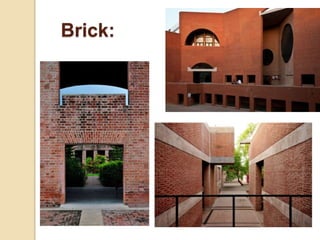
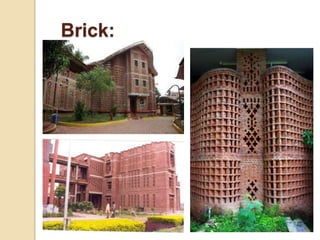
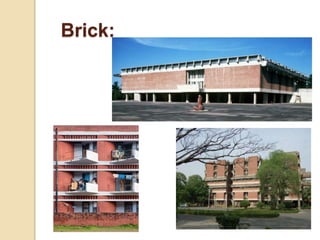
Brick:
 One of the oldest building material in the world.
 Available locally.
 Environment friendly.
 Very Versatile.
 Very enduring and durable.
 Very soothing colour.
 Colour does not fade.
 Can be used in load-bearing walls, columns, roofs
and as external finish also.
 Can be used as external finish also.
 Very economical.
Brick:
Brick:
Brick:
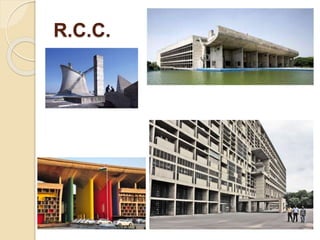
R.C.C. (Reinforced cement concrete) :
 Very Versatile.
 Has plastic qualities.
 Can be moulded in any shape.
 Can be made locally.
 Very enduring and durable.
 Can be used in load-bearing structural
components like walls, columns, beams and
slabs.
 Can be used as external finish also.
R.C.C.
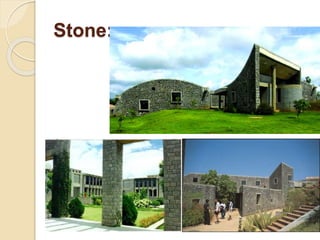
Stone:
 Oldest building material in the world.
 Environment friendly.
 Can be used in natural shape or in dressed form.
 Can be used in load-bearing walls, columns and
roofs.
 Can be used as external finish also.
 Very enduring and durable.
 Labour intensive – generates employment.
 Heavy and difficult to transport.
 Can be /should be used if available locally.
 Available in many varieties, colours and textures.
Stone:
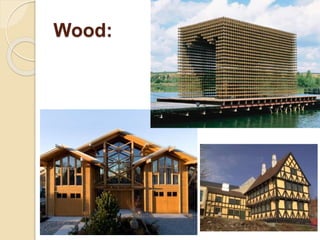
Wood:
 One of the oldest material in the world.
 Available in large varieties and everywhere.
 Environment friendly.
 Can be used as structural material, external
finish, and individual building components like
floors, doors, windows, furniture etc.
 If treated well, it is very enduring and durable.
 Very soothing to look at and touch.
 Very good for thermal insulation.
 Labour intensive –generates employment.
Wood:
Pre-Engineered Steel:
 Latest material and technology in building
construction.
 Being pre-engineered and pre-fabricated in
factories –reduces construction time.
 Easy to erect and assemble at site.
 High precision is achieved in construction.
 Very versatile.
 Able to construct any shape and form, and
large spans.
 Very durable and enduring.
 Can be reused and recycled.
 Very economical.
Pre-Engineered Steel:
Aluminium :
 Very durable and enduring.
 Very costly.
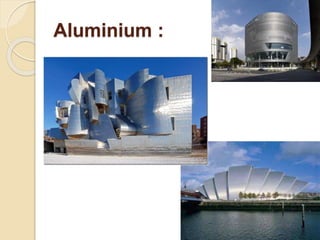
 Can be used as structural members in facades,
glazing etc.
 Can be used as external finish.
 Can be used in individual building components
like doors, windows etc.
 Consumes high energy in manufacturing.
 Not environment friendly.
Aluminium :
Glass:
 Available in large varieties, sizes and thicknesses.
 Toughened glass is very hard and does not break
easily.
 Latest double-skin glass is very useful for thermal
insulation –keeps heat of the sun out up to 73 per
cent.
 Can be used for glazing, façade treatment,
partitions, doors, windows etc.
 Needs no maintenance except cleaning.
 Latest varieties of glass are very costly.
 Can be moulded in curved form, but very costly.
 Not very easy to handle.
Glass:
Stainless Steel:
 Very versatile hard and tensile.
 Can be moulded in any shape.
 Very enduring and durable.
 Needs no maintenance.
 Very costly.
 Needs high technology and precision.
 Not very popular in India so far.
 Can be recycled and reused.
 Corrosion resistance and sustainable material.
Stainless Steel:
External Finishes:
 Brick/tile cladding.
 Stone cladding.
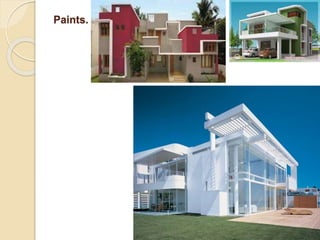
 Paints.
 Grit wash.
 Rough-cast-thrown concrete finish.
 ACP (Aluminium coated panel) cladding.
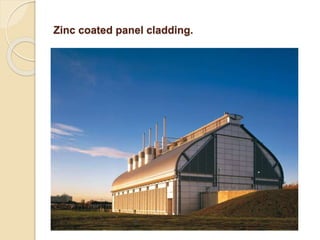
 Zinc coated panel cladding.
 Stainless steel cladding.
 Glass cladding.
Brick/tile cladding.
Stone cladding.
Grit wash
ACP (Aluminium coated panel) cladding.
Zinc coated panel cladding.
Stainless steel cladding.
Paints.
False Ceiling:
 Plaster-of-Paris (POP) false ceiling.
 Gypsum board false ceiling.
 Mineral-fibre tile false ceiling.
 Metal false ceiling.
Plaster-of-Paris (POP) false ceiling.
Gypsum board false ceiling.
Mineral-fibre tile false ceiling.
Metal false ceiling.
Thank You

Contemporary building materials

  • 1.
    Contemporary Building Materials SarbjitSingh Bahga Senior Architect Punjab Mandi Board
  • 2.
    An Over view Brick  R.C.C.  Stone  Wood  Pre-engineered steel  Aluminium  Glass  Stainless steel  External finishes  Flooring  False ceiling
  • 3.
    Brick:  One ofthe oldest building material in the world.  Available locally.  Environment friendly.  Very Versatile.  Very enduring and durable.  Very soothing colour.  Colour does not fade.  Can be used in load-bearing walls, columns, roofs and as external finish also.  Can be used as external finish also.  Very economical.
  • 4.
  • 5.
  • 6.
  • 7.
    R.C.C. (Reinforced cementconcrete) :  Very Versatile.  Has plastic qualities.  Can be moulded in any shape.  Can be made locally.  Very enduring and durable.  Can be used in load-bearing structural components like walls, columns, beams and slabs.  Can be used as external finish also.
  • 8.
  • 9.
    Stone:  Oldest buildingmaterial in the world.  Environment friendly.  Can be used in natural shape or in dressed form.  Can be used in load-bearing walls, columns and roofs.  Can be used as external finish also.  Very enduring and durable.  Labour intensive – generates employment.  Heavy and difficult to transport.  Can be /should be used if available locally.  Available in many varieties, colours and textures.
  • 10.
  • 11.
    Wood:  One ofthe oldest material in the world.  Available in large varieties and everywhere.  Environment friendly.  Can be used as structural material, external finish, and individual building components like floors, doors, windows, furniture etc.  If treated well, it is very enduring and durable.  Very soothing to look at and touch.  Very good for thermal insulation.  Labour intensive –generates employment.
  • 12.
  • 13.
    Pre-Engineered Steel:  Latestmaterial and technology in building construction.  Being pre-engineered and pre-fabricated in factories –reduces construction time.  Easy to erect and assemble at site.  High precision is achieved in construction.  Very versatile.  Able to construct any shape and form, and large spans.  Very durable and enduring.  Can be reused and recycled.  Very economical.
  • 14.
  • 15.
    Aluminium :  Verydurable and enduring.  Very costly.  Can be used as structural members in facades, glazing etc.  Can be used as external finish.  Can be used in individual building components like doors, windows etc.  Consumes high energy in manufacturing.  Not environment friendly.
  • 16.
  • 17.
    Glass:  Available inlarge varieties, sizes and thicknesses.  Toughened glass is very hard and does not break easily.  Latest double-skin glass is very useful for thermal insulation –keeps heat of the sun out up to 73 per cent.  Can be used for glazing, façade treatment, partitions, doors, windows etc.  Needs no maintenance except cleaning.  Latest varieties of glass are very costly.  Can be moulded in curved form, but very costly.  Not very easy to handle.
  • 18.
  • 19.
    Stainless Steel:  Veryversatile hard and tensile.  Can be moulded in any shape.  Very enduring and durable.  Needs no maintenance.  Very costly.  Needs high technology and precision.  Not very popular in India so far.  Can be recycled and reused.  Corrosion resistance and sustainable material.
  • 20.
  • 21.
    External Finishes:  Brick/tilecladding.  Stone cladding.  Paints.  Grit wash.  Rough-cast-thrown concrete finish.  ACP (Aluminium coated panel) cladding.  Zinc coated panel cladding.  Stainless steel cladding.  Glass cladding.
  • 22.
  • 23.
  • 24.
  • 25.
    ACP (Aluminium coatedpanel) cladding.
  • 26.
  • 27.
  • 28.
  • 29.
    False Ceiling:  Plaster-of-Paris(POP) false ceiling.  Gypsum board false ceiling.  Mineral-fibre tile false ceiling.  Metal false ceiling.
  • 30.
  • 31.
  • 32.
  • 33.
  • 34.