TYMPANIC MEMBRANE
PERFORATIONS
Abhilash Kumar
BSc (N) 3rd year
INTRODUCTION
✓ TYMPANIC MEMBRANE PERFORATIONS also called as
eardrum perforation is an injury of the TYMPANIC MEMBRANE .
✓ The tympanic membrane is a delicate, thin membrane present
in the middle ear which is responsible for conducting the
soundwaves to the inner part of the ear via vibrations .
✓ Damage to the eardrum can results in partial or complete
hearing loss , tinnitus and other symptoms .
DEFINITIONS
“Tympanic membrane perforation can be defined as a rupture or
perforation (hole) of the ear drum which can occur as a result of otitis
media , trauma , explosions , noise or surgery “ .
“ According to Javed Ansari “
“ A perforated ear drum or punctured ear drum is a hole in the tissue that
separates the auditory canal from inner ear .
“ According to J.M Hawk “
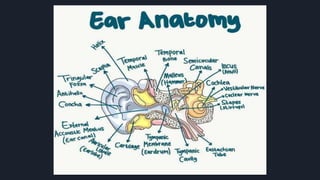
ANATOMY AND PHYSIOLOGY
OF THE MIDDLE EAR
✓ EAR is the organ of hearing and balance .
✓ The human ear can be divided into 3 parts :-
1- External Ear
2- Middle Ear
3- Inner Ear
EXTERNAL EAR :
The external ear consist of :- (a) pinna or auricle
.(b) external auditory canal
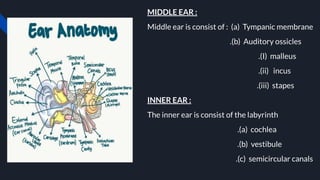
MIDDLE EAR :
Middle ear is consist of : (a) Tympanic membrane
.(b) Auditory ossicles
.(I) malleus
.(ii) incus
.(iii) stapes
INNER EAR :
The inner ear is consist of the labyrinth
.(a) cochlea
.(b) vestibule
.(c) semicircular canals
INCIDENCE
The prevalence of tympanic membrane perforation is 2.1 % among the
general population totalling to 0.2 millions adolescents , 3.3 million
adults and 2.8 million older adults .
Both male and female are equally affected .
TYPES OF TM PERFORATION
On the basis of location of the perforation ear drum perforation can
be classified as :
(a) Marginal perforation
(b) central perforation
(c) Attic perforation
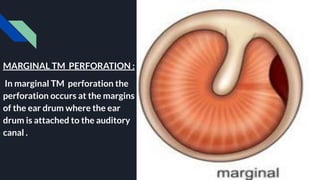
MARGINAL TM PERFORATION :
In marginal TM perforation the
perforation occurs at the margins
of the ear drum where the ear
drum is attached to the auditory
canal .
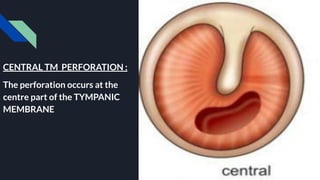
CENTRAL TM PERFORATION :
The perforation occurs at the
centre part of the TYMPANIC
MEMBRANE
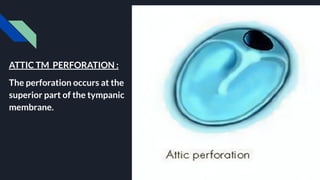
ATTIC TM PERFORATION :
The perforation occurs at the
superior part of the tympanic
membrane.
Continued…..
On the basis of cause of the perforation ear drum perforation can be of:
(1) PATHOGENIC PERFORATION ;
Pathogenic perforation of the tympanic membrane are caused by
bacterial , viral , fungal infection
(2) NONPATHOGENIC / TRAUMATIC PERFORATION ;
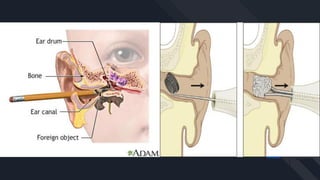
Nonpathogenic perforation are those caused by physical, chemical
or environmental agents
CAUSES / ETIOLOGY
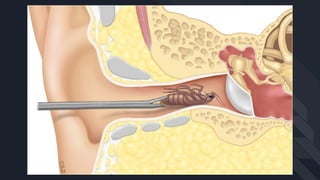
1. FOREIGN BODIES
2. SUDDEN CHANGE IN
ATMOSPHERIC PRESSURE
3. FALL INJURY
4. NOISE POLLUTION
5. INSECT MENIFESTATION
6. INFECTIONS
1. BACTERIAL INFECTION
• STREPTOCOCCUS PNEUMONIAE
•. STREPTOCOCCUS PYOGENES
•. NONTYPABLE HAEMOPHILUS INFLUENZA
•. STAPHYLOCOCCUS AUREUS
2. VIRUSES
• VERICELLA ZOSTER
• VARIOLA VIRUS
3. FUNGAL INFECTION
• CANDIDA ALBICANS
RISK FACTORS
(1) chronic use of antibiotics
(2) unhygienic practices
(3) travel by air
(4) underwater diving
(5) sinusitis
(6) prolonged use of headphones
(7) Head injuries
(8) Hard sneezing
(9) Heavy lifting
(10) upper respiratory tract
infection
PATHOPHYSIOLOGY
CLINICAL FEATURES
OTALGIA
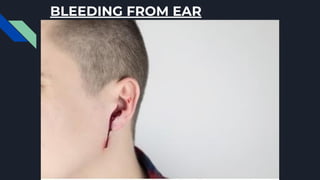
BLEEDING FROM EAR
FULLNESS OF EAR
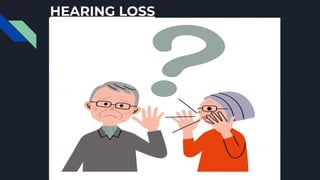
HEARING LOSS
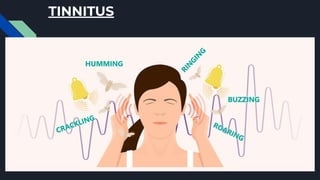
TINNITUS
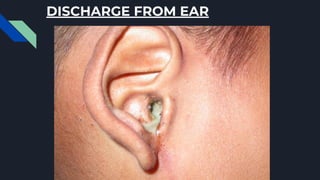
DISCHARGE FROM EAR
FEVER
DISORIENTION
DIAGNOSTIC EVALUATION
(a) History collection
(b) physical examination
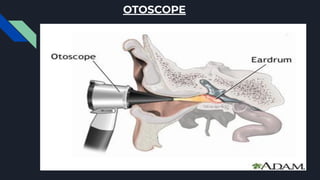
(c) otoscope
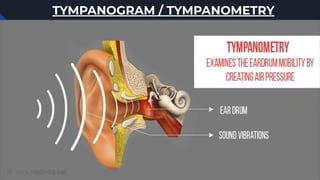
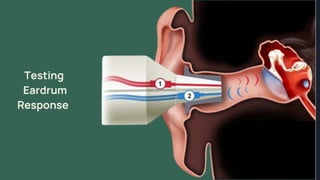
(d) tympanogram
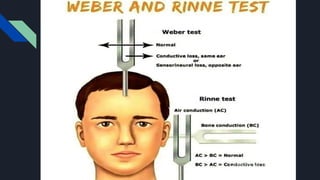
(e) Weber test
(f) Rinne test
(g) Audiometry
OTOSCOPE
TYMPANOGRAM / TYMPANOMETRY
MANAGEMENT
MEDICAL MANAGEMENT
1. NON PHARMACOLOGICAL MANAGEMENT :
✓. Hot application is applied to relieve discomfort .
✓. Aseptic cleaning of the acoustic canal is done .
✓. Swimming or allowing water into the ears is avoided until recovery .
✓. Prohibit nasal blow and ear drops .
✓. A water proof dressing should be applied over the affected ears .
2. PHARMACOLOGICAL MANAGEMENT
(A) ANTIBIOTICS MEDICATION :
Tab . Amoxicillin 500 mg
Tab . Amphicillin 450 mg
(B) ANALGESIC MEDICATION :
Inj . Diclofenac 75 mg
Inj . Tramadol. 100 mg
(C) ANTIPYRATIC MEDICATION :
Tab . Paracetamol 550 mg
(D) ANTIALLERGIC MEDICATION :
Tab . Cetrizine 5mg
Tab . Cyclizine 50 mg
SURGICAL MANAGEMENT
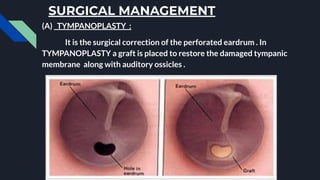
(A) TYMPANOPLASTY :
It is the surgical correction of the perforated eardrum . In
TYMPANOPLASTY a graft is placed to restore the damaged tympanic
membrane along with auditory ossicles .
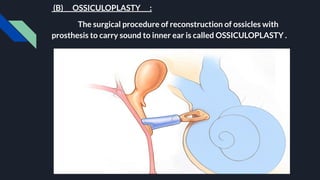
(B) OSSICULOPLASTY :
The surgical procedure of reconstruction of ossicles with
prosthesis to carry sound to inner ear is called OSSICULOPLASTY .
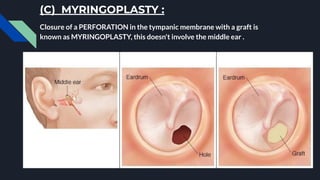
(C) MYRINGOPLASTY :
Closure of a PERFORATION in the tympanic membrane with a graft is
known as MYRINGOPLASTY, this doesn't involve the middle ear .
(C) TYMPANECTOMY :
TYMPANECTOMY is the surgical removal of the
tympanic membrane .
NURSING MANAGEMENT :
NURSING DIAGNOSIS :
● Acute pain related to disease condition as evidence by facial
expression .
● Altered auditory sense perception related to ruptured
tympanic membrane as evidence by bleeding and hearing
acuity
● Risk for infection related to EUSTACHIAN TUBE
DYSFUNCTION as evidence by fever .
● Anxiety related to hospital environment as evidence by
verbalization .
● Knowledge deficit related to disease condition as evidence by
asking frequent questions
COMPLICATIONS
● Complete hearing loss
● Meningitis
● Mastoiditis
● EUSTACHIAN TUBE infection
● Tinnitus
● Ear discharge
● Headache
● Ossicular discontinuity
● Chorda tympani nerve injury
● DISORIENTION
● Drowsyness
PREVENTION AND
HEALTH EDUCATION
SUMMARY
THANK YOU !!
Seminar conducted by Abhilash Kumar

TYMPANIC MEMBRANE PERFORATIONS

  • 1.
  • 2.
    INTRODUCTION ✓ TYMPANIC MEMBRANEPERFORATIONS also called as eardrum perforation is an injury of the TYMPANIC MEMBRANE . ✓ The tympanic membrane is a delicate, thin membrane present in the middle ear which is responsible for conducting the soundwaves to the inner part of the ear via vibrations . ✓ Damage to the eardrum can results in partial or complete hearing loss , tinnitus and other symptoms .
  • 3.
    DEFINITIONS “Tympanic membrane perforationcan be defined as a rupture or perforation (hole) of the ear drum which can occur as a result of otitis media , trauma , explosions , noise or surgery “ . “ According to Javed Ansari “ “ A perforated ear drum or punctured ear drum is a hole in the tissue that separates the auditory canal from inner ear . “ According to J.M Hawk “
  • 4.
  • 5.
    ✓ EAR isthe organ of hearing and balance . ✓ The human ear can be divided into 3 parts :- 1- External Ear 2- Middle Ear 3- Inner Ear EXTERNAL EAR : The external ear consist of :- (a) pinna or auricle .(b) external auditory canal
  • 6.
    MIDDLE EAR : Middleear is consist of : (a) Tympanic membrane .(b) Auditory ossicles .(I) malleus .(ii) incus .(iii) stapes INNER EAR : The inner ear is consist of the labyrinth .(a) cochlea .(b) vestibule .(c) semicircular canals
  • 8.
    INCIDENCE The prevalence oftympanic membrane perforation is 2.1 % among the general population totalling to 0.2 millions adolescents , 3.3 million adults and 2.8 million older adults . Both male and female are equally affected .
  • 9.
    TYPES OF TMPERFORATION On the basis of location of the perforation ear drum perforation can be classified as : (a) Marginal perforation (b) central perforation (c) Attic perforation
  • 10.
    MARGINAL TM PERFORATION: In marginal TM perforation the perforation occurs at the margins of the ear drum where the ear drum is attached to the auditory canal .
  • 11.
    CENTRAL TM PERFORATION: The perforation occurs at the centre part of the TYMPANIC MEMBRANE
  • 12.
    ATTIC TM PERFORATION: The perforation occurs at the superior part of the tympanic membrane.
  • 13.
    Continued….. On the basisof cause of the perforation ear drum perforation can be of: (1) PATHOGENIC PERFORATION ; Pathogenic perforation of the tympanic membrane are caused by bacterial , viral , fungal infection (2) NONPATHOGENIC / TRAUMATIC PERFORATION ; Nonpathogenic perforation are those caused by physical, chemical or environmental agents
  • 14.
  • 15.
  • 17.
    2. SUDDEN CHANGEIN ATMOSPHERIC PRESSURE
  • 19.
  • 21.
  • 23.
  • 25.
  • 26.
    1. BACTERIAL INFECTION •STREPTOCOCCUS PNEUMONIAE •. STREPTOCOCCUS PYOGENES •. NONTYPABLE HAEMOPHILUS INFLUENZA •. STAPHYLOCOCCUS AUREUS 2. VIRUSES • VERICELLA ZOSTER • VARIOLA VIRUS 3. FUNGAL INFECTION • CANDIDA ALBICANS
  • 27.
    RISK FACTORS (1) chronicuse of antibiotics (2) unhygienic practices (3) travel by air (4) underwater diving (5) sinusitis (6) prolonged use of headphones (7) Head injuries (8) Hard sneezing (9) Heavy lifting (10) upper respiratory tract infection
  • 28.
  • 29.
  • 30.
  • 31.
  • 32.
  • 33.
  • 34.
  • 35.
  • 36.
  • 37.
  • 38.
    DIAGNOSTIC EVALUATION (a) Historycollection (b) physical examination (c) otoscope (d) tympanogram (e) Weber test (f) Rinne test (g) Audiometry
  • 39.
  • 41.
  • 43.
  • 44.
    MEDICAL MANAGEMENT 1. NONPHARMACOLOGICAL MANAGEMENT : ✓. Hot application is applied to relieve discomfort . ✓. Aseptic cleaning of the acoustic canal is done . ✓. Swimming or allowing water into the ears is avoided until recovery . ✓. Prohibit nasal blow and ear drops . ✓. A water proof dressing should be applied over the affected ears .
  • 45.
    2. PHARMACOLOGICAL MANAGEMENT (A)ANTIBIOTICS MEDICATION : Tab . Amoxicillin 500 mg Tab . Amphicillin 450 mg (B) ANALGESIC MEDICATION : Inj . Diclofenac 75 mg Inj . Tramadol. 100 mg (C) ANTIPYRATIC MEDICATION : Tab . Paracetamol 550 mg (D) ANTIALLERGIC MEDICATION : Tab . Cetrizine 5mg Tab . Cyclizine 50 mg
  • 46.
    SURGICAL MANAGEMENT (A) TYMPANOPLASTY: It is the surgical correction of the perforated eardrum . In TYMPANOPLASTY a graft is placed to restore the damaged tympanic membrane along with auditory ossicles .
  • 47.
    (B) OSSICULOPLASTY : Thesurgical procedure of reconstruction of ossicles with prosthesis to carry sound to inner ear is called OSSICULOPLASTY .
  • 48.
    (C) MYRINGOPLASTY : Closureof a PERFORATION in the tympanic membrane with a graft is known as MYRINGOPLASTY, this doesn't involve the middle ear .
  • 49.
    (C) TYMPANECTOMY : TYMPANECTOMYis the surgical removal of the tympanic membrane .
  • 50.
    NURSING MANAGEMENT : NURSINGDIAGNOSIS : ● Acute pain related to disease condition as evidence by facial expression . ● Altered auditory sense perception related to ruptured tympanic membrane as evidence by bleeding and hearing acuity ● Risk for infection related to EUSTACHIAN TUBE DYSFUNCTION as evidence by fever . ● Anxiety related to hospital environment as evidence by verbalization . ● Knowledge deficit related to disease condition as evidence by asking frequent questions
  • 51.
    COMPLICATIONS ● Complete hearingloss ● Meningitis ● Mastoiditis ● EUSTACHIAN TUBE infection ● Tinnitus ● Ear discharge ● Headache ● Ossicular discontinuity ● Chorda tympani nerve injury ● DISORIENTION ● Drowsyness
  • 52.
  • 53.
  • 54.
    THANK YOU !! Seminarconducted by Abhilash Kumar