SUMITTED TO:
MADAM NAJMA
SHAHEEN
1.Rehma akram
2.Nisha Jamil
3.Umaima Khadim
4.Zunaira Sadiq
5.Saima Iqbal
OT
CON,KMSMC,SIALKOT
Objectives:
A learning cycle is an inquiry based teaching
approach and a philosophy of education / model of
instruction that can promote critical thinking ,
active learning and meaningful learning.
(Marek et al . 2003,Sowell 1993)
Learning cycle:
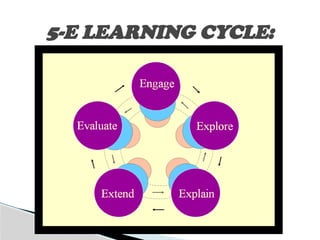
5-E LEARNING CYCLE:
1. Engage:
Access and builds connections with prior knowledge
and experiences, stimulates learner's interest,
provides motivation to learn
• Demonstration
• Reading
• Free Write
• Analyze a Graphic Organizer
• Brainstorming
2. Explore:
1.Let them see the big picture.
2. Encourage the formation of opinions.
3. Challenge them with real-world problems.
4.Provide opportunities to collect information
border see the big picture.
3. Explain:
 To ask them to analyze their explorations.
 Formally explain new concepts and provide
definitions.
 Student Analysis & Explanation Supporting
Ideas with Evidence Structured Questioning.
4. Elaborate:
• Expand/Extend/ Elaborate. They may
expand understanding of the concept to other
content areas. They test ideas more
thoroughly and explore additional
relationships. Providing closure to the lesson
and verifying student understanding is
critical at this point.
• Problem Solving
• Decision Making
5. Evaluate:
• Provide opportunities for self-assessment
• Assess/and or evaluate student performance and/or understandings of
concepts, skills, processes, and applications
•1 Provide opportunities for self-
assessment
•2. Assess/and or evaluate student
performance and/or
3.understandings of concepts,
skills, processes, and applications
 Knowledge acquisition
 Understanding concepts and idea
 Developing critical thinking and problem solving
skills
 Become more skilled in the process of concept
construction
 supporting diverse learning styles and abilities
 Building self awaerness and reflection skills
 Access to technology and digital resources
NEED OF LEARNING CYCLE
 David Kolb (1984), a management expert
from Case Western Reserve University,
developed his learning style model in the
early 1970s.
 In Kolb’s theory
Knowledge is Acquired through
Transformational process which is
continuously created or recreated
Following are four modes or abilities of
learning:
 Concrete Experience (CE)
 Reflective Observation (RO)
 Abstract Conceptualization (AC)
 Active Experimentation (AE)
Modes of Kolb’s Model:
Concrete Experience
(Feelings)
Reflective
Observation
(Watching)
Abstract Conceptualization
(Thinking)
Active
Experimentatio
n
(Doing)
Diverger
(Feel and Watch)
Assimilator
(Think and Watch)
Accommodato
r
(Feel and Do)
Converger
(Think and Do)
Processin
g
Continuum
Perception
Continuum
 At Concrete experience (CE) stage of learning
cycle, learners tend to rely more on feelings
then on a systemic approach to problems and
situations.
 Learners who fall into this category like
interacting with people, They learn from
feeling.
Concrete Experience:
 At Reflective Observation (RO) stage of learning
cycle, personal thoughts and feelings to form
opinions.
 His kind of people look for meaning of things
by viewing them from different perspectives.
 They learn by watching and listening.
Reflective Observation:
 learners rely on logic and ideas rather than on
feelings.
 People who fall into this category use logical
analysis to solve problems.
 They learn by thinking.
Abstract Conceptualization:
 learners like to experiment to get things done.
 They enjoy involvement and are risk taker.
 They learn by doing.
Active Experimentation:
Kolb’s model include two major
dimensions:
He hypothesizes that learning results from
the way learners perceive as well as how
they process what they perceive.
Dimensions:
PERCEPTION PROCESSING
two opposite perceptual
viewpoints:
 Some learners perceive
through concrete experience
(CE) mode
 Other learners perceive
through abstract
conceptualization (AC) mode
CE mode
RO
mod
e
AE mode
AC mode
Processing Continuum
Perception
Continuum
PERCEPTION
 Some learners process
information through reflective
observation (RO) mode
 Whereas others process
information through active
experimentation (AE) mode
CE mode
RO
mode
AC mode
AE
mode
Processin
g
Continuu
m
Continuum
Perceptio
n
PROCESSING
Kolb describes following four learning styles, which
are the combination of basic learning modes
(concrete experience, reflective observation,
abstract conceptualization, active
experimentation):
Learning Style:
 Diverger
 Accommodator
 Assimilator
 Converger
Diverger
CE mode
RO mode
AC mode
AE
mode
Assimilator
Accommodator
Converger
 Diverger
 (CE+RO)
Divergers learn best through group discussion and
participating in brain storming sessions.
1.They have active imaginations
2.They like to observe, gather
information
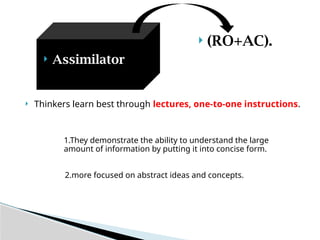
 Assimilator
 (RO+AC).
 Thinkers learn best through lectures, one-to-one instructions.
1.They demonstrate the ability to understand the large
amount of information by putting it into concise form.
2.more focused on abstract ideas and concepts.
 learns through demonstrations/return demonstration methods
of teaching accompanied by handouts and diagrams.
(AC+AE)
1.use deductive reasoning to solve
problems.
2.prefer technical tasks rather than dealing with
social and interpersonal issues.
 Converger
 Accommodator
(AE+CE).
Accommodative thinkers demand new and
exciting experiences and are willing to take
risks.
1.Role play
2.gaming and computer simulations are most
preferred methods of teaching for this type of
learners.
HISTORICAL CONTENT:
• Developed by Ralph Tyler in the 1940’s
• The quintessential prototype of curriculum
development in the scientific approach.
DESCRIPTION:
The Tyler model involves a step-by-step
process of curriculum development that begins with defining
the objectives of the curriculum,
 identifying appropriate learning experiences,
 organizing these experiences into a logical
sequence
 assessing the effectiveness of the curriculum in
achieving its objectives.
The Tyler model of curriculum development, also known
as the objectives model, a systematic and linear approach
to curriculum development that focuses on four
fundamental questions:
• What educational purposes should the school seek to
attain?
• What educational experiences can be provided that are
likely to attain these purposes?
• How can these educational experiences be effectively
organized?
• How can we determine whether these purposes are
being attained?
STAGES OF TYLER’S MODEL:
The brilliance of Tyler’s model is
that it was one of the first models and it was and still is a
highly simple model consisting of four steps.
 Determine the school’s purposes (objectives)
 Identify educational experiences related to purpose
 Organize the experiences
 Evaluate the purposes
The four stages of the Tyler model are:
1.Defining objectives:
The first stage involves identifying the
educational objectives or goals that the curriculum is
intended to achieve. Objectives should be specific,
measurable, achievable, relevant, and time-bound.
2. Selecting content:
The second stage involves identifying the
content and learning experiences that will help students
achieve the objectives identified in the first stage. The
content should be relevant, meaningful, and appropriate
for the intended audience.
STRENGTHS:
• It has the ability to promote deep understanding and
the transfer of learning.
• It has flexibility and adaptability to different
teaching and learning contexts.
• It involves the active participation of the learner.
• It aims at students' developing behaviors as its target
of teaching.
• It provides an easy to follow step-by-step
guide to curriculum planning and
development
VARIATIONS:
There are variations on this model.
However, the Tyler model is still considered by many to
be the strongest model for curriculum development.
• Limited focus
• The Tyler model is mainly focused on cognitive
learning and does not give much attention to
affective or social learning. This means that it
may not fully address the diverse needs and
interests of students.
• too restrictive and covers a small range of students'
skills and knowledge.
• the model did not reflect how teachers develop
curriculum as in reality this process is constantly
changing and evolving.
Thank You!
Any Question?

Learning_Cycles,_Models_and_Styles-pptx_

  • 1.
  • 2.
    1.Rehma akram 2.Nisha Jamil 3.UmaimaKhadim 4.Zunaira Sadiq 5.Saima Iqbal OT CON,KMSMC,SIALKOT
  • 3.
  • 4.
    A learning cycleis an inquiry based teaching approach and a philosophy of education / model of instruction that can promote critical thinking , active learning and meaningful learning. (Marek et al . 2003,Sowell 1993) Learning cycle:
  • 5.
  • 6.
    1. Engage: Access andbuilds connections with prior knowledge and experiences, stimulates learner's interest, provides motivation to learn • Demonstration • Reading • Free Write • Analyze a Graphic Organizer • Brainstorming
  • 7.
    2. Explore: 1.Let themsee the big picture. 2. Encourage the formation of opinions. 3. Challenge them with real-world problems. 4.Provide opportunities to collect information border see the big picture.
  • 8.
    3. Explain:  Toask them to analyze their explorations.  Formally explain new concepts and provide definitions.  Student Analysis & Explanation Supporting Ideas with Evidence Structured Questioning.
  • 9.
    4. Elaborate: • Expand/Extend/Elaborate. They may expand understanding of the concept to other content areas. They test ideas more thoroughly and explore additional relationships. Providing closure to the lesson and verifying student understanding is critical at this point. • Problem Solving • Decision Making
  • 10.
    5. Evaluate: • Provideopportunities for self-assessment • Assess/and or evaluate student performance and/or understandings of concepts, skills, processes, and applications •1 Provide opportunities for self- assessment •2. Assess/and or evaluate student performance and/or 3.understandings of concepts, skills, processes, and applications
  • 11.
     Knowledge acquisition Understanding concepts and idea  Developing critical thinking and problem solving skills  Become more skilled in the process of concept construction  supporting diverse learning styles and abilities  Building self awaerness and reflection skills  Access to technology and digital resources NEED OF LEARNING CYCLE
  • 13.
     David Kolb(1984), a management expert from Case Western Reserve University, developed his learning style model in the early 1970s.  In Kolb’s theory Knowledge is Acquired through Transformational process which is continuously created or recreated
  • 14.
    Following are fourmodes or abilities of learning:  Concrete Experience (CE)  Reflective Observation (RO)  Abstract Conceptualization (AC)  Active Experimentation (AE) Modes of Kolb’s Model:
  • 15.
    Concrete Experience (Feelings) Reflective Observation (Watching) Abstract Conceptualization (Thinking) Active Experimentatio n (Doing) Diverger (Feeland Watch) Assimilator (Think and Watch) Accommodato r (Feel and Do) Converger (Think and Do) Processin g Continuum Perception Continuum
  • 16.
     At Concreteexperience (CE) stage of learning cycle, learners tend to rely more on feelings then on a systemic approach to problems and situations.  Learners who fall into this category like interacting with people, They learn from feeling. Concrete Experience:
  • 17.
     At ReflectiveObservation (RO) stage of learning cycle, personal thoughts and feelings to form opinions.  His kind of people look for meaning of things by viewing them from different perspectives.  They learn by watching and listening. Reflective Observation:
  • 18.
     learners relyon logic and ideas rather than on feelings.  People who fall into this category use logical analysis to solve problems.  They learn by thinking. Abstract Conceptualization:
  • 19.
     learners liketo experiment to get things done.  They enjoy involvement and are risk taker.  They learn by doing. Active Experimentation:
  • 20.
    Kolb’s model includetwo major dimensions: He hypothesizes that learning results from the way learners perceive as well as how they process what they perceive. Dimensions: PERCEPTION PROCESSING
  • 21.
    two opposite perceptual viewpoints: Some learners perceive through concrete experience (CE) mode  Other learners perceive through abstract conceptualization (AC) mode CE mode RO mod e AE mode AC mode Processing Continuum Perception Continuum PERCEPTION
  • 22.
     Some learnersprocess information through reflective observation (RO) mode  Whereas others process information through active experimentation (AE) mode CE mode RO mode AC mode AE mode Processin g Continuu m Continuum Perceptio n PROCESSING
  • 23.
    Kolb describes followingfour learning styles, which are the combination of basic learning modes (concrete experience, reflective observation, abstract conceptualization, active experimentation): Learning Style:  Diverger  Accommodator  Assimilator  Converger
  • 24.
    Diverger CE mode RO mode ACmode AE mode Assimilator Accommodator Converger
  • 25.
     Diverger  (CE+RO) Divergerslearn best through group discussion and participating in brain storming sessions. 1.They have active imaginations 2.They like to observe, gather information
  • 26.
     Assimilator  (RO+AC). Thinkers learn best through lectures, one-to-one instructions. 1.They demonstrate the ability to understand the large amount of information by putting it into concise form. 2.more focused on abstract ideas and concepts.
  • 27.
     learns throughdemonstrations/return demonstration methods of teaching accompanied by handouts and diagrams. (AC+AE) 1.use deductive reasoning to solve problems. 2.prefer technical tasks rather than dealing with social and interpersonal issues.  Converger
  • 28.
     Accommodator (AE+CE). Accommodative thinkersdemand new and exciting experiences and are willing to take risks. 1.Role play 2.gaming and computer simulations are most preferred methods of teaching for this type of learners.
  • 30.
    HISTORICAL CONTENT: • Developedby Ralph Tyler in the 1940’s • The quintessential prototype of curriculum development in the scientific approach.
  • 31.
    DESCRIPTION: The Tyler modelinvolves a step-by-step process of curriculum development that begins with defining the objectives of the curriculum,  identifying appropriate learning experiences,  organizing these experiences into a logical sequence  assessing the effectiveness of the curriculum in achieving its objectives.
  • 32.
    The Tyler modelof curriculum development, also known as the objectives model, a systematic and linear approach to curriculum development that focuses on four fundamental questions: • What educational purposes should the school seek to attain? • What educational experiences can be provided that are likely to attain these purposes? • How can these educational experiences be effectively organized? • How can we determine whether these purposes are being attained?
  • 33.
    STAGES OF TYLER’SMODEL: The brilliance of Tyler’s model is that it was one of the first models and it was and still is a highly simple model consisting of four steps.  Determine the school’s purposes (objectives)  Identify educational experiences related to purpose  Organize the experiences  Evaluate the purposes
  • 35.
    The four stagesof the Tyler model are: 1.Defining objectives: The first stage involves identifying the educational objectives or goals that the curriculum is intended to achieve. Objectives should be specific, measurable, achievable, relevant, and time-bound. 2. Selecting content: The second stage involves identifying the content and learning experiences that will help students achieve the objectives identified in the first stage. The content should be relevant, meaningful, and appropriate for the intended audience.
  • 37.
    STRENGTHS: • It hasthe ability to promote deep understanding and the transfer of learning. • It has flexibility and adaptability to different teaching and learning contexts. • It involves the active participation of the learner. • It aims at students' developing behaviors as its target of teaching. • It provides an easy to follow step-by-step guide to curriculum planning and development
  • 38.
    VARIATIONS: There are variationson this model. However, the Tyler model is still considered by many to be the strongest model for curriculum development. • Limited focus • The Tyler model is mainly focused on cognitive learning and does not give much attention to affective or social learning. This means that it may not fully address the diverse needs and interests of students. • too restrictive and covers a small range of students' skills and knowledge. • the model did not reflect how teachers develop curriculum as in reality this process is constantly changing and evolving.
  • 39.

Editor's Notes

  • #13 Nurse as educator by Susan B. Bastable, edition 2023-24. page #152
  • #26 Inductive reasoning is a method of drawing conclusions by going from specific to the general.
  • #27 Deductive reasoning is a logical approach where you progress from general ideas to specific conclusion.