AIDS
AIDS
Acquired Immuno deficiency syndrome or
AIDS, is a collection of symptoms due to
underlying infections and malignancies
resulting from specific damage to immune
system caused by human immunodeficiency
virus (HIV).
AIDS
AIDS
• The first indication of this new syndrome came in 1981 in
homosexual drug addict males;
• They had two things in
common- Pneumocystis pneumonia and Kaposi’s sarcoma.
• The affected patients appeared to have lost their immune
competence, rendering them vulnerable to overwhelming
and fatal infections with relatively avirulent micro-
organisms, as well as to lymphoid and other malignancies.
• This condition was given the name Acquired Immuno
deficiency Syndrome (AIDS).
Human Immunodeficiency Virus
• In 1986, The International Committee
on virus Nomenclature decided on the
generic name of the causative virus as
the Human Immunodeficiency
Virus.
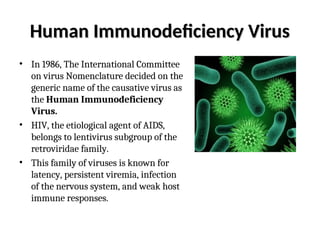
• HIV, the etiological agent of AIDS,
belongs to lentivirus subgroup of the
retroviridae family.
• This family of viruses is known for
latency, persistent viremia, infection
of the nervous system, and weak host
immune responses.
Human Immunodeficiency Virus
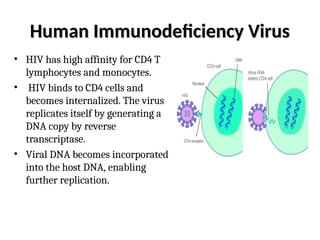
• HIV has high affinity for CD4 T
lymphocytes and monocytes.
• HIV binds to CD4 cells and
becomes internalized. The virus
replicates itself by generating a
DNA copy by reverse
transcriptase.
• Viral DNA becomes incorporated
into the host DNA, enabling
further replication.
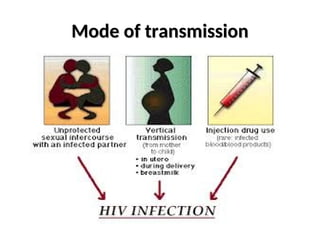
Mode of transmission
• HIV is transmitted when the virus enters the
body, usually by injecting infected cells or
semen.
• There are several possible ways in which the
virus can enter.
• Sexual contact- In 75 % cases , transmission
is by sexual contact.
o Most commonly, HIV infection is spread by
having sex with an infected partner.
Mode of transmission
o The virus can enter the body through the
lining of the vagina, vulva, penis, rectum, or
mouth during sex.
o People who already have a sexually
transmitted disease, such as syphilis, genital
herpes, chlamydial infection, gonorrhea,
or bacterial vaginitis, are more likely to
acquire HIV infection during sex with an
infected partner.
Mode of transmission
• Parenteral- In 15 % cases, it is by blood transfusion
or blood product transfusion.
o Sharing of unsterilized needles or syringes in drug
addicts contaminated with blood from an infected
person can spread virus.
o HIV can be spread in health-care settings
through accidental needle sticks or contact with
contaminated fluids.
o HIV can also spread through organ transplantation.
o Donors are now tested for HIV to minimize this risk.
Mode of transmission
• From mother to child
o Women can transmit HIV to their babies
during pregnancy or birth, when infected
maternal cells enter the baby's circulation.
o 30% of children born to infected mothers
have the acquired infection unless virus is
treated by antiviral drugs before pregnancy.
o In nursing mothers transmission can occur
through breast milk.
Mode of transmission
Pathogenesis
Pathogenesis
• Infection is transmitted when virus enters the
blood or tissues of a person and comes in to
contact with a suitable host cell, principally
the CD4 lymphocytes.
• The virus may infect any cell bearing the CD4
antigen on the surface.
• Primarily these are the CD4 + helper T
lymphocytes.
Pathogenesis
Pathogenesis
• Some other immune cells possessing CD4
antigens are also susceptible to infection, like
B lymphocytes, monocytes and macrophages
including specialized macrophages such as
Alveolar macrophages in the lungs and
Langerhans cells in the dermis.
• Glial cells and microglia cells are also
susceptible.
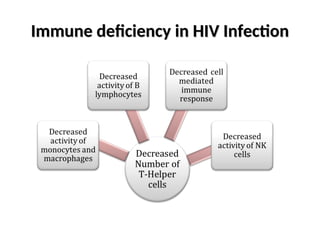
Immune deficiency in HIV Infection
Clinical Manifestations
• AIDS is only the last stage in the wide spectrum of
clinical features in HIV infection.
• The Center for Disease Control (CDC) has classified the
clinical course of HIV infection under various groups.
1. Acute HIV infection
2. Asymptomatic or Latent infection
3. Persistent generalized lymphadenopathy (PGL)
4. AIDS related complex
5. Full blown AIDS (Last stage)
1. Acute HIV infection
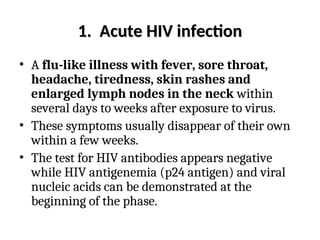
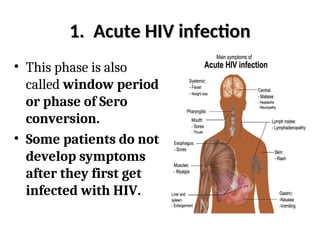
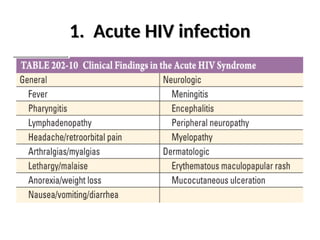
• A flu-like illness with fever, sore throat,
headache, tiredness, skin rashes and
enlarged lymph nodes in the neck within
several days to weeks after exposure to virus.
• These symptoms usually disappear of their own
within a few weeks.
• The test for HIV antibodies appears negative
while HIV antigenemia (p24 antigen) and viral
nucleic acids can be demonstrated at the
beginning of the phase.
1. Acute HIV infection
• This phase is also
called window period
or phase of Sero
conversion.
• Some patients do not
develop symptoms
after they first get
infected with HIV.
1. Acute HIV infection
2. Asymptomatic or
2. Asymptomatic or Latent infection
Latent infection
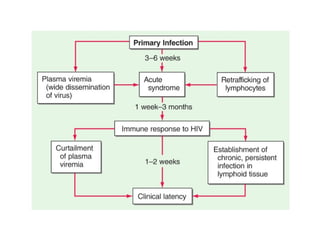
• All persons infected with HIV, pass through a phase of
symptomless infection (Clinical latency), which may
last up to several years.
• The progression of disease varies widely among
individuals.
• This state may last from a few months to more than 10
years.
• During this period, the virus continues to multiply
actively and infects and kills the cells of the immune
system.
• The virus destroys the CD4 cells that are the primary
infection fighters.
2. Asymptomatic or
2. Asymptomatic or Latent infection
Latent infection
• The patients show positive antibody tests
during this phase.
• Even though the person has no symptoms, he or
she is contagious and can pass HIV to others.
• The median time between primary HIV infection
and development of AIDS has been stated as
approximately 10 years.
• About 5-10 % percent of the infected appear to
escape clinical AIDS for 15 years or more.
• They have been termed ‘long term survivors”
or “long term non progressors”.
3
3.
. Persistent generalized lymphadenopathy
Persistent generalized lymphadenopathy
(PGL)
(PGL)
• This has been defined by presence of enlarged
lymph nodes, at least 1 cm in diameter, in two
or more non contiguous extra inguinal sites,
that persist for at least three months, in the
absence of any current illness or medication
that may cause lymphadenopathy.
• These are diagnostic of HIV when blood tests
are positive for antibodies.
4. AIDS related complex
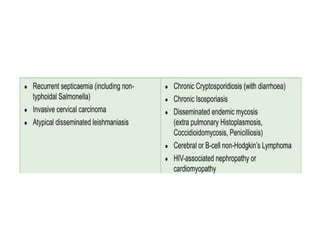
• The patients present with weight loss – of
more than 10% of body weight, persistent
fever, diarrhea, generalized fatigue and signs
of other opportunistic infections may be
apparent.
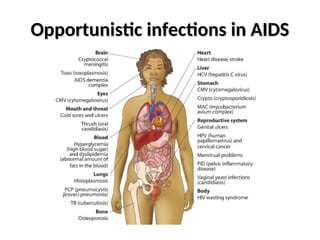
• The opportunistic infections are oral
candidiasis, herpes zoster, salmonellosis or
Tuberculosis and hairy cell leucoplakia.
Opportunistic infections in AIDS
4. AIDS related complex
• The patients are usually severely ill and many of them
progress to AIDS in few months.
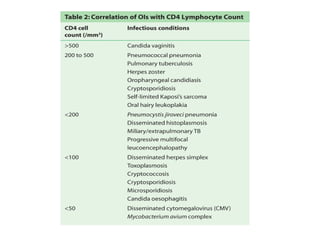
• The CD4 cell count decreases steadily when the count
falls to 200, or less, clinical AIDS usually sets in.
• For this reason the case definition by CDC includes all
HIV infected cases with CD4 + T cell counts of 200 or
less, irrespective of clinical condition which was
further improvised to also include anyone with HIV
infection who develops one of the HIV-associated
diseases considered to be indicative of a severe defect
in cell-mediated immunity
5.
5. Full blown AIDS
Full blown AIDS
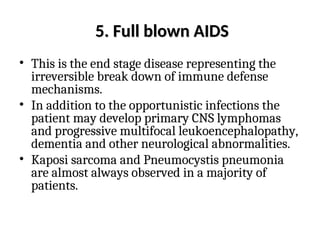
• This is the end stage disease representing the
irreversible break down of immune defense
mechanisms.
• In addition to the opportunistic infections the
patient may develop primary CNS lymphomas
and progressive multifocal leukoencephalopathy,
dementia and other neurological abnormalities.
• Kaposi sarcoma and Pneumocystis pneumonia
are almost always observed in a majority of
patients.
Laboratory Diagnosis of HIV infection
1) Non Specific Tests- The following tests help to
establish the immunodeficiency in HIV infection.
a) Total Leukocyte and lymphocyte count- to
demonstrate leucopenia and lymphopenia. The
lymphocytic count is usually below 2000/mm3
b) T cell subset Assays- Absolute CD4+ cell count is less
than 200/µL. CD4:CD8 ratio is reversed. The decrease
in CD4 is the hall mark for AIDS.
c) Platelet count-
shows Thrombocytopenia.
d) IgA and Ig G levels are raised
Laboratory Diagnosis of HIV infection
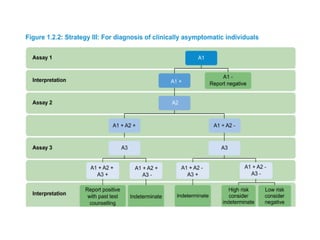
2.Specific Tests for HIV infection- These
include demonstration of -
• HIV antigen,
• Antibodies,
• Viral nucleic acids or other components and
• Isolation of virus
Laboratory Diagnosis of HIV infection
i) Detection of antigen
o Following a contact, as by blood transfusion,
the viral antigen may be detectable in blood
after about 2 weeks.
o If the infecting dose is small, as following a
needle stick injury, the process may be
considerably delayed.
o The major core antigen p24 is the earliest
virus marker to appear in blood.
Laboratory Diagnosis of HIV infection
• i) Detection of antigen (contd.)
• Free p24 antigen disappears from circulation and
remains absent during the long asymptomatic phase to
reappear only when severe clinical disease sets in.
• The p24 Capture ELISA assay, which uses anti p24
antibody as the solid phase can be used for this.
• This test is positive in about 30% of the infected
persons.
• In the first few weeks after infection and in the
terminal phase, the test is uniformly positive.
Laboratory Diagnosis of HIV infection
• Detection of antibodies
o It takes 2-8 weeks to months for the
antibodies to appear in circulation
o IgM antibodies appear first, to be followed by
IgG antibodies
o Once antibodies appear they increase in titer
for the next several months
o IgM antibodies disappear in 8-10weeks while
IgG antibodies remain through out.
Laboratory Diagnosis of HIV infection
• Detection of antibodies (contd.)
• There are two types of serological
tests- Screening tests and supplemental
tests.
i) Screening tests include-
o ELISA- ELISA is the most frequently used
method for screening of blood samples for
HIV antibody.
Laboratory Diagnosis of HIV infection
ELISA
1) First generation - whole viral lysates
2) Second generation - recombinant antigen
3) Third generation - synthetic peptide
4) Fourth generation - antigen + antibody
(Simultaneous detection of HIV antigen and
antibody) - HIV duo
Laboratory Diagnosis of HIV
infection
infection
Significance of ELISA
• Antibody can be detected in a majority of individuals
within 6-12 weeks after infection using the earlier
generation of assays.
• But it can be detected within 3-4 weeks when using
the newer third generation ELISA.
• Due to their ability to detect p24 antigen, the fourth-
generation ELISA can be of value in detecting early
infection.
• The window period can be shortened to two weeks
using p24-antigen assay.
Laboratory Diagnosis of HIV
infection
infection
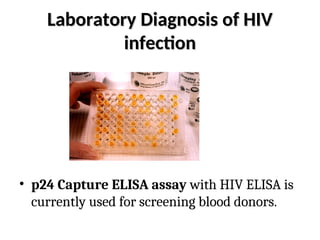
• p24 Capture ELISA assay with HIV ELISA is
currently used for screening blood donors.
Laboratory Diagnosis of HIV
infection
infection
ii) Supplemental Tests
a)Western Blot Test
b) Indirect Immunoflorescence test
c)Radio ImmunoPrecipitaion Assay
iii) Rapid Tests
a) Dot Blot assay
b) Particle Agglutination tests
c) HIV spot and comb test
d)Fluorimetric micro particle technologies
Laboratory Diagnosis of HIV
infection
infection
Western blotting
• Western blots are regarded as the gold
standard and seropositivity is diagnosed when
antibodies against both the env and the gag
proteins are detected.
• The sensitivity of the test systems are
currently being improved by the use of
recombinant antigens.
Laboratory Diagnosis of HIV
infection
infection
3. Demonstration of viral Nucleic acid
• This can be accomplished by probes or by PCR techniques.
• The latter may be useful because of its extremely high
sensitivity.
• Cases of HIV are occasionally missed because individuals can
have negative antibody tests during the early stages of
infection.
• Also, a few people with long-term HIV infection may have
false negative antibody tests or may be chronic carriers who
are clinically asymptomatic.
Laboratory Diagnosis of HIV
infection
infection
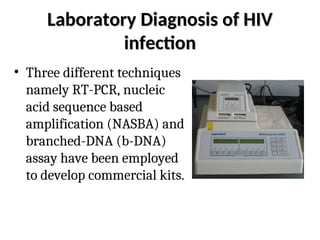
• Three different techniques
namely RT-PCR, nucleic
acid sequence based
amplification (NASBA) and
branched-DNA (b-DNA)
assay have been employed
to develop commercial kits.
Laboratory Diagnosis of HIV
infection
infection
4. Virus isolation
• Virus isolation is accomplished by the co cultivation of the
patient's lymphocytes with fresh peripheral blood cells of
healthy donors or with suitable culture lines such as T-
lymphomas.
• The presence of the virus can be confirmed by reverse
transcriptase assays, serological tests, or by changes in
growth pattern of the indicator cells.
• Virus isolation is tedious and time-consuming (weeks) and is
successful in only 70 to 90% of cases.
• Therefore virus isolation is mainly used for the
characterization of the virus.
Laboratory Diagnosis of HIV
infection
infection
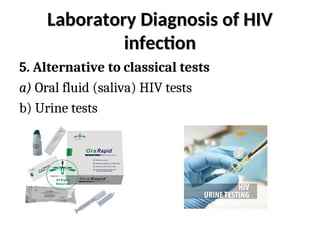
5. Alternative to classical tests
a) Oral fluid (saliva) HIV tests
b) Urine tests
Prevention
Prevention
• The risk of contracting HIV increases with the
number of sexual partners.
• A change in the lifestyle can reduce the risk.
• HIV-infected mothers are not recommended to have
children at present and pregnancy itself can to be a
risk factor for seropositive mothers.
• A recent clinical trial demonstrated the efficacy of
AZT in preventing transmission of HIV from the
mother to the fetus.
Prevention
Prevention
• The spread of HIV through blood transfusion
had virtually been eliminated since the
introduction of blood donor screening in
many countries.
• Blood products such as factor VIII now
undergo routine treatment which appears to
inactivate any HIV present effectively.
Development of vaccine
Development of vaccine is fraught with several problems unique
to this virus. These include-
1) HIV can mutate rapidly, thus, it is not possible to design
antibodies against all antigens.
2) Antibody alone is not sufficient, cell mediated immunity may
also be necessary.
3) Virus enters the body not as free virions but also as infected
cells, in which the virus or the provirus is protected against
antibody or cell mediated lysis.
4) Virus readily establishes life long latent infection hiding from
antibodies.
Approaches to an AIDS vaccine
The main types of approaches to an AIDS vaccine are as
follows:
• Live attenuated virus
• Inactivated virus
• Live recombinant viruses
• Synthetic peptides
• Recombinant DNA products (gp120, gp160)
• Native envelope and/or core proteins
• Anti-idiotypes antibodies
• Passive immunization
• To-date, the best hope lies in an inactivated vaccine
Cause of death in HIV infection
• Despite progress in dealing directly with HIV, however, the
virus, by impairing the immune system, exposes the infected
person to a range of opportunistic viral, bacterial, and parasitic
infections and malignancies.
• It is these which are the actual cause of death in most patients
with AIDS and, notwithstanding the success of anti-HIV drug
treatment in reducing viral load, it is still unclear whether HIV
induced damage to the immune system can be reversed.
• New strains of HIV undetectable by current screening methods
and resistant to the best antiretroviral drugs currently
available have also now been discovered.
Summary
Summary
• Acquired immunodeficiency syndrome, is a disease caused by
Human Immuno deficiency Virus and is characterized by
marked Immunosuppression.
• The mode of transmission is by sexual contact, blood
transfusions, needle prick injury or from mother to child.
• About 5-10 % percent of the infected appear to escape clinical
AIDS for 15 years or more. They have been termed ‘long term
survivors” or “ long term non progressors”.
• ELISA is the method most commonly employed for the
screening purpose and western Blotting is used for the
confirmation of the diagnosis.
• Treatment is imparted simply to check the progression of
the disease, there is no cure of AIDS and there is no vaccine
available for prophylaxis of this disease.

HIV-AIDS- Classification, pathogenesis, diagnosis, management

  • 2.
    AIDS AIDS Acquired Immuno deficiencysyndrome or AIDS, is a collection of symptoms due to underlying infections and malignancies resulting from specific damage to immune system caused by human immunodeficiency virus (HIV).
  • 3.
    AIDS AIDS • The firstindication of this new syndrome came in 1981 in homosexual drug addict males; • They had two things in common- Pneumocystis pneumonia and Kaposi’s sarcoma. • The affected patients appeared to have lost their immune competence, rendering them vulnerable to overwhelming and fatal infections with relatively avirulent micro- organisms, as well as to lymphoid and other malignancies. • This condition was given the name Acquired Immuno deficiency Syndrome (AIDS).
  • 4.
    Human Immunodeficiency Virus HumanImmunodeficiency Virus • In 1986, The International Committee on virus Nomenclature decided on the generic name of the causative virus as the Human Immunodeficiency Virus. • HIV, the etiological agent of AIDS, belongs to lentivirus subgroup of the retroviridae family. • This family of viruses is known for latency, persistent viremia, infection of the nervous system, and weak host immune responses.
  • 5.
    Human Immunodeficiency Virus HumanImmunodeficiency Virus • HIV has high affinity for CD4 T lymphocytes and monocytes. • HIV binds to CD4 cells and becomes internalized. The virus replicates itself by generating a DNA copy by reverse transcriptase. • Viral DNA becomes incorporated into the host DNA, enabling further replication.
  • 6.
    Mode of transmission Modeof transmission • HIV is transmitted when the virus enters the body, usually by injecting infected cells or semen. • There are several possible ways in which the virus can enter. • Sexual contact- In 75 % cases , transmission is by sexual contact. o Most commonly, HIV infection is spread by having sex with an infected partner.
  • 7.
    Mode of transmission Modeof transmission o The virus can enter the body through the lining of the vagina, vulva, penis, rectum, or mouth during sex. o People who already have a sexually transmitted disease, such as syphilis, genital herpes, chlamydial infection, gonorrhea, or bacterial vaginitis, are more likely to acquire HIV infection during sex with an infected partner.
  • 8.
    Mode of transmission Modeof transmission • Parenteral- In 15 % cases, it is by blood transfusion or blood product transfusion. o Sharing of unsterilized needles or syringes in drug addicts contaminated with blood from an infected person can spread virus. o HIV can be spread in health-care settings through accidental needle sticks or contact with contaminated fluids. o HIV can also spread through organ transplantation. o Donors are now tested for HIV to minimize this risk.
  • 9.
    Mode of transmission Modeof transmission • From mother to child o Women can transmit HIV to their babies during pregnancy or birth, when infected maternal cells enter the baby's circulation. o 30% of children born to infected mothers have the acquired infection unless virus is treated by antiviral drugs before pregnancy. o In nursing mothers transmission can occur through breast milk.
  • 10.
  • 11.
    Pathogenesis Pathogenesis • Infection istransmitted when virus enters the blood or tissues of a person and comes in to contact with a suitable host cell, principally the CD4 lymphocytes. • The virus may infect any cell bearing the CD4 antigen on the surface. • Primarily these are the CD4 + helper T lymphocytes.
  • 12.
    Pathogenesis Pathogenesis • Some otherimmune cells possessing CD4 antigens are also susceptible to infection, like B lymphocytes, monocytes and macrophages including specialized macrophages such as Alveolar macrophages in the lungs and Langerhans cells in the dermis. • Glial cells and microglia cells are also susceptible.
  • 13.
    Immune deficiency inHIV Infection Immune deficiency in HIV Infection
  • 14.
    Clinical Manifestations Clinical Manifestations •AIDS is only the last stage in the wide spectrum of clinical features in HIV infection. • The Center for Disease Control (CDC) has classified the clinical course of HIV infection under various groups. 1. Acute HIV infection 2. Asymptomatic or Latent infection 3. Persistent generalized lymphadenopathy (PGL) 4. AIDS related complex 5. Full blown AIDS (Last stage)
  • 15.
    1. Acute HIVinfection 1. Acute HIV infection • A flu-like illness with fever, sore throat, headache, tiredness, skin rashes and enlarged lymph nodes in the neck within several days to weeks after exposure to virus. • These symptoms usually disappear of their own within a few weeks. • The test for HIV antibodies appears negative while HIV antigenemia (p24 antigen) and viral nucleic acids can be demonstrated at the beginning of the phase.
  • 16.
    1. Acute HIVinfection 1. Acute HIV infection • This phase is also called window period or phase of Sero conversion. • Some patients do not develop symptoms after they first get infected with HIV.
  • 17.
    1. Acute HIVinfection 1. Acute HIV infection
  • 19.
    2. Asymptomatic or 2.Asymptomatic or Latent infection Latent infection • All persons infected with HIV, pass through a phase of symptomless infection (Clinical latency), which may last up to several years. • The progression of disease varies widely among individuals. • This state may last from a few months to more than 10 years. • During this period, the virus continues to multiply actively and infects and kills the cells of the immune system. • The virus destroys the CD4 cells that are the primary infection fighters.
  • 20.
    2. Asymptomatic or 2.Asymptomatic or Latent infection Latent infection • The patients show positive antibody tests during this phase. • Even though the person has no symptoms, he or she is contagious and can pass HIV to others. • The median time between primary HIV infection and development of AIDS has been stated as approximately 10 years. • About 5-10 % percent of the infected appear to escape clinical AIDS for 15 years or more. • They have been termed ‘long term survivors” or “long term non progressors”.
  • 21.
    3 3. . Persistent generalizedlymphadenopathy Persistent generalized lymphadenopathy (PGL) (PGL) • This has been defined by presence of enlarged lymph nodes, at least 1 cm in diameter, in two or more non contiguous extra inguinal sites, that persist for at least three months, in the absence of any current illness or medication that may cause lymphadenopathy. • These are diagnostic of HIV when blood tests are positive for antibodies.
  • 22.
    4. AIDS relatedcomplex 4. AIDS related complex • The patients present with weight loss – of more than 10% of body weight, persistent fever, diarrhea, generalized fatigue and signs of other opportunistic infections may be apparent. • The opportunistic infections are oral candidiasis, herpes zoster, salmonellosis or Tuberculosis and hairy cell leucoplakia.
  • 23.
    Opportunistic infections inAIDS Opportunistic infections in AIDS
  • 24.
    4. AIDS relatedcomplex 4. AIDS related complex • The patients are usually severely ill and many of them progress to AIDS in few months. • The CD4 cell count decreases steadily when the count falls to 200, or less, clinical AIDS usually sets in. • For this reason the case definition by CDC includes all HIV infected cases with CD4 + T cell counts of 200 or less, irrespective of clinical condition which was further improvised to also include anyone with HIV infection who develops one of the HIV-associated diseases considered to be indicative of a severe defect in cell-mediated immunity
  • 26.
    5. 5. Full blownAIDS Full blown AIDS • This is the end stage disease representing the irreversible break down of immune defense mechanisms. • In addition to the opportunistic infections the patient may develop primary CNS lymphomas and progressive multifocal leukoencephalopathy, dementia and other neurological abnormalities. • Kaposi sarcoma and Pneumocystis pneumonia are almost always observed in a majority of patients.
  • 31.
    Laboratory Diagnosis ofHIV infection Laboratory Diagnosis of HIV infection 1) Non Specific Tests- The following tests help to establish the immunodeficiency in HIV infection. a) Total Leukocyte and lymphocyte count- to demonstrate leucopenia and lymphopenia. The lymphocytic count is usually below 2000/mm3 b) T cell subset Assays- Absolute CD4+ cell count is less than 200/µL. CD4:CD8 ratio is reversed. The decrease in CD4 is the hall mark for AIDS. c) Platelet count- shows Thrombocytopenia. d) IgA and Ig G levels are raised
  • 32.
    Laboratory Diagnosis ofHIV infection Laboratory Diagnosis of HIV infection 2.Specific Tests for HIV infection- These include demonstration of - • HIV antigen, • Antibodies, • Viral nucleic acids or other components and • Isolation of virus
  • 33.
    Laboratory Diagnosis ofHIV infection Laboratory Diagnosis of HIV infection i) Detection of antigen o Following a contact, as by blood transfusion, the viral antigen may be detectable in blood after about 2 weeks. o If the infecting dose is small, as following a needle stick injury, the process may be considerably delayed. o The major core antigen p24 is the earliest virus marker to appear in blood.
  • 34.
    Laboratory Diagnosis ofHIV infection Laboratory Diagnosis of HIV infection • i) Detection of antigen (contd.) • Free p24 antigen disappears from circulation and remains absent during the long asymptomatic phase to reappear only when severe clinical disease sets in. • The p24 Capture ELISA assay, which uses anti p24 antibody as the solid phase can be used for this. • This test is positive in about 30% of the infected persons. • In the first few weeks after infection and in the terminal phase, the test is uniformly positive.
  • 35.
    Laboratory Diagnosis ofHIV infection Laboratory Diagnosis of HIV infection • Detection of antibodies o It takes 2-8 weeks to months for the antibodies to appear in circulation o IgM antibodies appear first, to be followed by IgG antibodies o Once antibodies appear they increase in titer for the next several months o IgM antibodies disappear in 8-10weeks while IgG antibodies remain through out.
  • 36.
    Laboratory Diagnosis ofHIV infection Laboratory Diagnosis of HIV infection • Detection of antibodies (contd.) • There are two types of serological tests- Screening tests and supplemental tests. i) Screening tests include- o ELISA- ELISA is the most frequently used method for screening of blood samples for HIV antibody.
  • 37.
    Laboratory Diagnosis ofHIV infection Laboratory Diagnosis of HIV infection ELISA 1) First generation - whole viral lysates 2) Second generation - recombinant antigen 3) Third generation - synthetic peptide 4) Fourth generation - antigen + antibody (Simultaneous detection of HIV antigen and antibody) - HIV duo
  • 38.
    Laboratory Diagnosis ofHIV Laboratory Diagnosis of HIV infection infection Significance of ELISA • Antibody can be detected in a majority of individuals within 6-12 weeks after infection using the earlier generation of assays. • But it can be detected within 3-4 weeks when using the newer third generation ELISA. • Due to their ability to detect p24 antigen, the fourth- generation ELISA can be of value in detecting early infection. • The window period can be shortened to two weeks using p24-antigen assay.
  • 39.
    Laboratory Diagnosis ofHIV Laboratory Diagnosis of HIV infection infection • p24 Capture ELISA assay with HIV ELISA is currently used for screening blood donors.
  • 40.
    Laboratory Diagnosis ofHIV Laboratory Diagnosis of HIV infection infection ii) Supplemental Tests a)Western Blot Test b) Indirect Immunoflorescence test c)Radio ImmunoPrecipitaion Assay iii) Rapid Tests a) Dot Blot assay b) Particle Agglutination tests c) HIV spot and comb test d)Fluorimetric micro particle technologies
  • 41.
    Laboratory Diagnosis ofHIV Laboratory Diagnosis of HIV infection infection Western blotting • Western blots are regarded as the gold standard and seropositivity is diagnosed when antibodies against both the env and the gag proteins are detected. • The sensitivity of the test systems are currently being improved by the use of recombinant antigens.
  • 42.
    Laboratory Diagnosis ofHIV Laboratory Diagnosis of HIV infection infection 3. Demonstration of viral Nucleic acid • This can be accomplished by probes or by PCR techniques. • The latter may be useful because of its extremely high sensitivity. • Cases of HIV are occasionally missed because individuals can have negative antibody tests during the early stages of infection. • Also, a few people with long-term HIV infection may have false negative antibody tests or may be chronic carriers who are clinically asymptomatic.
  • 43.
    Laboratory Diagnosis ofHIV Laboratory Diagnosis of HIV infection infection • Three different techniques namely RT-PCR, nucleic acid sequence based amplification (NASBA) and branched-DNA (b-DNA) assay have been employed to develop commercial kits.
  • 44.
    Laboratory Diagnosis ofHIV Laboratory Diagnosis of HIV infection infection 4. Virus isolation • Virus isolation is accomplished by the co cultivation of the patient's lymphocytes with fresh peripheral blood cells of healthy donors or with suitable culture lines such as T- lymphomas. • The presence of the virus can be confirmed by reverse transcriptase assays, serological tests, or by changes in growth pattern of the indicator cells. • Virus isolation is tedious and time-consuming (weeks) and is successful in only 70 to 90% of cases. • Therefore virus isolation is mainly used for the characterization of the virus.
  • 45.
    Laboratory Diagnosis ofHIV Laboratory Diagnosis of HIV infection infection 5. Alternative to classical tests a) Oral fluid (saliva) HIV tests b) Urine tests
  • 48.
    Prevention Prevention • The riskof contracting HIV increases with the number of sexual partners. • A change in the lifestyle can reduce the risk. • HIV-infected mothers are not recommended to have children at present and pregnancy itself can to be a risk factor for seropositive mothers. • A recent clinical trial demonstrated the efficacy of AZT in preventing transmission of HIV from the mother to the fetus.
  • 49.
    Prevention Prevention • The spreadof HIV through blood transfusion had virtually been eliminated since the introduction of blood donor screening in many countries. • Blood products such as factor VIII now undergo routine treatment which appears to inactivate any HIV present effectively.
  • 50.
    Development of vaccine Developmentof vaccine Development of vaccine is fraught with several problems unique to this virus. These include- 1) HIV can mutate rapidly, thus, it is not possible to design antibodies against all antigens. 2) Antibody alone is not sufficient, cell mediated immunity may also be necessary. 3) Virus enters the body not as free virions but also as infected cells, in which the virus or the provirus is protected against antibody or cell mediated lysis. 4) Virus readily establishes life long latent infection hiding from antibodies.
  • 51.
    Approaches to anAIDS vaccine Approaches to an AIDS vaccine The main types of approaches to an AIDS vaccine are as follows: • Live attenuated virus • Inactivated virus • Live recombinant viruses • Synthetic peptides • Recombinant DNA products (gp120, gp160) • Native envelope and/or core proteins • Anti-idiotypes antibodies • Passive immunization • To-date, the best hope lies in an inactivated vaccine
  • 52.
    Cause of deathin HIV infection Cause of death in HIV infection • Despite progress in dealing directly with HIV, however, the virus, by impairing the immune system, exposes the infected person to a range of opportunistic viral, bacterial, and parasitic infections and malignancies. • It is these which are the actual cause of death in most patients with AIDS and, notwithstanding the success of anti-HIV drug treatment in reducing viral load, it is still unclear whether HIV induced damage to the immune system can be reversed. • New strains of HIV undetectable by current screening methods and resistant to the best antiretroviral drugs currently available have also now been discovered.
  • 53.
    Summary Summary • Acquired immunodeficiencysyndrome, is a disease caused by Human Immuno deficiency Virus and is characterized by marked Immunosuppression. • The mode of transmission is by sexual contact, blood transfusions, needle prick injury or from mother to child. • About 5-10 % percent of the infected appear to escape clinical AIDS for 15 years or more. They have been termed ‘long term survivors” or “ long term non progressors”. • ELISA is the method most commonly employed for the screening purpose and western Blotting is used for the confirmation of the diagnosis. • Treatment is imparted simply to check the progression of the disease, there is no cure of AIDS and there is no vaccine available for prophylaxis of this disease.