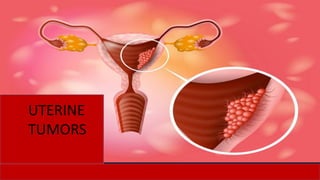

UTERINE TUMORS
Dr. IMRANA TANVIR
Associate Professor of Pathology
Faculty of Medicine Rabigh KAU
2020
UTERINE
TUMORS
Objectives
Identify morphology of endometrial polyp
Correlate morphological types of endometrial hyperplasia with associated
and risk of malignancy
Describe pathogenesis, morphology and grading of endometrial carcinoma
Identify morphology of leiomyoma and leiomyosarcoma and criteria of
malignancy
Definition of mixed Mullerian tumor
2
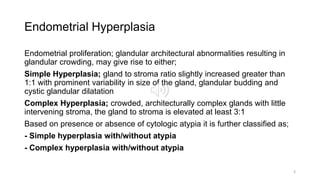
Endometrial Hyperplasia
Endometrial proliferation; glandular architectural abnormalities resulting in
glandular crowding, may give rise to either;
Simple Hyperplasia; gland to stroma ratio slightly increased greater than
1:1 with prominent variability in size of the gland, glandular budding and
cystic glandular dilatation
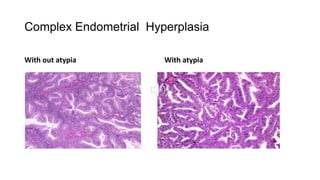
Complex Hyperplasia; crowded, architecturally complex glands with little
intervening stroma, the gland to stroma is elevated at least 3:1
Based on presence or absence of cytologic atypia it is further classified as;
- Simple hyperplasia with/without atypia
- Complex hyperplasia with/without atypia
3
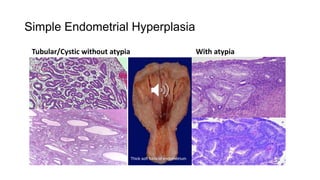
Simple Endometrial Hyperplasia
Tubular/Cystic without atypia With atypia
Thick soft folds of endometrium
Complex Endometrial Hyperplasia
With out atypia With atypia
Causes of Endometrial Hyperplasia
An excess of estrogen relative to progestin, if sufficiently prolonged or
marked, can induce exaggerated endometrial proliferation (hyperplasia), an
important precursor of endometrial carcinoma
Potential causes of estrogen excess:
Failure of ovulation (such as is seen in perimenopause)
Prolonged administration of estrogenic steroids without counterbalancing
progestin
Estrogen producing ovarian lesions (such as polycystic ovary disease and
granulosa-theca cell tumors)
Obesity, a common cause, as adipose tissue converts steroid precursors
into estrogens
Risk of Carcinoma in Endometrial Hyperplasia
Complex hyperplasia without cellular atypia; carries a low risk (less
than 5%)
Complex hyperplasia with cellular atypia; associated with higher risk
(20% to 50%)
In a significant number of cases, the hyperplasia is associated with
inactivating mutations in the PTEN tumor suppressor gene which is
believed to be one of several key steps in the transformation of
hyperplasia to endometrial carcinoma
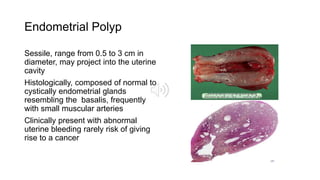
Endometrial Polyp
Sessile, range from 0.5 to 3 cm in
diameter, may project into the uterine
cavity
Histologically, composed of normal to
cystically endometrial glands
resembling the basalis, frequently
with small muscular arteries
Clinically present with abnormal
uterine bleeding rarely risk of giving
rise to a cancer
Endometrial carcinomas
Peak age incidence 55 to 65 year, they classified into;
Type I (80%): Majority well differentiated (Endometrioid carcinoma); Grade1
Associated with estrogen excess, endometrial hyperplasia, inactivation of
DNA mismatch repair genes and PTEN tumor suppressor gene in 30-80%
Associated risk factors; Obesity, DM, HTN and Infertility
Type II (15%): Poorly Differentiated; Grade 3
Usually arise in the setting of endometrial atrophy, mutation in p53, and
PIK3CA, KRAS seen
Histological subtypes; Clear cell and Papillary serous carcinomas,
aggressive behavior
9
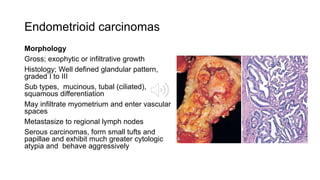
Endometrioid carcinomas
Morphology
Gross; exophytic or infiltrative growth
Histology; Well defined glandular pattern,
graded I to III
Sub types, mucinous, tubal (ciliated),
squamous differentiation
May infiltrate myometrium and enter vascular
spaces
Metastasize to regional lymph nodes
Serous carcinomas, form small tufts and
papillae and exhibit much greater cytologic
atypia and behave aggressively
Leiomyomas
Most common benign tumor of uterine myometrium of smooth muscle origin
Affects 30% to 50% of women of reproductive age
Tumors monoclonal, associated with several different recurrent
chromosomal abnormalities, including rearrangements of chromosomes 6
and 12 that are also found in endometrial polyps and lipomas
Estrogens and possibly oral contraceptives stimulate their growth and these
tumors shrink in post menopausal
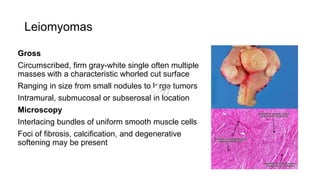
Leiomyomas
Gross
Circumscribed, firm gray-white single often multiple
masses with a characteristic whorled cut surface
Ranging in size from small nodules to large tumors
Intramural, submucosal or subserosal in location
Microscopy
Interlacing bundles of uniform smooth muscle cells
Foci of fibrosis, calcification, and degenerative
softening may be present
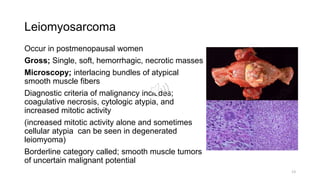
Leiomyosarcoma
Occur in postmenopausal women
Gross; Single, soft, hemorrhagic, necrotic masses
Microscopy; interlacing bundles of atypical
smooth muscle fibers
Diagnostic criteria of malignancy includes;
coagulative necrosis, cytologic atypia, and
increased mitotic activity
(increased mitotic activity alone and sometimes
cellular atypia can be seen in degenerated
leiomyoma)
Borderline category called; smooth muscle tumors
of uncertain malignant potential
13
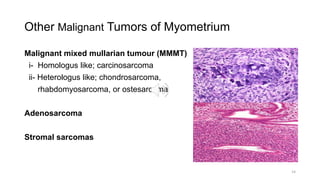
Other Malignant Tumors of Myometrium
Malignant mixed mullarian tumour (MMMT)
i- Homologus like; carcinosarcoma
ii- Heterologus like; chondrosarcoma,
rhabdomyosarcoma, or ostesarcoma
Adenosarcoma
Stromal sarcomas
14
Self Assessment
Q1. What is the histologic diagnostic criteria of malignancy in
uterine smooth muscle tumors?
Q2. What is the difference between adenomyosis and endometriosis?
Q3. Enlist organic causes of abnormal uterine bleeding in reproductive
age group.
References
Basic Pathology, 10th Edition 2017; Kumar, Abbas, Aster
www.webpathology.com

uterus pathological lesions

  • 1.
    UTERINE TUMORS Dr. IMRANATANVIR Associate Professor of Pathology Faculty of Medicine Rabigh KAU 2020 UTERINE TUMORS
  • 2.
    Objectives Identify morphology ofendometrial polyp Correlate morphological types of endometrial hyperplasia with associated and risk of malignancy Describe pathogenesis, morphology and grading of endometrial carcinoma Identify morphology of leiomyoma and leiomyosarcoma and criteria of malignancy Definition of mixed Mullerian tumor 2
  • 3.
    Endometrial Hyperplasia Endometrial proliferation;glandular architectural abnormalities resulting in glandular crowding, may give rise to either; Simple Hyperplasia; gland to stroma ratio slightly increased greater than 1:1 with prominent variability in size of the gland, glandular budding and cystic glandular dilatation Complex Hyperplasia; crowded, architecturally complex glands with little intervening stroma, the gland to stroma is elevated at least 3:1 Based on presence or absence of cytologic atypia it is further classified as; - Simple hyperplasia with/without atypia - Complex hyperplasia with/without atypia 3
  • 4.
    Simple Endometrial Hyperplasia Tubular/Cysticwithout atypia With atypia Thick soft folds of endometrium
  • 5.
  • 6.
    Causes of EndometrialHyperplasia An excess of estrogen relative to progestin, if sufficiently prolonged or marked, can induce exaggerated endometrial proliferation (hyperplasia), an important precursor of endometrial carcinoma Potential causes of estrogen excess: Failure of ovulation (such as is seen in perimenopause) Prolonged administration of estrogenic steroids without counterbalancing progestin Estrogen producing ovarian lesions (such as polycystic ovary disease and granulosa-theca cell tumors) Obesity, a common cause, as adipose tissue converts steroid precursors into estrogens
  • 7.
    Risk of Carcinomain Endometrial Hyperplasia Complex hyperplasia without cellular atypia; carries a low risk (less than 5%) Complex hyperplasia with cellular atypia; associated with higher risk (20% to 50%) In a significant number of cases, the hyperplasia is associated with inactivating mutations in the PTEN tumor suppressor gene which is believed to be one of several key steps in the transformation of hyperplasia to endometrial carcinoma
  • 8.
    Endometrial Polyp Sessile, rangefrom 0.5 to 3 cm in diameter, may project into the uterine cavity Histologically, composed of normal to cystically endometrial glands resembling the basalis, frequently with small muscular arteries Clinically present with abnormal uterine bleeding rarely risk of giving rise to a cancer
  • 9.
    Endometrial carcinomas Peak ageincidence 55 to 65 year, they classified into; Type I (80%): Majority well differentiated (Endometrioid carcinoma); Grade1 Associated with estrogen excess, endometrial hyperplasia, inactivation of DNA mismatch repair genes and PTEN tumor suppressor gene in 30-80% Associated risk factors; Obesity, DM, HTN and Infertility Type II (15%): Poorly Differentiated; Grade 3 Usually arise in the setting of endometrial atrophy, mutation in p53, and PIK3CA, KRAS seen Histological subtypes; Clear cell and Papillary serous carcinomas, aggressive behavior 9
  • 10.
    Endometrioid carcinomas Morphology Gross; exophyticor infiltrative growth Histology; Well defined glandular pattern, graded I to III Sub types, mucinous, tubal (ciliated), squamous differentiation May infiltrate myometrium and enter vascular spaces Metastasize to regional lymph nodes Serous carcinomas, form small tufts and papillae and exhibit much greater cytologic atypia and behave aggressively
  • 11.
    Leiomyomas Most common benigntumor of uterine myometrium of smooth muscle origin Affects 30% to 50% of women of reproductive age Tumors monoclonal, associated with several different recurrent chromosomal abnormalities, including rearrangements of chromosomes 6 and 12 that are also found in endometrial polyps and lipomas Estrogens and possibly oral contraceptives stimulate their growth and these tumors shrink in post menopausal
  • 12.
    Leiomyomas Gross Circumscribed, firm gray-whitesingle often multiple masses with a characteristic whorled cut surface Ranging in size from small nodules to large tumors Intramural, submucosal or subserosal in location Microscopy Interlacing bundles of uniform smooth muscle cells Foci of fibrosis, calcification, and degenerative softening may be present
  • 13.
    Leiomyosarcoma Occur in postmenopausalwomen Gross; Single, soft, hemorrhagic, necrotic masses Microscopy; interlacing bundles of atypical smooth muscle fibers Diagnostic criteria of malignancy includes; coagulative necrosis, cytologic atypia, and increased mitotic activity (increased mitotic activity alone and sometimes cellular atypia can be seen in degenerated leiomyoma) Borderline category called; smooth muscle tumors of uncertain malignant potential 13
  • 14.
    Other Malignant Tumorsof Myometrium Malignant mixed mullarian tumour (MMMT) i- Homologus like; carcinosarcoma ii- Heterologus like; chondrosarcoma, rhabdomyosarcoma, or ostesarcoma Adenosarcoma Stromal sarcomas 14
  • 15.
    Self Assessment Q1. Whatis the histologic diagnostic criteria of malignancy in uterine smooth muscle tumors? Q2. What is the difference between adenomyosis and endometriosis? Q3. Enlist organic causes of abnormal uterine bleeding in reproductive age group.
  • 16.
    References Basic Pathology, 10thEdition 2017; Kumar, Abbas, Aster www.webpathology.com