Brick Bonds
                          stretcher - flemish - english - american


                                 Stretcher Bond


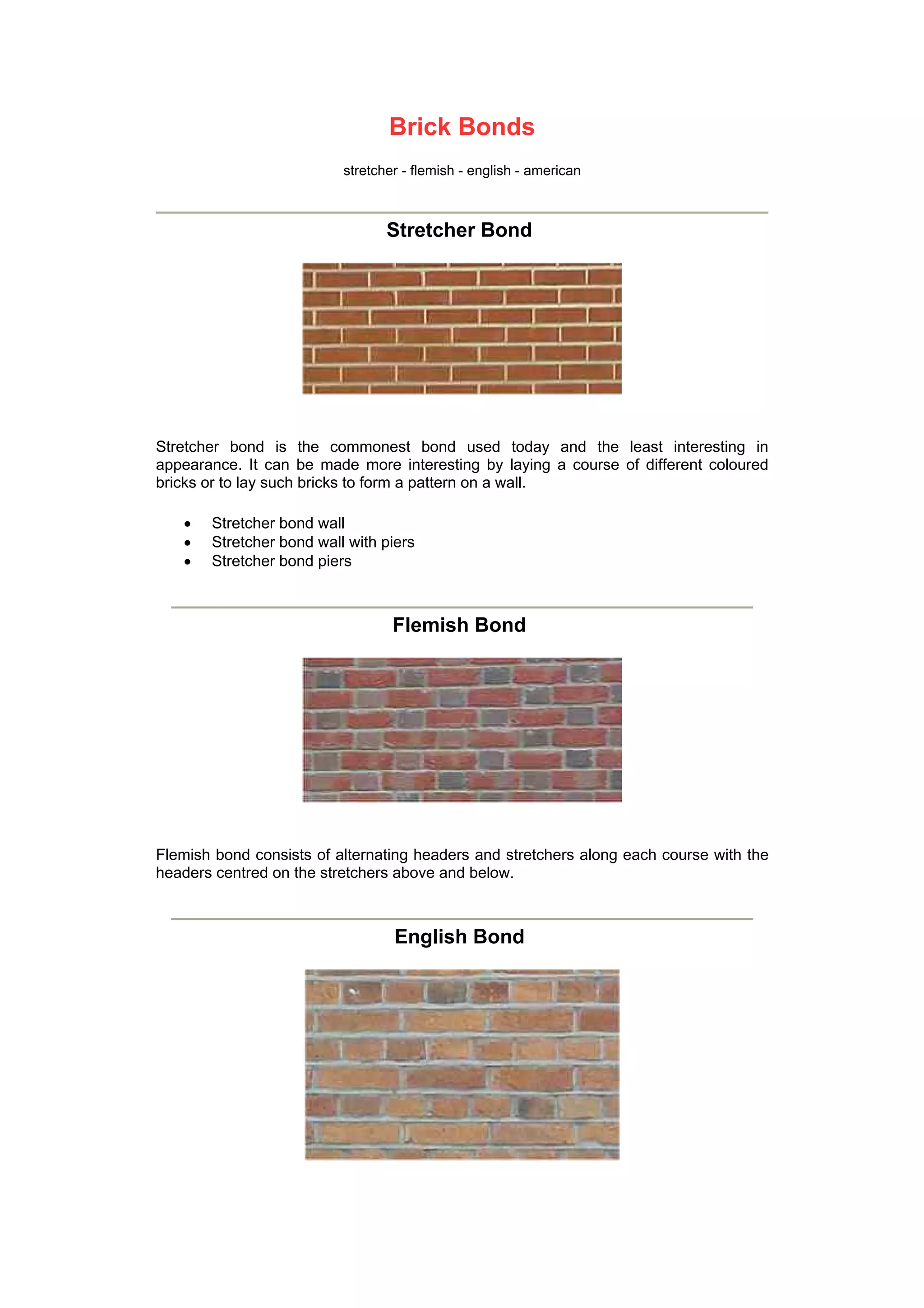
Stretcher bond is the commonest bond used today and the least interesting in
appearance. It can be made more interesting by laying a course of different coloured
bricks or to lay such bricks to form a pattern on a wall.

   •   Stretcher bond wall
   •   Stretcher bond wall with piers
   •   Stretcher bond piers


                                  Flemish Bond


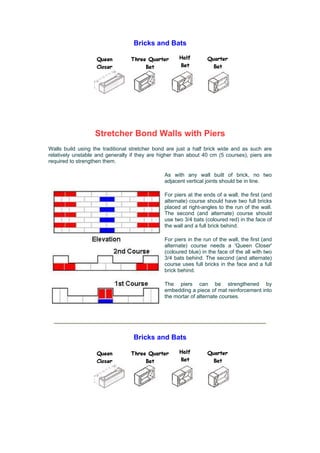
Flemish bond consists of alternating headers and stretchers along each course with the
headers centred on the stretchers above and below.


                                  English Bond
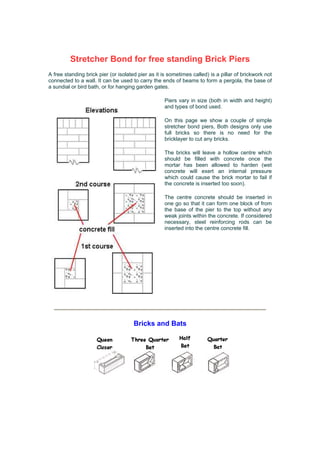
English bond consists of alternating courses of headers and stretchers, with the
alternative headers centred over and under the vertical joints of the stretchers.


                         American common bond


American common bond is similar to the English Bond but the courses of headers are
separated by approximately five courses of stretchers.


                   Stretcher Bond Brick Walls
                                                 English bond - Flemish bond

                                   Walls built using the traditional Stretcher bond are
                                   just a half brick wide. As with any wall built of brick,
                                   no two adjacent vertical joints should be in line.

                                   With a straight wall this is not a problem, just offset
                                   each course by half a brick.

                                   When turning a corner at the end of a straight run
                                   again causes no problems, just interlock the two runs
                                   of bricks on every other course.

                                   When joining into a wall part way along the wall, it's
                                   necessary to use two 3/4 bats (coloured red - one on
                                   either side) on the main face of the wall on every
                                   other course.
Bricks and Bats


                   Stretcher Bond Walls with Piers
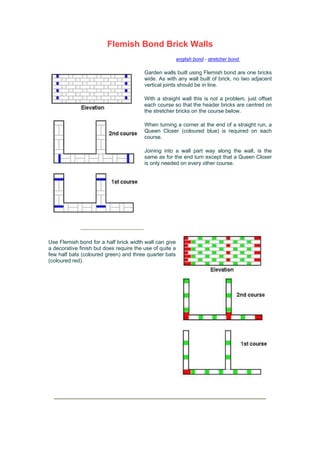
Walls build using the traditional stretcher bond are just a half brick wide and as such are
relatively unstable and generally if they are higher than about 40 cm (5 courses), piers are
required to strengthen them.

                                               As with any wall built of brick, no two
                                               adjacent vertical joints should be in line.

                                               For piers at the ends of a wall, the first (and
                                               alternate) course should have two full bricks
                                               placed at right-angles to the run of the wall.
                                               The second (and alternate) course should
                                               use two 3/4 bats (coloured red) in the face of
                                               the wall and a full brick behind.

                                               For piers in the run of the wall, the first (and
                                               alternate) course needs a 'Queen Closer'
                                               (coloured blue) in the face of the all with two
                                               3/4 bats behind. The second (and alternate)
                                               course uses full bricks in the face and a full
                                               brick behind.

                                               The piers can be strengthened by
                                               embedding a piece of mat reinforcement into
                                               the mortar of alternate courses.


                                   Bricks and Bats
Stretcher Bond for free standing Brick Piers
A free standing brick pier (or isolated pier as it is sometimes called) is a pillar of brickwork not
connected to a wall. It can be used to carry the ends of beams to form a pergola, the base of
a sundial or bird bath, or for hanging garden gates.

                                                    Piers vary in size (both in width and height)
                                                    and types of bond used.

                                                    On this page we show a couple of simple
                                                    stretcher bond piers, Both designs only use
                                                    full bricks so there is no need for the
                                                    bricklayer to cut any bricks.

                                                    The bricks will leave a hollow centre which
                                                    should be filled with concrete once the
                                                    mortar has been allowed to harden (wet
                                                    concrete will exert an internal pressure
                                                    which could cause the brick mortar to fail if
                                                    the concrete is inserted too soon).

                                                    The centre concrete should be inserted in
                                                    one go so that it can form one block of from
                                                    the base of the pier to the top without any
                                                    weak joints within the concrete. If considered
                                                    necessary, steel reinforcing rods can be
                                                    inserted into the centre concrete fill.


                                      Bricks and Bats
Flemish Bond Brick Walls
                                                          english bond - stretcher bond

                                         Garden walls built using Flemish bond are one bricks
                                         wide. As with any wall built of brick, no two adjacent
                                         vertical joints should be in line.

                                         With a straight wall this is not a problem, just offset
                                         each course so that the header bricks are centred on
                                         the stretcher bricks on the course below.

                                         When turning a corner at the end of a straight run, a
                                         Queen Closer (coloured blue) is required on each
                                         course.

                                         Joining into a wall part way along the wall, is the
                                         same as for the end turn except that a Queen Closer
                                         is only needed on every other course.


Use Flemish bond for a half brick width wall can give
a decorative finish but does require the use of quite a
few half bats (coloured green) and three quarter bats
(coloured red).
Bricks and Bats


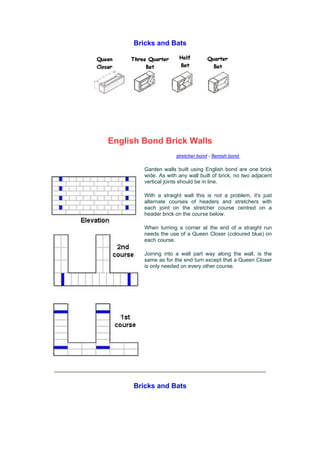
English Bond Brick Walls
                     stretcher bond - flemish bond

        Garden walls built using English bond are one brick
        wide. As with any wall built of brick, no two adjacent
        vertical joints should be in line.

        With a straight wall this is not a problem, it's just
        alternate courses of headers and stretchers with
        each joint on the stretcher course centred on a
        header brick on the course below.

        When turning a corner at the end of a straight run
        needs the use of a Queen Closer (coloured blue) on
        each course.

        Joining into a wall part way along the wall, is the
        same as for the end turn except that a Queen Closer
        is only needed on every other course.


     Bricks and Bats
Brick bonds

Brick bonds

  • 1.
    Brick Bonds stretcher - flemish - english - american Stretcher Bond Stretcher bond is the commonest bond used today and the least interesting in appearance. It can be made more interesting by laying a course of different coloured bricks or to lay such bricks to form a pattern on a wall. • Stretcher bond wall • Stretcher bond wall with piers • Stretcher bond piers Flemish Bond Flemish bond consists of alternating headers and stretchers along each course with the headers centred on the stretchers above and below. English Bond
  • 2.
    English bond consistsof alternating courses of headers and stretchers, with the alternative headers centred over and under the vertical joints of the stretchers. American common bond American common bond is similar to the English Bond but the courses of headers are separated by approximately five courses of stretchers. Stretcher Bond Brick Walls English bond - Flemish bond Walls built using the traditional Stretcher bond are just a half brick wide. As with any wall built of brick, no two adjacent vertical joints should be in line. With a straight wall this is not a problem, just offset each course by half a brick. When turning a corner at the end of a straight run again causes no problems, just interlock the two runs of bricks on every other course. When joining into a wall part way along the wall, it's necessary to use two 3/4 bats (coloured red - one on either side) on the main face of the wall on every other course.
  • 3.
    Bricks and Bats Stretcher Bond Walls with Piers Walls build using the traditional stretcher bond are just a half brick wide and as such are relatively unstable and generally if they are higher than about 40 cm (5 courses), piers are required to strengthen them. As with any wall built of brick, no two adjacent vertical joints should be in line. For piers at the ends of a wall, the first (and alternate) course should have two full bricks placed at right-angles to the run of the wall. The second (and alternate) course should use two 3/4 bats (coloured red) in the face of the wall and a full brick behind. For piers in the run of the wall, the first (and alternate) course needs a 'Queen Closer' (coloured blue) in the face of the all with two 3/4 bats behind. The second (and alternate) course uses full bricks in the face and a full brick behind. The piers can be strengthened by embedding a piece of mat reinforcement into the mortar of alternate courses. Bricks and Bats
  • 4.
    Stretcher Bond forfree standing Brick Piers A free standing brick pier (or isolated pier as it is sometimes called) is a pillar of brickwork not connected to a wall. It can be used to carry the ends of beams to form a pergola, the base of a sundial or bird bath, or for hanging garden gates. Piers vary in size (both in width and height) and types of bond used. On this page we show a couple of simple stretcher bond piers, Both designs only use full bricks so there is no need for the bricklayer to cut any bricks. The bricks will leave a hollow centre which should be filled with concrete once the mortar has been allowed to harden (wet concrete will exert an internal pressure which could cause the brick mortar to fail if the concrete is inserted too soon). The centre concrete should be inserted in one go so that it can form one block of from the base of the pier to the top without any weak joints within the concrete. If considered necessary, steel reinforcing rods can be inserted into the centre concrete fill. Bricks and Bats
  • 5.
    Flemish Bond BrickWalls english bond - stretcher bond Garden walls built using Flemish bond are one bricks wide. As with any wall built of brick, no two adjacent vertical joints should be in line. With a straight wall this is not a problem, just offset each course so that the header bricks are centred on the stretcher bricks on the course below. When turning a corner at the end of a straight run, a Queen Closer (coloured blue) is required on each course. Joining into a wall part way along the wall, is the same as for the end turn except that a Queen Closer is only needed on every other course. Use Flemish bond for a half brick width wall can give a decorative finish but does require the use of quite a few half bats (coloured green) and three quarter bats (coloured red).
  • 6.
    Bricks and Bats EnglishBond Brick Walls stretcher bond - flemish bond Garden walls built using English bond are one brick wide. As with any wall built of brick, no two adjacent vertical joints should be in line. With a straight wall this is not a problem, it's just alternate courses of headers and stretchers with each joint on the stretcher course centred on a header brick on the course below. When turning a corner at the end of a straight run needs the use of a Queen Closer (coloured blue) on each course. Joining into a wall part way along the wall, is the same as for the end turn except that a Queen Closer is only needed on every other course. Bricks and Bats