BAMBOO
INTRO
•Bamboo is a woody grass. It is the fastest-growing
woody plant
•Some species of bamboo grow so fast you can almost
see them growing.
• They are capable of growing 60 cm or more per day.
•However, the growth rate is dependent on local soil
and climatic conditions.
WHY BAMBOO USED FOR STRUCTURAL APPLICATIONS?
• High strength to weight ratio and its flexibility.
• It is particularly appealing, in seismic areas, as complement to
relatively non rigid wall systems such as straw-bale.
• Extremely strong fiber - twice the compressive strength of concrete.
• - roughly same strength to weight ratio of
steel in tension.
• Uses - in residential and commercial building applications
• Wall systems
• Floor systems
• Finishes
USE OF BAMBOO IN CONSTRUCTION
•Reinforcement
•Roofing
•Walling
•Flooring
•Scaffolding
•Doors & Windows
•Decoration
REINFORCEMENT
BAMBOO FOUNDATIONS
BAMBOO PILES
• Bamboo compacts soft soil, thus
increasing the bearing capacity of
soil.
• The friction provided by the
construction-grade bamboo
increases its load-bearing
capacity.
•Treated split bamboo piles 8m
long and 80 to 90mm in diameter
were filled with coconut coir
strands wrapped with jute.
ROOFING
1.Bamboo trusses
2.Bamboo tile roofing
3.Thatch roofing
WALLING/CEILING
• Bajareque wall: This wall-building technique is very well-
known in Latin America.
Bamboo strips are tied on either side of timber and then
intermediate space is filled with mortar.
• Bamboo board wall: This is a common method of
construction in Indonesia.
WALLING
FLOORING
Bamboo can be used as flooring material due to its better
wear and tear resistance and its resilience properties.
Modern construction: apartment unit utilizing bamboo
flooring
SCAFFOLDING
REED BOARDS
Reed boards are made by flat pressing
the reed at high temperatures.
These reed boards are used in elements
like flooring, walls, ceiling and
roofing. They can also be used for
partitions, doors, windows etc.
Bamboo poles lashed together have been
used as scaffolding in high
rise structures due to their strength and
resilience. The timber planks
can be replaced with bamboo culms and
these can be lashed to the
vertical culms. The working platforms for
masons can also be built of
bamboo
DOORS & WINDOWS
Bamboo frames can replace
timber frames appropriate to
function. Bamboo mat
shutters fixed to bamboo frame or
a panel of bamboo board fixed to
the frame
which is hinged to the wall can be
used as door. Small framed
openings hinged
to the top in the wall can serve as
windows.
JOINERY TECHNIQUES
BASICS PRINCIPLES
•Do not use green, fresh cut bamboo. Bamboo has to be
completely dry before using it in construction (preferable air dried).
•Do not use bamboo when it is less then 3 years of age. Only
use mature bamboo of 4-6 years.
•Do not use bamboo poles with profound vertical cracks.
•Do not use bamboo that has flourished. Rest assured bamboo
only flourishes once in a lifetime (60-120 years).
•Use appropriate cuts and joints when building with bamboo.
•Use bamboo with the right diameter and wall thickness for your
project.
•Do not use conventional wood nails in bamboo joinery, they will cause
the bamboo to split.
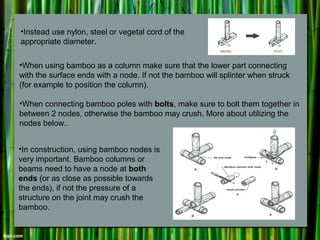
•Instead use nylon, steel or vegetal cord of the
appropriate diameter.
•When using bamboo as a column make sure that the lower part connecting
with the surface ends with a node. If not the bamboo will splinter when struck
(for example to position the column).
•When connecting bamboo poles with bolts, make sure to bolt them together in
between 2 nodes, otherwise the bamboo may crush. More about utilizing the
nodes below..
•In construction, using bamboo nodes is
very important. Bamboo columns or
beams need to have a node at both
ends (or as close as possible towards
the ends), if not the pressure of a
structure on the joint may crush the
bamboo.
BAMBOO CUTS
These are the most common cuts to use
when making bamboo joints:
one ear / two ear / beveled / flute mouth /
fish mouth
•As you can see in the illustration
below, making basic cuts in
bamboo doesn't require
expensive or heavy power tools,
just a few traditional hand tools
will work fine.
JOINING HORIZONTAL WITH VERTICAL ELEMENTS
•Joint with one or two ears. Is used
to join bamboo rafters, logs or
lumber.
•Flap joint. Is used when there is no
lashing wire available. The flap can be
secured with bamboo strips.
•Fish mouth joint. Use of dowels and
anchors in bamboo joinery
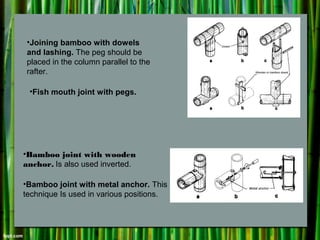
•Joining bamboo with dowels
and lashing. The peg should be
placed in the column parallel to the
rafter.
•Fish mouth joint with pegs.
•Bamboo joint with wooden
anchor. Is also used inverted.
•Bamboo joint with metal anchor. This
technique Is used in various positions.
DOUBLE AND QUADRUPLE BAMBOO RAFTER SUPPORT
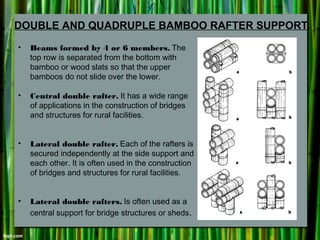
• Beams formed by 4 or 6 members. The
top row is separated from the bottom with
bamboo or wood slats so that the upper
bamboos do not slide over the lower.
• Central double rafter. It has a wide range
of applications in the construction of bridges
and structures for rural facilities.
• Lateral double rafter. Each of the rafters is
secured independently at the side support and
each other. It is often used in the construction
of bridges and structures for rural facilities.
 
• Lateral double rafters. Is often used as a
central support for bridge structures or sheds.
JOINING AND FIXATION OF BAMBOO POLES
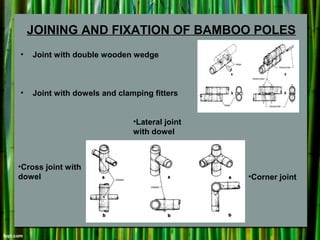
• Joint with double wooden wedge
• Joint with dowels and clamping fitters
•Cross joint with
dowel
•Lateral joint
with dowel
•Corner joint
SPLICING BAMBOO POLES
•Top splicing.
 
•Bevel splicing.
 
•Ray splicing
 
•Half bamboo splicing.
 
•Splicing with internal union.
 
•Splicing with external union.
 
•Telescope splicing.
THANK YOU

Bamboo Construction

  • 1.
  • 2.
    INTRO •Bamboo is awoody grass. It is the fastest-growing woody plant •Some species of bamboo grow so fast you can almost see them growing. • They are capable of growing 60 cm or more per day. •However, the growth rate is dependent on local soil and climatic conditions.
  • 3.
    WHY BAMBOO USEDFOR STRUCTURAL APPLICATIONS? • High strength to weight ratio and its flexibility. • It is particularly appealing, in seismic areas, as complement to relatively non rigid wall systems such as straw-bale. • Extremely strong fiber - twice the compressive strength of concrete. • - roughly same strength to weight ratio of steel in tension. • Uses - in residential and commercial building applications • Wall systems • Floor systems • Finishes
  • 4.
    USE OF BAMBOOIN CONSTRUCTION •Reinforcement •Roofing •Walling •Flooring •Scaffolding •Doors & Windows •Decoration
  • 5.
  • 6.
    BAMBOO FOUNDATIONS BAMBOO PILES •Bamboo compacts soft soil, thus increasing the bearing capacity of soil. • The friction provided by the construction-grade bamboo increases its load-bearing capacity. •Treated split bamboo piles 8m long and 80 to 90mm in diameter were filled with coconut coir strands wrapped with jute.
  • 7.
  • 8.
    WALLING/CEILING • Bajareque wall:This wall-building technique is very well- known in Latin America. Bamboo strips are tied on either side of timber and then intermediate space is filled with mortar. • Bamboo board wall: This is a common method of construction in Indonesia.
  • 9.
  • 10.
    FLOORING Bamboo can beused as flooring material due to its better wear and tear resistance and its resilience properties. Modern construction: apartment unit utilizing bamboo flooring
  • 11.
    SCAFFOLDING REED BOARDS Reed boardsare made by flat pressing the reed at high temperatures. These reed boards are used in elements like flooring, walls, ceiling and roofing. They can also be used for partitions, doors, windows etc. Bamboo poles lashed together have been used as scaffolding in high rise structures due to their strength and resilience. The timber planks can be replaced with bamboo culms and these can be lashed to the vertical culms. The working platforms for masons can also be built of bamboo
  • 12.
    DOORS & WINDOWS Bambooframes can replace timber frames appropriate to function. Bamboo mat shutters fixed to bamboo frame or a panel of bamboo board fixed to the frame which is hinged to the wall can be used as door. Small framed openings hinged to the top in the wall can serve as windows.
  • 13.
    JOINERY TECHNIQUES BASICS PRINCIPLES •Donot use green, fresh cut bamboo. Bamboo has to be completely dry before using it in construction (preferable air dried). •Do not use bamboo when it is less then 3 years of age. Only use mature bamboo of 4-6 years. •Do not use bamboo poles with profound vertical cracks. •Do not use bamboo that has flourished. Rest assured bamboo only flourishes once in a lifetime (60-120 years). •Use appropriate cuts and joints when building with bamboo. •Use bamboo with the right diameter and wall thickness for your project. •Do not use conventional wood nails in bamboo joinery, they will cause the bamboo to split.
  • 14.
    •Instead use nylon,steel or vegetal cord of the appropriate diameter. •When using bamboo as a column make sure that the lower part connecting with the surface ends with a node. If not the bamboo will splinter when struck (for example to position the column). •When connecting bamboo poles with bolts, make sure to bolt them together in between 2 nodes, otherwise the bamboo may crush. More about utilizing the nodes below.. •In construction, using bamboo nodes is very important. Bamboo columns or beams need to have a node at both ends (or as close as possible towards the ends), if not the pressure of a structure on the joint may crush the bamboo.
  • 15.
    BAMBOO CUTS These arethe most common cuts to use when making bamboo joints: one ear / two ear / beveled / flute mouth / fish mouth •As you can see in the illustration below, making basic cuts in bamboo doesn't require expensive or heavy power tools, just a few traditional hand tools will work fine.
  • 16.
    JOINING HORIZONTAL WITHVERTICAL ELEMENTS •Joint with one or two ears. Is used to join bamboo rafters, logs or lumber. •Flap joint. Is used when there is no lashing wire available. The flap can be secured with bamboo strips. •Fish mouth joint. Use of dowels and anchors in bamboo joinery
  • 17.
    •Joining bamboo withdowels and lashing. The peg should be placed in the column parallel to the rafter. •Fish mouth joint with pegs. •Bamboo joint with wooden anchor. Is also used inverted. •Bamboo joint with metal anchor. This technique Is used in various positions.
  • 18.
    DOUBLE AND QUADRUPLEBAMBOO RAFTER SUPPORT • Beams formed by 4 or 6 members. The top row is separated from the bottom with bamboo or wood slats so that the upper bamboos do not slide over the lower. • Central double rafter. It has a wide range of applications in the construction of bridges and structures for rural facilities. • Lateral double rafter. Each of the rafters is secured independently at the side support and each other. It is often used in the construction of bridges and structures for rural facilities.   • Lateral double rafters. Is often used as a central support for bridge structures or sheds.
  • 19.
    JOINING AND FIXATIONOF BAMBOO POLES • Joint with double wooden wedge • Joint with dowels and clamping fitters •Cross joint with dowel •Lateral joint with dowel •Corner joint
  • 20.
    SPLICING BAMBOO POLES •Topsplicing.   •Bevel splicing.   •Ray splicing   •Half bamboo splicing.   •Splicing with internal union.   •Splicing with external union.   •Telescope splicing.
  • 21.