TURNSTILE ANTENNA
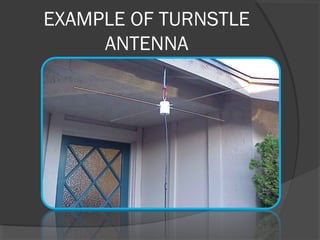
 A turnstile antenna is a set of two dipole 
  antennas aligned at right angles to each 
  other and fed 90 degrees out-of-phase. 
 It has been developed primarily for 
  omnidirectional vhf communications.
TURNSTILE ANTENNA –
             cont’d
   Antenna Gain - The gain of a turnstile 
    antenna is actually about 3 dB less than 
    that of a single dipole in its direction of 
    maximum radiation, because each of the 
    elements of the turnstile receives only 
    one-half the transmitter power.
TURNSTILE ANTENNA –
            cont’d
   Turnstile antennas are often used for 
    FM broadcast reception, where they 
    give reasonable performance in all 
    directions without the need for a rotor.
RADIATION PATTERN
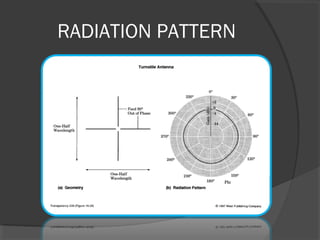
   When these two antennas are excited 
    with equal currents 90 degrees out of 
    phase, the typical figure-eight patterns 
    of the two antennas merge to produce 
    the nearly circular pattern.
RADIATION PATTERN
EXAMPLE OF TURNSTLE
     ANTENNA
MARCONI ANTENNA
 Marconi Antenna is usually a quarter –
  wave grounded antenna or any odd
  multiple of quarter wavelength.
 It is used primarily with frequencies
  below 2 MHz .
 Marconi type requires a conducting path
  to ground.
GROUNDED MARCONI
    ANTENNA
EFFECTS OF GROUND
        REFLECTION
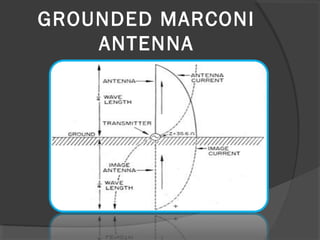
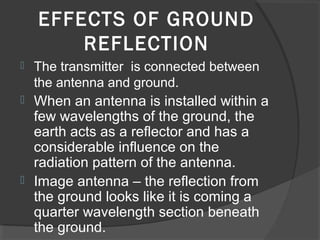
   The transmitter is connected between
    the antenna and ground.
 When an antenna is installed within a
  few wavelengths of the ground, the
  earth acts as a reflector and has a
  considerable influence on the
  radiation pattern of the antenna.
 Image antenna – the reflection from
  the ground looks like it is coming a
  quarter wavelength section beneath
  the ground.
EFFECTS OF GROUND
    REFLECTION – cont’d
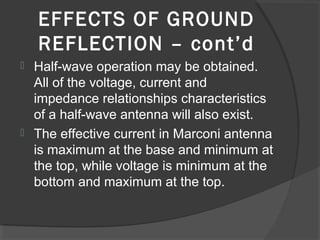
 Half-wave operation may be obtained.
  All of the voltage, current and
  impedance relationships characteristics
  of a half-wave antenna will also exist.
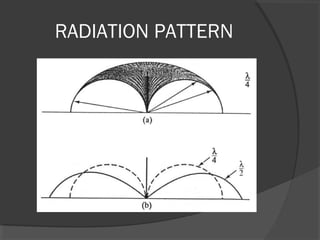
 The effective current in Marconi antenna
  is maximum at the base and minimum at
  the top, while voltage is minimum at the
  bottom and maximum at the top.
EFFECTS OF GROUND
    REFLECTION – cont’d
 If the conductivity of the soil in which the
  Marconi antenna is supported very low,
  the reflected wave from the ground may
  be attenuated.
 This problem is alleviated by installing a
  counterpoise.
COUNTERPOISE
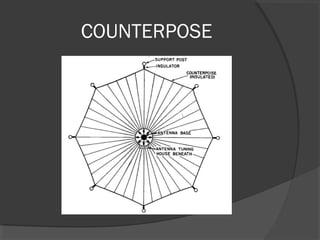
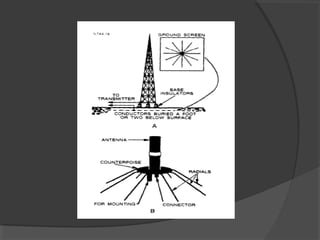
 It is a portion of an antenna system that
  is composed of wires or other types of
  conductor arranged in a circular pattern
  at the base of the antenna at a certain
  distance above ground.
 Counterpoise is a grounding grid
  established where the earth grounding
  cannot satisfy electrical requirement for
  circuits completion. It designed to be
  non-resonant at the operating
  frequency.
COUNTERPOSE
RADIATION PATTERN
TOP LOADING
   It is used to increase the current at the
    base of antenna, and also to make the
    current distribution more uniform.
GROUND PLANE ANTENNA
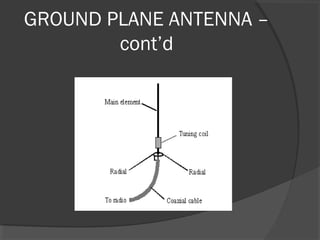
 A ground-plane antenna is a variant of
  the dipole antenna, designed for use
  with an unbalanced feed line such as
  coaxial cable.
 It resembles a coaxial antenna whose
  lower section consists of straight
  elements called radials instead of a
  hollow conducting cylinder.
GROUND PLANE ANTENNA -
            cont’d
 There are two or more radials, each
  measuring ¼ wavelength.
 The main element can be any length,
  but it must be adjusted to function at and
  near a specific frequency. This
  adjustment is done using a tuning coil.
GROUND PLANE ANTENNA –
        cont’d
 Ground-plane antennas are favored at
  frequencies above approximately 10
  MHz where the dimensions are
  manageable.
 This type of antenna is especially
  popular among Citizens Band radio
  operators for fixed-station use in the
  class-D band at 27 MHz.

Turnstile antenna

  • 2.
    TURNSTILE ANTENNA  A turnstile antenna is a set of two dipole  antennas aligned at right angles to each  other and fed 90 degrees out-of-phase.   It has been developed primarily for  omnidirectional vhf communications.
  • 3.
    TURNSTILE ANTENNA – cont’d  Antenna Gain - The gain of a turnstile  antenna is actually about 3 dB less than  that of a single dipole in its direction of  maximum radiation, because each of the  elements of the turnstile receives only  one-half the transmitter power.
  • 4.
    TURNSTILE ANTENNA – cont’d  Turnstile antennas are often used for  FM broadcast reception, where they  give reasonable performance in all  directions without the need for a rotor.
  • 5.
    RADIATION PATTERN  When these two antennas are excited  with equal currents 90 degrees out of  phase, the typical figure-eight patterns  of the two antennas merge to produce  the nearly circular pattern.
  • 6.
  • 7.
  • 9.
    MARCONI ANTENNA  MarconiAntenna is usually a quarter – wave grounded antenna or any odd multiple of quarter wavelength.  It is used primarily with frequencies below 2 MHz .  Marconi type requires a conducting path to ground.
  • 10.
  • 11.
    EFFECTS OF GROUND REFLECTION  The transmitter is connected between the antenna and ground.  When an antenna is installed within a few wavelengths of the ground, the earth acts as a reflector and has a considerable influence on the radiation pattern of the antenna.  Image antenna – the reflection from the ground looks like it is coming a quarter wavelength section beneath the ground.
  • 12.
    EFFECTS OF GROUND REFLECTION – cont’d  Half-wave operation may be obtained. All of the voltage, current and impedance relationships characteristics of a half-wave antenna will also exist.  The effective current in Marconi antenna is maximum at the base and minimum at the top, while voltage is minimum at the bottom and maximum at the top.
  • 13.
    EFFECTS OF GROUND REFLECTION – cont’d  If the conductivity of the soil in which the Marconi antenna is supported very low, the reflected wave from the ground may be attenuated.  This problem is alleviated by installing a counterpoise.
  • 14.
    COUNTERPOISE  It isa portion of an antenna system that is composed of wires or other types of conductor arranged in a circular pattern at the base of the antenna at a certain distance above ground.  Counterpoise is a grounding grid established where the earth grounding cannot satisfy electrical requirement for circuits completion. It designed to be non-resonant at the operating frequency.
  • 15.
  • 17.
  • 18.
    TOP LOADING  It is used to increase the current at the base of antenna, and also to make the current distribution more uniform.
  • 20.
    GROUND PLANE ANTENNA A ground-plane antenna is a variant of the dipole antenna, designed for use with an unbalanced feed line such as coaxial cable.  It resembles a coaxial antenna whose lower section consists of straight elements called radials instead of a hollow conducting cylinder.
  • 21.
    GROUND PLANE ANTENNA- cont’d  There are two or more radials, each measuring ¼ wavelength.  The main element can be any length, but it must be adjusted to function at and near a specific frequency. This adjustment is done using a tuning coil.
  • 22.
  • 23.
     Ground-plane antennasare favored at frequencies above approximately 10 MHz where the dimensions are manageable.  This type of antenna is especially popular among Citizens Band radio operators for fixed-station use in the class-D band at 27 MHz.