Unit 4.
Tunnel Engineering
Introduction:
A tunnel can be defined as an underground passage for the transport of passengers, goods, water,
sewage, oil, gas etc.
The construction of a tunnel is normally carried out without causing much disturbance to the ground
surface.
Tunnels are more economical than open cuts beyond certain depths.
Tunnels avoid disturbing or interfering with surface life traffic during construction.
Tunnels prove to be cheaper than bridges and open cuts to carry public utility services like water,
sewer and gas.
Feasibility of tunnel project depends on the geological conditions of the site, construction time and
costs.
At its most basic, a tunnel is a tube hollowed through soil or stone.
Constructing a tunnel, however, is one of the most complex challenges in the field of civil
engineering.
A tunnel is a horizontal passageway located underground.
There are many different ways to excavate a tunnel, including manual labor, explosives, rapid
heating and cooling, tunneling machinery or a combination of these methods.
The diagram below shows the relationship between these underground structures in a typical
mountain tunnel.
The opening of the tunnel is a portal.
The "roof" of the tunnel, or the top half of the tube, is the crown.
The bottom half is the invert.
The basic geometry of the tunnel is a continuous arch. Because tunnels must withstand tremendous
pressure from all sides, the arch is an ideal shape. In the case of a tunnel, the arch simply goes all the
way around.
Tunnel engineers, like bridge engineers, must be concerned with an area of physics known as statics.
Statics describes how the following forces interact to produce equilibrium on structures such as
tunnels and bridges:
Tension, which expands, or pulls on, material
Compression, which shortens, or squeezes material
Shearing, which causes parts of a material to slide past one another in opposite directions
Torsion, which twists a material
The tunnel must oppose these forces with strong materials, such as masonry, steel, iron and concrete.
In order to remain static, tunnels must be able to withstand the loads placed on them.
Dead load refers to the weight of the structure itself, while live load refers to the weight of the
vehicles and people that move through the tunnel.
Tunnel:
It is an artificial underground passage to by pass obstacles safely without disturbing the
overburden to carry traffic, water, sewage,etc.
ADVANTAGES
2.
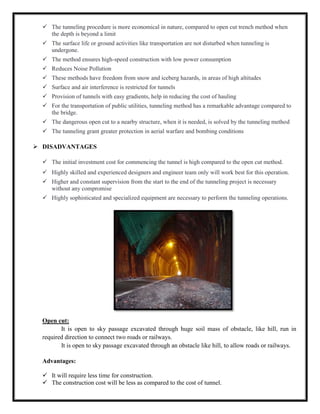
The tunnelingprocedure is more economical in nature, compared to open cut trench method when
the depth is beyond a limit
The surface life or ground activities like transportation are not disturbed when tunneling is
undergone.
The method ensures high-speed construction with low power consumption
Reduces Noise Pollution
These methods have freedom from snow and iceberg hazards, in areas of high altitudes
Surface and air interference is restricted for tunnels
Provision of tunnels with easy gradients, help in reducing the cost of hauling
For the transportation of public utilities, tunneling method has a remarkable advantage compared to
the bridge.
The dangerous open cut to a nearby structure, when it is needed, is solved by the tunneling method
The tunneling grant greater protection in aerial warfare and bombing conditions
DISADVANTAGES
The initial investment cost for commencing the tunnel is high compared to the open cut method.
Highly skilled and experienced designers and engineer team only will work best for this operation.
Higher and constant supervision from the start to the end of the tunneling project is necessary
without any compromise
Highly sophisticated and specialized equipment are necessary to perform the tunneling operations.
Open cut:
It is open to sky passage excavated through huge soil mass of obstacle, like hill, run in
required direction to connect two roads or railways.
It is open to sky passage excavated through an obstacle like hill, to allow roads or railways.
Advantages:
It will require less time for construction.
The construction cost will be less as compared to the cost of tunnel.
3.
Disadvantages:
It willrequire greater length due to approaches.
The maintenance costs of highway and railways are very high.
It requires locomotives and automobiles with high tractive force due to grades.
It proves unsafe during aerial warfare or bombing of cities.
The wear and tear of pavements due to natural forces like snow, rain etc high.
Tunnel v/s Open cut
Initial cost of construction of a tunnel is high as compared to an open cut
No disturbance to the surface activities during construction of a tunnel. This is not possible with
open cuts.
Wear and tear of pavements due to rain, snow,etc. is more in open cuts than in tunnels
Tunnels are more safe in case of warfare and bombing than the open cuts
Construction of a tunnel requires long time than an open cut
More specialized equipment are needed for tunnel construction
Highly skilled labour and supervision are required for tunnel construction.
HISTORY OF TUNNELS CONSTRUCTED:
It is understood that the first tunnel of the world as constructed by Egyptians and
Babylonians about 4000 years ago. It was built to connect two buildings in Babylon. The length,
width and height of this tunnel were respectively 10 m, 3600 mm and 4500 mm. Subsequently,
Romans constructed the tunnels with the following improvements:
1. Substituting vinegar for water in cooling the rock so as to attack the rock chemically as well
as mechanically.
2. Using fire as an agent for disintegration of rocks.
3. Working at several points by introducing shafts.
The use of shield in tunnel engineering was introduced by Sir Isam Bard Brunel while
constructing tunnel under river Thames in London in 1825.
In a similar way, various other countries such as France, U.S.A., Canada, Soviet Union,
Japan, etc. have also contributed to the important developments of the present day science of
tunnelling.
The gigantic project of this century, the channel tunnel, linking Britain and France was
declared open on 6th May, 1994. The length of the tunnel is 50 km which covers the greatest
distance under sea of 39 km. It consists of three parallel bores of 50 km length interconnected at
every 375 m by cross-passages.
The outer bores of 7.6 m internal diameter are used for railways and the central bore of 4.8 m
internal diameter is used as a service tunnel. The service tunnel contains a roadway used by
maintenance and emergency personnel. The project is financed by shareholders and bankers
amounting to 15 billion dollars which will be repaid out of revenue (no government support).
The tunnel carries trains running at a speed of about 160 to 200 km p.h. The vehicles like
motors and trucks are placed in the trains and within a short period of about 35 minutes, the tunnel
can be crossed between the terminals near Calais and Folkestone. The drivers can then move in their
own vehicles either in Britain or Europe. The benefit of the tunnel is available not only to Britain or
France but to the whole of Europe and hence, it has attained great political importance also.
Our country during the last four decades has also witnessed the construction of many long tunnels
whichare mainly for the hydro-electric and water supply projects The notable amongst these may be
mentioned as follows:
4.
o 3.75km longhead-race tunnel for Koyna hydroelectric project.
o 1.54 km and 4.25 km long water supply tunnels in Bombay.
o 4.77 km total length of five diversion tunnels for the Beas dam project.
o 6.62 km long head-race tunnel for Loktak project'
o 3.80 km long Malbar hill project.
o 12.79 km long lower periyar tunnel etc.
DEVELOPMENTS IN TUNNELLING METHODS:
Current methods of tunnelling differ in principle from those used for many decades or even
hundreds years Changes in technology of tunnelling because of inventions such as gun powder in
1680, detachable tungsten carbide drill bits in 1930 and rock bolts, shot crete have not improved
ability to construct tunnel but have improved hence, speed of economical excavation tunnel reduction
construction in supports can be required made.
Construction rate has increased to 3.5 km/year and increased useful cross sectional tunnel
area from 50 m2 to 80 m2 with equal excavated volume and reduced support volume from 45 m2
/m to
15 m2
/m and reduced fatality rates.
Since old days difficulty is experienced in tunnelling through soft soils.
From yester-years’ experience for tunnelling in soft soils, some findings are tabulated for future
advantages.
1. Use shield if ground allows for easy penetration.
2. Excavate small headings and support them immediately to prevent loosening.
3. Provide good foundations for temporary support system.
4. Find special solution for non-systemic pressures likely to develop during tunnel construction.
5. Close the arch against high lateral pressure.
6. Provide adequate space for simultaneous excavation and support system.
ECONOMICS OF TUNNELLING:
This is a very broad question and in general depends on the relative cost of open cut vs
tunnelling. The following aspects of the problem are instructive:
1. Nature of soil, particularly in deep cutting, with the consequent side slopes and volume of
excavation, will greatly influence the cost of open cuts. A tunnel may be comparatively
cheaper and easier.
2. If the soil is hard rock, the open cut could be of steep side slope, involving much less
volume of excavation and may prove cheaper; whereas a tunnel through the same, though
may require little or no timbering, may be very difficult to blast out.
3. The requirements of fill in the neighbourhood also largely influence the choice. If a large
amount of material is needed for the nearby fill, an open cut may be justified, though a
tunnel may be comparatively more economical.
Generally, when depth of cut is over 18 m, tunneling is advisable and from the point of economy in
construction maintenance and various other aspects affecting the working of roads and railway, the
tunnelling operation is desirable under the following circumstances:
1. It allows rapid and unobstructed transport facilities in big congested cities,
2. It avoids acquisition of valuable land.
3. It avoids long circuitous routes around a mountain or spur,
4. It connects the two terminal stations separated by a mountain or any other obstacle with the shortest
route.
5.
5. It divertswater for generation of power.
6. It is desirable to carry public utility services like oil, gas, water, etc. across a stream or a mountain.
7. It permits easy gradients in mountainous terrain and thereby encourages high speed of vehicles.
8. It is preferred on routes of strategic importance because a tunnel is hidden in ground.
9. It is better then open cuts having side embankment sliding in soft soils.
It should be remembered that construction of a tunnel involves heavy expenditure and it requires
substantial time for making the productive use of a tunnel. It becomes therefore necessary to consider
carefully major economic factors for designing and constructing a tunnel.
The factors involved are equipment to be used, nature of labour force, driving methods, lining,
mucking, ventilation, etc.
SELECTION OF ALIGNMENT OF TUNNEL:
The selection of route of tunnel will naturally depend on the topography of the area through which
tunnel is passing and also on the convenient points of its entrance and exit.
However, the following two important considerations also sometimes may lead to the alteration of
the proposed tunnel alignment:
In some cases, it will be very difficult to secure right of way for carrying the tunnel through privately
owned properties. The tunnel alignment in such situations altered to some other route having the min of
securing the right of way for passing through tunnel.
The tunnel alignment having unfavourable geological conditions is uncontrolled in preference to one
having the most favourable geological conditions.
Thus, the selection of site of tunnel should be made by keeping in mind the following two facts:
1. Alignment restraints:
Underground area heterogenous mass and in addition, problems like water table, meeting
high temperature zones, position of fractured rocks, etc. are to be tackled. In a similar way, the
works of human beings such as filled up ground, presence of service lines, etc. are also to be
tackled.
A thorough detailed inspection and evaluation of the existing alignment restraints of
underground space should therefore be made and it should be correlated with the tunnelling
technology to be adopted for the project.
2. Environmental considerations:
The site of tunnel should be selected in such a way that the least difficulty is experienced for
various environmental factors such as disposal of exhaust gas, ground-water, muck, etc.
CLASSIFICATION OF TUNNELS:
The tunnels can be classified in various ways as shown below:
1. Classification according to alignment.
2. Classification according to purpose.
3. Classification according to type of material met with, at the time of construction.
4. Classification according to the shape of tunnels
(1) Classification according to alignment:
Tunnels according to alignment or position are classified as follows:
a) Off-spur tunnels, i.e. short length tunnels to negotiatethe minor local obstacles, are very high
projections on way, which cannot be followed with permitted curves.
b) Saddle or base tunnels i.e. tunnels constructed in the valleys along the natural slope till the slope
does not exceed the ruling gradient.
6.
c) Slope tunnelsi.e. tunnels constructed in steep hills for economic and safe operations of roads and
railways.
d) Spiral tunnels i.e. tunnels provided in narrow valleys in the form of loops in the interior of
mountain so as to increase the length of tunnel to avoid steep slopes.
(2) Classification according to purpose:
Tunnels according to their purpose are classified as follows:
a) Conveyance tunnels and they include sewer tunnels, water supply tunnels, hydro-electric power
tunnels, etc.
b) Traffic tunnels and they include highway tunnels, railway tunnels, pedestrian tunnels, navigation
tunnels and subway tunnels.
(3) Classification according to type of material met with in the construction:
Tunnels according to the material through which are driven or constructed are classified as
follows:
a) Tunnels in hard rock
b) Tunnels in soft materials
c) Tunnels underneath river bed or in water bearing soils.
4) Classification according to the shape of tunnels:
Criteria for selection of shape:
o Shape of sectional profile of tunnel should be such that lining is able to resist the pressure
exerted by unsupported walls of tunnel excavation.
o These pressures are both vertical and lateral.
o If there is great lateral pressure due to cohesion, tunnel should be so designed, so as to offer
greater resistance at highest point.
o Curve must be sharper at the crown and may decrease towards the base.
o In some cases like quicksands or cohensionless soils, pressure will be acting normal to the
line of profile, circular section is best suited.
1. Rectangular or Box type shape:
The tunnels of rectangular shapes are small in depth. These tunnels are suitable for pedestrian
tunnels.
These tunnels are rarely used these days because their construction in difficult. The roof of such
tunnels is subjected to bending stresses and therefore, steel girders are to be provided to form to roof
lining.
7.
2. Circular shape:
Tunnels ate commonly used for carrying water under pressure. The tunnels of circular shape are best
for grouting resisting external and internal pressures.
These tunnels provide the greatest cross sectional area for the least perimeter. Circular shape tunnels
can be easily constructed in soft rock. Their lining is difficult. These tunnels require costly filling to
form flat base for providing a road or railway.
3. Segmental or D shape :
Where the risk of failure or collapse caused by external pressure from water or loose unstable soil
conditions on tunnel lining is non-existent . It is also called segmented roof tunnel. In this, roof takes up
the entire load and distributes it to the straight walls. Suitable for subways. Main advantage of this section
over others is additional floor space.
4. Horse- shoe shape:
The tunnels of this shape have nearly flat bottom and curved sides and roof. These tunnels are
suitable in soft rock. Tunnels of these shapes are commonly used as traffic, tunnels for road and
railways routes in all country. These tunnels resist the external pressure by arch action also at their
bottom. They are difficult to construct. They are not suitable as water tunnel.
8.
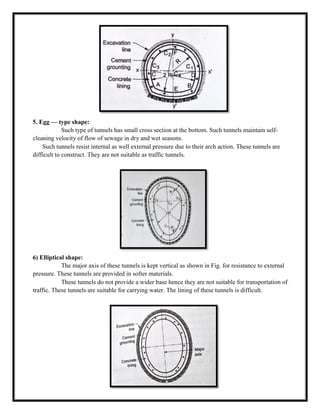
5. Egg —type shape:
Such type of tunnels has small cross section at the bottom. Such tunnels maintain self-
cleaning velocity of flow of sewage in dry and wet seasons.
Such tunnels resist internal as well external pressure due to their arch action. These tunnels are
difficult to construct. They are not suitable as traffic tunnels.
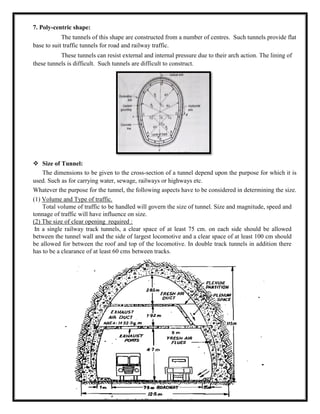
6) Elliptical shape:
The major axis of these tunnels is kept vertical as shown in Fig. for resistance to external
pressure. These tunnels are provided in softer materials.
These tunnels do not provide a wider base hence they are not suitable for transportation of
traffic. These tunnels are suitable for carrying water. The lining of these tunnels is difficult.
9.
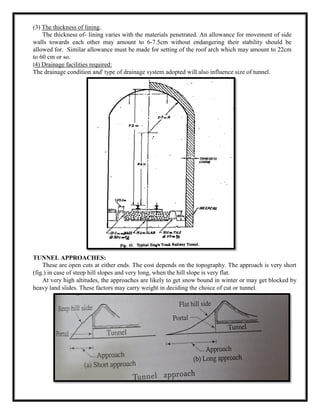
7. Poly-centric shape:
Thetunnels of this shape are constructed from a number of centres. Such tunnels provide flat
base to suit traffic tunnels for road and railway traffic.
These tunnels can resist external and internal pressure due to their arch action. The lining of
these tunnels is difficult. Such tunnels are difficult to construct.
Size of Tunnel:
The dimensions to be given to the cross-section of a tunnel depend upon the purpose for which it is
used. Such as for carrying water, sewage, railways or highways etc.
Whatever the purpose for the tunnel, the following aspects have to be considered in determining the size.
(1) Volume and Type of traffic.
Total volume of traffic to be handled will govern the size of tunnel. Size and magnitude, speed and
tonnage of traffic will have influence on size.
(2) The size of clear opening required :
In a single railway track tunnels, a clear space of at least 75 cm. on each side should be allowed
between the tunnel wall and the side of largest locomotive and a clear space of at least 100 cm should
be allowed for between the roof and top of the locomotive. In double track tunnels in addition there
has to be a clearance of at least 60 cms between tracks.
10.
(3) The thicknessof lining.
The thickness of- lining varies with the materials penetrated. An allowance for movement of side
walls towards each other may amount to 6-7.5cm without endangering their stability should be
allowed for. Similar allowance must be made for setting of the roof arch which may amount to 22cm
to 60 cm or so.
(4) Drainage facilities required:
The drainage condition and' type of drainage system adopted will also influence size of tunnel.
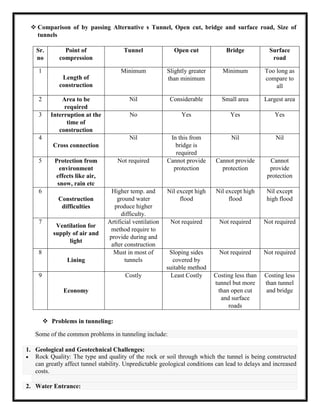
TUNNEL APPROACHES:
These are open cuts at either ends. The cost depends on the topography. The approach is very short
(fig.) in case of steep hill slopes and very long, when the hill slope is very flat.
At very high altitudes, the approaches are likely to get snow bound in winter or may get blocked by
heavy land slides. These factors may carry weight in deciding the choice of cut or tunnel.
11.
Comparison ofby passing Alternative s Tunnel, Open cut, bridge and surface road, Size of
tunnels
Sr.
no
Point of
compression
Tunnel Open cut Bridge Surface
road
1
Length of
construction
Minimum Slightly greater
than minimum
Minimum Too long as
compare to
all
2 Area to be
required
Nil Considerable Small area Largest area
3 Interruption at the
time of
construction
No Yes Yes Yes
4
Cross connection
Nil In this from
bridge is
required
Nil Nil
5 Protection from
environment
effects like air,
snow, rain etc
Not required Cannot provide
protection
Cannot provide
protection
Cannot
provide
protection
6
Construction
difficulties
Higher temp. and
ground water
produce higher
difficulty.
Nil except high
flood
Nil except high
flood
Nil except
high flood
7
Ventilation for
supply of air and
light
Artificial ventilation
method require to
provide during and
after construction
Not required Not required Not required
8
Lining
Must in most of
tunnels
Sloping sides
covered by
suitable method
Not required Not required
9
Economy
Costly Least Costly Costing less than
tunnel but more
than open cut
and surface
roads
Costing less
than tunnel
and bridge
Problems in tunneling:
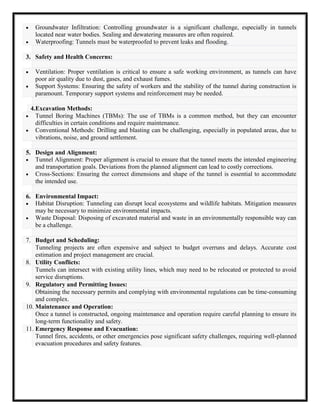
Some of the common problems in tunneling include:
1. Geological and Geotechnical Challenges:
Rock Quality: The type and quality of the rock or soil through which the tunnel is being constructed
can greatly affect tunnel stability. Unpredictable geological conditions can lead to delays and increased
costs.
2. Water Entrance:
12.
Groundwater Infiltration:Controlling groundwater is a significant challenge, especially in tunnels
located near water bodies. Sealing and dewatering measures are often required.
Waterproofing: Tunnels must be waterproofed to prevent leaks and flooding.
3. Safety and Health Concerns:
Ventilation: Proper ventilation is critical to ensure a safe working environment, as tunnels can have
poor air quality due to dust, gases, and exhaust fumes.
Support Systems: Ensuring the safety of workers and the stability of the tunnel during construction is
paramount. Temporary support systems and reinforcement may be needed.
4.Excavation Methods:
Tunnel Boring Machines (TBMs): The use of TBMs is a common method, but they can encounter
difficulties in certain conditions and require maintenance.
Conventional Methods: Drilling and blasting can be challenging, especially in populated areas, due to
vibrations, noise, and ground settlement.
5. Design and Alignment:
Tunnel Alignment: Proper alignment is crucial to ensure that the tunnel meets the intended engineering
and transportation goals. Deviations from the planned alignment can lead to costly corrections.
Cross-Sections: Ensuring the correct dimensions and shape of the tunnel is essential to accommodate
the intended use.
6. Environmental Impact:
Habitat Disruption: Tunneling can disrupt local ecosystems and wildlife habitats. Mitigation measures
may be necessary to minimize environmental impacts.
Waste Disposal: Disposing of excavated material and waste in an environmentally responsible way can
be a challenge.
7. Budget and Scheduling:
Tunneling projects are often expensive and subject to budget overruns and delays. Accurate cost
estimation and project management are crucial.
8. Utility Conflicts:
Tunnels can intersect with existing utility lines, which may need to be relocated or protected to avoid
service disruptions.
9. Regulatory and Permitting Issues:
Obtaining the necessary permits and complying with environmental regulations can be time-consuming
and complex.
10. Maintenance and Operation:
Once a tunnel is constructed, ongoing maintenance and operation require careful planning to ensure its
long-term functionality and safety.
11. Emergency Response and Evacuation:
Tunnel fires, accidents, or other emergencies pose significant safety challenges, requiring well-planned
evacuation procedures and safety features.