SUBMERGED TUNNEL
UNDERWATER TUNNELING
BY
RIJWI GHOSH
1EW10CV060
Under the Guidance of
Mr. Nagaraja Gupta MS
Associate Professor
Dept. of Civil Engineering
East West Institute of
Technology
Bangalore-560091
UNDER WATER TUNNELLING
 An underwater tunnel is a passage, gallery, or roadway
beneath a body of water. Underwater tunnels are used
for highway traffic, railroads, and subways; to
transport water, sewage, oil, and gas; to divert rivers
around dam sites while the dam is being built; and for
military and civil defence purposes.
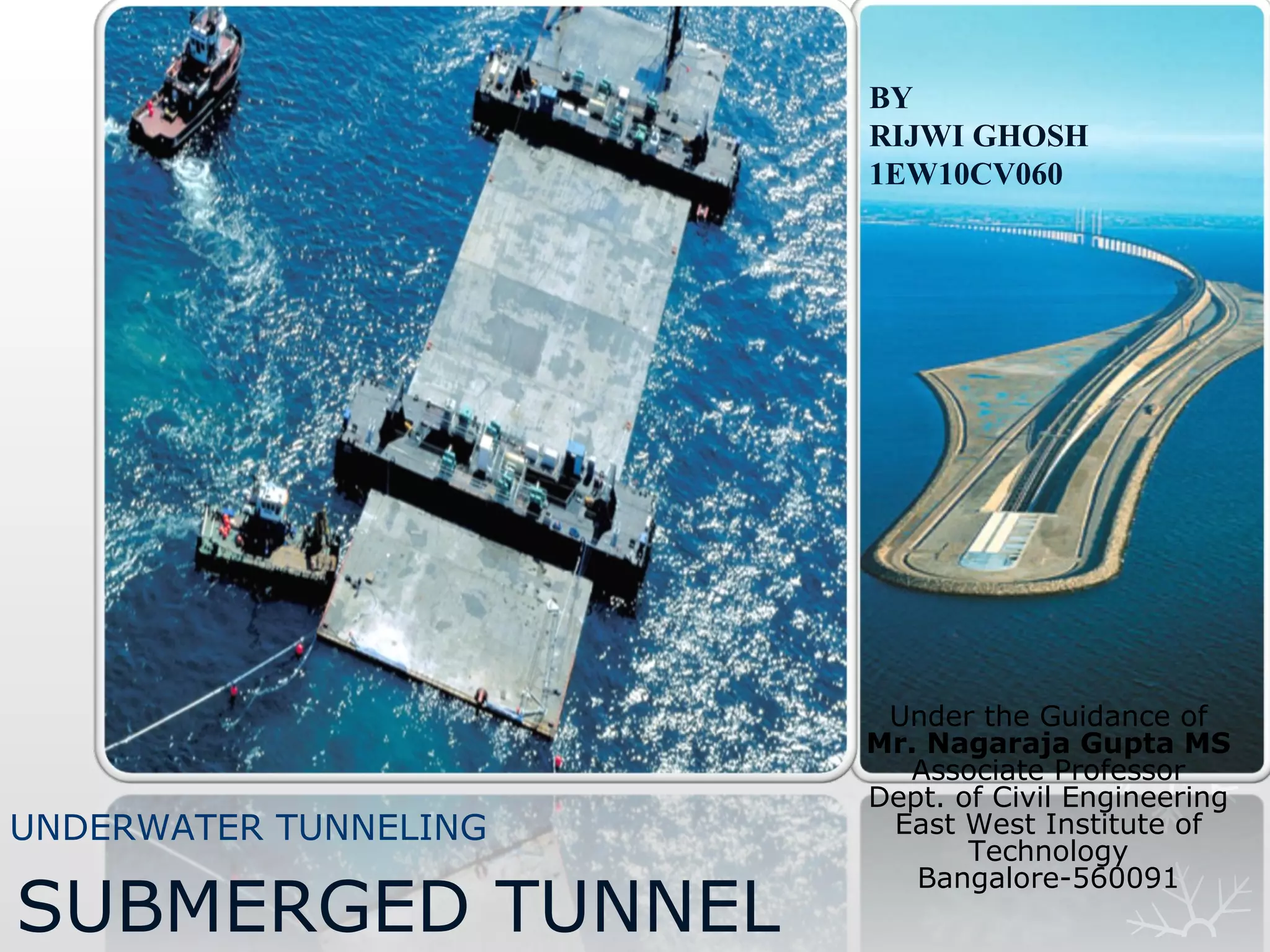
 Modern underwater tunnelling begins by constructing
an immersed tube within a pre-dug trench on the river
or sea floor. To do this, prefabricated sections of steel
tube are floated into position and strategically sunk
into the trench.
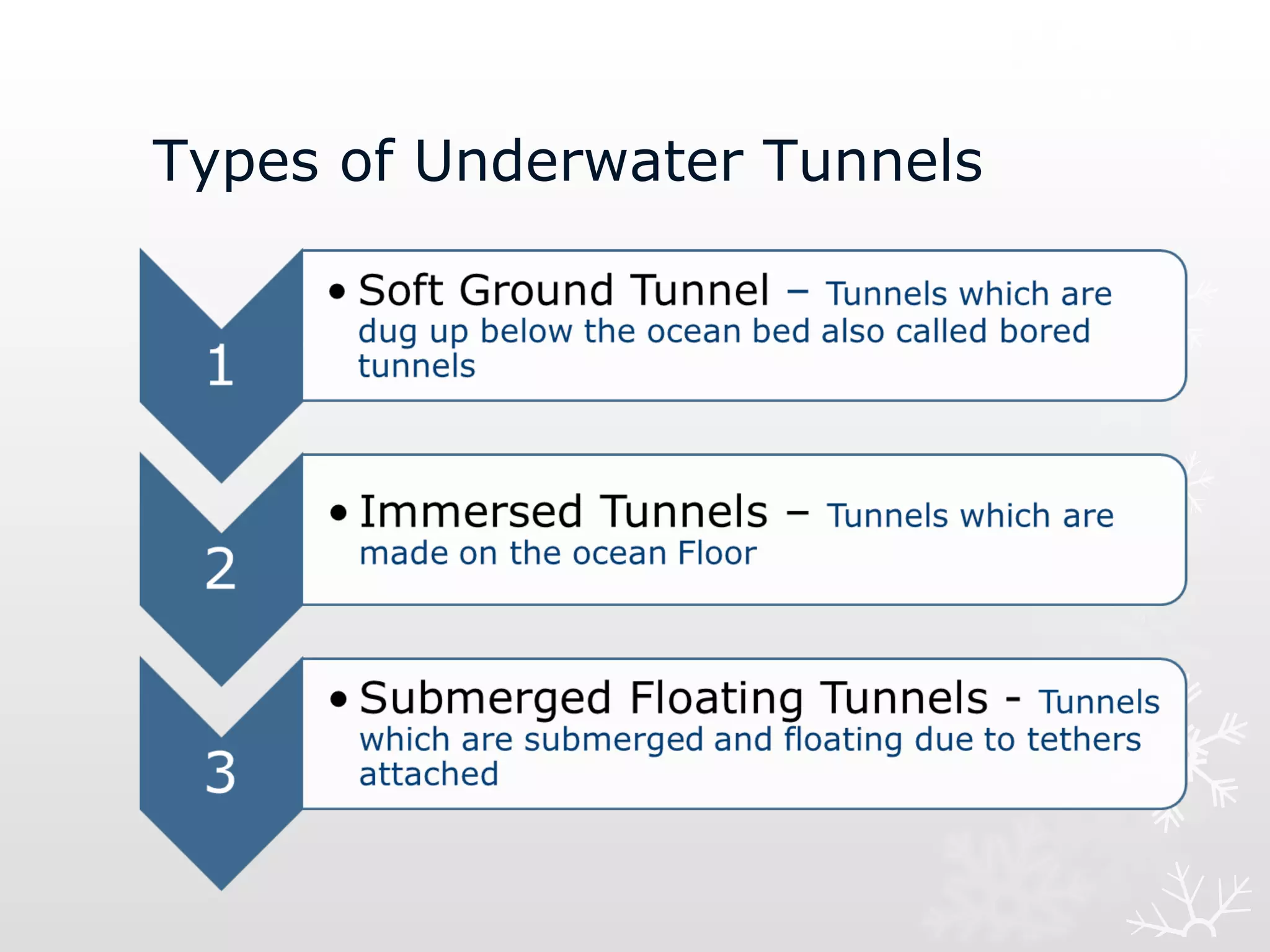
Types of Underwater Tunnels
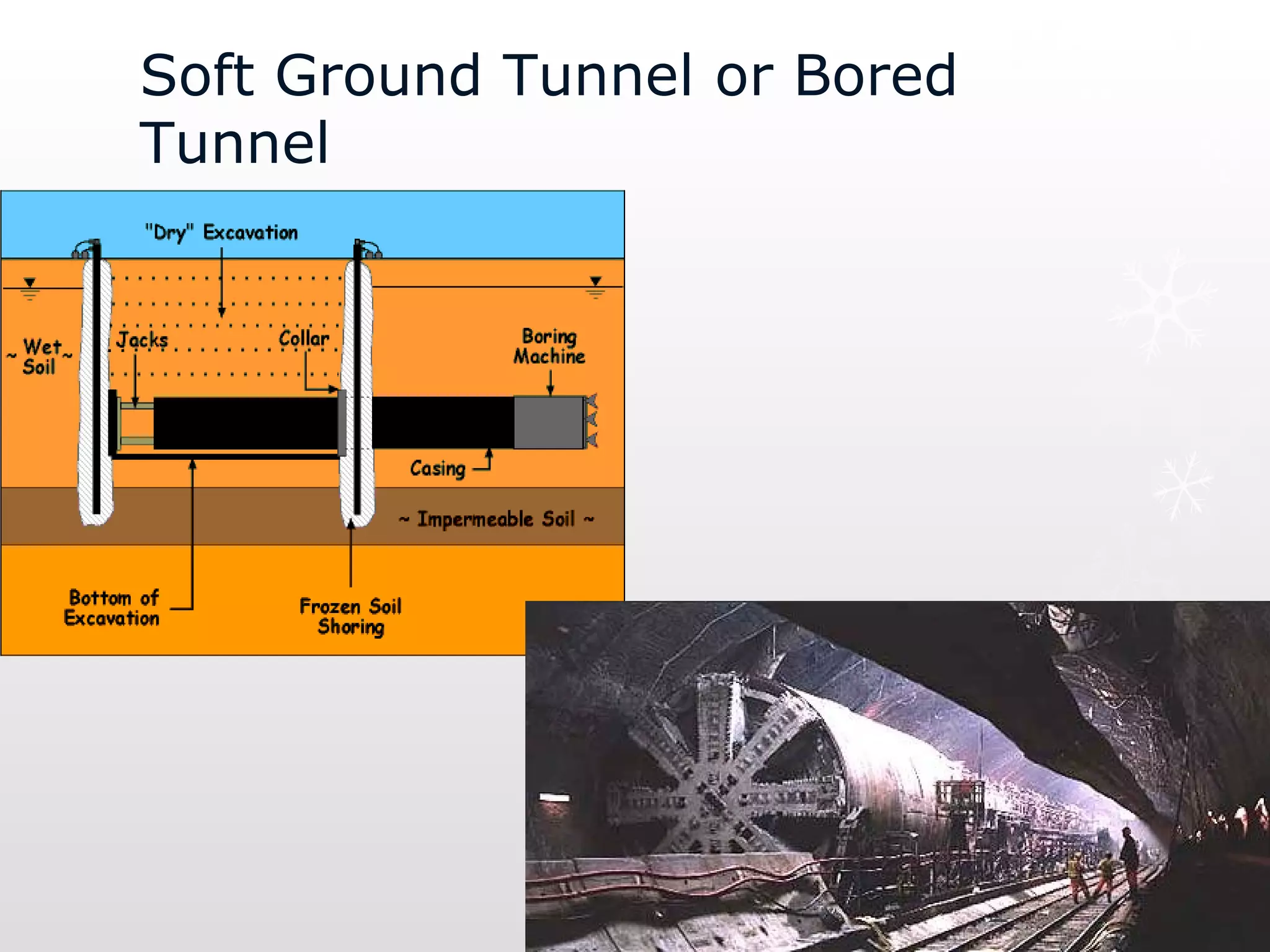
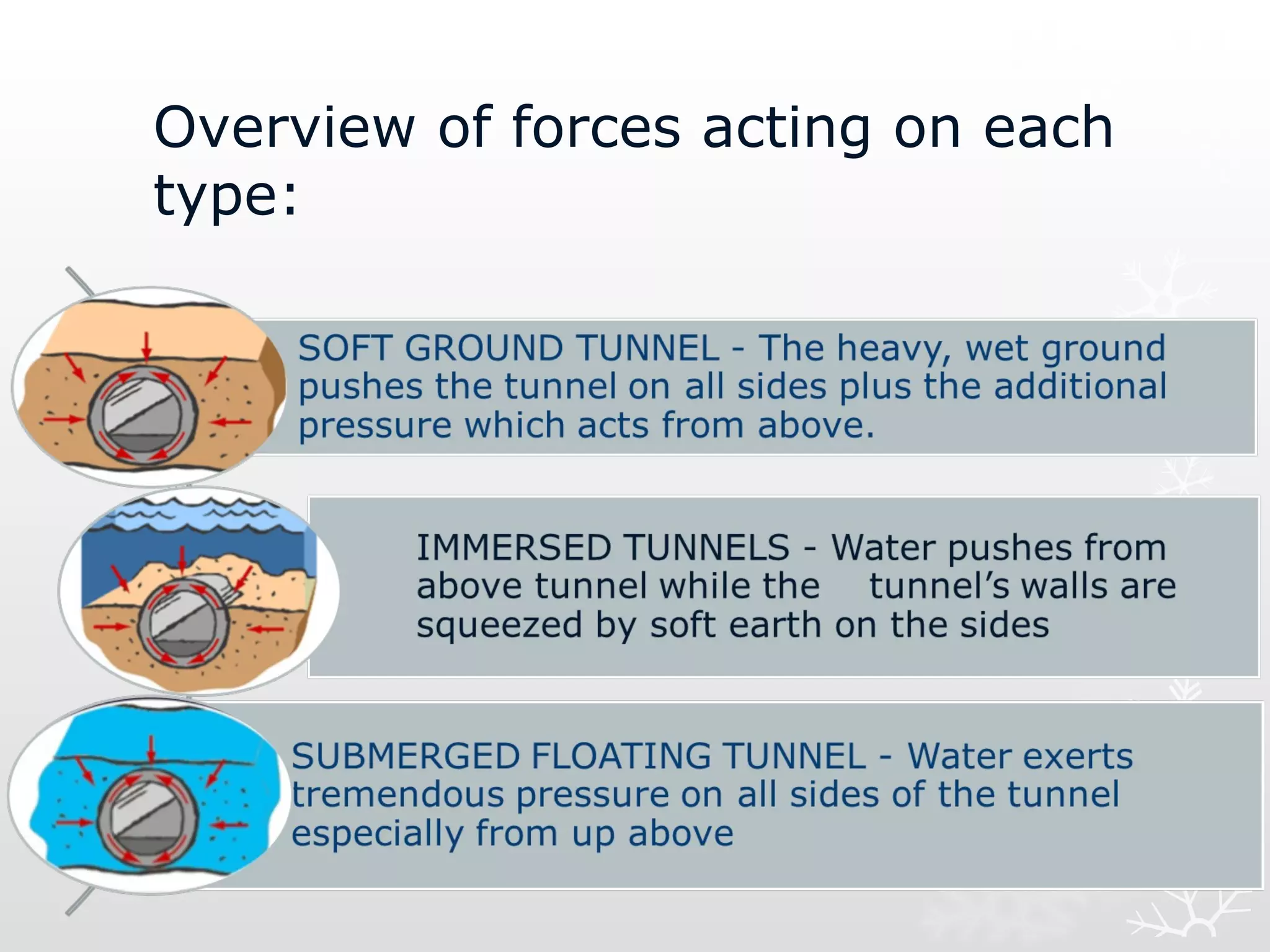
Soft Ground Tunnel or Bored
Tunnel
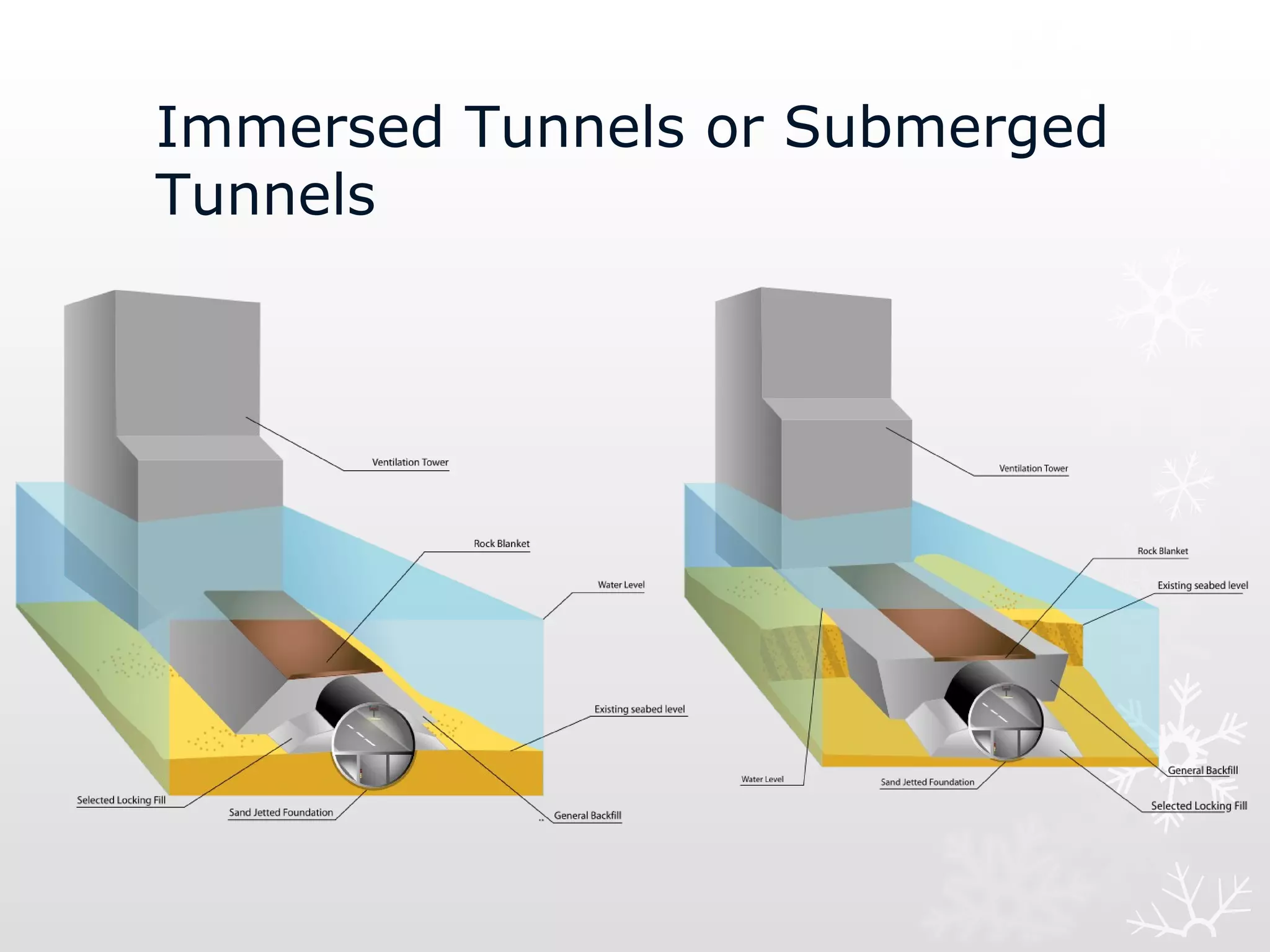
Immersed Tunnels or Submerged
Tunnels
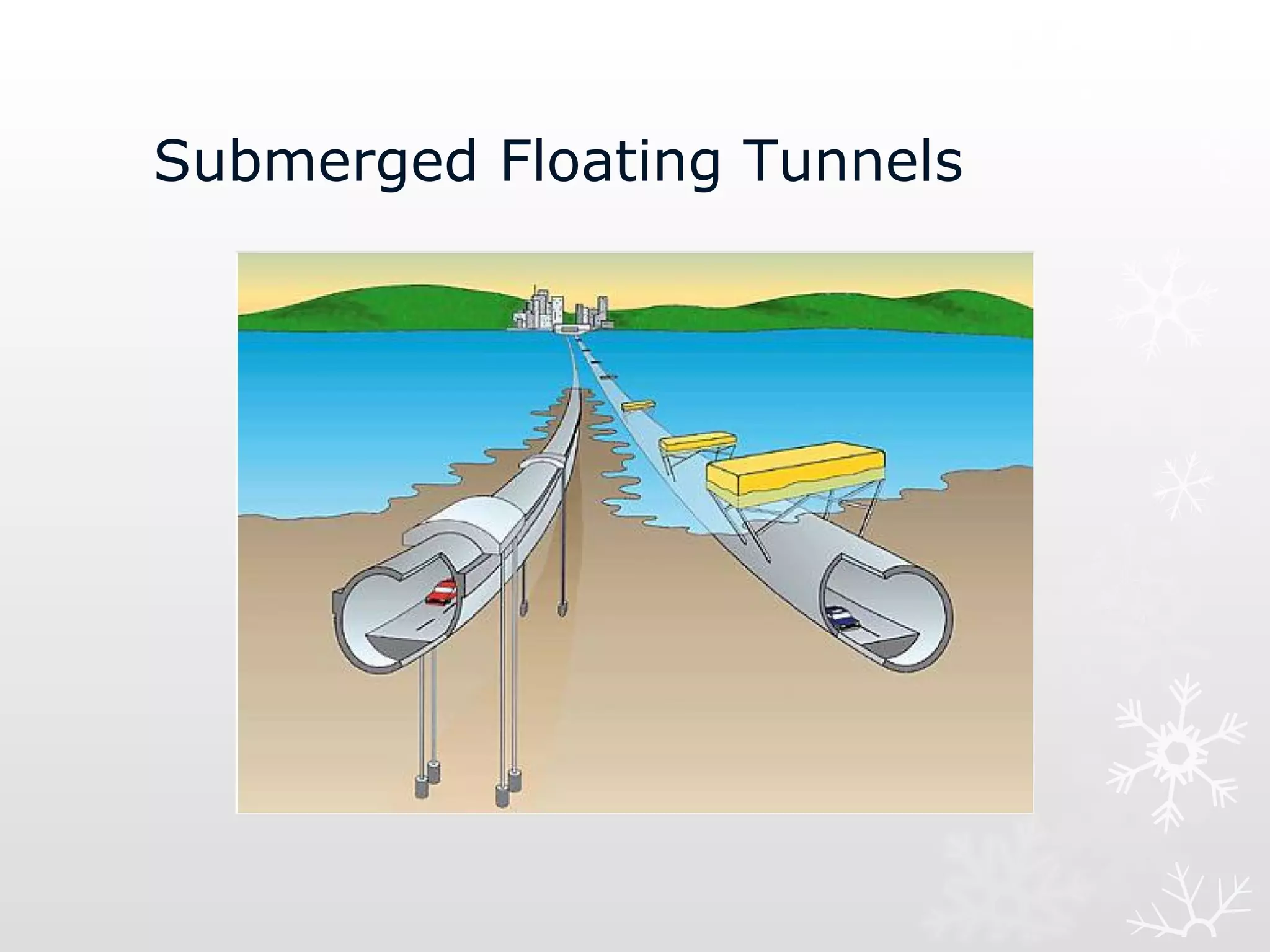
Submerged Floating Tunnels
Overview of forces acting on each
type:
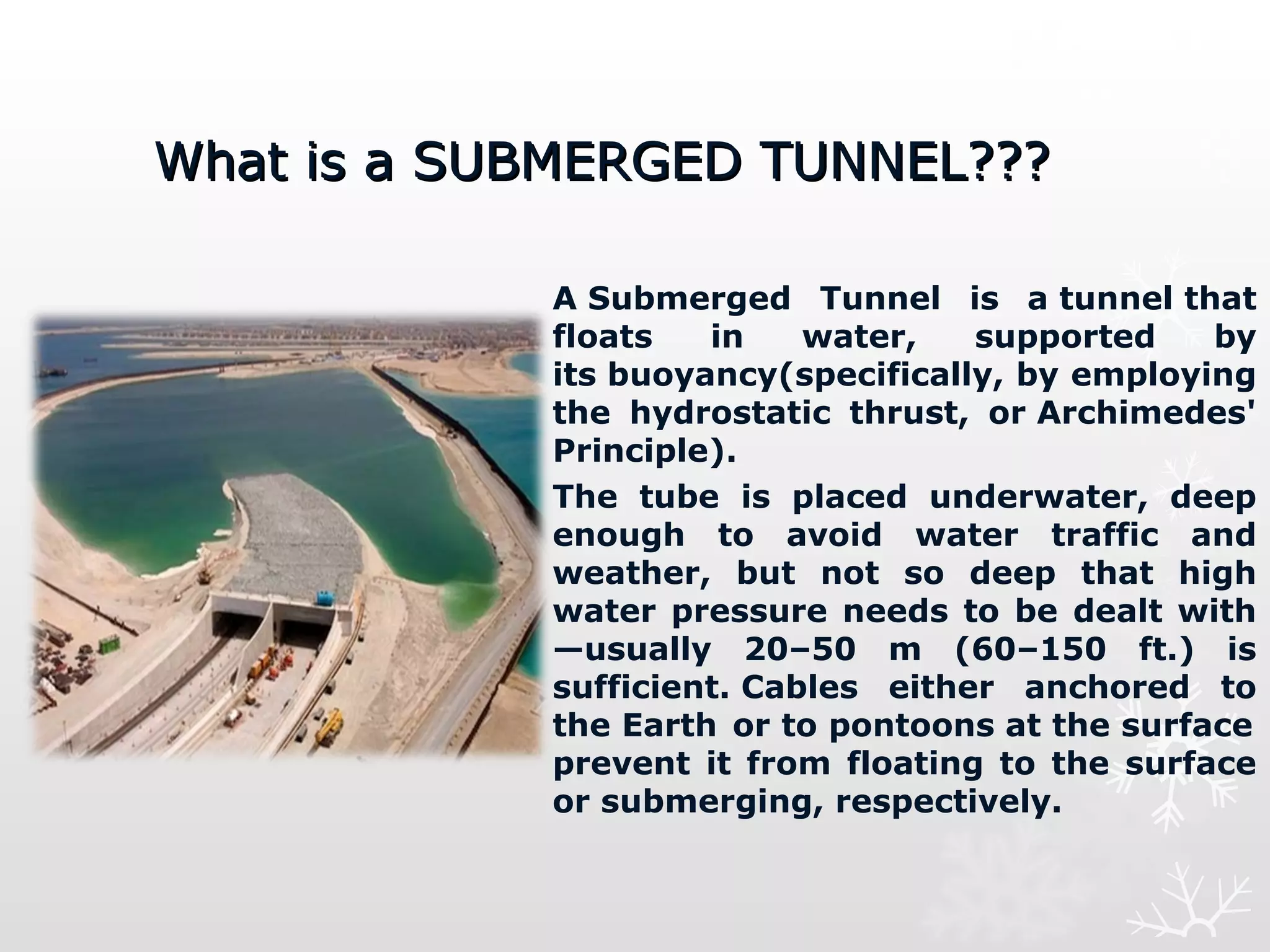
What is a SUBMERGED TUNNEL???What is a SUBMERGED TUNNEL???
A Submerged  Tunnel  is  a tunnel that 
floats  in  water,  supported  by 
its buoyancy(specifically, by employing 
the  hydrostatic  thrust,  or Archimedes' 
Principle).
The  tube  is  placed  underwater,  deep 
enough  to  avoid  water  traffic  and 
weather,  but  not  so  deep  that  high 
water pressure needs to be dealt with
—usually  20–50  m  (60–150  ft.)  is 
sufficient. Cables  either  anchored  to 
the Earth 
 or to pontoons at the surface 
 
prevent  it from  floating to the  surface 
or submerging, respectively.
Why this ?Why this ?
 The big advantage of a floating submerged tunnel compared to a
bridge is the lightly loaded constructionlightly loaded construction.. Under water a weight
reduction takes place which lowers the loads to be carried by the
tunnel.
 Flexible submerged tunnel has much less  problems  with less  problems  with 
earthquakesearthquakes which can happen in this area.
 Floating tunnel can be built fast from both shores having  no   no 
problems with wind or high seasproblems with wind or high seas.
 Another possible advantage is space: the downward ramp leading
to a tunnel leaves a smaller footprint compared to the upward
ramps required by most bridges.
 Moreover traffic can run very fast through this tunnel compared to
ferry link.
 Due to lesser contact with the sea bed it has lesser possibilities of
chemical reaction with the construction material & the sea bad soil
strata.
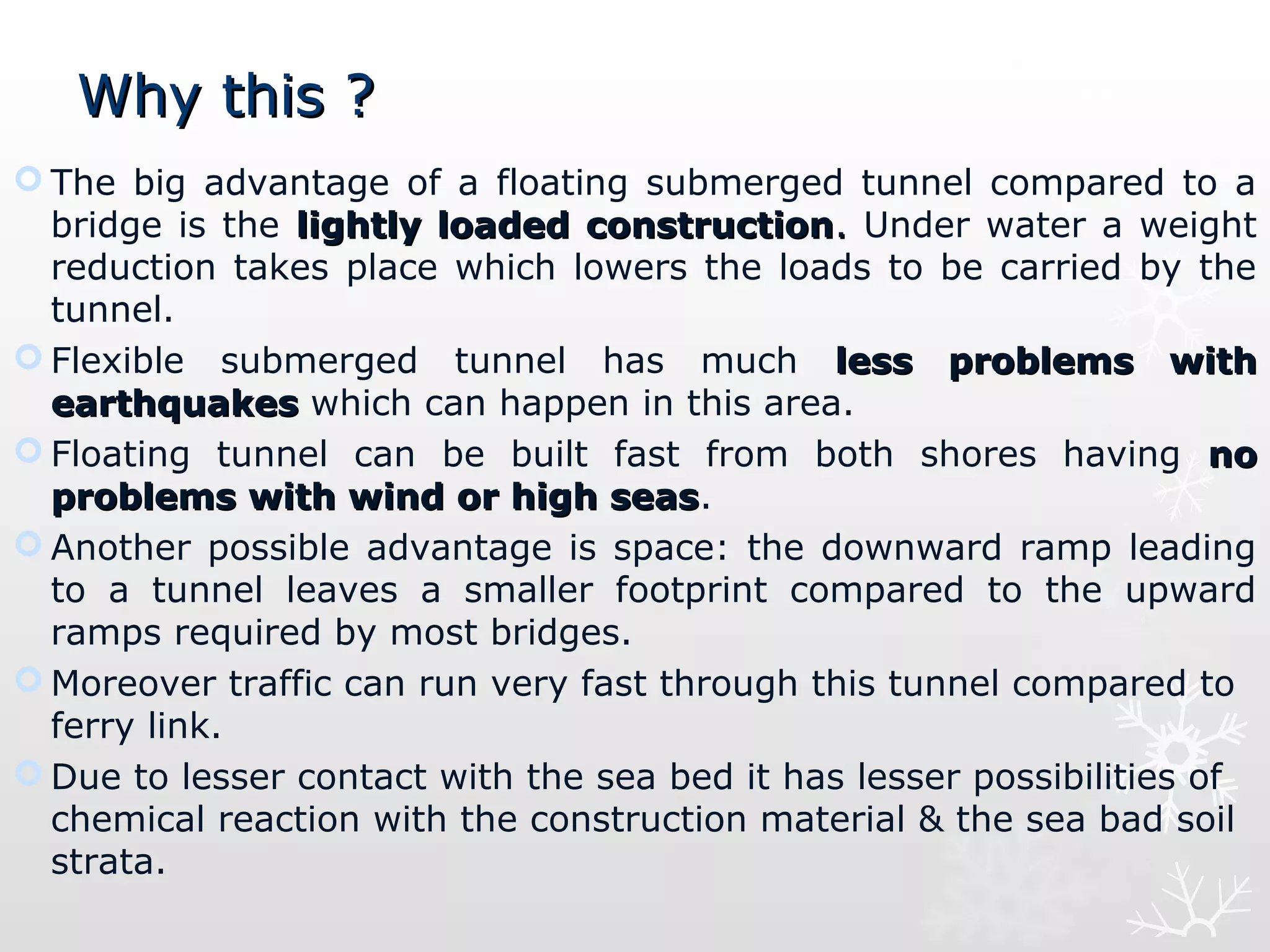
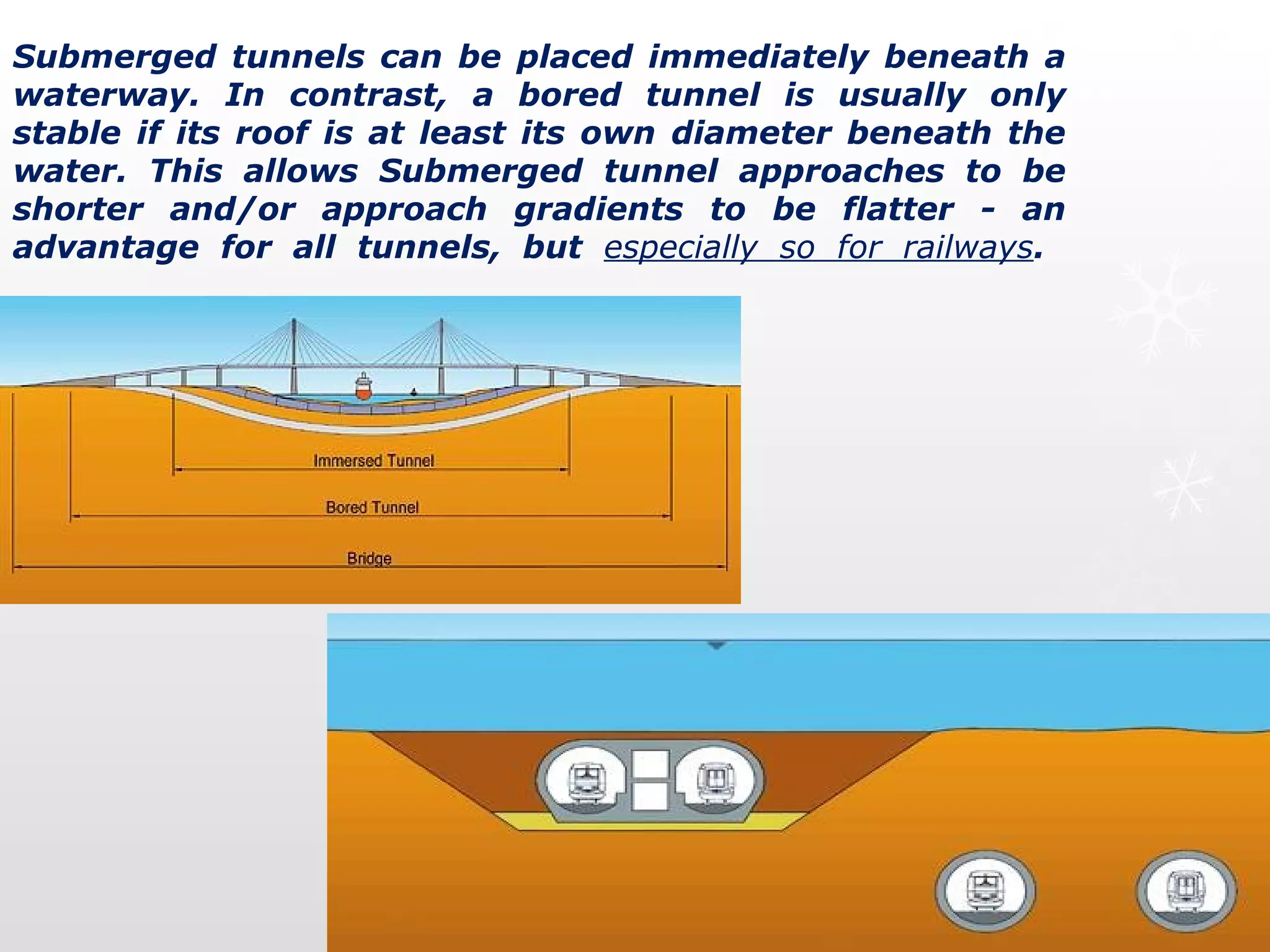
Submerged tunnels can be placed immediately beneath a
waterway. In contrast, a bored tunnel is usually only
stable if its roof is at least its own diameter beneath the
water. This allows Submerged tunnel approaches to be
shorter and/or approach gradients to be flatter - an
advantage for all tunnels, but especially so for railways.
How this is constructed…….
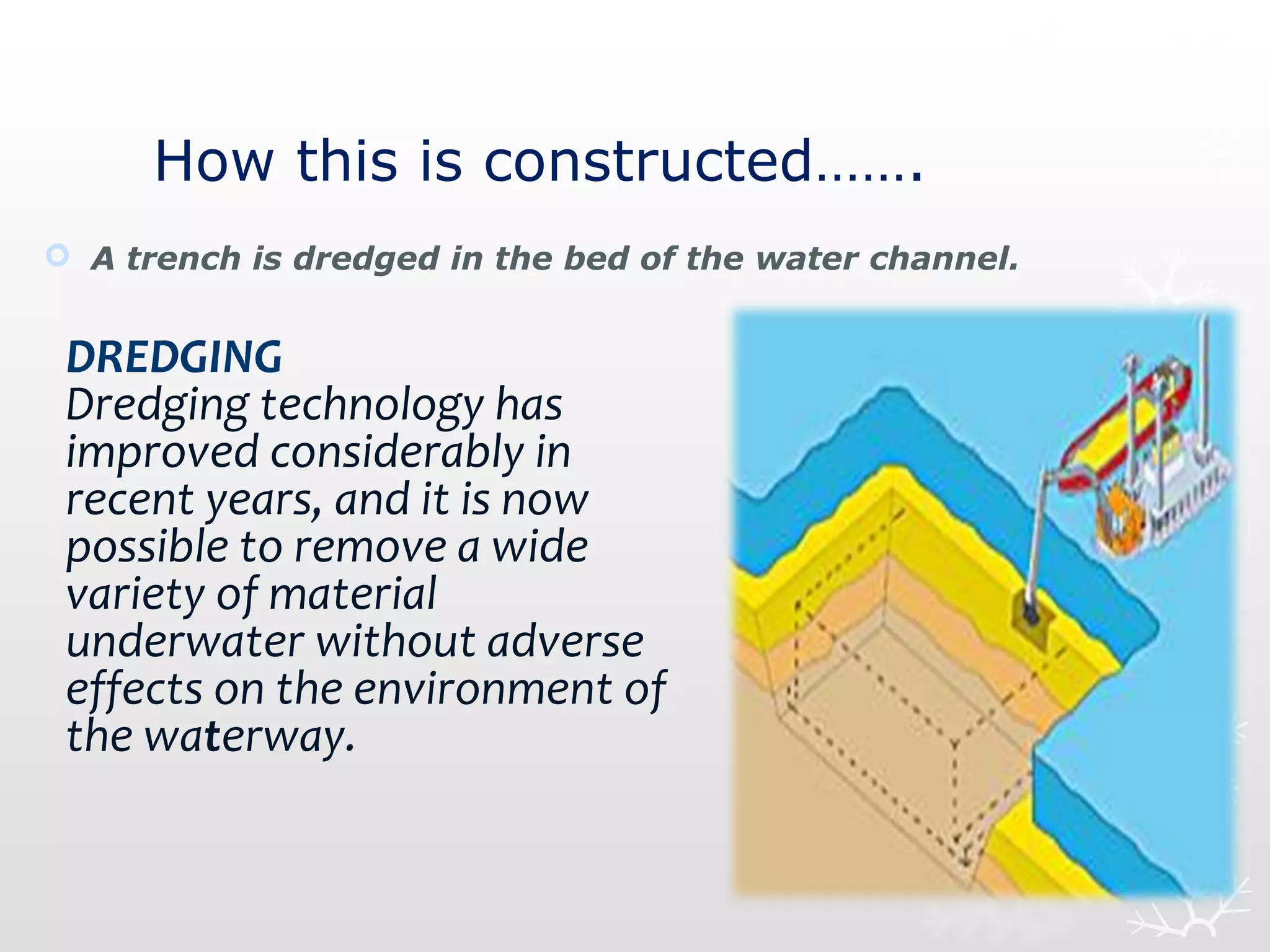
 A trench is dredged in the bed of the water channel.
DREDGING
Dredging technology has
improved considerably in
recent years, and it is now
possible to remove a wide
variety of material
underwater without adverse
effects on the environment of
the waterway.
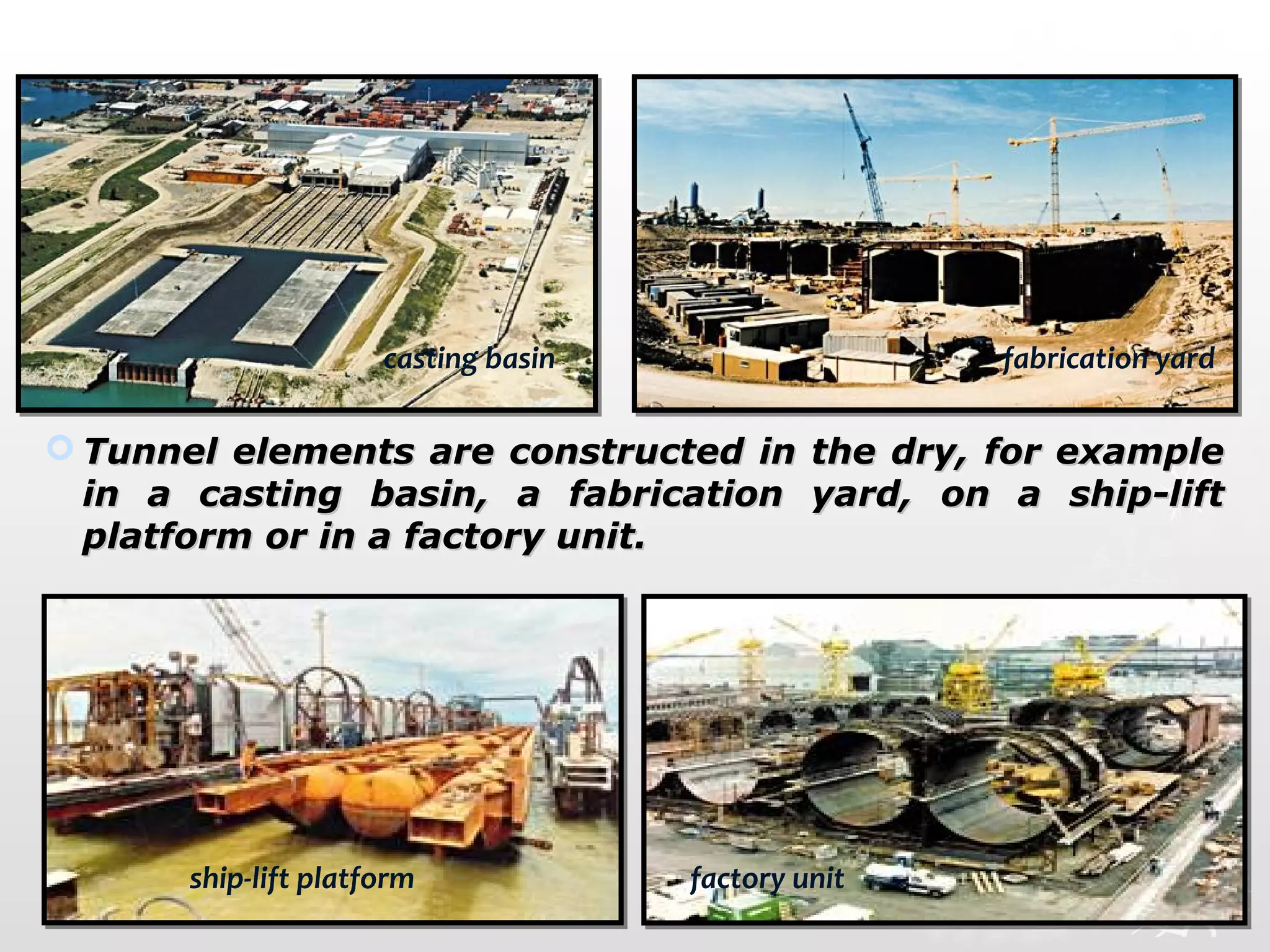
 Tunnel elements are constructed in the dry, for exampleTunnel elements are constructed in the dry, for example
in a casting basin, a fabrication yard, on a ship-liftin a casting basin, a fabrication yard, on a ship-lift
platform or in a factory unit.platform or in a factory unit.  
casting basin fabrication yard
ship-lift platform factory unit
Materials used:
As the tunnel is situated at a depth of 20-50m, it should be 
perfectly water tight and secondly it should resist the salty 
sea water and thirdly it should be withstand against 
hydrostatic forces coming on it.  
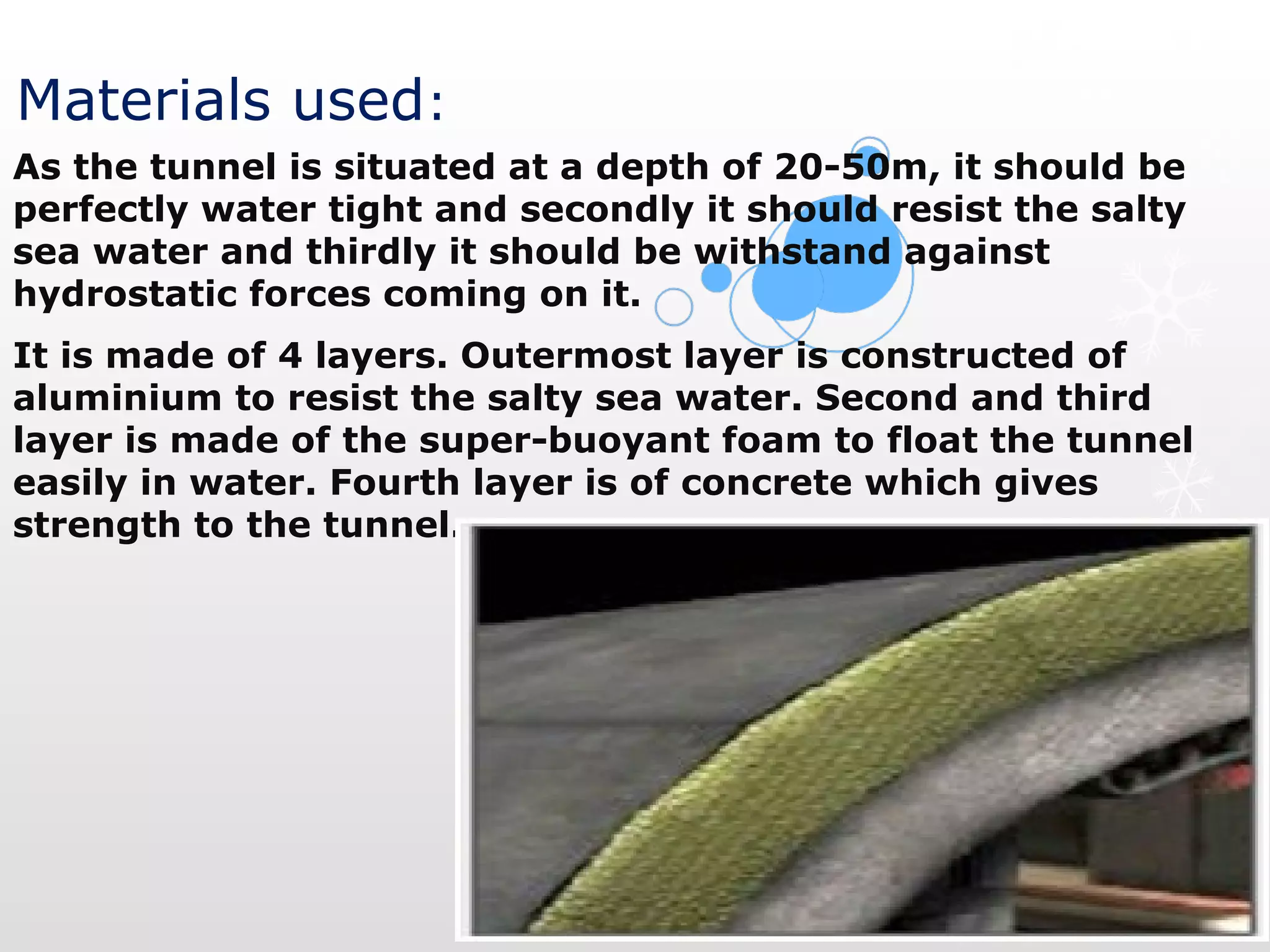
It is made of 4 layers. Outermost layer is constructed of 
aluminium to resist the salty sea water. Second and third 
layer is made of the super-buoyant foam to float the tunnel 
easily in water. Fourth layer is of concrete which gives 
strength to the tunnel.
After Casting…..After Casting…..
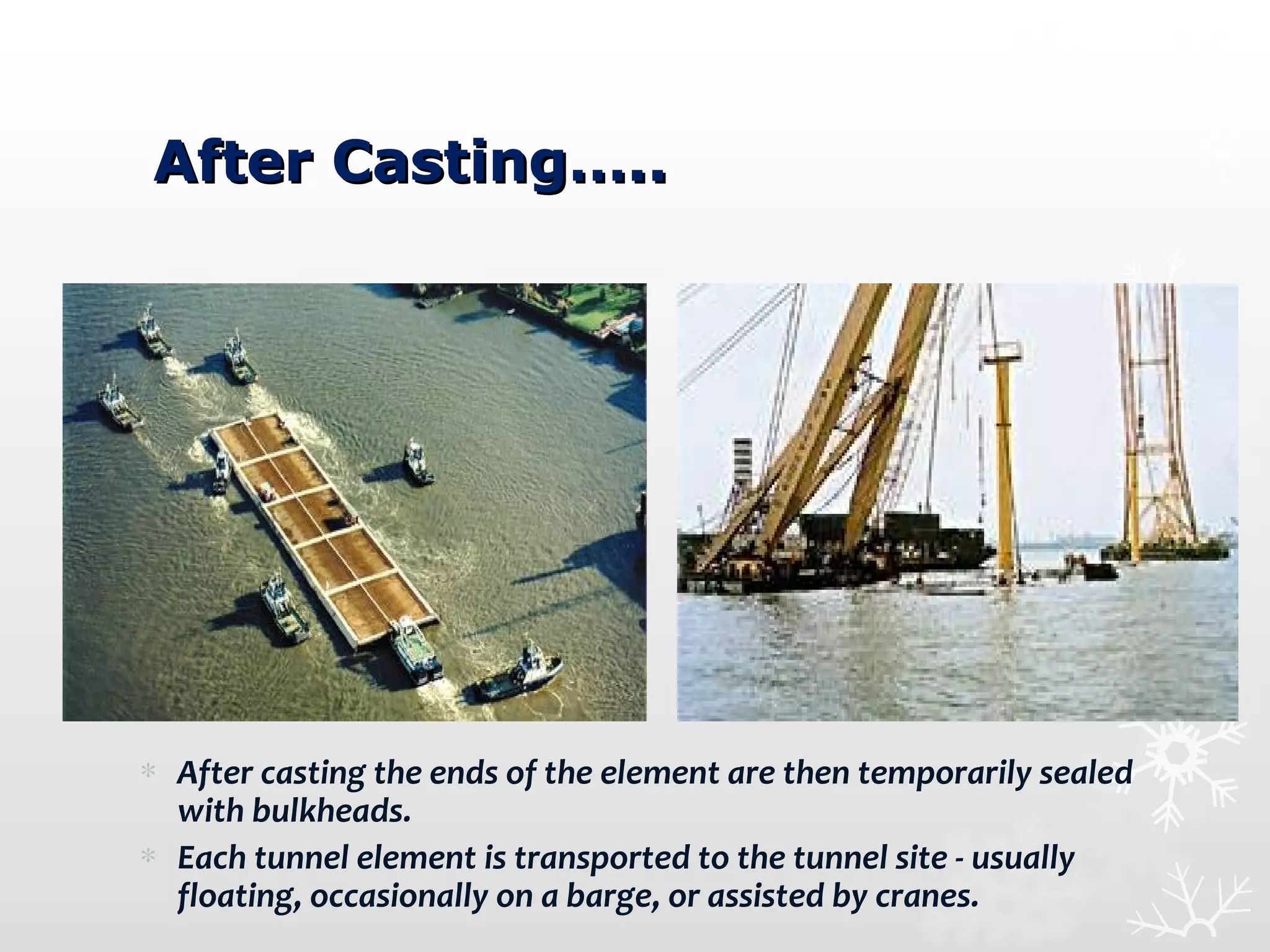
∗ After casting the ends of the element are then temporarily sealed
with bulkheads.
∗ Each tunnel element is transported to the tunnel site - usually
floating, occasionally on a barge, or assisted by cranes.
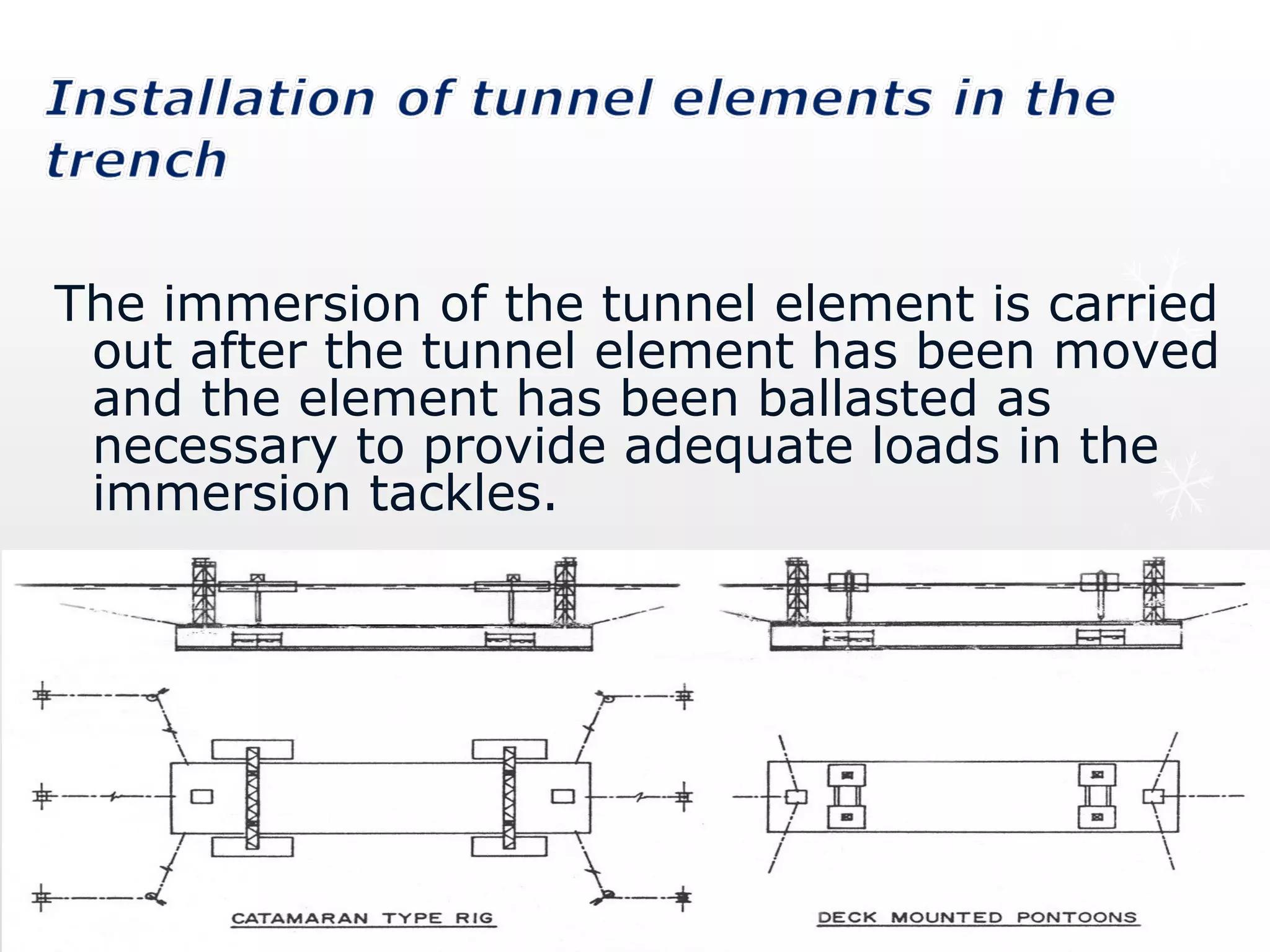
The immersion of the tunnel element is carried
out after the tunnel element has been moved
and the element has been ballasted as
necessary to provide adequate loads in the
immersion tackles.
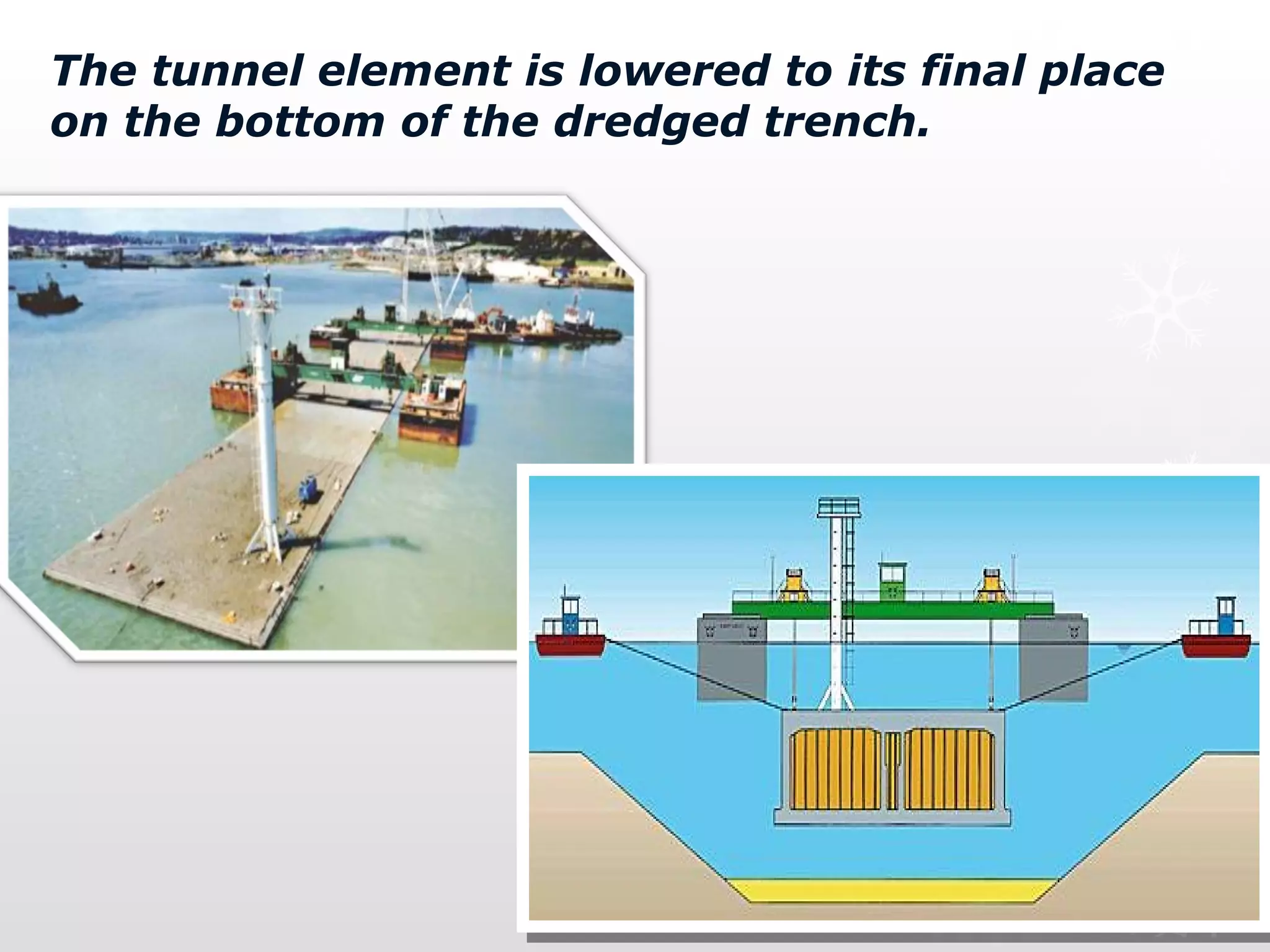
The tunnel element is lowered to its final place
on the bottom of the dredged trench.
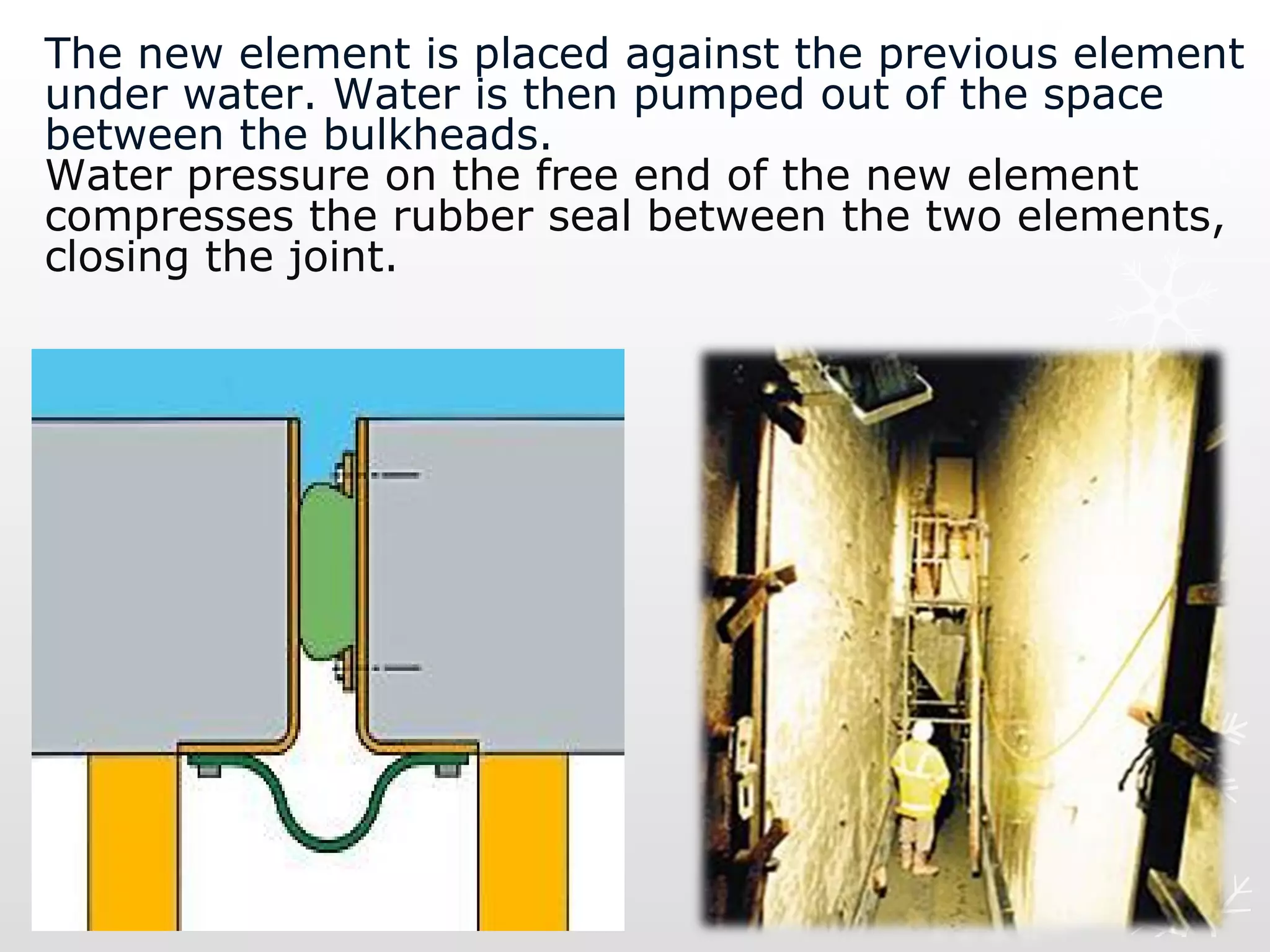
The new element is placed against the previous element
under water. Water is then pumped out of the space
between the bulkheads.
Water pressure on the free end of the new element
compresses the rubber seal between the two elements,
closing the joint.
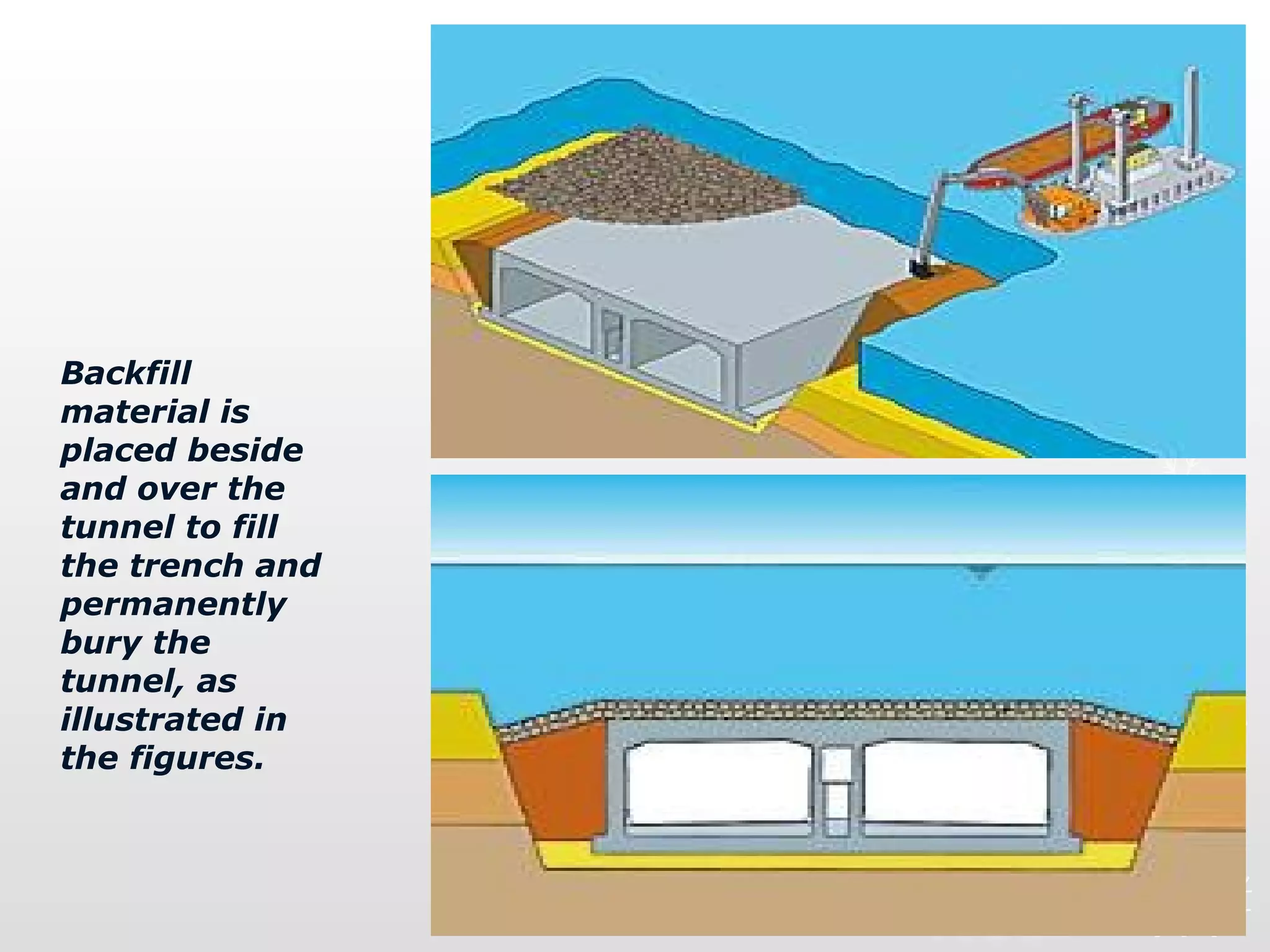
Backfill
material is
placed beside
and over the
tunnel to fill
the trench and
permanently
bury the
tunnel, as
illustrated in
the figures.
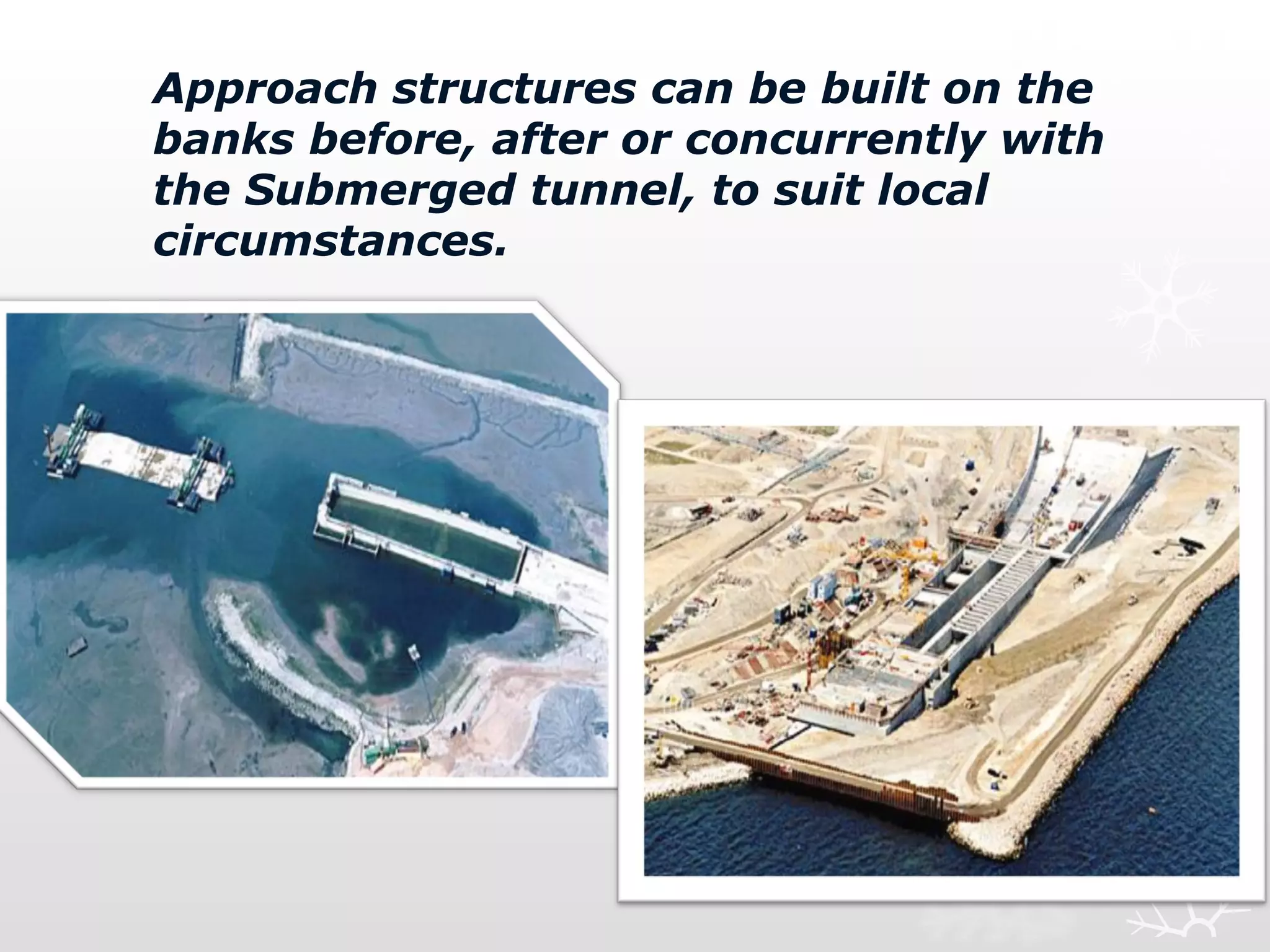
Approach structures can be built on the
banks before, after or concurrently with
the Submerged tunnel, to suit local
circumstances.
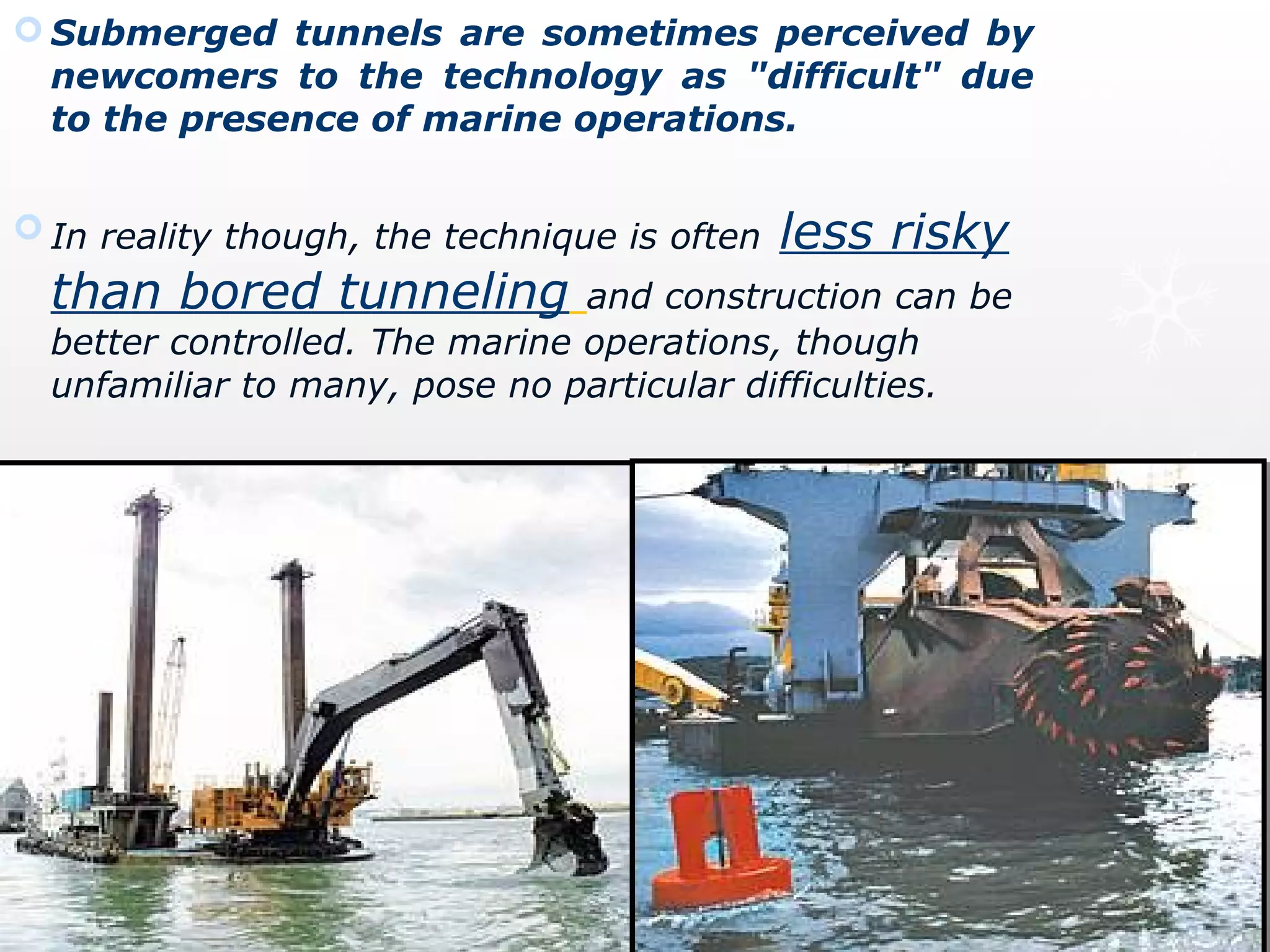
 Submerged tunnels are sometimes perceived by
newcomers to the technology as "difficult" due
to the presence of marine operations.
 In reality though, the technique is often less risky
than bored tunneling and construction can be
better controlled. The marine operations, though
unfamiliar to many, pose no particular difficulties.
Case Study:
 Seikan Tunnel
 Channel Tunnel
 Tokyo Bay Aqua-Line
 Eiksund Tunnel
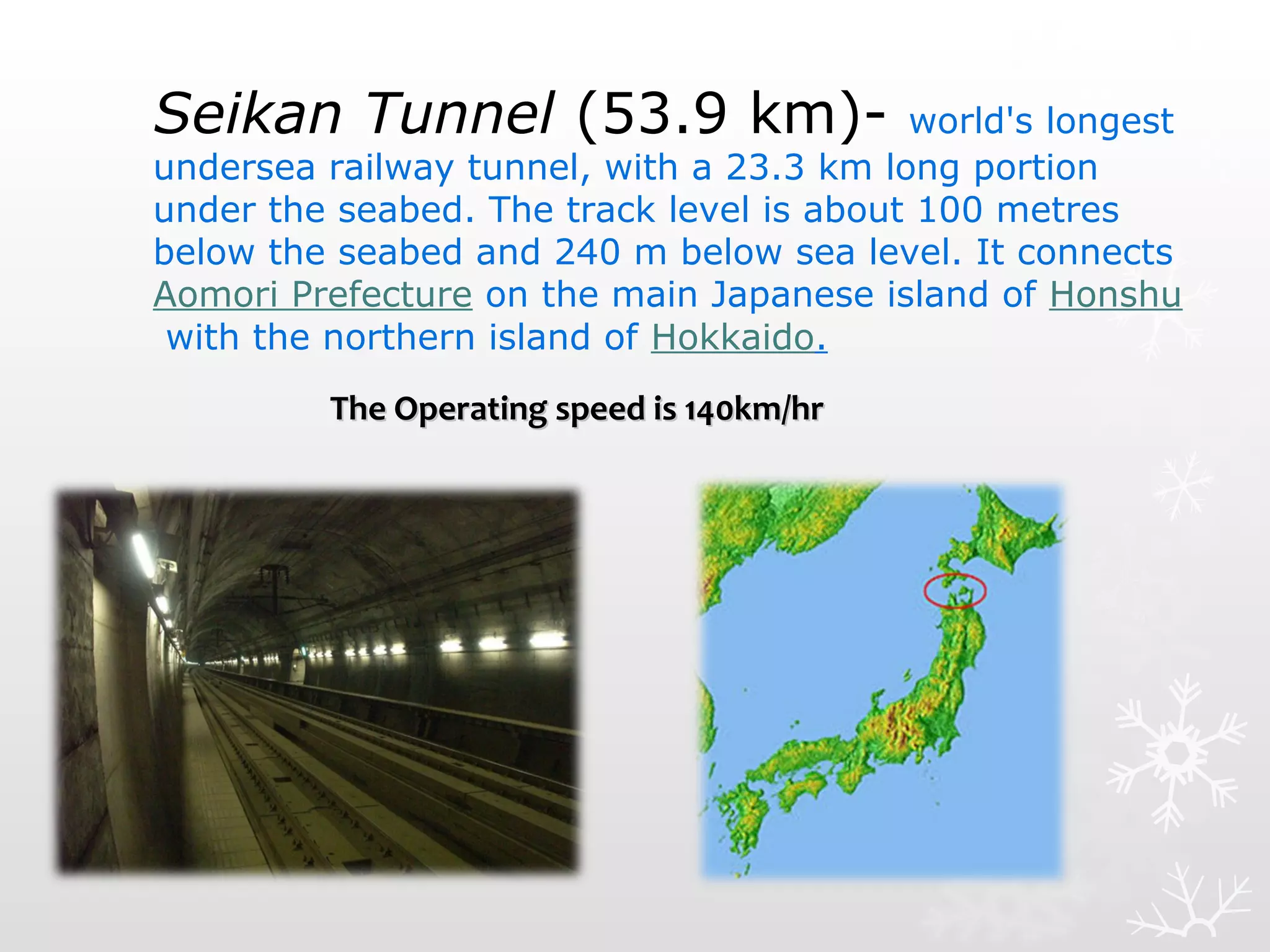
Seikan Tunnel (53.9 km)- world's longest
undersea railway tunnel, with a 23.3 km long portion
under the seabed. The track level is about 100 metres
below the seabed and 240 m below sea level. It connects
Aomori Prefecture on the main Japanese island of Honshu
with the northern island of Hokkaido.
The Operating speed is 140km/hrThe Operating speed is 140km/hr
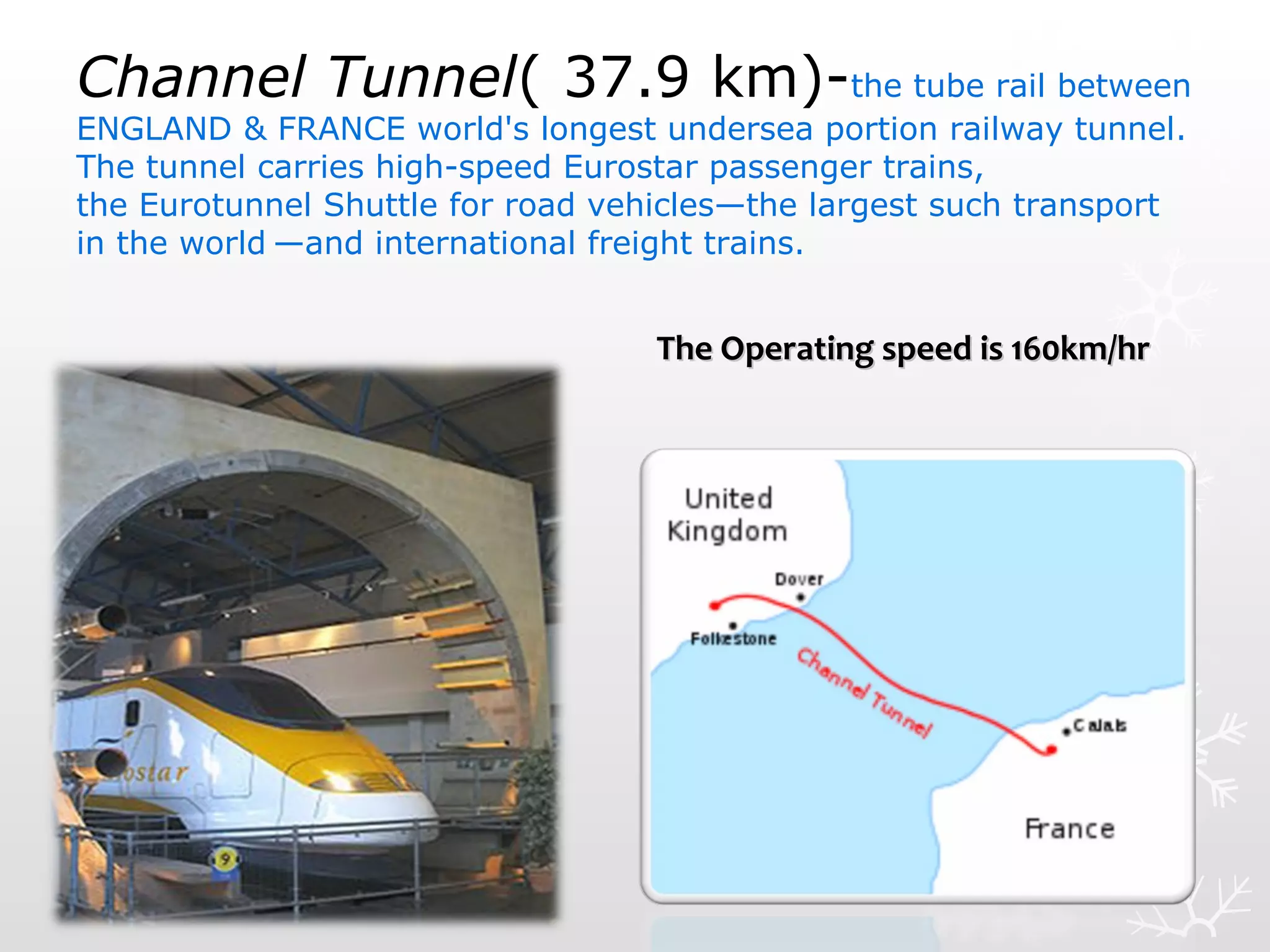
Channel Tunnel( 37.9 km)-the tube rail between
ENGLAND & FRANCE world's longest undersea portion railway tunnel.
The tunnel carries high-speed Eurostar passenger trains,
the Eurotunnel Shuttle for road vehicles—the largest such transport
in the world —and international freight trains.
The Operating speed is 160km/hrThe Operating speed is 160km/hr
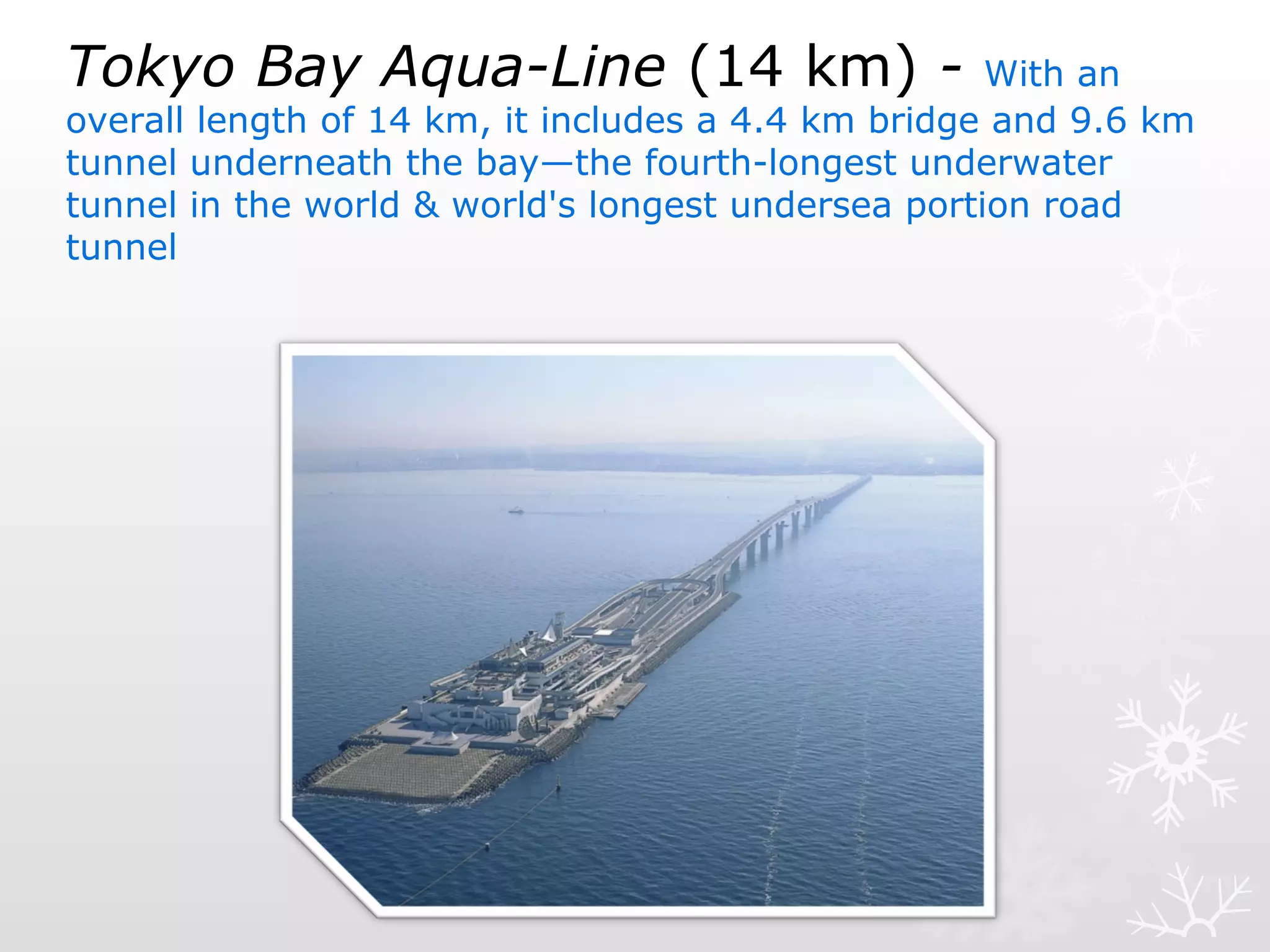
Tokyo Bay Aqua-Line (14 km) - With an
overall length of 14 km, it includes a 4.4 km bridge and 9.6 km
tunnel underneath the bay—the fourth-longest underwater
tunnel in the world & world's longest undersea portion road
tunnel
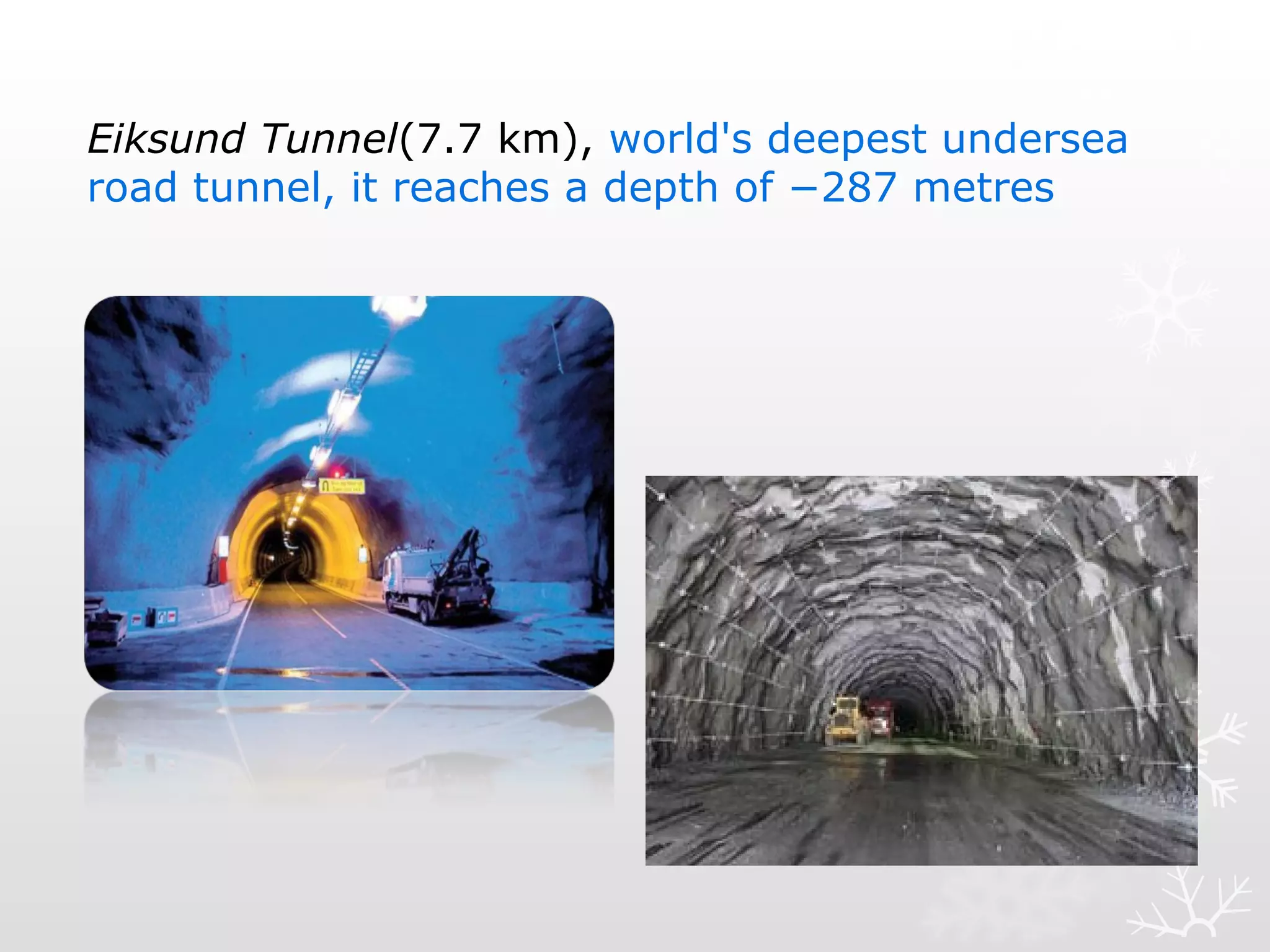
Eiksund Tunnel(7.7 km), world's deepest undersea
road tunnel, it reaches a depth of −287 metres
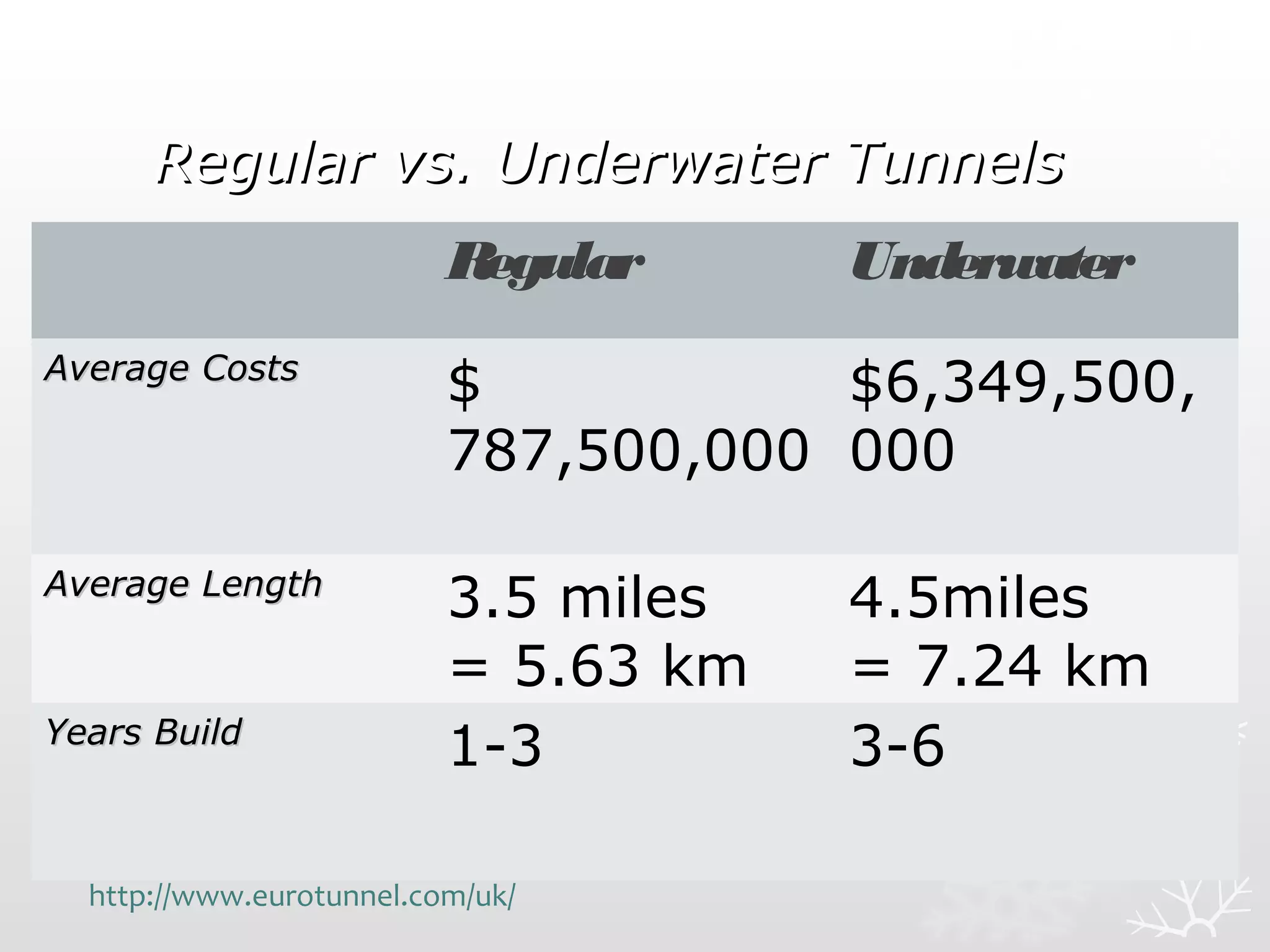
Regular vs. Underwater TunnelsRegular vs. Underwater Tunnels
Regular Underwater
Average CostsAverage Costs
$
787,500,000
$6,349,500,
000
Average LengthAverage Length
3.5 miles
= 5.63 km
4.5miles
= 7.24 km
Years BuildYears Build
1-3 3-6
http://www.eurotunnel.com/uk/
 Tunnels required for higher costs of security and construction than
bridges. This may mean that over short distances bridges may be
preferred rather than tunnels (for example Dartford Crossing).
 Bridges may not allow shipping to pass, so solutions such as the Oresund
Bridge have been constructed.
 Implementation of this project is very tough & requiring skilled labours &
heavy machinery & facing very adverse situations.
THANK YOUTHANK YOU

Submerged tunnel technical seminar

  • 1.
    SUBMERGED TUNNEL UNDERWATER TUNNELING BY RIJWIGHOSH 1EW10CV060 Under the Guidance of Mr. Nagaraja Gupta MS Associate Professor Dept. of Civil Engineering East West Institute of Technology Bangalore-560091
  • 2.
    UNDER WATER TUNNELLING An underwater tunnel is a passage, gallery, or roadway beneath a body of water. Underwater tunnels are used for highway traffic, railroads, and subways; to transport water, sewage, oil, and gas; to divert rivers around dam sites while the dam is being built; and for military and civil defence purposes.  Modern underwater tunnelling begins by constructing an immersed tube within a pre-dug trench on the river or sea floor. To do this, prefabricated sections of steel tube are floated into position and strategically sunk into the trench.
  • 3.
  • 4.
    Soft Ground Tunnelor Bored Tunnel
  • 5.
    Immersed Tunnels orSubmerged Tunnels
  • 6.
  • 7.
    Overview of forcesacting on each type:
  • 8.
    What is aSUBMERGED TUNNEL???What is a SUBMERGED TUNNEL??? A Submerged  Tunnel  is  a tunnel that  floats  in  water,  supported  by  its buoyancy(specifically, by employing  the  hydrostatic  thrust,  or Archimedes'  Principle). The  tube  is  placed  underwater,  deep  enough  to  avoid  water  traffic  and  weather,  but  not  so  deep  that  high  water pressure needs to be dealt with —usually  20–50  m  (60–150  ft.)  is  sufficient. Cables  either  anchored  to  the Earth   or to pontoons at the surface    prevent  it from  floating to the  surface  or submerging, respectively.
  • 9.
    Why this ?Whythis ?  The big advantage of a floating submerged tunnel compared to a bridge is the lightly loaded constructionlightly loaded construction.. Under water a weight reduction takes place which lowers the loads to be carried by the tunnel.  Flexible submerged tunnel has much less  problems  with less  problems  with  earthquakesearthquakes which can happen in this area.  Floating tunnel can be built fast from both shores having  no   no  problems with wind or high seasproblems with wind or high seas.  Another possible advantage is space: the downward ramp leading to a tunnel leaves a smaller footprint compared to the upward ramps required by most bridges.  Moreover traffic can run very fast through this tunnel compared to ferry link.  Due to lesser contact with the sea bed it has lesser possibilities of chemical reaction with the construction material & the sea bad soil strata.
  • 10.
    Submerged tunnels canbe placed immediately beneath a waterway. In contrast, a bored tunnel is usually only stable if its roof is at least its own diameter beneath the water. This allows Submerged tunnel approaches to be shorter and/or approach gradients to be flatter - an advantage for all tunnels, but especially so for railways.
  • 11.
    How this isconstructed…….  A trench is dredged in the bed of the water channel. DREDGING Dredging technology has improved considerably in recent years, and it is now possible to remove a wide variety of material underwater without adverse effects on the environment of the waterway.
  • 12.
     Tunnel elementsare constructed in the dry, for exampleTunnel elements are constructed in the dry, for example in a casting basin, a fabrication yard, on a ship-liftin a casting basin, a fabrication yard, on a ship-lift platform or in a factory unit.platform or in a factory unit.   casting basin fabrication yard ship-lift platform factory unit
  • 13.
  • 14.
    After Casting…..After Casting….. ∗ After castingthe ends of the element are then temporarily sealed with bulkheads. ∗ Each tunnel element is transported to the tunnel site - usually floating, occasionally on a barge, or assisted by cranes.
  • 15.
    The immersion ofthe tunnel element is carried out after the tunnel element has been moved and the element has been ballasted as necessary to provide adequate loads in the immersion tackles.
  • 16.
    The tunnel elementis lowered to its final place on the bottom of the dredged trench.
  • 17.
    The new elementis placed against the previous element under water. Water is then pumped out of the space between the bulkheads. Water pressure on the free end of the new element compresses the rubber seal between the two elements, closing the joint.
  • 18.
    Backfill material is placed beside andover the tunnel to fill the trench and permanently bury the tunnel, as illustrated in the figures.
  • 19.
    Approach structures canbe built on the banks before, after or concurrently with the Submerged tunnel, to suit local circumstances.
  • 20.
     Submerged tunnelsare sometimes perceived by newcomers to the technology as "difficult" due to the presence of marine operations.  In reality though, the technique is often less risky than bored tunneling and construction can be better controlled. The marine operations, though unfamiliar to many, pose no particular difficulties.
  • 21.
    Case Study:  SeikanTunnel  Channel Tunnel  Tokyo Bay Aqua-Line  Eiksund Tunnel
  • 22.
    Seikan Tunnel (53.9km)- world's longest undersea railway tunnel, with a 23.3 km long portion under the seabed. The track level is about 100 metres below the seabed and 240 m below sea level. It connects Aomori Prefecture on the main Japanese island of Honshu with the northern island of Hokkaido. The Operating speed is 140km/hrThe Operating speed is 140km/hr
  • 23.
    Channel Tunnel( 37.9km)-the tube rail between ENGLAND & FRANCE world's longest undersea portion railway tunnel. The tunnel carries high-speed Eurostar passenger trains, the Eurotunnel Shuttle for road vehicles—the largest such transport in the world —and international freight trains. The Operating speed is 160km/hrThe Operating speed is 160km/hr
  • 24.
    Tokyo Bay Aqua-Line(14 km) - With an overall length of 14 km, it includes a 4.4 km bridge and 9.6 km tunnel underneath the bay—the fourth-longest underwater tunnel in the world & world's longest undersea portion road tunnel
  • 25.
    Eiksund Tunnel(7.7 km),world's deepest undersea road tunnel, it reaches a depth of −287 metres
  • 26.
    Regular vs. UnderwaterTunnelsRegular vs. Underwater Tunnels Regular Underwater Average CostsAverage Costs $ 787,500,000 $6,349,500, 000 Average LengthAverage Length 3.5 miles = 5.63 km 4.5miles = 7.24 km Years BuildYears Build 1-3 3-6 http://www.eurotunnel.com/uk/
  • 27.
     Tunnels requiredfor higher costs of security and construction than bridges. This may mean that over short distances bridges may be preferred rather than tunnels (for example Dartford Crossing).  Bridges may not allow shipping to pass, so solutions such as the Oresund Bridge have been constructed.  Implementation of this project is very tough & requiring skilled labours & heavy machinery & facing very adverse situations.
  • 28.