INTRODUCTION TO
IMMERSED TUBE TUNNEL TECHNOLOGY
BY
ABHAY OCEAN INDIA PVT LTD
BACKGROUND
TRADITIONALLY LARGE (SEA) CROSSINGS CARRIED OUT BY MEANS OF THE
APPARENT MOST ECONOMIC OPTION –BRIDGE.
IF A TUNNEL OPTION IS CONSIDERED - BORED TUNNEL SEEMS FAVOURITE .
IN RECENT PAST NEW DEVELOPMENTS AND INNOVATIONS HAVE LEAD TO
REVIVAL OF IMMERSED TUNNEL AS A COMPETITIVE ALTERNATIVE FOR LARGE
FIXED LINKS .
THE ØRESUND LINK BETWEEN DENMARK AND SWEDEN GAVE THE IMMERSED
TUNNEL TECHNIQUE THE FIRST BOOST.
THIS WAS FOLLOWED BY OTHER MAJOR LINKS IN WHICH IMMERSED TUNNEL
TECHNIQUE IS APPLIED ON LARGE SCALE.
THE LAST IMPRESSIVE EXAMPLE IS THE FEHMERNBELT LINK, THE LINK
BETWEEN DENMARK AND GERMANY COMPRISING AN IMMERSED TUNNEL OF
ALMOST 19 KM.
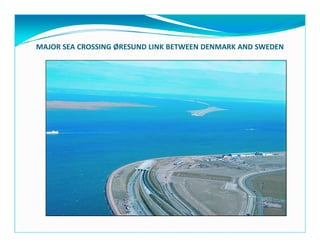
MAJOR SEA CROSSING ØRESUND LINK BETWEEN DENMARK AND SWEDEN
INTRODUCTION TO IMMERSED TUNNELS
AN ALTERNATIVE TO BRIDGES AND BORED TUNNELS .
IMMERSED TUBE TUNNEL UNITS OF LENGTH OF ABOUT 100M LONG,
FORMING COMPLETE TUNNEL CROSS-SECTIONS WITH BOTH ENDS
TEMPORARILY SEALED BY A BULKHEAD ARE FABRICATED IN A DRY DOCK.
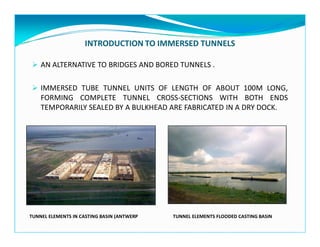
TUNNEL ELEMENTS IN CASTING BASIN (ANTWERP TUNNEL ELEMENTS FLOODED CASTING BASIN
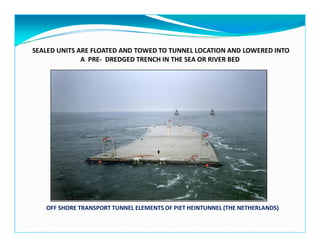
SEALED UNITS ARE FLOATED AND TOWED TO TUNNEL LOCATION AND LOWERED INTO
A PRE- DREDGED TRENCH IN THE SEA OR RIVER BED
OFF SHORE TRANSPORT TUNNEL ELEMENTS OF PIET HEINTUNNEL (THE NETHERLANDS)
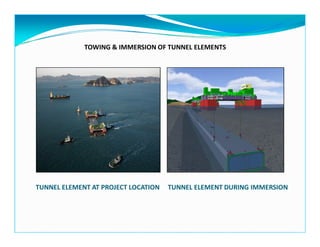
TUNNEL ELEMENT AT PROJECT LOCATION TUNNEL ELEMENT DURING IMMERSION
TOWING & IMMERSION OF TUNNEL ELEMENTS
AN ALTERNATIVE TO BRIDGES AND BORED TUNNELS.
IMMERSED TUBE TUNNEL UNITS OF LENGTH OF ABOUT 100M LONG, FORMING COMPLETE
TUNNEL CROSS-SECTIONS WITH BOTH ENDS TEMPORARILY SEALED BY A BULKHEAD ARE
FABRICATED IN A DRY DOCK.
SEALED UNITS ARE FLOATED AND TOWED TO TUNNEL LOCATION AND LOWERED INTO A PRE
DREDGED TRENCH IN THE SEA OR RIVER BED.
ON ONE END OF EACH TUNNEL ELEMENT, AN ENDLESS GINA GASKET IS MOUNTED.
UPON TUNNEL UNIT BEING IMMERSED, IT IS THEN PULLED FIRMLY UP AGAINST THE
PRECEDING IMMERSED TUNNEL UNIT WITH A HYDRAULIC JACK.
WHEN THE GINA GASKET HAS FULL CONTACT AROUND THE TOTAL CIRCUMFERENCE OF THE
ADJACENT TUNNEL UNIT, THE WATER BETWEEN THE BULKHEADS IS PUMPED OUT.
DUE TO THE PRESSURE DIFFERENCE BETWEEN THE BULKHEADS AND THE HYDROSTATIC
PRESSURE ON THE OUTSIDE OF THE TUNNEL, THE GINA PROFILE COMPRESSES AND SEALS
THE JOINT. THE UNITS WILL THEN FORM A CONTINUOUS TUBE AND THE TRENCH IS
BACKFILLED PROGRESSIVELY.
IMMERSED TUBE TUNNEL
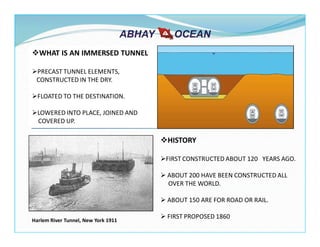
WHAT IS AN IMMERSED TUNNEL
PRECAST TUNNEL ELEMENTS,
CONSTRUCTED IN THE DRY.
FLOATED TO THE DESTINATION.
LOWERED INTO PLACE, JOINED AND
COVERED UP.
HISTORY
FIRST CONSTRUCTED ABOUT 120 YEARS AGO.
ABOUT 200 HAVE BEEN CONSTRUCTED ALL
OVER THE WORLD.
ABOUT 150 ARE FOR ROAD OR RAIL.
FIRST PROPOSED 1860
Harlem River Tunnel, New York 1911
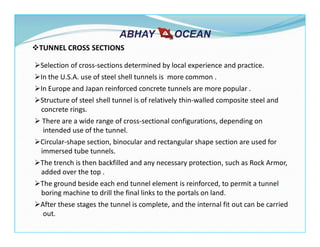
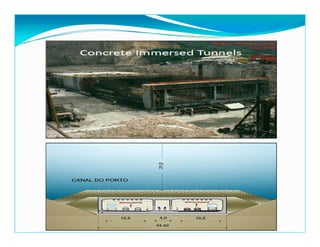
TUNNEL CROSS SECTIONS
Selection of cross-sections determined by local experience and practice.
In the U.S.A. use of steel shell tunnels is more common .
In Europe and Japan reinforced concrete tunnels are more popular .
Structure of steel shell tunnel is of relatively thin-walled composite steel and
concrete rings.
There are a wide range of cross-sectional configurations, depending on
intended use of the tunnel.
Circular-shape section, binocular and rectangular shape section are used for
immersed tube tunnels.
The trench is then backfilled and any necessary protection, such as Rock Armor,
added over the top .
The ground beside each end tunnel element is reinforced, to permit a tunnel
boring machine to drill the final links to the portals on land.
After these stages the tunnel is complete, and the internal fit out can be carried
out.
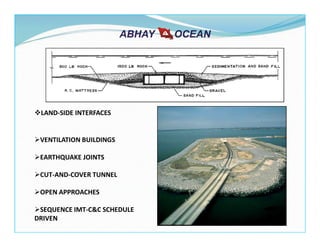
LAND-SIDE INTERFACES
VENTILATION BUILDINGS
EARTHQUAKE JOINTS
CUT-AND-COVER TUNNEL
OPEN APPROACHES
SEQUENCE IMT-C&C SCHEDULE
DRIVEN
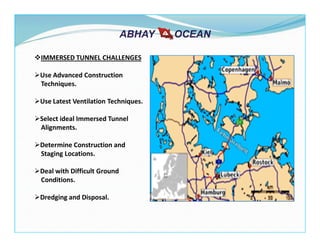
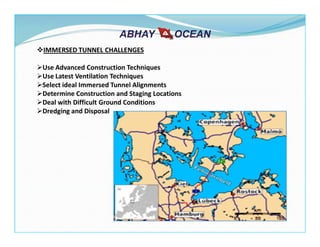
IMMERSED TUNNEL CHALLENGES
Use Advanced Construction
Techniques.
Use Latest Ventilation Techniques.
Select ideal Immersed Tunnel
Alignments.
Determine Construction and
Staging Locations.
Deal with Difficult Ground
Conditions.
Dredging and Disposal.
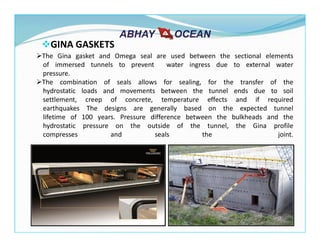
The Gina gasket and Omega seal are used between the sectional elements
of immersed tunnels to prevent water ingress due to external water
pressure.
The combination of seals allows for sealing, for the transfer of the
hydrostatic loads and movements between the tunnel ends due to soil
settlement, creep of concrete, temperature effects and if required
earthquakes The designs are generally based on the expected tunnel
lifetime of 100 years. Pressure difference between the bulkheads and the
hydrostatic pressure on the outside of the tunnel, the Gina profile
compresses and seals the joint.
GINA GASKETS
FINAL PLACEMENT OF IMMERSED TUBE ELEMENTS
Immersed tunnel elements floated to site using their buoyant state.
Ends of tunnel elements equipped with bulkheads (dam plates) across
ends to keep inside dry.
Bulkheads located to allow only about 1.0 m between the bulkheads of
adjacent elements at immersion joint.
This space is emptied once an initial seal is obtained during the joining
process.
Joints usually equipped with gaskets to create seal with the adjacent
element.
Adjustment devices allow placement of the elements on line and grade.
Tunnel elements lowered into their location after adding temporary water
ballast in designated water ballast tank.
After installation of back fill, ballast water is exchanged with ballast
concrete, installed on the tunnel base slab.
Subsequently finishing of tunnel and tunnel installations place.
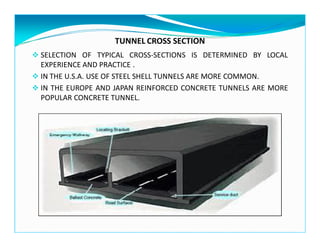
TUNNEL CROSS SECTION
SELECTION OF TYPICAL CROSS-SECTIONS IS DETERMINED BY LOCAL
EXPERIENCE AND PRACTICE .
IN THE U.S.A. USE OF STEEL SHELL TUNNELS ARE MORE COMMON.
IN THE EUROPE AND JAPAN REINFORCED CONCRETE TUNNELS ARE MORE
POPULAR CONCRETE TUNNEL.
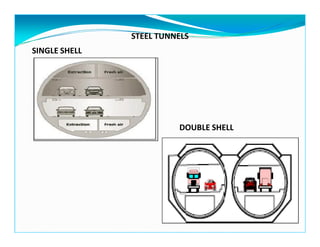
STEEL TUNNELS
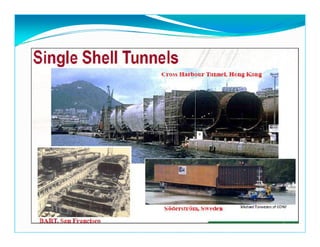
SINGLE SHELL
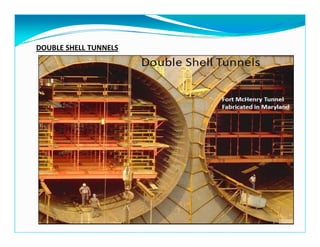
DOUBLE SHELL
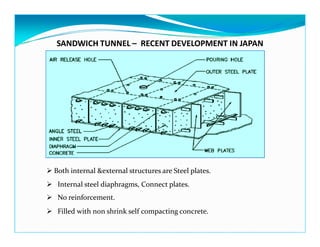
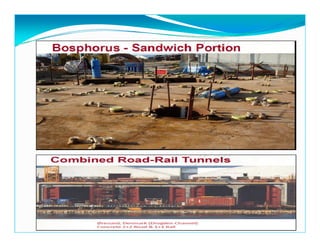
SANDWICH TUNNEL – RECENT DEVELOPMENT IN JAPAN
Both internal &external structures are Steel plates.
Internal steel diaphragms, Connect plates.
No reinforcement.
Filled with non shrink self compacting concrete.
DOUBLE SHELL TUNNELS
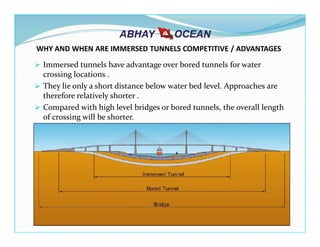
WHY AND WHEN ARE IMMERSED TUNNELS COMPETITIVE / ADVANTAGES
Immersed tunnels have advantage over bored tunnels for water
crossing locations .
They lie only a short distance below water bed level. Approaches are
therefore relatively shorter .
Compared with high level bridges or bored tunnels, the overall length
of crossing will be shorter.
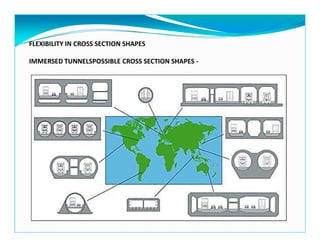
FLEXIBILITY IN CROSS SECTION SHAPES
IMMERSED TUNNELSPOSSIBLE CROSS SECTION SHAPES -
OTHER ADVANTAGES OF IMMERSED TUNNELS
MAIN ADVANTAGE IS THEY CAN BE CONSIDERABLY MORE COST EFFECTIVE THAN
BORED TUNNEL BENEATH THE WATER OR A BRIDGE
OTHER ADVANTAGES RELATIVE TO THESE ALTERNATIVES INCLUDE:
SPEED OF CONSTRUCTION
MINIMAL DISRUPTION TO RIVER/CHANNEL, IF CROSSING A SHIPPING ROUTE
RESISTANCE TO SEISMIC ACTIVITY
SAFETY OF CONSTRUCTION (WORK IN A DRY DOCK AS OPPOSED TO BORING
BENEATH A RIVER)
DREDGED MATERIAL CAN BE USED MAKING ARTIFICIAL ISLANDS / LAND
RECLAMATION
DISADVANTAGES ARE:
DIRECT CONTACT WITH WATER - CAREFUL WATERPROOFING DESIGN AROUND
JOINTS
THE SEGMENTAL APPROACH REQUIRES CAREFUL DESIGN OF THE CONNECTIONS
ENVIRONMENTAL IMPACT OF TUBE AND UNDERWATER EMBANKMENT ON
EXISTING CHANNEL / SEA BED.
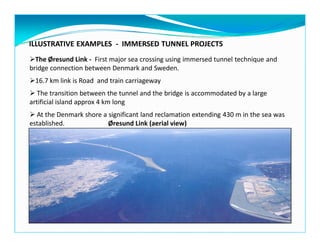
ILLUSTRATIVE EXAMPLES - IMMERSED TUNNEL PROJECTS
The Øresund Link - First major sea crossing using immersed tunnel technique and
bridge connection between Denmark and Sweden.
16.7 km link is Road and train carriageway
The transition between the tunnel and the bridge is accommodated by a large
artificial island approx 4 km long
At the Denmark shore a significant land reclamation extending 430 m in the sea was
established. Øresund Link (aerial view)
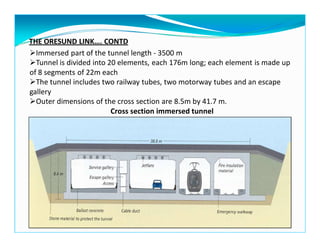
THE ORESUND LINK…. CONTD
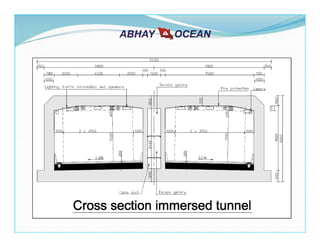
Immersed part of the tunnel length - 3500 m
Tunnel is divided into 20 elements, each 176m long; each element is made up
of 8 segments of 22m each
The tunnel includes two railway tubes, two motorway tubes and an escape
gallery
Outer dimensions of the cross section are 8.5m by 41.7 m.
Cross section immersed tunnel
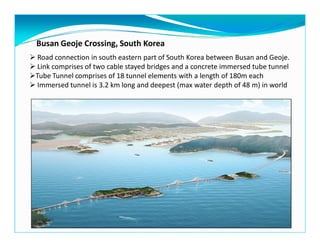
Busan Geoje Crossing, South Korea
Road connection in south eastern part of South Korea between Busan and Geoje.
Link comprises of two cable stayed bridges and a concrete immersed tube tunnel
Tube Tunnel comprises of 18 tunnel elements with a length of 180m each
Immersed tunnel is 3.2 km long and deepest (max water depth of 48 m) in world
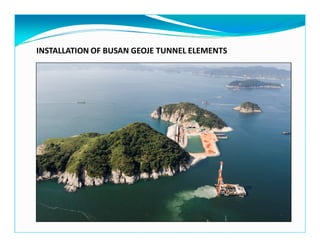
INSTALLATION OF BUSAN GEOJE TUNNEL ELEMENTS
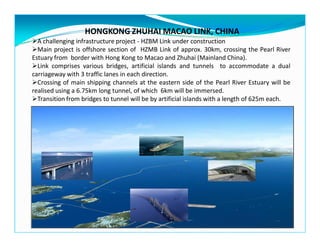
HONGKONG ZHUHAI MACAO LINK, CHINA
A challenging infrastructure project - HZBM Link under construction
Main project is offshore section of HZMB Link of approx. 30km, crossing the Pearl River
Estuary from border with Hong Kong to Macao and Zhuhai (Mainland China).
Link comprises various bridges, artificial islands and tunnels to accommodate a dual
carriageway with 3 traffic lanes in each direction.
Crossing of main shipping channels at the eastern side of the Pearl River Estuary will be
realised using a 6.75km long tunnel, of which 6km will be immersed.
Transition from bridges to tunnel will be by artificial islands with a length of 625m each.
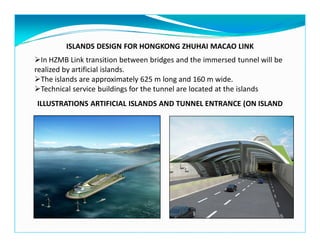
ISLANDS DESIGN FOR HONGKONG ZHUHAI MACAO LINK
ILLUSTRATIONS ARTIFICIAL ISLANDS AND TUNNEL ENTRANCE (ON ISLAND
In HZMB Link transition between bridges and the immersed tunnel will be
realized by artificial islands.
The islands are approximately 625 m long and 160 m wide.
Technical service buildings for the tunnel are located at the islands
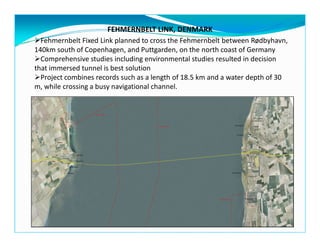
FEHMERNBELT LINK, DENMARK
Fehmernbelt Fixed Link planned to cross the Fehmernbelt between Rødbyhavn,
140km south of Copenhagen, and Puttgarden, on the north coast of Germany
Comprehensive studies including environmental studies resulted in decision
that immersed tunnel is best solution
Project combines records such as a length of 18.5 km and a water depth of 30
m, while crossing a busy navigational channel.
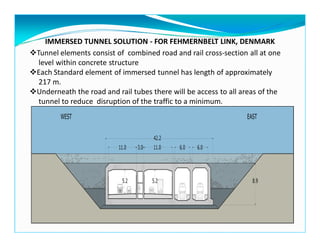
IMMERSED TUNNEL SOLUTION - FOR FEHMERNBELT LINK, DENMARK
Tunnel elements consist of combined road and rail cross-section all at one
level within concrete structure
Each Standard element of immersed tunnel has length of approximately
217 m.
Underneath the road and rail tubes there will be access to all areas of the
tunnel to reduce disruption of the traffic to a minimum.
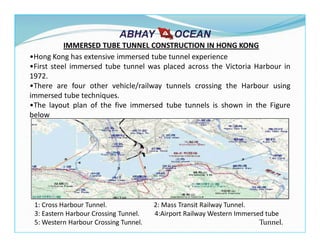
IMMERSED TUBE TUNNEL CONSTRUCTION IN HONG KONG
1: Cross Harbour Tunnel. 2: Mass Transit Railway Tunnel.
3: Eastern Harbour Crossing Tunnel. 4:Airport Railway Western Immersed tube
5: Western Harbour Crossing Tunnel. Tunnel.
•Hong Kong has extensive immersed tube tunnel experience
•First steel immersed tube tunnel was placed across the Victoria Harbour in
1972.
•There are four other vehicle/railway tunnels crossing the Harbour using
immersed tube techniques.
•The layout plan of the five immersed tube tunnels is shown in the Figure
below
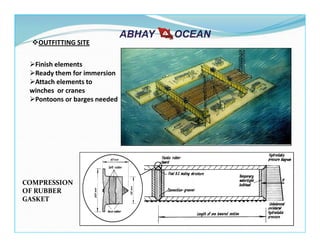
OUTFITTING SITE
Finish elements
Ready them for immersion
Attach elements to
winches or cranes
Pontoons or barges needed
COMPRESSION
OF RUBBER
GASKET
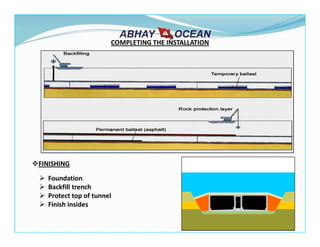
COMPLETING THE INSTALLATION
FINISHING
Foundation
Backfill trench
Protect top of tunnel
Finish insides
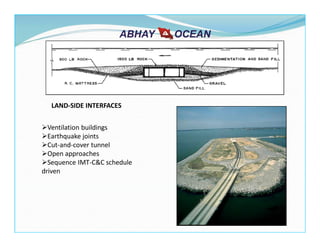
LAND-SIDE INTERFACES
Ventilation buildings
Earthquake joints
Cut-and-cover tunnel
Open approaches
Sequence IMT-C&C schedule
driven
IMMERSED TUNNEL CHALLENGES
Use Advanced Construction Techniques
Use Latest Ventilation Techniques
Select ideal Immersed Tunnel Alignments
Determine Construction and Staging Locations
Deal with Difficult Ground Conditions
Dredging and Disposal
FINDINGS OF STUDY FOR OF AN IMMERSED TUNNEL IN IZMIR BAY, TURKEY
The proposed izmir bay immersed tube tunnel (ibitt) will measure 40 m in width
and 7.6 km in length. The tunnel is characterized by a rectangular cross-section, and
will have 2x3 road traffic lanes on both sides, and a 2x1 railway tracks in the middle.
An immersed tube tunnel construction is considered along this route for the
following reasons:
Izmir bay is relatively shallow (<25 m) so it meets the maximum depth criteria (60
m) for constructability
Seabed soil is generally made of the non-cohesive very loose to loose silt-sand
mixtures, with a very low bearing capacity, which can be improved by suitable soil-
improvement technique
By selection of a straight-line route between two sides of the bay, the tunnel can
be connected to the existing highway junctions and nearby railway lines
The buried tube tunnel surrounded with a selected compacted fill in the tunnel’s
dredged ditch has a better earthquake response when compared to a much heavier
elevated bridge structure
Substantial foundation cost savings, compared to other fixed-crossing options, will
be realized due to the fact that the immersed tube tunnel makes use of water-
buoyancy (Archimedes principle), which enables smaller load transfer to the very
loose seabed soil with very low bearing capacity.
CONSTRUCTION OF AN IMMERSED TUBE TUNNEL ACROSS THE IZMIR BAY WILL ENABLE:
Direct link to the existing highway and railway junctions in the north and
the south districts.
Also, traffic congestion in the centre of the city will diminish substantially.
The tunnel will considerably shorten the commuting distance between the
Çeşme-Motorway and Izmir-Çanakkale Highway by about 40 km.
Shorter distance & smooth drive -- Leads to considerably Lower petrol
consumption leading to considerable reduction in foreign exchange outgo
for the import of petrol -- highly beneficial to national economy.
Quality of life and air for people living in the city will be improved, as
transport difficulties and environmental pollution will decrease.
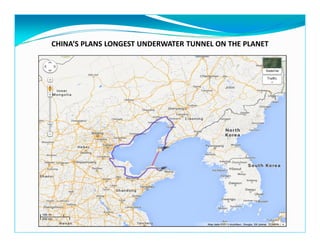
CHINA’S PLANS LONGEST UNDERWATER TUNNEL ON THE PLANET
PLANNED SUBMERGED TUNNEL IN CHINA
ESTIMATED LENGTH - 123KM
LONGER THAN COMBINED LENGTH OF WORLD’S TWO
LONGEST UNDERWATER TUNNELS—JAPAN’S SEIKAN TUNNEL
AND CHANNEL TUNNEL BETWEEN THE UK AND FRANCE.
CONNECT PORTS OF DALIAN AND YANTAI – 105 MILES APART
AS CROW FLIES
AT PRESENT DRIVE BETWEEN PORTS TAKES – 7-8 HRS
TUNNEL WILL SHORTEN DRIVING TIME TO ONE HOUR.
PASSES THROUGH TWO SEISMIC FAULT ZONES –
CONSTRUCTION TO WITHSTAND EARTHQUAKE OF EIGHT
MAGNITUDE
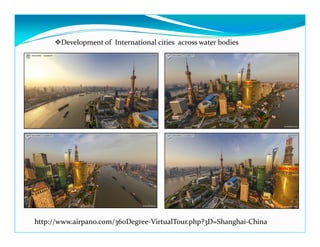
Development of International cities across water bodies
http://www.airpano.com/360Degree-VirtualTour.php?3D=Shanghai-China
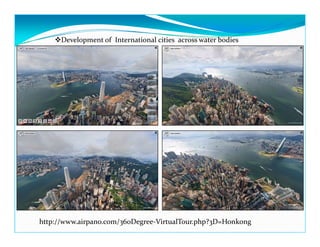
Development of International cities across water bodies
http://www.airpano.com/360Degree-VirtualTour.php?3D=Honkong
THANK YOU

Immersed tunnels Proposal Mumbai, India

  • 1.
    INTRODUCTION TO IMMERSED TUBETUNNEL TECHNOLOGY BY ABHAY OCEAN INDIA PVT LTD
  • 2.
    BACKGROUND TRADITIONALLY LARGE (SEA)CROSSINGS CARRIED OUT BY MEANS OF THE APPARENT MOST ECONOMIC OPTION –BRIDGE. IF A TUNNEL OPTION IS CONSIDERED - BORED TUNNEL SEEMS FAVOURITE . IN RECENT PAST NEW DEVELOPMENTS AND INNOVATIONS HAVE LEAD TO REVIVAL OF IMMERSED TUNNEL AS A COMPETITIVE ALTERNATIVE FOR LARGE FIXED LINKS . THE ØRESUND LINK BETWEEN DENMARK AND SWEDEN GAVE THE IMMERSED TUNNEL TECHNIQUE THE FIRST BOOST. THIS WAS FOLLOWED BY OTHER MAJOR LINKS IN WHICH IMMERSED TUNNEL TECHNIQUE IS APPLIED ON LARGE SCALE. THE LAST IMPRESSIVE EXAMPLE IS THE FEHMERNBELT LINK, THE LINK BETWEEN DENMARK AND GERMANY COMPRISING AN IMMERSED TUNNEL OF ALMOST 19 KM.
  • 3.
    MAJOR SEA CROSSINGØRESUND LINK BETWEEN DENMARK AND SWEDEN
  • 4.
    INTRODUCTION TO IMMERSEDTUNNELS AN ALTERNATIVE TO BRIDGES AND BORED TUNNELS . IMMERSED TUBE TUNNEL UNITS OF LENGTH OF ABOUT 100M LONG, FORMING COMPLETE TUNNEL CROSS-SECTIONS WITH BOTH ENDS TEMPORARILY SEALED BY A BULKHEAD ARE FABRICATED IN A DRY DOCK. TUNNEL ELEMENTS IN CASTING BASIN (ANTWERP TUNNEL ELEMENTS FLOODED CASTING BASIN
  • 5.
    SEALED UNITS AREFLOATED AND TOWED TO TUNNEL LOCATION AND LOWERED INTO A PRE- DREDGED TRENCH IN THE SEA OR RIVER BED OFF SHORE TRANSPORT TUNNEL ELEMENTS OF PIET HEINTUNNEL (THE NETHERLANDS)
  • 6.
    TUNNEL ELEMENT ATPROJECT LOCATION TUNNEL ELEMENT DURING IMMERSION TOWING & IMMERSION OF TUNNEL ELEMENTS
  • 7.
    AN ALTERNATIVE TOBRIDGES AND BORED TUNNELS. IMMERSED TUBE TUNNEL UNITS OF LENGTH OF ABOUT 100M LONG, FORMING COMPLETE TUNNEL CROSS-SECTIONS WITH BOTH ENDS TEMPORARILY SEALED BY A BULKHEAD ARE FABRICATED IN A DRY DOCK. SEALED UNITS ARE FLOATED AND TOWED TO TUNNEL LOCATION AND LOWERED INTO A PRE DREDGED TRENCH IN THE SEA OR RIVER BED. ON ONE END OF EACH TUNNEL ELEMENT, AN ENDLESS GINA GASKET IS MOUNTED. UPON TUNNEL UNIT BEING IMMERSED, IT IS THEN PULLED FIRMLY UP AGAINST THE PRECEDING IMMERSED TUNNEL UNIT WITH A HYDRAULIC JACK. WHEN THE GINA GASKET HAS FULL CONTACT AROUND THE TOTAL CIRCUMFERENCE OF THE ADJACENT TUNNEL UNIT, THE WATER BETWEEN THE BULKHEADS IS PUMPED OUT. DUE TO THE PRESSURE DIFFERENCE BETWEEN THE BULKHEADS AND THE HYDROSTATIC PRESSURE ON THE OUTSIDE OF THE TUNNEL, THE GINA PROFILE COMPRESSES AND SEALS THE JOINT. THE UNITS WILL THEN FORM A CONTINUOUS TUBE AND THE TRENCH IS BACKFILLED PROGRESSIVELY. IMMERSED TUBE TUNNEL
  • 8.
    WHAT IS ANIMMERSED TUNNEL PRECAST TUNNEL ELEMENTS, CONSTRUCTED IN THE DRY. FLOATED TO THE DESTINATION. LOWERED INTO PLACE, JOINED AND COVERED UP. HISTORY FIRST CONSTRUCTED ABOUT 120 YEARS AGO. ABOUT 200 HAVE BEEN CONSTRUCTED ALL OVER THE WORLD. ABOUT 150 ARE FOR ROAD OR RAIL. FIRST PROPOSED 1860 Harlem River Tunnel, New York 1911
  • 9.
    TUNNEL CROSS SECTIONS Selectionof cross-sections determined by local experience and practice. In the U.S.A. use of steel shell tunnels is more common . In Europe and Japan reinforced concrete tunnels are more popular . Structure of steel shell tunnel is of relatively thin-walled composite steel and concrete rings. There are a wide range of cross-sectional configurations, depending on intended use of the tunnel. Circular-shape section, binocular and rectangular shape section are used for immersed tube tunnels. The trench is then backfilled and any necessary protection, such as Rock Armor, added over the top . The ground beside each end tunnel element is reinforced, to permit a tunnel boring machine to drill the final links to the portals on land. After these stages the tunnel is complete, and the internal fit out can be carried out.
  • 10.
    LAND-SIDE INTERFACES VENTILATION BUILDINGS EARTHQUAKEJOINTS CUT-AND-COVER TUNNEL OPEN APPROACHES SEQUENCE IMT-C&C SCHEDULE DRIVEN
  • 11.
    IMMERSED TUNNEL CHALLENGES UseAdvanced Construction Techniques. Use Latest Ventilation Techniques. Select ideal Immersed Tunnel Alignments. Determine Construction and Staging Locations. Deal with Difficult Ground Conditions. Dredging and Disposal.
  • 12.
    The Gina gasketand Omega seal are used between the sectional elements of immersed tunnels to prevent water ingress due to external water pressure. The combination of seals allows for sealing, for the transfer of the hydrostatic loads and movements between the tunnel ends due to soil settlement, creep of concrete, temperature effects and if required earthquakes The designs are generally based on the expected tunnel lifetime of 100 years. Pressure difference between the bulkheads and the hydrostatic pressure on the outside of the tunnel, the Gina profile compresses and seals the joint. GINA GASKETS
  • 13.
    FINAL PLACEMENT OFIMMERSED TUBE ELEMENTS Immersed tunnel elements floated to site using their buoyant state. Ends of tunnel elements equipped with bulkheads (dam plates) across ends to keep inside dry. Bulkheads located to allow only about 1.0 m between the bulkheads of adjacent elements at immersion joint. This space is emptied once an initial seal is obtained during the joining process. Joints usually equipped with gaskets to create seal with the adjacent element. Adjustment devices allow placement of the elements on line and grade. Tunnel elements lowered into their location after adding temporary water ballast in designated water ballast tank. After installation of back fill, ballast water is exchanged with ballast concrete, installed on the tunnel base slab. Subsequently finishing of tunnel and tunnel installations place.
  • 15.
    TUNNEL CROSS SECTION SELECTIONOF TYPICAL CROSS-SECTIONS IS DETERMINED BY LOCAL EXPERIENCE AND PRACTICE . IN THE U.S.A. USE OF STEEL SHELL TUNNELS ARE MORE COMMON. IN THE EUROPE AND JAPAN REINFORCED CONCRETE TUNNELS ARE MORE POPULAR CONCRETE TUNNEL.
  • 16.
  • 17.
    SANDWICH TUNNEL –RECENT DEVELOPMENT IN JAPAN Both internal &external structures are Steel plates. Internal steel diaphragms, Connect plates. No reinforcement. Filled with non shrink self compacting concrete.
  • 19.
  • 22.
    WHY AND WHENARE IMMERSED TUNNELS COMPETITIVE / ADVANTAGES Immersed tunnels have advantage over bored tunnels for water crossing locations . They lie only a short distance below water bed level. Approaches are therefore relatively shorter . Compared with high level bridges or bored tunnels, the overall length of crossing will be shorter.
  • 23.
    FLEXIBILITY IN CROSSSECTION SHAPES IMMERSED TUNNELSPOSSIBLE CROSS SECTION SHAPES -
  • 24.
    OTHER ADVANTAGES OFIMMERSED TUNNELS MAIN ADVANTAGE IS THEY CAN BE CONSIDERABLY MORE COST EFFECTIVE THAN BORED TUNNEL BENEATH THE WATER OR A BRIDGE OTHER ADVANTAGES RELATIVE TO THESE ALTERNATIVES INCLUDE: SPEED OF CONSTRUCTION MINIMAL DISRUPTION TO RIVER/CHANNEL, IF CROSSING A SHIPPING ROUTE RESISTANCE TO SEISMIC ACTIVITY SAFETY OF CONSTRUCTION (WORK IN A DRY DOCK AS OPPOSED TO BORING BENEATH A RIVER) DREDGED MATERIAL CAN BE USED MAKING ARTIFICIAL ISLANDS / LAND RECLAMATION DISADVANTAGES ARE: DIRECT CONTACT WITH WATER - CAREFUL WATERPROOFING DESIGN AROUND JOINTS THE SEGMENTAL APPROACH REQUIRES CAREFUL DESIGN OF THE CONNECTIONS ENVIRONMENTAL IMPACT OF TUBE AND UNDERWATER EMBANKMENT ON EXISTING CHANNEL / SEA BED.
  • 25.
    ILLUSTRATIVE EXAMPLES -IMMERSED TUNNEL PROJECTS The Øresund Link - First major sea crossing using immersed tunnel technique and bridge connection between Denmark and Sweden. 16.7 km link is Road and train carriageway The transition between the tunnel and the bridge is accommodated by a large artificial island approx 4 km long At the Denmark shore a significant land reclamation extending 430 m in the sea was established. Øresund Link (aerial view)
  • 26.
    THE ORESUND LINK….CONTD Immersed part of the tunnel length - 3500 m Tunnel is divided into 20 elements, each 176m long; each element is made up of 8 segments of 22m each The tunnel includes two railway tubes, two motorway tubes and an escape gallery Outer dimensions of the cross section are 8.5m by 41.7 m. Cross section immersed tunnel
  • 27.
    Busan Geoje Crossing,South Korea Road connection in south eastern part of South Korea between Busan and Geoje. Link comprises of two cable stayed bridges and a concrete immersed tube tunnel Tube Tunnel comprises of 18 tunnel elements with a length of 180m each Immersed tunnel is 3.2 km long and deepest (max water depth of 48 m) in world
  • 28.
    INSTALLATION OF BUSANGEOJE TUNNEL ELEMENTS
  • 29.
    HONGKONG ZHUHAI MACAOLINK, CHINA A challenging infrastructure project - HZBM Link under construction Main project is offshore section of HZMB Link of approx. 30km, crossing the Pearl River Estuary from border with Hong Kong to Macao and Zhuhai (Mainland China). Link comprises various bridges, artificial islands and tunnels to accommodate a dual carriageway with 3 traffic lanes in each direction. Crossing of main shipping channels at the eastern side of the Pearl River Estuary will be realised using a 6.75km long tunnel, of which 6km will be immersed. Transition from bridges to tunnel will be by artificial islands with a length of 625m each.
  • 30.
    ISLANDS DESIGN FORHONGKONG ZHUHAI MACAO LINK ILLUSTRATIONS ARTIFICIAL ISLANDS AND TUNNEL ENTRANCE (ON ISLAND In HZMB Link transition between bridges and the immersed tunnel will be realized by artificial islands. The islands are approximately 625 m long and 160 m wide. Technical service buildings for the tunnel are located at the islands
  • 31.
    FEHMERNBELT LINK, DENMARK FehmernbeltFixed Link planned to cross the Fehmernbelt between Rødbyhavn, 140km south of Copenhagen, and Puttgarden, on the north coast of Germany Comprehensive studies including environmental studies resulted in decision that immersed tunnel is best solution Project combines records such as a length of 18.5 km and a water depth of 30 m, while crossing a busy navigational channel.
  • 32.
    IMMERSED TUNNEL SOLUTION- FOR FEHMERNBELT LINK, DENMARK Tunnel elements consist of combined road and rail cross-section all at one level within concrete structure Each Standard element of immersed tunnel has length of approximately 217 m. Underneath the road and rail tubes there will be access to all areas of the tunnel to reduce disruption of the traffic to a minimum.
  • 33.
    IMMERSED TUBE TUNNELCONSTRUCTION IN HONG KONG 1: Cross Harbour Tunnel. 2: Mass Transit Railway Tunnel. 3: Eastern Harbour Crossing Tunnel. 4:Airport Railway Western Immersed tube 5: Western Harbour Crossing Tunnel. Tunnel. •Hong Kong has extensive immersed tube tunnel experience •First steel immersed tube tunnel was placed across the Victoria Harbour in 1972. •There are four other vehicle/railway tunnels crossing the Harbour using immersed tube techniques. •The layout plan of the five immersed tube tunnels is shown in the Figure below
  • 34.
    OUTFITTING SITE Finish elements Readythem for immersion Attach elements to winches or cranes Pontoons or barges needed COMPRESSION OF RUBBER GASKET
  • 35.
    COMPLETING THE INSTALLATION FINISHING Foundation Backfilltrench Protect top of tunnel Finish insides
  • 36.
    LAND-SIDE INTERFACES Ventilation buildings Earthquakejoints Cut-and-cover tunnel Open approaches Sequence IMT-C&C schedule driven
  • 37.
    IMMERSED TUNNEL CHALLENGES UseAdvanced Construction Techniques Use Latest Ventilation Techniques Select ideal Immersed Tunnel Alignments Determine Construction and Staging Locations Deal with Difficult Ground Conditions Dredging and Disposal
  • 38.
    FINDINGS OF STUDYFOR OF AN IMMERSED TUNNEL IN IZMIR BAY, TURKEY The proposed izmir bay immersed tube tunnel (ibitt) will measure 40 m in width and 7.6 km in length. The tunnel is characterized by a rectangular cross-section, and will have 2x3 road traffic lanes on both sides, and a 2x1 railway tracks in the middle. An immersed tube tunnel construction is considered along this route for the following reasons: Izmir bay is relatively shallow (<25 m) so it meets the maximum depth criteria (60 m) for constructability Seabed soil is generally made of the non-cohesive very loose to loose silt-sand mixtures, with a very low bearing capacity, which can be improved by suitable soil- improvement technique By selection of a straight-line route between two sides of the bay, the tunnel can be connected to the existing highway junctions and nearby railway lines The buried tube tunnel surrounded with a selected compacted fill in the tunnel’s dredged ditch has a better earthquake response when compared to a much heavier elevated bridge structure Substantial foundation cost savings, compared to other fixed-crossing options, will be realized due to the fact that the immersed tube tunnel makes use of water- buoyancy (Archimedes principle), which enables smaller load transfer to the very loose seabed soil with very low bearing capacity.
  • 39.
    CONSTRUCTION OF ANIMMERSED TUBE TUNNEL ACROSS THE IZMIR BAY WILL ENABLE: Direct link to the existing highway and railway junctions in the north and the south districts. Also, traffic congestion in the centre of the city will diminish substantially. The tunnel will considerably shorten the commuting distance between the Çeşme-Motorway and Izmir-Çanakkale Highway by about 40 km. Shorter distance & smooth drive -- Leads to considerably Lower petrol consumption leading to considerable reduction in foreign exchange outgo for the import of petrol -- highly beneficial to national economy. Quality of life and air for people living in the city will be improved, as transport difficulties and environmental pollution will decrease.
  • 40.
    CHINA’S PLANS LONGESTUNDERWATER TUNNEL ON THE PLANET
  • 41.
    PLANNED SUBMERGED TUNNELIN CHINA ESTIMATED LENGTH - 123KM LONGER THAN COMBINED LENGTH OF WORLD’S TWO LONGEST UNDERWATER TUNNELS—JAPAN’S SEIKAN TUNNEL AND CHANNEL TUNNEL BETWEEN THE UK AND FRANCE. CONNECT PORTS OF DALIAN AND YANTAI – 105 MILES APART AS CROW FLIES AT PRESENT DRIVE BETWEEN PORTS TAKES – 7-8 HRS TUNNEL WILL SHORTEN DRIVING TIME TO ONE HOUR. PASSES THROUGH TWO SEISMIC FAULT ZONES – CONSTRUCTION TO WITHSTAND EARTHQUAKE OF EIGHT MAGNITUDE
  • 42.
    Development of Internationalcities across water bodies http://www.airpano.com/360Degree-VirtualTour.php?3D=Shanghai-China
  • 43.
    Development of Internationalcities across water bodies http://www.airpano.com/360Degree-VirtualTour.php?3D=Honkong
  • 44.