Dept of Urology
Govt Royapettah Hospital and Kilpauk Medical College
Chennai 1
Moderators:
Professors:
 Prof. Dr. G. Sivasankar, M.S., M.Ch.,
 Prof. Dr. A. Senthilvel, M.S., M.Ch.,
Asst Professors:
 Dr. J. Sivabalan, M.S., M.Ch.,
 Dr. R. Bhargavi, M.S., M.Ch.,
 Dr. S. Raju, M.S., M.Ch.,
 Dr. K. Muthurathinam, M.S., M.Ch.,
 Dr. D. Tamilselvan, M.S., M.Ch.,
 Dr. K. Senthilkumar, M.S., M.Ch.
Dept of Urology, GRH and KMC, Chennai. 2
Introduction
 TUR of bladder tumor (TURBT):
 Gold standard treatment
(1) Remove all visible tumors
(2) Provide specimens for pathologic examination to
determine stage and grade.
3
Dept of Urology, GRH and KMC, Chennai.
Treatment targets
1) To decrease recurrence free interval
2) To decrease number of recurrences
3) To decrease tumour progression
4) To increase survival
4
Dept of Urology, GRH and KMC, Chennai.
Non–Muscle-Invasive Bladder
Cancer (CIS ,Ta, T1)
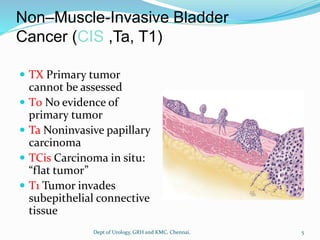
 TX Primary tumor
cannot be assessed
 T0 No evidence of
primary tumor
 Ta Noninvasive papillary
carcinoma
 TCis Carcinoma in situ:
“flat tumor”
 T1 Tumor invades
subepithelial connective
tissue
5
Dept of Urology, GRH and KMC, Chennai.
Agents
 Immunotherapy
BCG
Interferon –alpha
 Chemotherapeutic agents
Mitomycin C
Doxorubicin
Valrubicin
Thiotepa
Epirubicin
Gemcitabine
Taxanes
6
Dept of Urology, GRH and KMC, Chennai.
7
Dept of Urology, GRH and KMC, Chennai.
IMMUNOTHERAPY
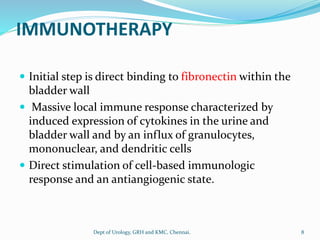
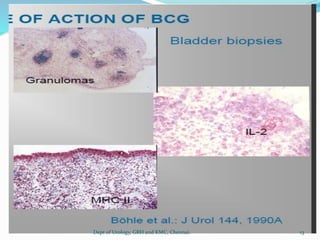
 Initial step is direct binding to fibronectin within the
bladder wall
 Massive local immune response characterized by
induced expression of cytokines in the urine and
bladder wall and by an influx of granulocytes,
mononuclear, and dendritic cells
 Direct stimulation of cell-based immunologic
response and an antiangiogenic state.
8
Dept of Urology, GRH and KMC, Chennai.
 Cytokines involved in the initiation and maintenance
of inflammatory processes
 TNF-α, GM-CSF, IFN-γ, IL-1, IL-2, IL-5, IL-6, IL-8,
IL-10, IL-12, and IL-18
 Upregulation of interferon-γ, IL-2, and IL-12 reflects
induction of a T-helper type-1 response
9
Dept of Urology, GRH and KMC, Chennai.
 BCG may concomitantly stimulate IL-10, resulting in
the suppressive T-helper type-2 response.
 This immunologic response activates cell-mediated
cytotoxic mechanisms that are believed to underlie the
efficacy of BCG and other agents in the prevention of
recurrence and progression
10
Dept of Urology, GRH and KMC, Chennai.
BCG
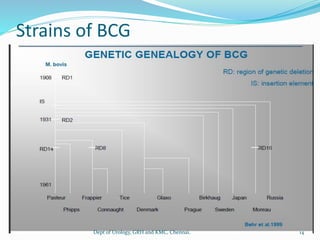
 Live attenuated mycobacterium Bovis strain
 Demonstrated antitumor activity
 Danish 1331 strain
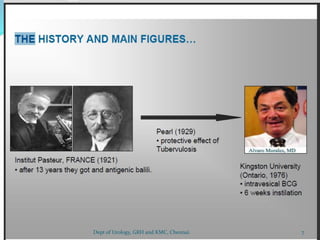
 The original regimen described by Morales included a
percutaneous dose, which was discontinued after
success using a similar intravesical regimen by
Brosman
11
Dept of Urology, GRH and KMC, Chennai.
 BCG is stored in refrigeration and reconstituted from a
lyophilized powder.
 Reconstituted with 50 mL of saline and should be
administered through a urethral catheter under gravity
drainage
12
Dept of Urology, GRH and KMC, Chennai.
13
Dept of Urology, GRH and KMC, Chennai.
Strains of BCG
14
Dept of Urology, GRH and KMC, Chennai.
Composition
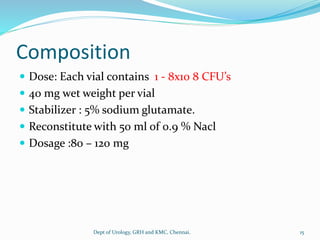
 Dose: Each vial contains 1 - 8x10 8 CFU’s
 40 mg wet weight per vial
 Stabilizer : 5% sodium glutamate.
 Reconstitute with 50 ml of 0.9 % Nacl
 Dosage :80 – 120 mg
15
Dept of Urology, GRH and KMC, Chennai.
 Treatments begun 2 to 4 weeks after TURBT.
 Traumatic catheterization occurs treatment delayed
for several days to 1 week, depending on the extent of
injury.
 After instillation, the patient should retain the
solution for at least 2 hours.
 Fluid, diuretic, and caffeine restriction before
instillation is essential
 Patients are instructed to clean the toilet with bleach,
16
Dept of Urology, GRH and KMC, Chennai.
BCG Treatment of Carcinoma in Situ
 BCG is approved by the U.S. Food and Drug
Administration (FDA).
 Initial tumor-free response rate is as high as 84%
 Approximately 50% of patients experience a durable
response for a median period of 4 years.
 Over a 10-year period, approximately 30% of patients
remain free of tumor progression or recurrence
17
Dept of Urology, GRH and KMC, Chennai.
BCG Treatment of Residual Tumor
 Intravesical BCG can effectively treat residual papillary
lesions but should not be used as a substitute for
surgical resection.
 60% response by residual tumor with intravesical BCG
alone
 Carcinoma of the mucosa or the superficial ducts of
the prostate can be adequately treated by BCG with a
50% tumour-free rate.
18
Dept of Urology, GRH and KMC, Chennai.
BCG Prophylaxis to Prevent Recurrence
 In several larger series, tumor recurrence after TURBT
was reduced by 20% to 65%, for an average of
approximately 40%
 Patients receiving maintenance BCG had a statistically
decreased rate of recurrence compared with those
receiving induction therapy alone
19
Dept of Urology, GRH and KMC, Chennai.
Intravesical BCG - schedule
 6 week induction alone is insufficient to achieve
optimal response
 Lamm and SWOG Maintenance
(after 6 week induction)
@ 3 months- 3 weekly instillations
@ 6 months- 3 weekly instillations
 then every 6 months for 3 years
20
Dept of Urology, GRH and KMC, Chennai.
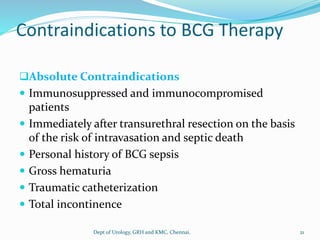
Contraindications to BCG Therapy
❑Absolute Contraindications
 Immunosuppressed and immunocompromised
patients
 Immediately after transurethral resection on the basis
of the risk of intravasation and septic death
 Personal history of BCG sepsis
 Gross hematuria
 Traumatic catheterization
 Total incontinence
21
Dept of Urology, GRH and KMC, Chennai.
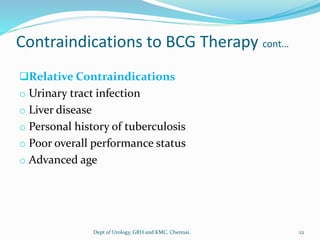
Contraindications to BCG Therapy cont…
❑Relative Contraindications
o Urinary tract infection
o Liver disease
o Personal history of tuberculosis
o Poor overall performance status
o Advanced age
22
Dept of Urology, GRH and KMC, Chennai.
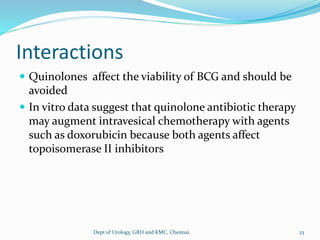
Interactions
 Quinolones affect the viability of BCG and should be
avoided
 In vitro data suggest that quinolone antibiotic therapy
may augment intravesical chemotherapy with agents
such as doxorubicin because both agents affect
topoisomerase II inhibitors
23
Dept of Urology, GRH and KMC, Chennai.
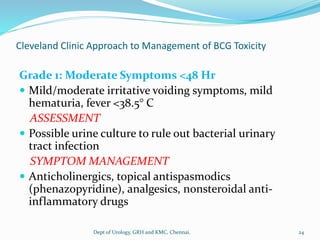
Cleveland Clinic Approach to Management of BCG Toxicity
Grade 1: Moderate Symptoms <48 Hr
 Mild/moderate irritative voiding symptoms, mild
hematuria, fever <38.5° C
ASSESSMENT
 Possible urine culture to rule out bacterial urinary
tract infection
SYMPTOM MANAGEMENT
 Anticholinergics, topical antispasmodics
(phenazopyridine), analgesics, nonsteroidal anti-
inflammatory drugs
24
Dept of Urology, GRH and KMC, Chennai.
Grade 2: Severe Symptoms and/or >48 Hr
 Severe irritative voiding symptoms, hematuria, or
symptoms lasting >48 hr
 All maneuvers for grade 1, plus the following:
ASSESSMENT
Urine culture, chest radiograph, liver function
tests
25
Dept of Urology, GRH and KMC, Chennai.
MANAGEMENT
 Consult immediately with physician experienced in
management of mycobacterial infections/complications.
 Consider dose reduction to one half to one third of dose
when instillations resume.
 Treat culture results as appropriate.
ANTIMICROBIAL AGENTS
 Administer isoniazid and rifampins, 300 mg/day and 600
mg/day, orally until symptom resolution.
 Do not use monotherapy.
26
Dept of Urology, GRH and KMC, Chennai.
Grade 3: Serious Complications (Hemodynamic
Changes, Persistent High-Grade Fever)
ALLERGIC REACTIONS (JOINT PAIN, RASH)
 Perform all maneuvers described for grades 1 and 2,
plus the following:
 Isoniazid, 300 mg/day, and rifampin, 600 mg/day, for
3-6 months depending on response
27
Dept of Urology, GRH and KMC, Chennai.
❑SOLID ORGAN INVOLVEMENT (EPIDIDYMITIS, LIVER,
LUNG, KIDNEY, OSTEOMYELITIS, PROSTATE)
 Isoniazid, 300 mg/day, rifampin, 600 mg/day, ethambutol,
15 mg/kg/ day single daily dose for 3-6 months
 BCG is almost uniformly resistant to pyrazinamide, so this
drug has no role.
 Consider prednisone, 40 mg/day, when response is
inadequate or for septic shock
28
Dept of Urology, GRH and KMC, Chennai.
MANAGEMENT OF REFRACTORY
HIGH-GRADE DISEASE
 Recurrent or persistent disease after an initial 6-week
course of BCG has been traditionally referred to as
BCG failure,
 Current consensus is that persistent disease after BCG
therapy can be categorized to
BCG refractory
BCG resistant
BCG relapsing
BCG intolerant
29
Dept of Urology, GRH and KMC, Chennai.
 BCG refractory : Non improving or worsening disease
despite BCG
 BCG resistant :Recurrence or persistence of lesser
degree, stage, or grade after an initial course, which
then resolves with further BCG
 BCG relapsing: Recurrence after initial resolution with
BCG
30
Dept of Urology, GRH and KMC, Chennai.
 BCG intolerant : Disease recurs after less than
adequate course of therapy because of serious adverse
events or symptomatic intolerance that mandates BCG
discontinuation.
 BCG-refractory patients in particular are an especially
high-risk group and should be strongly considered for
immediate cystectomy if young and in generally good
health
31
Dept of Urology, GRH and KMC, Chennai.
Followup biopsy
 Role of biopsy to determine BCG response is unclear,
although it should be strongly considered in high-risk
patients to determine disease status .
 Dalbagni and colleagues (1999) reported minimal
utility in routine biopsy after BCG if cystoscopy and
urinary cytology were both negative.
32
Dept of Urology, GRH and KMC, Chennai.
Failure of intravesical BCG
immunotherapy
 Treatment with BCG is considered to have failed
in following situations:
a. Whenever muscle invasive tumour is detected during
follow up.
b. If high grade, non-muscle-invasive tumour is present at
both 3 and 6 months .
c. Any worsening of the disease under BCG treatment, such
as
Higher number of recurrences,
Higher T stage or higher grade,
Appearance of CIS, in spite of an initial response
33
Dept of Urology, GRH and KMC, Chennai.
 Declaring failure may take up to 6 months because the
response rate for patients with high-grade bladder
cancer treated with BCG rose from 57% to 80%
between 3 and 6 months after therapy.
 Patients who cannot tolerate BCG for any reason may
be considered for salvage chemotherapy, but the risk
of failure and progression is high.
34
Dept of Urology, GRH and KMC, Chennai.
BCG Failure – treatment(IBCG)
 Intermediate risk:
-TURBT plus single dose intravesical CT
-Repeat BCG induction plus maintenance or
-Radical cystectomy
 High risk:
Radical cystectomy
35
Dept of Urology, GRH and KMC, Chennai.
Interferon
 Interferons are glycoproteins
 Produced response to antigenic stimuli.
 Interferons have multiple antitumor activities
❖ Inhibition of nucleotide synthesis
❖ Upregulation of tumor antigens
❖ Antiangiogenic properties
❖ Stimulation of cytokine release with enhanced T
and B cell activation
❖ Enhanced natural killer cell activity
36
Dept of Urology, GRH and KMC, Chennai.
 Interferon-α commonly used.
 Doses of at least 100 million units required, although
optimal dose and administration schedule have yet to
be determined
 More expensive and less effective than BCG or
intravesical chemotherapy
37
Dept of Urology, GRH and KMC, Chennai.
 Combination of BCG and interferon suggested the
potential superiority and possibility of decreasing the
dosage of BCG, which may reduce side effects.
 In those CIS patients who failed an induction course of
BCG, the combination of low-dose BCG and interferon
produced a 45% durable response at 2 years.
38
Dept of Urology, GRH and KMC, Chennai.
Investigational Immunotherapeutic Agents
 Keyhole-limpet hemocyanin (KLH) :
Hemolymph of the mollusk Megathura crenulata
Nonspecific immune stimulant
 Bropirimine :
Oral arylpyridinone
Inducer of host interferon and induces natural
killer cell and tumour necrosis factor
Demonstrating a 23% to 55% complete response in
patients with CIS
39
Dept of Urology, GRH and KMC, Chennai.
 Mycobacterial cell wall DNA extract
Mixture of immunostimulatory DNA attached to
antigenic cell wall.
Phase 2 trial results indicate success rates less than
that achieved with BCG
Good tolerability
 Thiosulfinate
Extracts of garlic.
Inhibit tumour growth in older studies and may
have an immunostimulatory role
40
Dept of Urology, GRH and KMC, Chennai.
 Interleukin-12 (IL-2)
Highly expressed after BCG stimulation
Key component of the Th1 immune response.
 Adenoviral-delivered GM-CSF
BCG refractory bladder cancer.
41
Dept of Urology, GRH and KMC, Chennai.
INTRAVESICAL CHEMOTHERAPY
 Induction therapy – instilled within 6 hours of
TURBT – clear impact on survival
 Less effective than BCG in reducing progression
rate
( 15% Vs 37%)
 No infective complication
 Reduce the tumour implantation and recurrence,
42
Dept of Urology, GRH and KMC, Chennai.
One, immediate, postoperative intravesical instillation of chemotherapy
 RATIONALE:
• Destruction of circulating tumour cells
immediately after TUR
 As an ablative effect (CHEMORESECTION) of
residual tumour cells at the resection site.
 Prevention of tumour cell implantation should be
initiated within the first hours after cell seeding.
 Within few hours- tumor cells implanted and covered
by ECM
43
Dept of Urology, GRH and KMC, Chennai.
CAUTION
 The immediate post-operative chemotherapy
instillation should be omitted in any case
of overt or suspected intra or extraperitoneal
perforation,
 Severe complications follow extravasation of
the drug
44
Dept of Urology, GRH and KMC, Chennai.
Mitomycin C
 Alkylating agent & inhibits DNA synthesis.
 Instilled weekly for 6 to 8 weeks at dose ranges from
20 to 60 mg.
 A meta-analysis of nine clinical trials compared its
efficacy on progression with BCG.
 Within median follow-up of 26 months, 7.67% of the
patients in the BCG group and 9.44% of the patients in
the MMC group developed tumor progression
45
Dept of Urology, GRH and KMC, Chennai.
 Optimization of MMC delivery can result in halving of
the recurrence rate.
 Achieved by eliminating residual urine volume,
overnight fasting, using sodium bicarbonate to reduce
drug degradation, and increasing concentration to 40
mg in 20 Ml
 Side effects - Rash and rarely contracted bladder
46
Dept of Urology, GRH and KMC, Chennai.
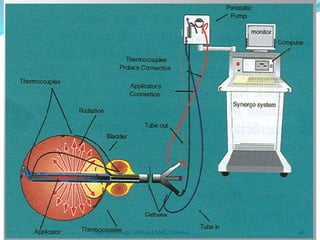
▪ The use of local microwave therapy in conjunction
with MMC, 20 mg/50 mL, reduced recurrence rates
from 57.5% to 17.1% in a multicenter trial.
▪ Electromotive intravesical MMC appears to
improve drug delivery in to bladder tissue
47
Dept of Urology, GRH and KMC, Chennai.
48
Dept of Urology, GRH and KMC, Chennai.
Doxorubicin and Its Derivatives
 Anthracycline antibiotic that acts by binding DNA
base pairs, inhibiting topoisomerase II, and inhibiting
protein synthesis.
 Dosage :50 mg/50 mL
 Doxorubicin demonstrated a 13% to 17% improvement
over TUR in preventing recurrence but no advantage
in preventing tumor progression
 Side effect:chemical cystitis, reduced bladder capacity
49
Dept of Urology, GRH and KMC, Chennai.
 Epirubicin:
Doxorubicin derivative
Decreases recurrence compared with TUR alone by
12% to 15%
Dosage :50 mg/50 mL
50
Dept of Urology, GRH and KMC, Chennai.
 Valrubicin
 Semisynthetic analog of doxorubicin.
 Approved by the FDA for treatment of BCG refractory
CIS in patients who cannot tolerate cystectomy.
 In a cohort of 90 patients with BCG-refractory CIS, 21%
demonstrated a complete response (Steinberg et al,
2000).
51
Dept of Urology, GRH and KMC, Chennai.
Thiotepa
 Triethylenethiophosphoramide
 It is an alkylating agent and is not cell cycle specific.
 30 mg/30 ml
 In controlled clinical trials (N = 950 patients), it has
been shown to significantly decrease tumor recurrence
in 6 of 11 studies up to 41% (mean decrease, 16%).
 Side effects :due to its low molecular weight
hematopoietic toxicity
52
Dept of Urology, GRH and KMC, Chennai.
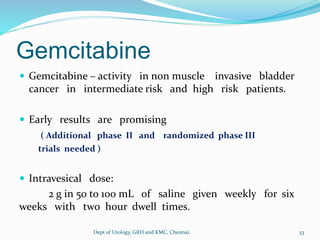
Gemcitabine
 Gemcitabine – activity in non muscle invasive bladder
cancer in intermediate risk and high risk patients.
 Early results are promising
( Additional phase II and randomized phase III
trials needed )
 Intravesical dose:
2 g in 50 to 100 mL of saline given weekly for six
weeks with two hour dwell times.
53
Dept of Urology, GRH and KMC, Chennai.
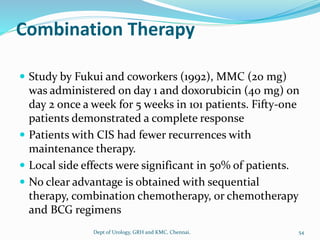
Combination Therapy
 Study by Fukui and coworkers (1992), MMC (20 mg)
was administered on day 1 and doxorubicin (40 mg) on
day 2 once a week for 5 weeks in 101 patients. Fifty-one
patients demonstrated a complete response
 Patients with CIS had fewer recurrences with
maintenance therapy.
 Local side effects were significant in 50% of patients.
 No clear advantage is obtained with sequential
therapy, combination chemotherapy, or chemotherapy
and BCG regimens
54
Dept of Urology, GRH and KMC, Chennai.
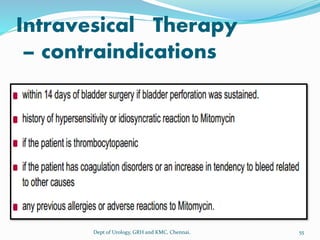
Intravesical Therapy
– contraindications
55
Dept of Urology, GRH and KMC, Chennai.
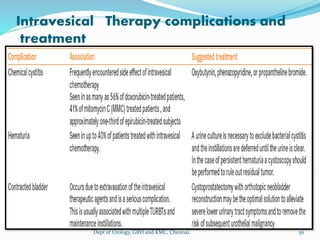
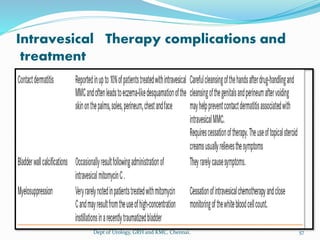
Intravesical Therapy complications and
treatment
56
Dept of Urology, GRH and KMC, Chennai.
Intravesical Therapy complications and
treatment
57
Dept of Urology, GRH and KMC, Chennai.
Failure of intravesical
chemotherapy(IBCG)
❑ TURBT plus single dose intravesical CT
❑ Repeat BCG induction plus maintenance or
❑ Additional intravesical chemotherapy
58
Dept of Urology, GRH and KMC, Chennai.
59
Dept of Urology, GRH and KMC, Chennai.

Bladder carcinoma- intravesical therapy

  • 1.
    Dept of Urology GovtRoyapettah Hospital and Kilpauk Medical College Chennai 1
  • 2.
    Moderators: Professors:  Prof. Dr.G. Sivasankar, M.S., M.Ch.,  Prof. Dr. A. Senthilvel, M.S., M.Ch., Asst Professors:  Dr. J. Sivabalan, M.S., M.Ch.,  Dr. R. Bhargavi, M.S., M.Ch.,  Dr. S. Raju, M.S., M.Ch.,  Dr. K. Muthurathinam, M.S., M.Ch.,  Dr. D. Tamilselvan, M.S., M.Ch.,  Dr. K. Senthilkumar, M.S., M.Ch. Dept of Urology, GRH and KMC, Chennai. 2
  • 3.
    Introduction  TUR ofbladder tumor (TURBT):  Gold standard treatment (1) Remove all visible tumors (2) Provide specimens for pathologic examination to determine stage and grade. 3 Dept of Urology, GRH and KMC, Chennai.
  • 4.
    Treatment targets 1) Todecrease recurrence free interval 2) To decrease number of recurrences 3) To decrease tumour progression 4) To increase survival 4 Dept of Urology, GRH and KMC, Chennai.
  • 5.
    Non–Muscle-Invasive Bladder Cancer (CIS,Ta, T1)  TX Primary tumor cannot be assessed  T0 No evidence of primary tumor  Ta Noninvasive papillary carcinoma  TCis Carcinoma in situ: “flat tumor”  T1 Tumor invades subepithelial connective tissue 5 Dept of Urology, GRH and KMC, Chennai.
  • 6.
    Agents  Immunotherapy BCG Interferon –alpha Chemotherapeutic agents Mitomycin C Doxorubicin Valrubicin Thiotepa Epirubicin Gemcitabine Taxanes 6 Dept of Urology, GRH and KMC, Chennai.
  • 7.
    7 Dept of Urology,GRH and KMC, Chennai.
  • 8.
    IMMUNOTHERAPY  Initial stepis direct binding to fibronectin within the bladder wall  Massive local immune response characterized by induced expression of cytokines in the urine and bladder wall and by an influx of granulocytes, mononuclear, and dendritic cells  Direct stimulation of cell-based immunologic response and an antiangiogenic state. 8 Dept of Urology, GRH and KMC, Chennai.
  • 9.
     Cytokines involvedin the initiation and maintenance of inflammatory processes  TNF-α, GM-CSF, IFN-γ, IL-1, IL-2, IL-5, IL-6, IL-8, IL-10, IL-12, and IL-18  Upregulation of interferon-γ, IL-2, and IL-12 reflects induction of a T-helper type-1 response 9 Dept of Urology, GRH and KMC, Chennai.
  • 10.
     BCG mayconcomitantly stimulate IL-10, resulting in the suppressive T-helper type-2 response.  This immunologic response activates cell-mediated cytotoxic mechanisms that are believed to underlie the efficacy of BCG and other agents in the prevention of recurrence and progression 10 Dept of Urology, GRH and KMC, Chennai.
  • 11.
    BCG  Live attenuatedmycobacterium Bovis strain  Demonstrated antitumor activity  Danish 1331 strain  The original regimen described by Morales included a percutaneous dose, which was discontinued after success using a similar intravesical regimen by Brosman 11 Dept of Urology, GRH and KMC, Chennai.
  • 12.
     BCG isstored in refrigeration and reconstituted from a lyophilized powder.  Reconstituted with 50 mL of saline and should be administered through a urethral catheter under gravity drainage 12 Dept of Urology, GRH and KMC, Chennai.
  • 13.
    13 Dept of Urology,GRH and KMC, Chennai.
  • 14.
    Strains of BCG 14 Deptof Urology, GRH and KMC, Chennai.
  • 15.
    Composition  Dose: Eachvial contains 1 - 8x10 8 CFU’s  40 mg wet weight per vial  Stabilizer : 5% sodium glutamate.  Reconstitute with 50 ml of 0.9 % Nacl  Dosage :80 – 120 mg 15 Dept of Urology, GRH and KMC, Chennai.
  • 16.
     Treatments begun2 to 4 weeks after TURBT.  Traumatic catheterization occurs treatment delayed for several days to 1 week, depending on the extent of injury.  After instillation, the patient should retain the solution for at least 2 hours.  Fluid, diuretic, and caffeine restriction before instillation is essential  Patients are instructed to clean the toilet with bleach, 16 Dept of Urology, GRH and KMC, Chennai.
  • 17.
    BCG Treatment ofCarcinoma in Situ  BCG is approved by the U.S. Food and Drug Administration (FDA).  Initial tumor-free response rate is as high as 84%  Approximately 50% of patients experience a durable response for a median period of 4 years.  Over a 10-year period, approximately 30% of patients remain free of tumor progression or recurrence 17 Dept of Urology, GRH and KMC, Chennai.
  • 18.
    BCG Treatment ofResidual Tumor  Intravesical BCG can effectively treat residual papillary lesions but should not be used as a substitute for surgical resection.  60% response by residual tumor with intravesical BCG alone  Carcinoma of the mucosa or the superficial ducts of the prostate can be adequately treated by BCG with a 50% tumour-free rate. 18 Dept of Urology, GRH and KMC, Chennai.
  • 19.
    BCG Prophylaxis toPrevent Recurrence  In several larger series, tumor recurrence after TURBT was reduced by 20% to 65%, for an average of approximately 40%  Patients receiving maintenance BCG had a statistically decreased rate of recurrence compared with those receiving induction therapy alone 19 Dept of Urology, GRH and KMC, Chennai.
  • 20.
    Intravesical BCG -schedule  6 week induction alone is insufficient to achieve optimal response  Lamm and SWOG Maintenance (after 6 week induction) @ 3 months- 3 weekly instillations @ 6 months- 3 weekly instillations  then every 6 months for 3 years 20 Dept of Urology, GRH and KMC, Chennai.
  • 21.
    Contraindications to BCGTherapy ❑Absolute Contraindications  Immunosuppressed and immunocompromised patients  Immediately after transurethral resection on the basis of the risk of intravasation and septic death  Personal history of BCG sepsis  Gross hematuria  Traumatic catheterization  Total incontinence 21 Dept of Urology, GRH and KMC, Chennai.
  • 22.
    Contraindications to BCGTherapy cont… ❑Relative Contraindications o Urinary tract infection o Liver disease o Personal history of tuberculosis o Poor overall performance status o Advanced age 22 Dept of Urology, GRH and KMC, Chennai.
  • 23.
    Interactions  Quinolones affectthe viability of BCG and should be avoided  In vitro data suggest that quinolone antibiotic therapy may augment intravesical chemotherapy with agents such as doxorubicin because both agents affect topoisomerase II inhibitors 23 Dept of Urology, GRH and KMC, Chennai.
  • 24.
    Cleveland Clinic Approachto Management of BCG Toxicity Grade 1: Moderate Symptoms <48 Hr  Mild/moderate irritative voiding symptoms, mild hematuria, fever <38.5° C ASSESSMENT  Possible urine culture to rule out bacterial urinary tract infection SYMPTOM MANAGEMENT  Anticholinergics, topical antispasmodics (phenazopyridine), analgesics, nonsteroidal anti- inflammatory drugs 24 Dept of Urology, GRH and KMC, Chennai.
  • 25.
    Grade 2: SevereSymptoms and/or >48 Hr  Severe irritative voiding symptoms, hematuria, or symptoms lasting >48 hr  All maneuvers for grade 1, plus the following: ASSESSMENT Urine culture, chest radiograph, liver function tests 25 Dept of Urology, GRH and KMC, Chennai.
  • 26.
    MANAGEMENT  Consult immediatelywith physician experienced in management of mycobacterial infections/complications.  Consider dose reduction to one half to one third of dose when instillations resume.  Treat culture results as appropriate. ANTIMICROBIAL AGENTS  Administer isoniazid and rifampins, 300 mg/day and 600 mg/day, orally until symptom resolution.  Do not use monotherapy. 26 Dept of Urology, GRH and KMC, Chennai.
  • 27.
    Grade 3: SeriousComplications (Hemodynamic Changes, Persistent High-Grade Fever) ALLERGIC REACTIONS (JOINT PAIN, RASH)  Perform all maneuvers described for grades 1 and 2, plus the following:  Isoniazid, 300 mg/day, and rifampin, 600 mg/day, for 3-6 months depending on response 27 Dept of Urology, GRH and KMC, Chennai.
  • 28.
    ❑SOLID ORGAN INVOLVEMENT(EPIDIDYMITIS, LIVER, LUNG, KIDNEY, OSTEOMYELITIS, PROSTATE)  Isoniazid, 300 mg/day, rifampin, 600 mg/day, ethambutol, 15 mg/kg/ day single daily dose for 3-6 months  BCG is almost uniformly resistant to pyrazinamide, so this drug has no role.  Consider prednisone, 40 mg/day, when response is inadequate or for septic shock 28 Dept of Urology, GRH and KMC, Chennai.
  • 29.
    MANAGEMENT OF REFRACTORY HIGH-GRADEDISEASE  Recurrent or persistent disease after an initial 6-week course of BCG has been traditionally referred to as BCG failure,  Current consensus is that persistent disease after BCG therapy can be categorized to BCG refractory BCG resistant BCG relapsing BCG intolerant 29 Dept of Urology, GRH and KMC, Chennai.
  • 30.
     BCG refractory: Non improving or worsening disease despite BCG  BCG resistant :Recurrence or persistence of lesser degree, stage, or grade after an initial course, which then resolves with further BCG  BCG relapsing: Recurrence after initial resolution with BCG 30 Dept of Urology, GRH and KMC, Chennai.
  • 31.
     BCG intolerant: Disease recurs after less than adequate course of therapy because of serious adverse events or symptomatic intolerance that mandates BCG discontinuation.  BCG-refractory patients in particular are an especially high-risk group and should be strongly considered for immediate cystectomy if young and in generally good health 31 Dept of Urology, GRH and KMC, Chennai.
  • 32.
    Followup biopsy  Roleof biopsy to determine BCG response is unclear, although it should be strongly considered in high-risk patients to determine disease status .  Dalbagni and colleagues (1999) reported minimal utility in routine biopsy after BCG if cystoscopy and urinary cytology were both negative. 32 Dept of Urology, GRH and KMC, Chennai.
  • 33.
    Failure of intravesicalBCG immunotherapy  Treatment with BCG is considered to have failed in following situations: a. Whenever muscle invasive tumour is detected during follow up. b. If high grade, non-muscle-invasive tumour is present at both 3 and 6 months . c. Any worsening of the disease under BCG treatment, such as Higher number of recurrences, Higher T stage or higher grade, Appearance of CIS, in spite of an initial response 33 Dept of Urology, GRH and KMC, Chennai.
  • 34.
     Declaring failuremay take up to 6 months because the response rate for patients with high-grade bladder cancer treated with BCG rose from 57% to 80% between 3 and 6 months after therapy.  Patients who cannot tolerate BCG for any reason may be considered for salvage chemotherapy, but the risk of failure and progression is high. 34 Dept of Urology, GRH and KMC, Chennai.
  • 35.
    BCG Failure –treatment(IBCG)  Intermediate risk: -TURBT plus single dose intravesical CT -Repeat BCG induction plus maintenance or -Radical cystectomy  High risk: Radical cystectomy 35 Dept of Urology, GRH and KMC, Chennai.
  • 36.
    Interferon  Interferons areglycoproteins  Produced response to antigenic stimuli.  Interferons have multiple antitumor activities ❖ Inhibition of nucleotide synthesis ❖ Upregulation of tumor antigens ❖ Antiangiogenic properties ❖ Stimulation of cytokine release with enhanced T and B cell activation ❖ Enhanced natural killer cell activity 36 Dept of Urology, GRH and KMC, Chennai.
  • 37.
     Interferon-α commonlyused.  Doses of at least 100 million units required, although optimal dose and administration schedule have yet to be determined  More expensive and less effective than BCG or intravesical chemotherapy 37 Dept of Urology, GRH and KMC, Chennai.
  • 38.
     Combination ofBCG and interferon suggested the potential superiority and possibility of decreasing the dosage of BCG, which may reduce side effects.  In those CIS patients who failed an induction course of BCG, the combination of low-dose BCG and interferon produced a 45% durable response at 2 years. 38 Dept of Urology, GRH and KMC, Chennai.
  • 39.
    Investigational Immunotherapeutic Agents Keyhole-limpet hemocyanin (KLH) : Hemolymph of the mollusk Megathura crenulata Nonspecific immune stimulant  Bropirimine : Oral arylpyridinone Inducer of host interferon and induces natural killer cell and tumour necrosis factor Demonstrating a 23% to 55% complete response in patients with CIS 39 Dept of Urology, GRH and KMC, Chennai.
  • 40.
     Mycobacterial cellwall DNA extract Mixture of immunostimulatory DNA attached to antigenic cell wall. Phase 2 trial results indicate success rates less than that achieved with BCG Good tolerability  Thiosulfinate Extracts of garlic. Inhibit tumour growth in older studies and may have an immunostimulatory role 40 Dept of Urology, GRH and KMC, Chennai.
  • 41.
     Interleukin-12 (IL-2) Highlyexpressed after BCG stimulation Key component of the Th1 immune response.  Adenoviral-delivered GM-CSF BCG refractory bladder cancer. 41 Dept of Urology, GRH and KMC, Chennai.
  • 42.
    INTRAVESICAL CHEMOTHERAPY  Inductiontherapy – instilled within 6 hours of TURBT – clear impact on survival  Less effective than BCG in reducing progression rate ( 15% Vs 37%)  No infective complication  Reduce the tumour implantation and recurrence, 42 Dept of Urology, GRH and KMC, Chennai.
  • 43.
    One, immediate, postoperativeintravesical instillation of chemotherapy  RATIONALE: • Destruction of circulating tumour cells immediately after TUR  As an ablative effect (CHEMORESECTION) of residual tumour cells at the resection site.  Prevention of tumour cell implantation should be initiated within the first hours after cell seeding.  Within few hours- tumor cells implanted and covered by ECM 43 Dept of Urology, GRH and KMC, Chennai.
  • 44.
    CAUTION  The immediatepost-operative chemotherapy instillation should be omitted in any case of overt or suspected intra or extraperitoneal perforation,  Severe complications follow extravasation of the drug 44 Dept of Urology, GRH and KMC, Chennai.
  • 45.
    Mitomycin C  Alkylatingagent & inhibits DNA synthesis.  Instilled weekly for 6 to 8 weeks at dose ranges from 20 to 60 mg.  A meta-analysis of nine clinical trials compared its efficacy on progression with BCG.  Within median follow-up of 26 months, 7.67% of the patients in the BCG group and 9.44% of the patients in the MMC group developed tumor progression 45 Dept of Urology, GRH and KMC, Chennai.
  • 46.
     Optimization ofMMC delivery can result in halving of the recurrence rate.  Achieved by eliminating residual urine volume, overnight fasting, using sodium bicarbonate to reduce drug degradation, and increasing concentration to 40 mg in 20 Ml  Side effects - Rash and rarely contracted bladder 46 Dept of Urology, GRH and KMC, Chennai.
  • 47.
    ▪ The useof local microwave therapy in conjunction with MMC, 20 mg/50 mL, reduced recurrence rates from 57.5% to 17.1% in a multicenter trial. ▪ Electromotive intravesical MMC appears to improve drug delivery in to bladder tissue 47 Dept of Urology, GRH and KMC, Chennai.
  • 48.
    48 Dept of Urology,GRH and KMC, Chennai.
  • 49.
    Doxorubicin and ItsDerivatives  Anthracycline antibiotic that acts by binding DNA base pairs, inhibiting topoisomerase II, and inhibiting protein synthesis.  Dosage :50 mg/50 mL  Doxorubicin demonstrated a 13% to 17% improvement over TUR in preventing recurrence but no advantage in preventing tumor progression  Side effect:chemical cystitis, reduced bladder capacity 49 Dept of Urology, GRH and KMC, Chennai.
  • 50.
     Epirubicin: Doxorubicin derivative Decreasesrecurrence compared with TUR alone by 12% to 15% Dosage :50 mg/50 mL 50 Dept of Urology, GRH and KMC, Chennai.
  • 51.
     Valrubicin  Semisyntheticanalog of doxorubicin.  Approved by the FDA for treatment of BCG refractory CIS in patients who cannot tolerate cystectomy.  In a cohort of 90 patients with BCG-refractory CIS, 21% demonstrated a complete response (Steinberg et al, 2000). 51 Dept of Urology, GRH and KMC, Chennai.
  • 52.
    Thiotepa  Triethylenethiophosphoramide  Itis an alkylating agent and is not cell cycle specific.  30 mg/30 ml  In controlled clinical trials (N = 950 patients), it has been shown to significantly decrease tumor recurrence in 6 of 11 studies up to 41% (mean decrease, 16%).  Side effects :due to its low molecular weight hematopoietic toxicity 52 Dept of Urology, GRH and KMC, Chennai.
  • 53.
    Gemcitabine  Gemcitabine –activity in non muscle invasive bladder cancer in intermediate risk and high risk patients.  Early results are promising ( Additional phase II and randomized phase III trials needed )  Intravesical dose: 2 g in 50 to 100 mL of saline given weekly for six weeks with two hour dwell times. 53 Dept of Urology, GRH and KMC, Chennai.
  • 54.
    Combination Therapy  Studyby Fukui and coworkers (1992), MMC (20 mg) was administered on day 1 and doxorubicin (40 mg) on day 2 once a week for 5 weeks in 101 patients. Fifty-one patients demonstrated a complete response  Patients with CIS had fewer recurrences with maintenance therapy.  Local side effects were significant in 50% of patients.  No clear advantage is obtained with sequential therapy, combination chemotherapy, or chemotherapy and BCG regimens 54 Dept of Urology, GRH and KMC, Chennai.
  • 55.
    Intravesical Therapy – contraindications 55 Deptof Urology, GRH and KMC, Chennai.
  • 56.
    Intravesical Therapy complicationsand treatment 56 Dept of Urology, GRH and KMC, Chennai.
  • 57.
    Intravesical Therapy complicationsand treatment 57 Dept of Urology, GRH and KMC, Chennai.
  • 58.
    Failure of intravesical chemotherapy(IBCG) ❑TURBT plus single dose intravesical CT ❑ Repeat BCG induction plus maintenance or ❑ Additional intravesical chemotherapy 58 Dept of Urology, GRH and KMC, Chennai.
  • 59.
    59 Dept of Urology,GRH and KMC, Chennai.