












Tumour Markers
Presented By-
Himanshu Upadhyay
Tumour Markers
• Tumour markers are oncoproteins or mutated forms of these
proteins that can indicate the presence of a tumour.
• Tumour Markers are substances either released by cancer
cells into the blood or urine or substances created by the
body in response to cancer cells.
• Tumour markers are used to evaluate how well a patient has
responded to treatment and to check for tumour recurrence.
• Research is currently being conducted on the role of tumour
markers in detection, diagnosis and treatment of cancers.
Himanshu Upadhyay (MSc. Clinical
Biochemist.)
2
• Tumour markers are used for screening of cancer or
monitoring the deseases.
• The first tumour marker reported was BENCE JONES PROTEIN
in multiple myeloma in 1847.
Himanshu Upadhyay (MSc. Clinical
Biochemist.)
3
Classification
Tumour Markers can be can be:
• Enzymes
• Hormones
• Antigen
Himanshu Upadhyay (MSc. Clinical
Biochemist.)
4
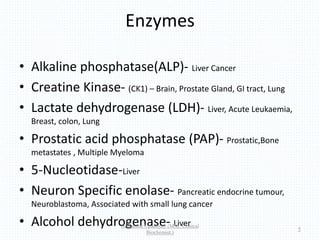
Enzymes
• Alkaline phosphatase(ALP)- Liver Cancer
• Creatine Kinase- (CK1) – Brain, Prostate Gland, GI tract, Lung
• Lactate dehydrogenase (LDH)- Liver, Acute Leukaemia,
Breast, colon, Lung
• Prostatic acid phosphatase (PAP)- Prostatic,Bone
metastates , Multiple Myeloma
• 5-Nucleotidase-Liver
• Neuron Specific enolase- Pancreatic endocrine tumour,
Neuroblastoma, Associated with small lung cancer
• Alcohol dehydrogenase- LiverHimanshu Upadhyay (MSc. Clinical
Biochemist.)
5
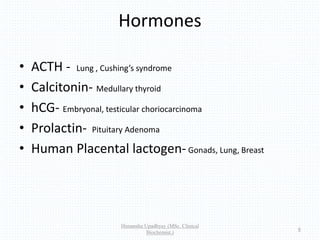
Hormones
• ACTH - Lung , Cushing’s syndrome
• Calcitonin- Medullary thyroid
• hCG- Embryonal, testicular choriocarcinoma
• Prolactin- Pituitary Adenoma
• Human Placental lactogen-Gonads, Lung, Breast
Himanshu Upadhyay (MSc. Clinical
Biochemist.)
6
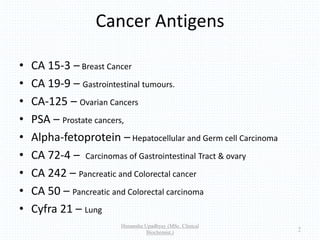
Cancer Antigens
• CA 15-3 – Breast Cancer
• CA 19-9 – Gastrointestinal tumours.
• CA-125 – Ovarian Cancers
• PSA – Prostate cancers,
• Alpha-fetoprotein – Hepatocellular and Germ cell Carcinoma
• CA 72-4 – Carcinomas of Gastrointestinal Tract & ovary
• CA 242 – Pancreatic and Colorectal cancer
• CA 50 – Pancreatic and Colorectal carcinoma
• Cyfra 21 – Lung
Himanshu Upadhyay (MSc. Clinical
Biochemist.)
7
Characteristics
An ideal tumour marker should having
following:
• Highly Sensitive
• Highly Specific
• Able to differentiate between Neoplastic &
Non-Neoplastic diseases.
• Its level should be preceding the neoplastic
process.
Himanshu Upadhyay (MSc. Clinical
Biochemist.)
8
Prostatic-Specific Antigen
• Prostate- Specific Antigen(PSA) is always present in
low concentration in the blood of adult males.
• An elevated PSA level in the blood may indicate
prostate cancer, but other conditions such as benign
prostatic hyperplasia (BPH) and prostatitis can also
raise PSA levels.
• PSA levels are used to evaluate how a patient has
responded to treatment and to check for tumor
recurrence.
Himanshu Upadhyay (MSc. Clinical
Biochemist.)
9
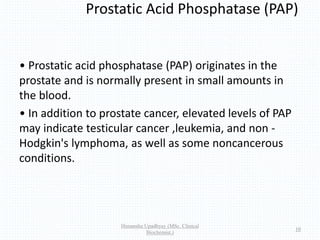
Prostatic Acid Phosphatase (PAP)
• Prostatic acid phosphatase (PAP) originates in the
prostate and is normally present in small amounts in
the blood.
• In addition to prostate cancer, elevated levels of PAP
may indicate testicular cancer ,leukemia, and non -
Hodgkin's lymphoma, as well as some noncancerous
conditions.
Himanshu Upadhyay (MSc. Clinical
Biochemist.)
10
CA 125
• Ovarian cancer is the most common cause of elevated
CA 125.
• Cancer of uterus, cervix, pancreas, liver, colon, breast,
lung, and digestive tract can also raise CA 125 levels.
• Several noncancerous conditions can also elevate CA
125. CA 125 is mainly used to monitor the treatment of
ovarian cancer.
Himanshu Upadhyay (MSc. Clinical
Biochemist.)
11
Carcinoembryonic Antigen (CEA)
• Carcinoembryonic antigen (CEA) is normally
found in small amounts in the blood.
• Colorectal cancer is the most common cancer
that raises this tumor marker.
• Several other cancers can also raise levels of
carcinoembryonic antigen.
Himanshu Upadhyay (MSc. Clinical
Biochemist.)
12
Alpha-Fetoprotein (AFP)
• Alpha-fetoprotein (AFP) is normally elevated in
pregnant women since it is produced by the foetus.
• However, AFP is not usually found in the blood of
adults.
• In men, and in women who are not pregnant, an
elevated level of AFP may indicate liver cancer Or
cancer of ovary or testicle.
• Non-cancerous conditions may also cause elevated
AFP levels.
Himanshu Upadhyay (MSc. Clinical
Biochemist.)
13
Human Chorionic Gonadotropin
(HCG)
• Human chorionic gondado-tropin (HCG) is
another substance that appears normally in
pregnancy and is produced by the placenta.
• If pregnancy is ruled out, HCG may indicate
cancer in testis, ovary, liver, stomach,
pancreas, and lung.
• Marijuana use can also raise HCG levels.
Himanshu Upadhyay (MSc. Clinical
Biochemist.)
14
CA 19-9
• The CA 19-9 marker is associated with cancers in the
colon, stomach, and bile duct.
• Elevated levels of CA 19-9 may indicate advanced
cancer in the pancreas.
• It is also associated with noncancerous conditions,
including gallstones, pancreatitis, cirrhosis of the
liver, and cholecystitis.
Himanshu Upadhyay (MSc. Clinical
Biochemist.)
15
CA 15-3
• The CA 15-3 marker is most useful in evaluating the
effect of treatment for women with advanced breast
cancer.
• Elevated levels of CA 15-3 are also associated with
cancers of the ovary, lung, and prostate.
• Noncancerous conditions such as benign breast or
ovarian disease, endometriosis, pelvic inflammatory
disease, and hepatitis may also elevate CA 15-3.
• Pregnancy and lactation also can raise CA 15-3
levels.
Himanshu Upadhyay (MSc. Clinical
Biochemist.)
16
CA 27-29
• The CA 27-29 marker, like CA 15-3, is used to follow
the course of treatment in women with advanced
breast cancer.
• Cancer of colon, stomach, kidney, lung, ovary,
pancreas, uterus, and liver may also raise CA 27-29
levels.
• Noncancerous conditions associated with this
substance are first trimester pregnancy,
endometriosis, ovarian cysts, benign breast disease,
kidney disease, and liver disease.
Himanshu Upadhyay (MSc. Clinical
Biochemist.)
17
Lactate Dehydrogenase
(LDH)
• LDH is a protein that normally appears throughout
the body in small amounts.
• Many cancers can raise LDH levels, so it is not useful
in identifying a specific kind of cancer.
• Measuring LDH levels can be helpful in monitoring
treatment for cancer.
• Noncancerous conditions that can raise LDH levels
include heart failure, hypothyroidism, anemia, and
lung or liver disease.
Himanshu Upadhyay (MSc. Clinical
Biochemist.)
18
Clinical Application
• Screening for Cancer
• Diagnosing Cancer
• Evaluating cancer prognosis
• Prediction of therapeutic response
• Tumour Staging
• Detecting tumour recurrence
• Localising tumour & directing radiotherapeutic
agents
• Monitoring effectiveness of cancer therapy
Himanshu Upadhyay (MSc. Clinical
Biochemist.)
19
Himanshu Upadhyay (MSc. Clinical
Biochemist.)
20

Tumour markers

  • 1.
  • 2.
    Tumour Markers • Tumourmarkers are oncoproteins or mutated forms of these proteins that can indicate the presence of a tumour. • Tumour Markers are substances either released by cancer cells into the blood or urine or substances created by the body in response to cancer cells. • Tumour markers are used to evaluate how well a patient has responded to treatment and to check for tumour recurrence. • Research is currently being conducted on the role of tumour markers in detection, diagnosis and treatment of cancers. Himanshu Upadhyay (MSc. Clinical Biochemist.) 2
  • 3.
    • Tumour markersare used for screening of cancer or monitoring the deseases. • The first tumour marker reported was BENCE JONES PROTEIN in multiple myeloma in 1847. Himanshu Upadhyay (MSc. Clinical Biochemist.) 3
  • 4.
    Classification Tumour Markers canbe can be: • Enzymes • Hormones • Antigen Himanshu Upadhyay (MSc. Clinical Biochemist.) 4
  • 5.
    Enzymes • Alkaline phosphatase(ALP)-Liver Cancer • Creatine Kinase- (CK1) – Brain, Prostate Gland, GI tract, Lung • Lactate dehydrogenase (LDH)- Liver, Acute Leukaemia, Breast, colon, Lung • Prostatic acid phosphatase (PAP)- Prostatic,Bone metastates , Multiple Myeloma • 5-Nucleotidase-Liver • Neuron Specific enolase- Pancreatic endocrine tumour, Neuroblastoma, Associated with small lung cancer • Alcohol dehydrogenase- LiverHimanshu Upadhyay (MSc. Clinical Biochemist.) 5
  • 6.
    Hormones • ACTH -Lung , Cushing’s syndrome • Calcitonin- Medullary thyroid • hCG- Embryonal, testicular choriocarcinoma • Prolactin- Pituitary Adenoma • Human Placental lactogen-Gonads, Lung, Breast Himanshu Upadhyay (MSc. Clinical Biochemist.) 6
  • 7.
    Cancer Antigens • CA15-3 – Breast Cancer • CA 19-9 – Gastrointestinal tumours. • CA-125 – Ovarian Cancers • PSA – Prostate cancers, • Alpha-fetoprotein – Hepatocellular and Germ cell Carcinoma • CA 72-4 – Carcinomas of Gastrointestinal Tract & ovary • CA 242 – Pancreatic and Colorectal cancer • CA 50 – Pancreatic and Colorectal carcinoma • Cyfra 21 – Lung Himanshu Upadhyay (MSc. Clinical Biochemist.) 7
  • 8.
    Characteristics An ideal tumourmarker should having following: • Highly Sensitive • Highly Specific • Able to differentiate between Neoplastic & Non-Neoplastic diseases. • Its level should be preceding the neoplastic process. Himanshu Upadhyay (MSc. Clinical Biochemist.) 8
  • 9.
    Prostatic-Specific Antigen • Prostate-Specific Antigen(PSA) is always present in low concentration in the blood of adult males. • An elevated PSA level in the blood may indicate prostate cancer, but other conditions such as benign prostatic hyperplasia (BPH) and prostatitis can also raise PSA levels. • PSA levels are used to evaluate how a patient has responded to treatment and to check for tumor recurrence. Himanshu Upadhyay (MSc. Clinical Biochemist.) 9
  • 10.
    Prostatic Acid Phosphatase(PAP) • Prostatic acid phosphatase (PAP) originates in the prostate and is normally present in small amounts in the blood. • In addition to prostate cancer, elevated levels of PAP may indicate testicular cancer ,leukemia, and non - Hodgkin's lymphoma, as well as some noncancerous conditions. Himanshu Upadhyay (MSc. Clinical Biochemist.) 10
  • 11.
    CA 125 • Ovariancancer is the most common cause of elevated CA 125. • Cancer of uterus, cervix, pancreas, liver, colon, breast, lung, and digestive tract can also raise CA 125 levels. • Several noncancerous conditions can also elevate CA 125. CA 125 is mainly used to monitor the treatment of ovarian cancer. Himanshu Upadhyay (MSc. Clinical Biochemist.) 11
  • 12.
    Carcinoembryonic Antigen (CEA) •Carcinoembryonic antigen (CEA) is normally found in small amounts in the blood. • Colorectal cancer is the most common cancer that raises this tumor marker. • Several other cancers can also raise levels of carcinoembryonic antigen. Himanshu Upadhyay (MSc. Clinical Biochemist.) 12
  • 13.
    Alpha-Fetoprotein (AFP) • Alpha-fetoprotein(AFP) is normally elevated in pregnant women since it is produced by the foetus. • However, AFP is not usually found in the blood of adults. • In men, and in women who are not pregnant, an elevated level of AFP may indicate liver cancer Or cancer of ovary or testicle. • Non-cancerous conditions may also cause elevated AFP levels. Himanshu Upadhyay (MSc. Clinical Biochemist.) 13
  • 14.
    Human Chorionic Gonadotropin (HCG) •Human chorionic gondado-tropin (HCG) is another substance that appears normally in pregnancy and is produced by the placenta. • If pregnancy is ruled out, HCG may indicate cancer in testis, ovary, liver, stomach, pancreas, and lung. • Marijuana use can also raise HCG levels. Himanshu Upadhyay (MSc. Clinical Biochemist.) 14
  • 15.
    CA 19-9 • TheCA 19-9 marker is associated with cancers in the colon, stomach, and bile duct. • Elevated levels of CA 19-9 may indicate advanced cancer in the pancreas. • It is also associated with noncancerous conditions, including gallstones, pancreatitis, cirrhosis of the liver, and cholecystitis. Himanshu Upadhyay (MSc. Clinical Biochemist.) 15
  • 16.
    CA 15-3 • TheCA 15-3 marker is most useful in evaluating the effect of treatment for women with advanced breast cancer. • Elevated levels of CA 15-3 are also associated with cancers of the ovary, lung, and prostate. • Noncancerous conditions such as benign breast or ovarian disease, endometriosis, pelvic inflammatory disease, and hepatitis may also elevate CA 15-3. • Pregnancy and lactation also can raise CA 15-3 levels. Himanshu Upadhyay (MSc. Clinical Biochemist.) 16
  • 17.
    CA 27-29 • TheCA 27-29 marker, like CA 15-3, is used to follow the course of treatment in women with advanced breast cancer. • Cancer of colon, stomach, kidney, lung, ovary, pancreas, uterus, and liver may also raise CA 27-29 levels. • Noncancerous conditions associated with this substance are first trimester pregnancy, endometriosis, ovarian cysts, benign breast disease, kidney disease, and liver disease. Himanshu Upadhyay (MSc. Clinical Biochemist.) 17
  • 18.
    Lactate Dehydrogenase (LDH) • LDHis a protein that normally appears throughout the body in small amounts. • Many cancers can raise LDH levels, so it is not useful in identifying a specific kind of cancer. • Measuring LDH levels can be helpful in monitoring treatment for cancer. • Noncancerous conditions that can raise LDH levels include heart failure, hypothyroidism, anemia, and lung or liver disease. Himanshu Upadhyay (MSc. Clinical Biochemist.) 18
  • 19.
    Clinical Application • Screeningfor Cancer • Diagnosing Cancer • Evaluating cancer prognosis • Prediction of therapeutic response • Tumour Staging • Detecting tumour recurrence • Localising tumour & directing radiotherapeutic agents • Monitoring effectiveness of cancer therapy Himanshu Upadhyay (MSc. Clinical Biochemist.) 19
  • 20.
    Himanshu Upadhyay (MSc.Clinical Biochemist.) 20