SUBMITTED BY :
SHAISTAAHMED
M.Sc. CLINICAL RESEARCH
SEMESTER - I
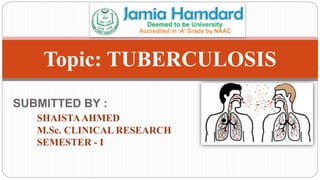
Topic: TUBERCULOSIS
INTRODUCTION
Tuberculosis is an ancient disease that has affected mankind of more than
4000 years.
It is an chronic disease caused by the bacillus Mycobacterium
Tuberculosis and spread from person to person through air.
TB usually affects the lungs but it can also affect other parts of the body
such as brain, intestine, kidney and the spine.
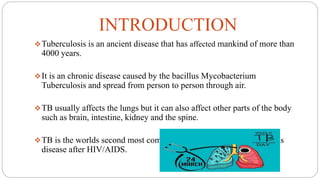
TB is the worlds second most common cause of death from infectious
disease after HIV/AIDS.
PERSON AT INCREASED RISK
 Weakend immune system
 Travelling or living in certain areas
 Lack of medical care
 Drinking excessive alchohol or using tobacco greatly
 Living with someone infected with TB
 Occupation (heath care workers).
PATHOPHYSIOLOGY
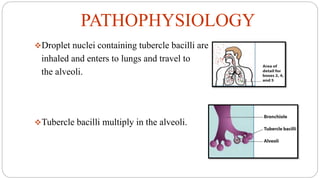
Droplet nuclei containing tubercle bacilli are
inhaled and enters to lungs and travel to
the alveoli.
Tubercle bacilli multiply in the alveoli.
 A small number of tubercle bacilli enter the bloodstream and
spread throughout the body including brain, larynx,
lymph node, lungs, spine, kidney.
 3 weeks after primary infection our special immune cells called
macrophages surrounds the tubercle bacilli and forms a barrier shells
called a granuloma that keeps the bacilli under control.
 If some how the shells breakdown, the bacilli begin to
multiply rapidly and goes to latent TB stage
LATENT TUBERCULOSIS
INFECTION
TB DISEASE
 Person with LTBI have small amount of
Tuberculosis in their bodies that are alive
but inactive.
 Cannot spread TB bacteria to others.
 Does not feel sick but may feel sick if
bacteria become active.
 Sputum smear culture are negative.
 Does not require any respiratory isolation.
 Large amount of TB bacteria in his/her
body
 May spread TB bacteria to others.
 May feel sick and may have symptoms such
as cough, fever, weight loss.
 Sputum smear culture test are positive.
 May require respiratory isolation.
SIGNS AND SYMPTOMS OCCURS AT THE ONSET
OF DISEASE
Lack of appetite, weightloss, high temperature,
night sweats, fatigue.
Cough that lasts more than 3 weeks and usually
bring bloody phlegm
Breathlessness that gradually gets worse
Swollen glands, abdominal pain, pain and loss
of movement in an affected bone or joint
DIAGNOSIS
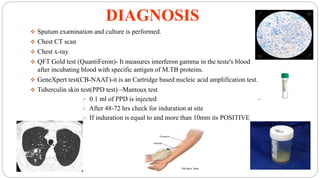
 Sputum examination and culture is performed.
 Chest CT scan
 Chest x-ray
 QFT Gold test (QuantiFeron)- It measures interferon gamma in the teste's blood
after incubating blood with specific antigen of M.TB proteins.
 GeneXpert test(CB-NAAT)-it is an Cartridge based nucleic acid amplification test.
 Tuberculin skin test(PPD test) –Mantoux test
 0.1 ml of PPD is injected
 After 48-72 hrs check for induration at site
 If induration is equal to and more than 10mm its POSITIVE
RNTCP
 Revised national TB control program of India 1992
 INDIA started NTP in 1962 revised in 1992
 Revised in programs- DOTS in India
 Objective- 90% curable rate,90% case detection rate.
 DOTS - Directly observed treatment, short course is the name given to WHO
recommended tuberculosis control strategy that combines five components.
1.Government commitment
2.Good quality of sputum microscopy
3.Accountability.
4.Uninterrupted supply of good quality drugs.
5.Direct observation Therapy.
TREATMENT-TB DRUGS
FIRST LINE-high antitubercular
efficacy and low toxicity
SECOND LINE-low
antituberculare efficacy but high
toxicity
 Isoniazid-5mg/4-6kg
 Rifampin-10mg/8-12kg
 Pyrazinamide-25mg/20-30kg
 Ethambutol-15mg/15-20kg
 Streptomycin-15mg/12-18kg
 Cycloserine
 Kanamicin
 Ethionamide
 Para-amino salicylic acid
 Rifabutin
 Newer drugs
 Linezolid
 Rifabutin
 Clarithromycin
 Azithromycin
 oflaxacin
First line drugs
Second line
drugs
Newer drugs
ISONIAZID CYCLOSERINE LINEZOLID
RIFAMPIN KANAMYCIN RIFABUTIN
PYRAZINAMIDE AMIKACIN CLARITHROMYCIN
ETHAMBUTOL PARA-AMINO SALICYLIC
ACID
AZITHROMYCIN
STREPTOMYCIN FLUROQUINOLONES OFLAXACIN
MULTIPLE DRUG RESISTANCE TB
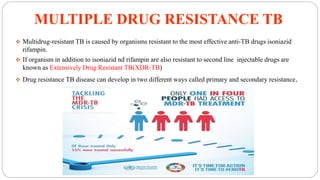
 Multidrug-resistant TB is caused by organisms resistant to the most effective anti-TB drugs isoniazid
rifampin.
 If organism in addition to isoniazid nd rifampin are also resistant to second line injectable drugs are
known as Extensively Drug Resistant TB(XDR-TB)
 Drug resistance TB disease can develop in two different ways called primary and secondary resistance.
MDR TB
Primary MDR TB Secondary MDR TB
 Infected with drug-resistance
organism.
 Travel in area with high prevalence
of drug-resistance TB disease
 Exposure to person who has known
drug-resistant TB
 Acquired or developed during drug
resistance.
 Drug-drug interactions causing low
serum levels.
 Develop because patient was not
treated with appropriate treatment
regimen or took drug incorrectly or
irregularly.
RECENT DEVELOPMENTS
 The Standardised treatment regimen of Anti-TB drugs for patient with MDR-TB (STREAM) trial is
the first multi-country randomised clinical trial to test the efficacy, safety and economic impact of
shortened multidrug-resistant tuberculosis(MDR-TB) treatment regimens.
 TB is world’s leading infectious cause of death, neonatal BCG(Bacillus Calmette-Guerin)
vaccination is partially protecting infants and young children against severe forms of TB it is poorly
protective against pulmonary disease in adults. Reaching the WHO End TB strategy targets of a
95% reduction in TB mortality and 90% reduction in TB incidence worldwide by 2035 will require
new vaccine that is effective at preventing adult tuberculosis.
 The U.S food and Drug Administration approved Pretomanid Tablets in combination with
bedaquiline and linezolid on august 14,2019
 OPC-67683 is promising new anti –TB drug with bactericidal and sterilizing activity in mice but its
role in TB treatment is still need to be established
REFERNCES
 Cardona PJ. Pathogenesis of tuberculosis and other mycobacteriosis.
Enferm Infecc Microbiol Clin. 2018 Jan;36(1):38-46. English, Spanish.
doi: 10.1016/j.eimc.2017.10.015. Epub 2017 Dec 2. PMID: 29198784
 Strausz J. Tuberkulózis 2006 [Tuberculosis 2006]. Orv Hetil. 2007 May
6;148(18):829-31. Hungarian. doi: 10.1556/OH.2007.28057. PMID:
17468065
 KD Tripathi
 Koch A, Mizrahi V. Mycobacterium tuberculosis. Trends Microbiol. 2018
Jun;26(6):555-556. doi: 10.1016/j.tim.2018.02.012. Epub 2018 Mar 23.
PMID: 29580884
 https://www.fda.gov/news-events/press-announcements/fda-approves-
new-drug-treatment-resistant-forms-tuberculosis-affects-
lungs#:~:text=The%20U.S.%20Food%20and%20Drug,(TB)%20of%20th
e%20lungs
TUBERCULOSIS

TUBERCULOSIS

  • 1.
    SUBMITTED BY : SHAISTAAHMED M.Sc.CLINICAL RESEARCH SEMESTER - I Topic: TUBERCULOSIS
  • 2.
    INTRODUCTION Tuberculosis is anancient disease that has affected mankind of more than 4000 years. It is an chronic disease caused by the bacillus Mycobacterium Tuberculosis and spread from person to person through air. TB usually affects the lungs but it can also affect other parts of the body such as brain, intestine, kidney and the spine. TB is the worlds second most common cause of death from infectious disease after HIV/AIDS.
  • 3.
    PERSON AT INCREASEDRISK  Weakend immune system  Travelling or living in certain areas  Lack of medical care  Drinking excessive alchohol or using tobacco greatly  Living with someone infected with TB  Occupation (heath care workers).
  • 4.
    PATHOPHYSIOLOGY Droplet nuclei containingtubercle bacilli are inhaled and enters to lungs and travel to the alveoli. Tubercle bacilli multiply in the alveoli.
  • 5.
     A smallnumber of tubercle bacilli enter the bloodstream and spread throughout the body including brain, larynx, lymph node, lungs, spine, kidney.  3 weeks after primary infection our special immune cells called macrophages surrounds the tubercle bacilli and forms a barrier shells called a granuloma that keeps the bacilli under control.  If some how the shells breakdown, the bacilli begin to multiply rapidly and goes to latent TB stage
  • 6.
    LATENT TUBERCULOSIS INFECTION TB DISEASE Person with LTBI have small amount of Tuberculosis in their bodies that are alive but inactive.  Cannot spread TB bacteria to others.  Does not feel sick but may feel sick if bacteria become active.  Sputum smear culture are negative.  Does not require any respiratory isolation.  Large amount of TB bacteria in his/her body  May spread TB bacteria to others.  May feel sick and may have symptoms such as cough, fever, weight loss.  Sputum smear culture test are positive.  May require respiratory isolation.
  • 7.
    SIGNS AND SYMPTOMSOCCURS AT THE ONSET OF DISEASE Lack of appetite, weightloss, high temperature, night sweats, fatigue. Cough that lasts more than 3 weeks and usually bring bloody phlegm Breathlessness that gradually gets worse Swollen glands, abdominal pain, pain and loss of movement in an affected bone or joint
  • 8.
    DIAGNOSIS  Sputum examinationand culture is performed.  Chest CT scan  Chest x-ray  QFT Gold test (QuantiFeron)- It measures interferon gamma in the teste's blood after incubating blood with specific antigen of M.TB proteins.  GeneXpert test(CB-NAAT)-it is an Cartridge based nucleic acid amplification test.  Tuberculin skin test(PPD test) –Mantoux test  0.1 ml of PPD is injected  After 48-72 hrs check for induration at site  If induration is equal to and more than 10mm its POSITIVE
  • 9.
    RNTCP  Revised nationalTB control program of India 1992  INDIA started NTP in 1962 revised in 1992  Revised in programs- DOTS in India  Objective- 90% curable rate,90% case detection rate.  DOTS - Directly observed treatment, short course is the name given to WHO recommended tuberculosis control strategy that combines five components. 1.Government commitment 2.Good quality of sputum microscopy 3.Accountability. 4.Uninterrupted supply of good quality drugs. 5.Direct observation Therapy.
  • 10.
    TREATMENT-TB DRUGS FIRST LINE-highantitubercular efficacy and low toxicity SECOND LINE-low antituberculare efficacy but high toxicity  Isoniazid-5mg/4-6kg  Rifampin-10mg/8-12kg  Pyrazinamide-25mg/20-30kg  Ethambutol-15mg/15-20kg  Streptomycin-15mg/12-18kg  Cycloserine  Kanamicin  Ethionamide  Para-amino salicylic acid  Rifabutin  Newer drugs  Linezolid  Rifabutin  Clarithromycin  Azithromycin  oflaxacin First line drugs Second line drugs Newer drugs ISONIAZID CYCLOSERINE LINEZOLID RIFAMPIN KANAMYCIN RIFABUTIN PYRAZINAMIDE AMIKACIN CLARITHROMYCIN ETHAMBUTOL PARA-AMINO SALICYLIC ACID AZITHROMYCIN STREPTOMYCIN FLUROQUINOLONES OFLAXACIN
  • 11.
    MULTIPLE DRUG RESISTANCETB  Multidrug-resistant TB is caused by organisms resistant to the most effective anti-TB drugs isoniazid rifampin.  If organism in addition to isoniazid nd rifampin are also resistant to second line injectable drugs are known as Extensively Drug Resistant TB(XDR-TB)  Drug resistance TB disease can develop in two different ways called primary and secondary resistance.
  • 12.
    MDR TB Primary MDRTB Secondary MDR TB  Infected with drug-resistance organism.  Travel in area with high prevalence of drug-resistance TB disease  Exposure to person who has known drug-resistant TB  Acquired or developed during drug resistance.  Drug-drug interactions causing low serum levels.  Develop because patient was not treated with appropriate treatment regimen or took drug incorrectly or irregularly.
  • 13.
    RECENT DEVELOPMENTS  TheStandardised treatment regimen of Anti-TB drugs for patient with MDR-TB (STREAM) trial is the first multi-country randomised clinical trial to test the efficacy, safety and economic impact of shortened multidrug-resistant tuberculosis(MDR-TB) treatment regimens.  TB is world’s leading infectious cause of death, neonatal BCG(Bacillus Calmette-Guerin) vaccination is partially protecting infants and young children against severe forms of TB it is poorly protective against pulmonary disease in adults. Reaching the WHO End TB strategy targets of a 95% reduction in TB mortality and 90% reduction in TB incidence worldwide by 2035 will require new vaccine that is effective at preventing adult tuberculosis.  The U.S food and Drug Administration approved Pretomanid Tablets in combination with bedaquiline and linezolid on august 14,2019  OPC-67683 is promising new anti –TB drug with bactericidal and sterilizing activity in mice but its role in TB treatment is still need to be established
  • 14.
    REFERNCES  Cardona PJ.Pathogenesis of tuberculosis and other mycobacteriosis. Enferm Infecc Microbiol Clin. 2018 Jan;36(1):38-46. English, Spanish. doi: 10.1016/j.eimc.2017.10.015. Epub 2017 Dec 2. PMID: 29198784  Strausz J. Tuberkulózis 2006 [Tuberculosis 2006]. Orv Hetil. 2007 May 6;148(18):829-31. Hungarian. doi: 10.1556/OH.2007.28057. PMID: 17468065  KD Tripathi  Koch A, Mizrahi V. Mycobacterium tuberculosis. Trends Microbiol. 2018 Jun;26(6):555-556. doi: 10.1016/j.tim.2018.02.012. Epub 2018 Mar 23. PMID: 29580884  https://www.fda.gov/news-events/press-announcements/fda-approves- new-drug-treatment-resistant-forms-tuberculosis-affects- lungs#:~:text=The%20U.S.%20Food%20and%20Drug,(TB)%20of%20th e%20lungs