GUIDELINES 21:
CLUSTER RANDOMISED TRIAL
PRESENTED BY :
SHAISTAAHMED
MSc (Semester-I)
CTCR
CIOMS
 The Council for International Organizations of Medical Sciences (CIOMS) is an
international, non-governmental, non-profit organization.
 Established by World Health Organization (WHO) and United Nations Educational,
Scientific and Culture Organization (UNESCO) in 1949.
 Aim of CIOMS is to advance public health through guidance on health research including
ethics, medical product development
and safety.
WHAT IS RANDOMISATION?
 Cluster randomization trials are experiments or study in which cluster of
individuals(communities, medical practice etc.) rather than independent individuals
are randomly allocated to intervention groups.
What are Cluster Randomization trials?
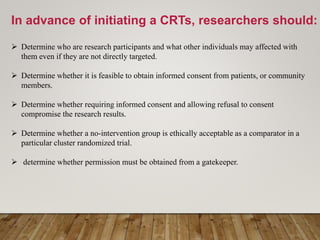
In advance of initiating a CRTs, researchers should:
 Determine who are research participants and what other individuals may affected with
them even if they are not directly targeted.
 Determine whether it is feasible to obtain informed consent from patients, or community
members.
 Determine whether requiring informed consent and allowing refusal to consent
compromise the research results.
 Determine whether a no-intervention group is ethically acceptable as a comparator in a
particular cluster randomized trial.
 determine whether permission must be obtained from a gatekeeper.
GENERAL CONSIDERATION
 In this research design, groups of (cluster), communities are
randomized to different interventions for cluster randomized trial.
DETERMINING THE RESEARCH
PARTICIPANTS
 IN CRTs the subjects can be patients, health care workers or both.
In CRTs in which healthcare workers are subject the intervention
may not be targeted at patients but aggregate data from patients
record may be used to judge the effectiveness of the intervention.
INFORMED CONSENT
 Researchers must obtain informed consent from participants in a
cluster randomization unless a waver or modification of consent is
granted by research ethics committee. Waiver or modification of
informed consent may be necessary in some CRTs in which it is
virtually impossible to obtain individual informed consent. This
occur when the intervention is directed at an entire community.
ETHICALACCEPTABILITY OF A
NO-INTERVENTION GROUP
 Some CRTs investigate interventions that have been proven to be
effective elsewhere.
 A ethical question to this type of study is whether it is acceptable to
withhold the proven intervention from a control group in a CRT.
GATEKEEPING IN CLUSTER
RANDOMIZED TRIAL
 When a CRT affects cluster or organization interests and a gatekeeper
(community leader or local health council) possesses the authority to make
decisions on the cluster or organization behalf.
 The researcher must obtain the gatekeeper’s permission to enrol cluster or
organization in the trial.
 The decision maker must ensure the risks of participation in the study and
randomisation are commensurate with the benefits for the cluster or of society.
THANK YOU

Cioms shaista ahmed

  • 1.
    GUIDELINES 21: CLUSTER RANDOMISEDTRIAL PRESENTED BY : SHAISTAAHMED MSc (Semester-I) CTCR
  • 2.
    CIOMS  The Councilfor International Organizations of Medical Sciences (CIOMS) is an international, non-governmental, non-profit organization.  Established by World Health Organization (WHO) and United Nations Educational, Scientific and Culture Organization (UNESCO) in 1949.  Aim of CIOMS is to advance public health through guidance on health research including ethics, medical product development and safety.
  • 3.
  • 4.
     Cluster randomizationtrials are experiments or study in which cluster of individuals(communities, medical practice etc.) rather than independent individuals are randomly allocated to intervention groups. What are Cluster Randomization trials?
  • 5.
    In advance ofinitiating a CRTs, researchers should:  Determine who are research participants and what other individuals may affected with them even if they are not directly targeted.  Determine whether it is feasible to obtain informed consent from patients, or community members.  Determine whether requiring informed consent and allowing refusal to consent compromise the research results.  Determine whether a no-intervention group is ethically acceptable as a comparator in a particular cluster randomized trial.  determine whether permission must be obtained from a gatekeeper.
  • 6.
    GENERAL CONSIDERATION  Inthis research design, groups of (cluster), communities are randomized to different interventions for cluster randomized trial.
  • 7.
    DETERMINING THE RESEARCH PARTICIPANTS IN CRTs the subjects can be patients, health care workers or both. In CRTs in which healthcare workers are subject the intervention may not be targeted at patients but aggregate data from patients record may be used to judge the effectiveness of the intervention.
  • 8.
    INFORMED CONSENT  Researchersmust obtain informed consent from participants in a cluster randomization unless a waver or modification of consent is granted by research ethics committee. Waiver or modification of informed consent may be necessary in some CRTs in which it is virtually impossible to obtain individual informed consent. This occur when the intervention is directed at an entire community.
  • 9.
    ETHICALACCEPTABILITY OF A NO-INTERVENTIONGROUP  Some CRTs investigate interventions that have been proven to be effective elsewhere.  A ethical question to this type of study is whether it is acceptable to withhold the proven intervention from a control group in a CRT.
  • 10.
    GATEKEEPING IN CLUSTER RANDOMIZEDTRIAL  When a CRT affects cluster or organization interests and a gatekeeper (community leader or local health council) possesses the authority to make decisions on the cluster or organization behalf.  The researcher must obtain the gatekeeper’s permission to enrol cluster or organization in the trial.  The decision maker must ensure the risks of participation in the study and randomisation are commensurate with the benefits for the cluster or of society.
  • 11.