Truth-Table Analysis Phil 57 section 3 San Jose State University Fall 2010
What are truth-tables good for?  Working out the truth value of a formula from the truth values of the atomic formulae in it. Defining the behavior of logical connectives used to build complex formulae.
What are truth-tables good for?  Determining the logical status of a single proposition. Determining the logical status of a group of propositions. Determining the validity of an argument.
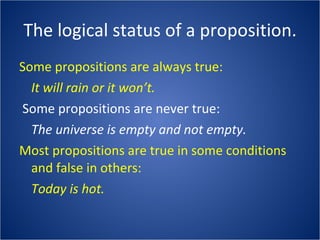
The logical status of a proposition. Some propositions are always true: It will rain or it won’t. Some propositions are never true: The universe is empty and not empty. Most propositions are true in some conditions and false in others: Today is hot.
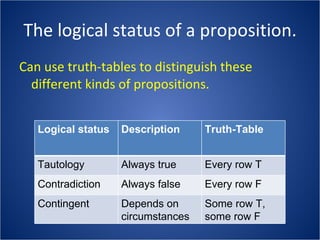
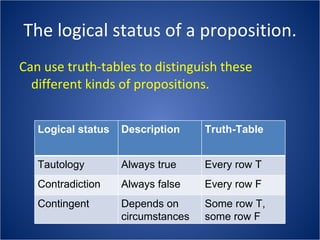
The logical status of a proposition. Can use truth-tables to distinguish these different kinds of propositions. Logical status Description Truth-Table Tautology Always true Every row T Contradiction Always false Every row F Contingent Depends on circumstances Some row T, some row F
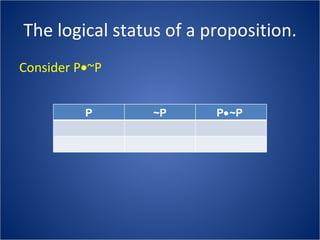
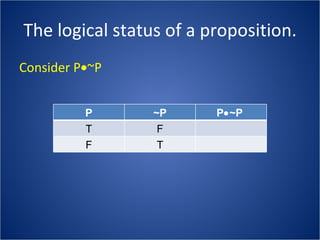
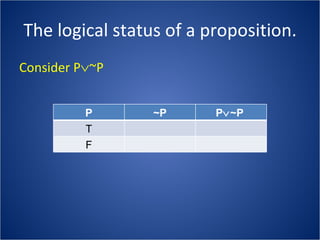
The logical status of a proposition. Consider P  ~P  P ~P P  ~P
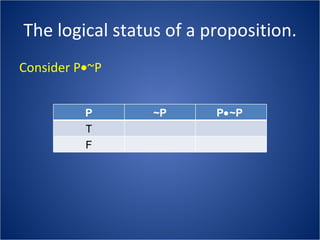
The logical status of a proposition. Consider P  ~P  P ~P P  ~P  T F
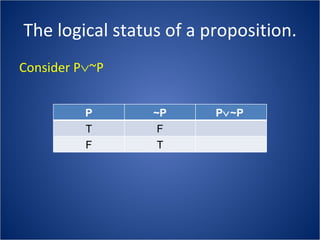
The logical status of a proposition. Consider P  ~P  P ~P P  ~P  T F F T
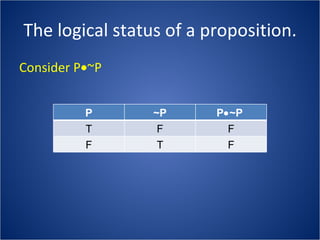
The logical status of a proposition. Consider P  ~P  P ~P P  ~P  T F F F T F
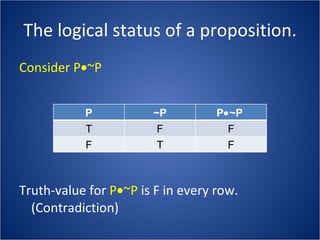
The logical status of a proposition. Consider P  ~P  Truth-value for  P  ~P  is F in every row. (Contradiction) P ~P P  ~P  T F F F T F
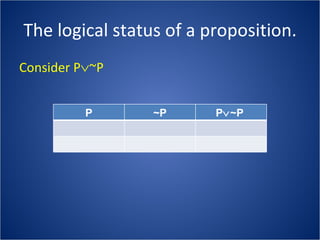
The logical status of a proposition. Consider P  ~P  P ~P P  ~P
The logical status of a proposition. Consider P  ~P  P ~P P  ~P  T F
The logical status of a proposition. Consider P  ~P  P ~P P  ~P  T F F T
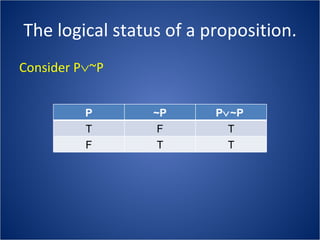
The logical status of a proposition. Consider P  ~P  P ~P P  ~P  T F T F T T
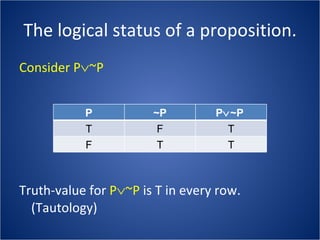
The logical status of a proposition. Consider P  ~P  Truth-value for  P  ~P  is T in every row. (Tautology) P ~P P  ~P  T F T F T T
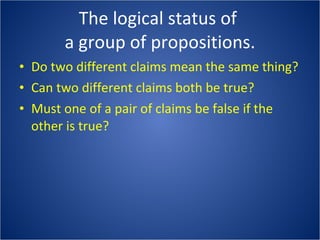
The logical status of  a group of propositions. Do two different claims mean the same thing? Can two different claims both be true? Must one of a pair of claims be false if the other is true?
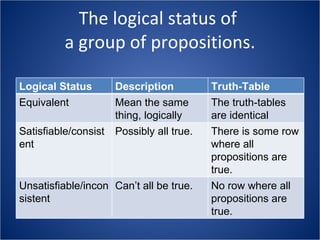
The logical status of  a group of propositions. Logical Status Description Truth-Table Equivalent Mean the same thing, logically The truth-tables are identical Satisfiable/consistent Possibly all true. There is some row where all propositions are true. Unsatisfiable/inconsistent Can’t all be true. No row where all propositions are true.
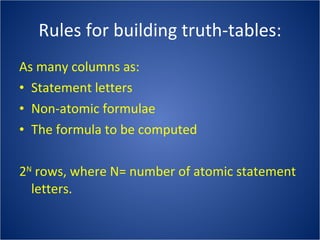
Rules for building truth-tables: As many columns as: Statement letters Non-atomic formulae The formula to be computed 2 N  rows, where N= number of atomic statement letters.
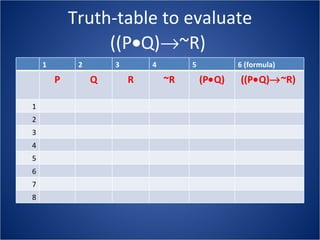
Truth-table to evaluate ((P  Q)  ~R)  1 2 3 4 5 6 (formula)  P Q R ~R (P  Q) ((P  Q)  ~R)   1 2 3 4 5 6 7 8
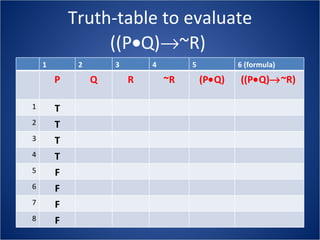
Truth-table to evaluate ((P  Q)  ~R)  1 2 3 4 5 6 (formula)  P Q R ~R (P  Q) ((P  Q)  ~R)   1 T 2 T 3 T 4 T 5 F 6 F 7 F 8 F
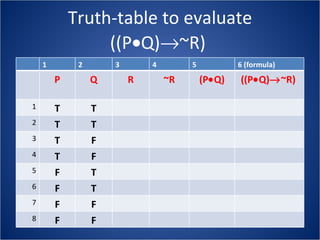
Truth-table to evaluate ((P  Q)  ~R)  1 2 3 4 5 6 (formula)  P Q R ~R (P  Q) ((P  Q)  ~R)   1 T T 2 T T 3 T F 4 T F 5 F T 6 F T 7 F F 8 F F
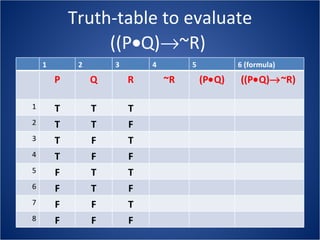
Truth-table to evaluate ((P  Q)  ~R)  1 2 3 4 5 6 (formula)  P Q R ~R (P  Q) ((P  Q)  ~R)   1 T T T 2 T T F 3 T F T 4 T F F 5 F T T 6 F T F 7 F F T 8 F F F
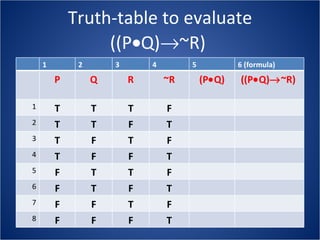
Truth-table to evaluate ((P  Q)  ~R)  1 2 3 4 5 6 (formula)  P Q R ~R (P  Q) ((P  Q)  ~R)   1 T T T F 2 T T F T 3 T F T F 4 T F F T 5 F T T F 6 F T F T 7 F F T F 8 F F F T
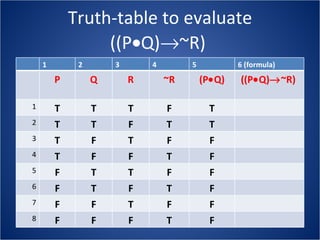
Truth-table to evaluate ((P  Q)  ~R)  1 2 3 4 5 6 (formula)  P Q R ~R (P  Q) ((P  Q)  ~R)   1 T T T F T 2 T T F T T 3 T F T F F 4 T F F T F 5 F T T F F 6 F T F T F 7 F F T F F 8 F F F T F
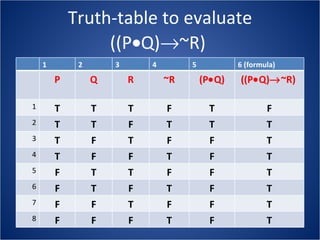
Truth-table to evaluate ((P  Q)  ~R)  1 2 3 4 5 6 (formula)  P Q R ~R (P  Q) ((P  Q)  ~R)   1 T T T F T F 2 T T F T T T 3 T F T F F T 4 T F F T F T 5 F T T F F T 6 F T F T F T 7 F F T F F T 8 F F F T F T
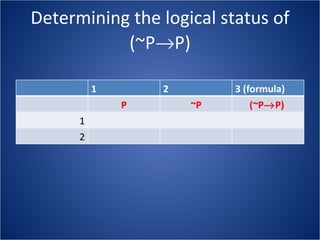
Determining the logical status of (~P  P) 1 2 3 (formula) P ~P (~P  P)   1 2
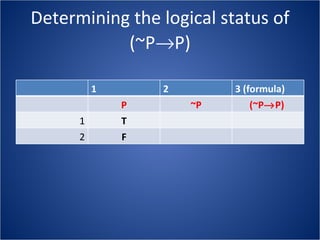
Determining the logical status of (~P  P) 1 2 3 (formula) P ~P (~P  P)   1 T 2 F
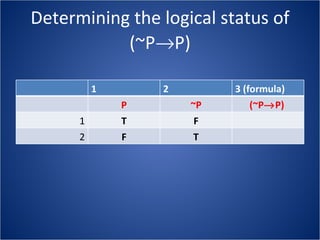
Determining the logical status of (~P  P) 1 2 3 (formula) P ~P (~P  P)   1 T F 2 F T
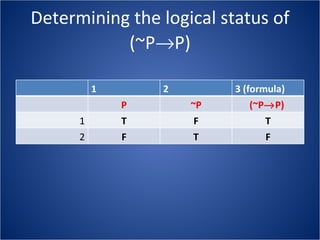
Determining the logical status of (~P  P) 1 2 3 (formula) P ~P (~P  P)   1 T F T 2 F T F
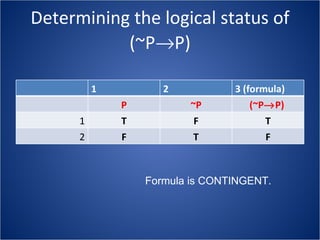
Determining the logical status of (~P  P) Formula is CONTINGENT. 1 2 3 (formula) P ~P (~P  P)   1 T F T 2 F T F
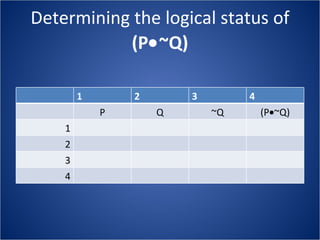
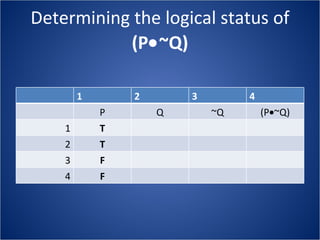
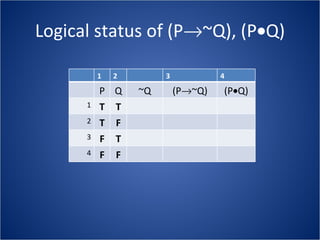
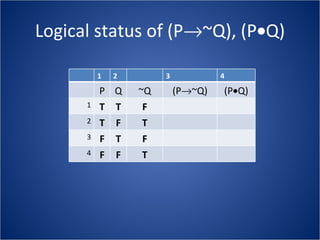
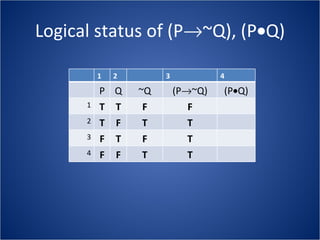
Determining the logical status of  (P  ~Q) 1 2 3 4 P Q ~Q (P  ~Q) 1 2 3 4
Determining the logical status of  (P  ~Q) 1 2 3 4 P Q ~Q (P  ~Q) 1 T 2 T 3 F 4 F
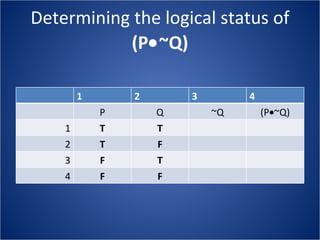
Determining the logical status of  (P  ~Q) 1 2 3 4 P Q ~Q (P  ~Q) 1 T T 2 T F 3 F T 4 F F
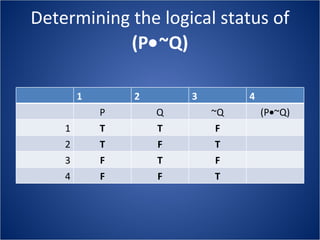
Determining the logical status of  (P  ~Q) 1 2 3 4 P Q ~Q (P  ~Q) 1 T T F 2 T F T 3 F T F 4 F F T
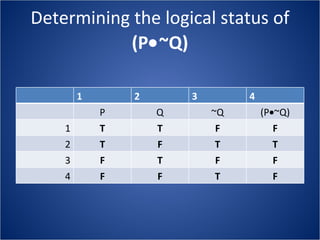
Determining the logical status of  (P  ~Q) 1 2 3 4 P Q ~Q (P  ~Q) 1 T T F F 2 T F T T 3 F T F F 4 F F T F
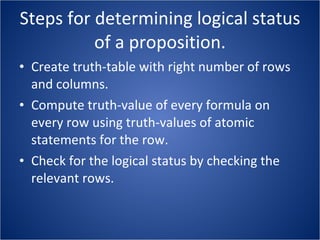
Steps for determining logical status of a proposition. Create truth-table with right number of rows and columns. Compute truth-value of every formula on every row using truth-values of atomic statements for the row. Check for the logical status by checking the relevant rows.
The logical status of a proposition. Can use truth-tables to distinguish these different kinds of propositions. Logical status Description Truth-Table Tautology Always true Every row T Contradiction Always false Every row F Contingent Depends on circumstances Some row T, some row F
Determining the logical status of a group of propositions. Build truth-table to give side-by-side comparison of the truth values of the propositions. Doing this in a single truth-table is the best way to ensure an apples-to-apples comparison.
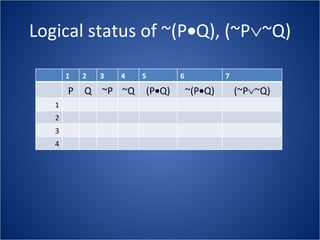
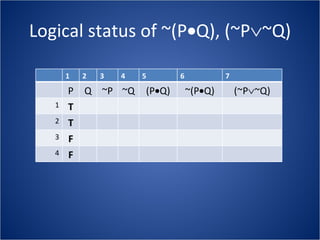
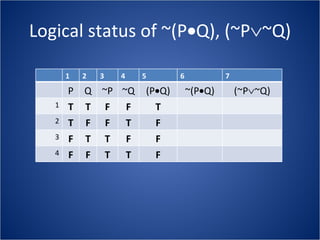
Logical status of ~(P  Q), (~P  ~Q) 1 2 3 4 5 6 7 P Q ~P ~Q (P  Q) ~(P  Q) (~P  ~Q) 1 2 3 4
Logical status of ~(P  Q), (~P  ~Q) 1 2 3 4 5 6 7 P Q ~P ~Q (P  Q) ~(P  Q) (~P  ~Q) 1 T 2 T 3 F 4 F
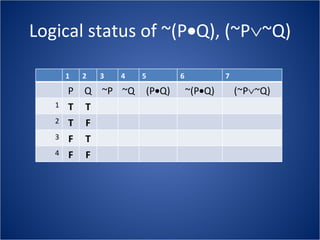
Logical status of ~(P  Q), (~P  ~Q) 1 2 3 4 5 6 7 P Q ~P ~Q (P  Q) ~(P  Q) (~P  ~Q) 1 T T 2 T F 3 F T 4 F F
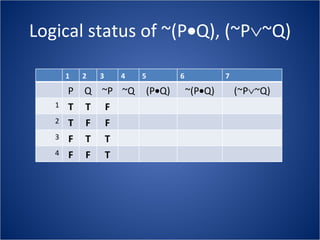
Logical status of ~(P  Q), (~P  ~Q) 1 2 3 4 5 6 7 P Q ~P ~Q (P  Q) ~(P  Q) (~P  ~Q) 1 T T F 2 T F F 3 F T T 4 F F T
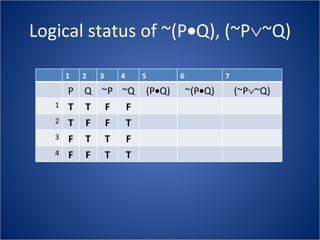
Logical status of ~(P  Q), (~P  ~Q) 1 2 3 4 5 6 7 P Q ~P ~Q (P  Q) ~(P  Q) (~P  ~Q) 1 T T F F 2 T F F T 3 F T T F 4 F F T T
Logical status of ~(P  Q), (~P  ~Q) 1 2 3 4 5 6 7 P Q ~P ~Q (P  Q) ~(P  Q) (~P  ~Q) 1 T T F F T 2 T F F T F 3 F T T F F 4 F F T T F
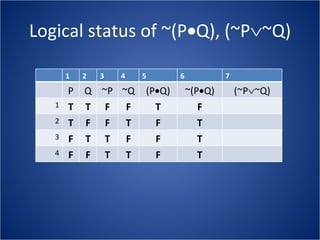
Logical status of ~(P  Q), (~P  ~Q) 1 2 3 4 5 6 7 P Q ~P ~Q (P  Q) ~(P  Q) (~P  ~Q) 1 T T F F T F 2 T F F T F T 3 F T T F F T 4 F F T T F T
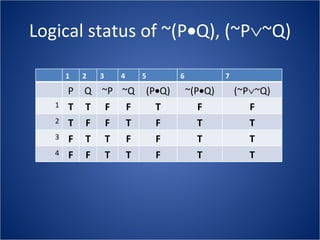
Logical status of ~(P  Q), (~P  ~Q) 1 2 3 4 5 6 7 P Q ~P ~Q (P  Q) ~(P  Q) (~P  ~Q) 1 T T F F T F F 2 T F F T F T T 3 F T T F F T T 4 F F T T F T T
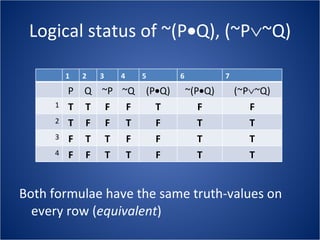
Logical status of ~(P  Q), (~P  ~Q) Both formulae have the same truth-values on every row ( equivalent ) 1 2 3 4 5 6 7 P Q ~P ~Q (P  Q) ~(P  Q) (~P  ~Q) 1 T T F F T F F 2 T F F T F T T 3 F T T F F T T 4 F F T T F T T
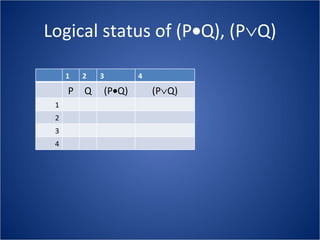
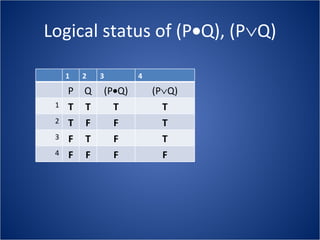
Logical status of (P  Q), (P  Q) 1 2 3 4 P Q (P  Q) (P  Q) 1 2 3 4
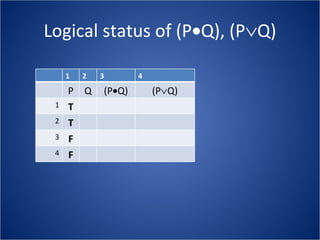
Logical status of (P  Q), (P  Q) 1 2 3 4 P Q (P  Q) (P  Q) 1 T 2 T 3 F 4 F
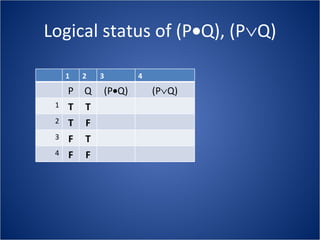
Logical status of (P  Q), (P  Q) 1 2 3 4 P Q (P  Q) (P  Q) 1 T T 2 T F 3 F T 4 F F
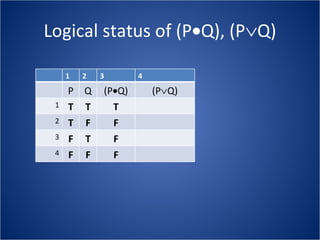
Logical status of (P  Q), (P  Q) 1 2 3 4 P Q (P  Q) (P  Q) 1 T T T 2 T F F 3 F T F 4 F F F
Logical status of (P  Q), (P  Q) 1 2 3 4 P Q (P  Q) (P  Q) 1 T T T T 2 T F F T 3 F T F T 4 F F F F
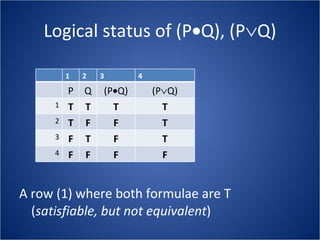
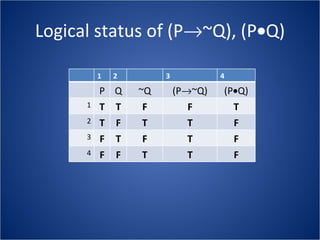
Logical status of (P  Q), (P  Q) A row (1) where both formulae are T  ( satisfiable, but not equivalent ) 1 2 3 4 P Q (P  Q) (P  Q) 1 T T T T 2 T F F T 3 F T F T 4 F F F F
Logical status of (P  ~Q), (P  Q) 1 2 3 4 P Q ~Q (P  ~Q) (P  Q) 1 2 3 4
Logical status of (P  ~Q), (P  Q) 1 2 3 4 P Q ~Q (P  ~Q) (P  Q) 1 T 2 T 3 F 4 F
Logical status of (P  ~Q), (P  Q) 1 2 3 4 P Q ~Q (P  ~Q) (P  Q) 1 T T 2 T F 3 F T 4 F F
Logical status of (P  ~Q), (P  Q) 1 2 3 4 P Q ~Q (P  ~Q) (P  Q) 1 T T F 2 T F T 3 F T F 4 F F T
Logical status of (P  ~Q), (P  Q) 1 2 3 4 P Q ~Q (P  ~Q) (P  Q) 1 T T F F 2 T F T T 3 F T F T 4 F F T T
Logical status of (P  ~Q), (P  Q) 1 2 3 4 P Q ~Q (P  ~Q) (P  Q) 1 T T F F T 2 T F T T F 3 F T F T F 4 F F T T F
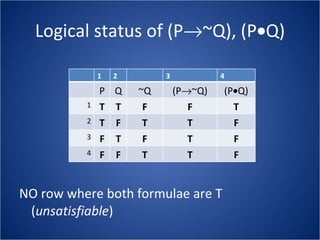
Logical status of (P  ~Q), (P  Q) NO row where both formulae are T  ( unsatisfiable ) 1 2 3 4 P Q ~Q (P  ~Q) (P  Q) 1 T T F F T 2 T F T T F 3 F T F T F 4 F F T T F
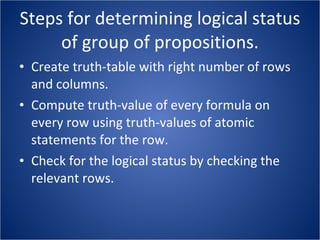
Steps for determining logical status of group of propositions. Create truth-table with right number of rows and columns. Compute truth-value of every formula on every row using truth-values of atomic statements for the row. Check for the logical status by checking the relevant rows.
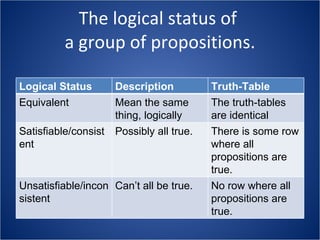
The logical status of  a group of propositions. Logical Status Description Truth-Table Equivalent Mean the same thing, logically The truth-tables are identical Satisfiable/consistent Possibly all true. There is some row where all propositions are true. Unsatisfiable/inconsistent Can’t all be true. No row where all propositions are true.
Determining the validity of an argument via truth-tables. Remember that a valid argument is one where, if all the premises are true, the conclusion  must  be true.
Determining the validity of an argument via truth-tables. Remember that a valid argument is one where, if all the premises are true, the conclusion  must  be true. Build truth table that includes formulae for premises and conclusion.
Determining the validity of an argument via truth-tables. Remember that a valid argument is one where, if all the premises are true, the conclusion  must  be true. Build truth table that includes formulae for premises and conclusion. If there’s a row where the premises are true and the conclusion is false, argument is  invalid .
Determining the validity of an argument via truth-tables. Remember that a valid argument is one where, if all the premises are true, the conclusion  must  be true. Build truth table that includes formulae for premises and conclusion. If there’s a row where the premises are true and the conclusion is false, argument is  invalid . Otherwise, argument is valid.
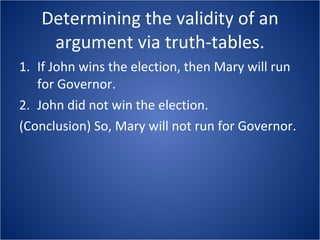
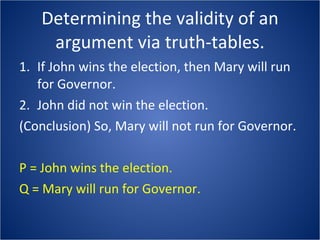
Determining the validity of an argument via truth-tables. If John wins the election, then Mary will run for Governor.  John did not win the election.  (Conclusion) So, Mary will not run for Governor.
Determining the validity of an argument via truth-tables. If John wins the election, then Mary will run for Governor.  John did not win the election.  (Conclusion) So, Mary will not run for Governor. P = John wins the election. Q = Mary will run for Governor.
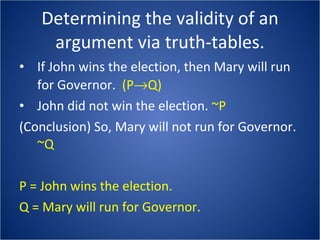
Determining the validity of an argument via truth-tables. If John wins the election, then Mary will run for Governor.  (P  Q) John did not win the election.  ~P (Conclusion) So, Mary will not run for Governor. ~Q P = John wins the election. Q = Mary will run for Governor.
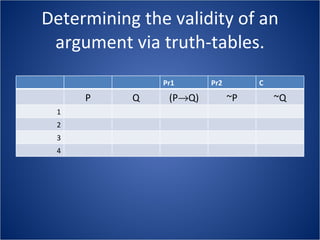
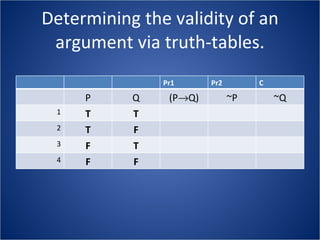
Determining the validity of an argument via truth-tables. Pr1 Pr2 C P Q (P  Q) ~P ~Q 1 2 3 4
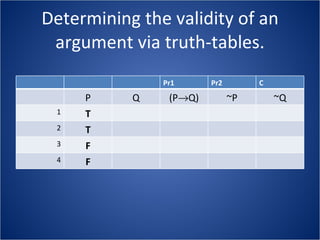
Determining the validity of an argument via truth-tables. Pr1 Pr2 C P Q (P  Q) ~P ~Q 1 T 2 T 3 F 4 F
Determining the validity of an argument via truth-tables. Pr1 Pr2 C P Q (P  Q) ~P ~Q 1 T T 2 T F 3 F T 4 F F
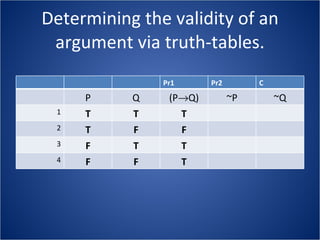
Determining the validity of an argument via truth-tables. Pr1 Pr2 C P Q (P  Q) ~P ~Q 1 T T T 2 T F F 3 F T T 4 F F T
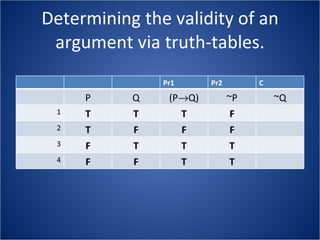
Determining the validity of an argument via truth-tables. Pr1 Pr2 C P Q (P  Q) ~P ~Q 1 T T T F 2 T F F F 3 F T T T 4 F F T T
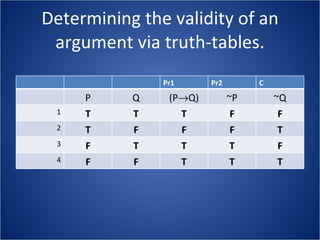
Determining the validity of an argument via truth-tables. Pr1 Pr2 C P Q (P  Q) ~P ~Q 1 T T T F F 2 T F F F T 3 F T T T F 4 F F T T T
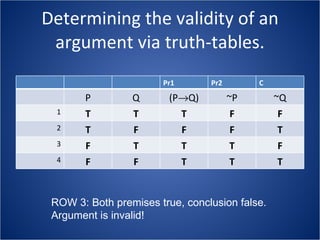
Determining the validity of an argument via truth-tables. ROW 3: Both premises true, conclusion false. Argument is invalid! Pr1 Pr2 C P Q (P  Q) ~P ~Q 1 T T T F F 2 T F F F T 3 F T T T F 4 F F T T T
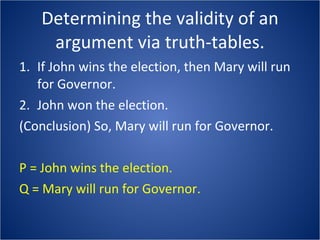
Determining the validity of an argument via truth-tables. If John wins the election, then Mary will run for Governor.  John won the election.  (Conclusion) So, Mary will run for Governor. P = John wins the election. Q = Mary will run for Governor.
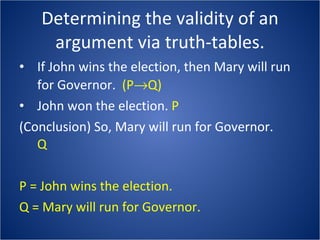
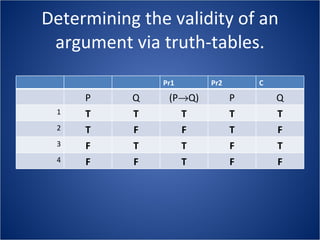
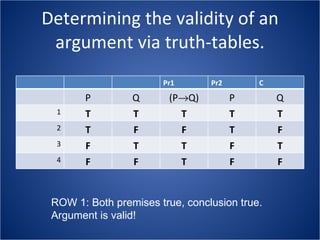
Determining the validity of an argument via truth-tables. If John wins the election, then Mary will run for Governor.  (P  Q) John won the election.  P (Conclusion) So, Mary will run for Governor. Q P = John wins the election. Q = Mary will run for Governor.
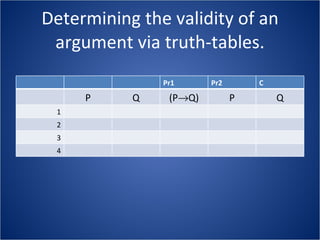
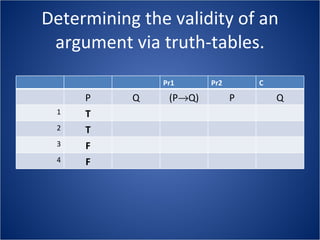
Determining the validity of an argument via truth-tables. Pr1 Pr2 C P Q (P  Q) P Q 1 2 3 4
Determining the validity of an argument via truth-tables. Pr1 Pr2 C P Q (P  Q) P Q 1 T 2 T 3 F 4 F
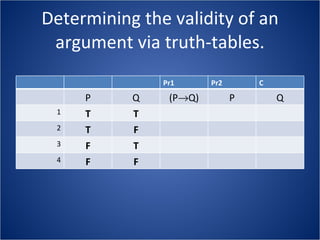
Determining the validity of an argument via truth-tables. Pr1 Pr2 C P Q (P  Q) P Q 1 T T 2 T F 3 F T 4 F F
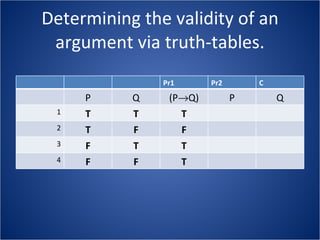
Determining the validity of an argument via truth-tables. Pr1 Pr2 C P Q (P  Q) P Q 1 T T T 2 T F F 3 F T T 4 F F T
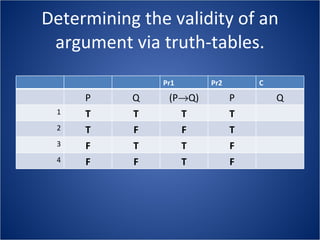
Determining the validity of an argument via truth-tables. Pr1 Pr2 C P Q (P  Q) P Q 1 T T T T 2 T F F T 3 F T T F 4 F F T F
Determining the validity of an argument via truth-tables. Pr1 Pr2 C P Q (P  Q) P Q 1 T T T T T 2 T F F T F 3 F T T F T 4 F F T F F
Determining the validity of an argument via truth-tables. ROW 1: Both premises true, conclusion true. Argument is valid! Pr1 Pr2 C P Q (P  Q) P Q 1 T T T T T 2 T F F T F 3 F T T F T 4 F F T F F
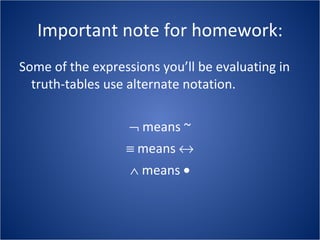
Important note for homework: Some of the expressions you’ll be evaluating in truth-tables use alternate notation.    means ~    means      means  

Truth table analysis

  • 1.
    Truth-Table Analysis Phil57 section 3 San Jose State University Fall 2010
  • 2.
    What are truth-tablesgood for? Working out the truth value of a formula from the truth values of the atomic formulae in it. Defining the behavior of logical connectives used to build complex formulae.
  • 3.
    What are truth-tablesgood for? Determining the logical status of a single proposition. Determining the logical status of a group of propositions. Determining the validity of an argument.
  • 4.
    The logical statusof a proposition. Some propositions are always true: It will rain or it won’t. Some propositions are never true: The universe is empty and not empty. Most propositions are true in some conditions and false in others: Today is hot.
  • 5.
    The logical statusof a proposition. Can use truth-tables to distinguish these different kinds of propositions. Logical status Description Truth-Table Tautology Always true Every row T Contradiction Always false Every row F Contingent Depends on circumstances Some row T, some row F
  • 6.
    The logical statusof a proposition. Consider P  ~P P ~P P  ~P
  • 7.
    The logical statusof a proposition. Consider P  ~P P ~P P  ~P T F
  • 8.
    The logical statusof a proposition. Consider P  ~P P ~P P  ~P T F F T
  • 9.
    The logical statusof a proposition. Consider P  ~P P ~P P  ~P T F F F T F
  • 10.
    The logical statusof a proposition. Consider P  ~P Truth-value for P  ~P is F in every row. (Contradiction) P ~P P  ~P T F F F T F
  • 11.
    The logical statusof a proposition. Consider P  ~P P ~P P  ~P
  • 12.
    The logical statusof a proposition. Consider P  ~P P ~P P  ~P T F
  • 13.
    The logical statusof a proposition. Consider P  ~P P ~P P  ~P T F F T
  • 14.
    The logical statusof a proposition. Consider P  ~P P ~P P  ~P T F T F T T
  • 15.
    The logical statusof a proposition. Consider P  ~P Truth-value for P  ~P is T in every row. (Tautology) P ~P P  ~P T F T F T T
  • 16.
    The logical statusof a group of propositions. Do two different claims mean the same thing? Can two different claims both be true? Must one of a pair of claims be false if the other is true?
  • 17.
    The logical statusof a group of propositions. Logical Status Description Truth-Table Equivalent Mean the same thing, logically The truth-tables are identical Satisfiable/consistent Possibly all true. There is some row where all propositions are true. Unsatisfiable/inconsistent Can’t all be true. No row where all propositions are true.
  • 18.
    Rules for buildingtruth-tables: As many columns as: Statement letters Non-atomic formulae The formula to be computed 2 N rows, where N= number of atomic statement letters.
  • 19.
    Truth-table to evaluate((P  Q)  ~R) 1 2 3 4 5 6 (formula) P Q R ~R (P  Q) ((P  Q)  ~R) 1 2 3 4 5 6 7 8
  • 20.
    Truth-table to evaluate((P  Q)  ~R) 1 2 3 4 5 6 (formula) P Q R ~R (P  Q) ((P  Q)  ~R) 1 T 2 T 3 T 4 T 5 F 6 F 7 F 8 F
  • 21.
    Truth-table to evaluate((P  Q)  ~R) 1 2 3 4 5 6 (formula) P Q R ~R (P  Q) ((P  Q)  ~R) 1 T T 2 T T 3 T F 4 T F 5 F T 6 F T 7 F F 8 F F
  • 22.
    Truth-table to evaluate((P  Q)  ~R) 1 2 3 4 5 6 (formula) P Q R ~R (P  Q) ((P  Q)  ~R) 1 T T T 2 T T F 3 T F T 4 T F F 5 F T T 6 F T F 7 F F T 8 F F F
  • 23.
    Truth-table to evaluate((P  Q)  ~R) 1 2 3 4 5 6 (formula) P Q R ~R (P  Q) ((P  Q)  ~R) 1 T T T F 2 T T F T 3 T F T F 4 T F F T 5 F T T F 6 F T F T 7 F F T F 8 F F F T
  • 24.
    Truth-table to evaluate((P  Q)  ~R) 1 2 3 4 5 6 (formula) P Q R ~R (P  Q) ((P  Q)  ~R) 1 T T T F T 2 T T F T T 3 T F T F F 4 T F F T F 5 F T T F F 6 F T F T F 7 F F T F F 8 F F F T F
  • 25.
    Truth-table to evaluate((P  Q)  ~R) 1 2 3 4 5 6 (formula) P Q R ~R (P  Q) ((P  Q)  ~R) 1 T T T F T F 2 T T F T T T 3 T F T F F T 4 T F F T F T 5 F T T F F T 6 F T F T F T 7 F F T F F T 8 F F F T F T
  • 26.
    Determining the logicalstatus of (~P  P) 1 2 3 (formula) P ~P (~P  P) 1 2
  • 27.
    Determining the logicalstatus of (~P  P) 1 2 3 (formula) P ~P (~P  P) 1 T 2 F
  • 28.
    Determining the logicalstatus of (~P  P) 1 2 3 (formula) P ~P (~P  P) 1 T F 2 F T
  • 29.
    Determining the logicalstatus of (~P  P) 1 2 3 (formula) P ~P (~P  P) 1 T F T 2 F T F
  • 30.
    Determining the logicalstatus of (~P  P) Formula is CONTINGENT. 1 2 3 (formula) P ~P (~P  P) 1 T F T 2 F T F
  • 31.
    Determining the logicalstatus of (P  ~Q) 1 2 3 4 P Q ~Q (P  ~Q) 1 2 3 4
  • 32.
    Determining the logicalstatus of (P  ~Q) 1 2 3 4 P Q ~Q (P  ~Q) 1 T 2 T 3 F 4 F
  • 33.
    Determining the logicalstatus of (P  ~Q) 1 2 3 4 P Q ~Q (P  ~Q) 1 T T 2 T F 3 F T 4 F F
  • 34.
    Determining the logicalstatus of (P  ~Q) 1 2 3 4 P Q ~Q (P  ~Q) 1 T T F 2 T F T 3 F T F 4 F F T
  • 35.
    Determining the logicalstatus of (P  ~Q) 1 2 3 4 P Q ~Q (P  ~Q) 1 T T F F 2 T F T T 3 F T F F 4 F F T F
  • 36.
    Steps for determininglogical status of a proposition. Create truth-table with right number of rows and columns. Compute truth-value of every formula on every row using truth-values of atomic statements for the row. Check for the logical status by checking the relevant rows.
  • 37.
    The logical statusof a proposition. Can use truth-tables to distinguish these different kinds of propositions. Logical status Description Truth-Table Tautology Always true Every row T Contradiction Always false Every row F Contingent Depends on circumstances Some row T, some row F
  • 38.
    Determining the logicalstatus of a group of propositions. Build truth-table to give side-by-side comparison of the truth values of the propositions. Doing this in a single truth-table is the best way to ensure an apples-to-apples comparison.
  • 39.
    Logical status of~(P  Q), (~P  ~Q) 1 2 3 4 5 6 7 P Q ~P ~Q (P  Q) ~(P  Q) (~P  ~Q) 1 2 3 4
  • 40.
    Logical status of~(P  Q), (~P  ~Q) 1 2 3 4 5 6 7 P Q ~P ~Q (P  Q) ~(P  Q) (~P  ~Q) 1 T 2 T 3 F 4 F
  • 41.
    Logical status of~(P  Q), (~P  ~Q) 1 2 3 4 5 6 7 P Q ~P ~Q (P  Q) ~(P  Q) (~P  ~Q) 1 T T 2 T F 3 F T 4 F F
  • 42.
    Logical status of~(P  Q), (~P  ~Q) 1 2 3 4 5 6 7 P Q ~P ~Q (P  Q) ~(P  Q) (~P  ~Q) 1 T T F 2 T F F 3 F T T 4 F F T
  • 43.
    Logical status of~(P  Q), (~P  ~Q) 1 2 3 4 5 6 7 P Q ~P ~Q (P  Q) ~(P  Q) (~P  ~Q) 1 T T F F 2 T F F T 3 F T T F 4 F F T T
  • 44.
    Logical status of~(P  Q), (~P  ~Q) 1 2 3 4 5 6 7 P Q ~P ~Q (P  Q) ~(P  Q) (~P  ~Q) 1 T T F F T 2 T F F T F 3 F T T F F 4 F F T T F
  • 45.
    Logical status of~(P  Q), (~P  ~Q) 1 2 3 4 5 6 7 P Q ~P ~Q (P  Q) ~(P  Q) (~P  ~Q) 1 T T F F T F 2 T F F T F T 3 F T T F F T 4 F F T T F T
  • 46.
    Logical status of~(P  Q), (~P  ~Q) 1 2 3 4 5 6 7 P Q ~P ~Q (P  Q) ~(P  Q) (~P  ~Q) 1 T T F F T F F 2 T F F T F T T 3 F T T F F T T 4 F F T T F T T
  • 47.
    Logical status of~(P  Q), (~P  ~Q) Both formulae have the same truth-values on every row ( equivalent ) 1 2 3 4 5 6 7 P Q ~P ~Q (P  Q) ~(P  Q) (~P  ~Q) 1 T T F F T F F 2 T F F T F T T 3 F T T F F T T 4 F F T T F T T
  • 48.
    Logical status of(P  Q), (P  Q) 1 2 3 4 P Q (P  Q) (P  Q) 1 2 3 4
  • 49.
    Logical status of(P  Q), (P  Q) 1 2 3 4 P Q (P  Q) (P  Q) 1 T 2 T 3 F 4 F
  • 50.
    Logical status of(P  Q), (P  Q) 1 2 3 4 P Q (P  Q) (P  Q) 1 T T 2 T F 3 F T 4 F F
  • 51.
    Logical status of(P  Q), (P  Q) 1 2 3 4 P Q (P  Q) (P  Q) 1 T T T 2 T F F 3 F T F 4 F F F
  • 52.
    Logical status of(P  Q), (P  Q) 1 2 3 4 P Q (P  Q) (P  Q) 1 T T T T 2 T F F T 3 F T F T 4 F F F F
  • 53.
    Logical status of(P  Q), (P  Q) A row (1) where both formulae are T ( satisfiable, but not equivalent ) 1 2 3 4 P Q (P  Q) (P  Q) 1 T T T T 2 T F F T 3 F T F T 4 F F F F
  • 54.
    Logical status of(P  ~Q), (P  Q) 1 2 3 4 P Q ~Q (P  ~Q) (P  Q) 1 2 3 4
  • 55.
    Logical status of(P  ~Q), (P  Q) 1 2 3 4 P Q ~Q (P  ~Q) (P  Q) 1 T 2 T 3 F 4 F
  • 56.
    Logical status of(P  ~Q), (P  Q) 1 2 3 4 P Q ~Q (P  ~Q) (P  Q) 1 T T 2 T F 3 F T 4 F F
  • 57.
    Logical status of(P  ~Q), (P  Q) 1 2 3 4 P Q ~Q (P  ~Q) (P  Q) 1 T T F 2 T F T 3 F T F 4 F F T
  • 58.
    Logical status of(P  ~Q), (P  Q) 1 2 3 4 P Q ~Q (P  ~Q) (P  Q) 1 T T F F 2 T F T T 3 F T F T 4 F F T T
  • 59.
    Logical status of(P  ~Q), (P  Q) 1 2 3 4 P Q ~Q (P  ~Q) (P  Q) 1 T T F F T 2 T F T T F 3 F T F T F 4 F F T T F
  • 60.
    Logical status of(P  ~Q), (P  Q) NO row where both formulae are T ( unsatisfiable ) 1 2 3 4 P Q ~Q (P  ~Q) (P  Q) 1 T T F F T 2 T F T T F 3 F T F T F 4 F F T T F
  • 61.
    Steps for determininglogical status of group of propositions. Create truth-table with right number of rows and columns. Compute truth-value of every formula on every row using truth-values of atomic statements for the row. Check for the logical status by checking the relevant rows.
  • 62.
    The logical statusof a group of propositions. Logical Status Description Truth-Table Equivalent Mean the same thing, logically The truth-tables are identical Satisfiable/consistent Possibly all true. There is some row where all propositions are true. Unsatisfiable/inconsistent Can’t all be true. No row where all propositions are true.
  • 63.
    Determining the validityof an argument via truth-tables. Remember that a valid argument is one where, if all the premises are true, the conclusion must be true.
  • 64.
    Determining the validityof an argument via truth-tables. Remember that a valid argument is one where, if all the premises are true, the conclusion must be true. Build truth table that includes formulae for premises and conclusion.
  • 65.
    Determining the validityof an argument via truth-tables. Remember that a valid argument is one where, if all the premises are true, the conclusion must be true. Build truth table that includes formulae for premises and conclusion. If there’s a row where the premises are true and the conclusion is false, argument is invalid .
  • 66.
    Determining the validityof an argument via truth-tables. Remember that a valid argument is one where, if all the premises are true, the conclusion must be true. Build truth table that includes formulae for premises and conclusion. If there’s a row where the premises are true and the conclusion is false, argument is invalid . Otherwise, argument is valid.
  • 67.
    Determining the validityof an argument via truth-tables. If John wins the election, then Mary will run for Governor. John did not win the election. (Conclusion) So, Mary will not run for Governor.
  • 68.
    Determining the validityof an argument via truth-tables. If John wins the election, then Mary will run for Governor. John did not win the election. (Conclusion) So, Mary will not run for Governor. P = John wins the election. Q = Mary will run for Governor.
  • 69.
    Determining the validityof an argument via truth-tables. If John wins the election, then Mary will run for Governor. (P  Q) John did not win the election. ~P (Conclusion) So, Mary will not run for Governor. ~Q P = John wins the election. Q = Mary will run for Governor.
  • 70.
    Determining the validityof an argument via truth-tables. Pr1 Pr2 C P Q (P  Q) ~P ~Q 1 2 3 4
  • 71.
    Determining the validityof an argument via truth-tables. Pr1 Pr2 C P Q (P  Q) ~P ~Q 1 T 2 T 3 F 4 F
  • 72.
    Determining the validityof an argument via truth-tables. Pr1 Pr2 C P Q (P  Q) ~P ~Q 1 T T 2 T F 3 F T 4 F F
  • 73.
    Determining the validityof an argument via truth-tables. Pr1 Pr2 C P Q (P  Q) ~P ~Q 1 T T T 2 T F F 3 F T T 4 F F T
  • 74.
    Determining the validityof an argument via truth-tables. Pr1 Pr2 C P Q (P  Q) ~P ~Q 1 T T T F 2 T F F F 3 F T T T 4 F F T T
  • 75.
    Determining the validityof an argument via truth-tables. Pr1 Pr2 C P Q (P  Q) ~P ~Q 1 T T T F F 2 T F F F T 3 F T T T F 4 F F T T T
  • 76.
    Determining the validityof an argument via truth-tables. ROW 3: Both premises true, conclusion false. Argument is invalid! Pr1 Pr2 C P Q (P  Q) ~P ~Q 1 T T T F F 2 T F F F T 3 F T T T F 4 F F T T T
  • 77.
    Determining the validityof an argument via truth-tables. If John wins the election, then Mary will run for Governor. John won the election. (Conclusion) So, Mary will run for Governor. P = John wins the election. Q = Mary will run for Governor.
  • 78.
    Determining the validityof an argument via truth-tables. If John wins the election, then Mary will run for Governor. (P  Q) John won the election. P (Conclusion) So, Mary will run for Governor. Q P = John wins the election. Q = Mary will run for Governor.
  • 79.
    Determining the validityof an argument via truth-tables. Pr1 Pr2 C P Q (P  Q) P Q 1 2 3 4
  • 80.
    Determining the validityof an argument via truth-tables. Pr1 Pr2 C P Q (P  Q) P Q 1 T 2 T 3 F 4 F
  • 81.
    Determining the validityof an argument via truth-tables. Pr1 Pr2 C P Q (P  Q) P Q 1 T T 2 T F 3 F T 4 F F
  • 82.
    Determining the validityof an argument via truth-tables. Pr1 Pr2 C P Q (P  Q) P Q 1 T T T 2 T F F 3 F T T 4 F F T
  • 83.
    Determining the validityof an argument via truth-tables. Pr1 Pr2 C P Q (P  Q) P Q 1 T T T T 2 T F F T 3 F T T F 4 F F T F
  • 84.
    Determining the validityof an argument via truth-tables. Pr1 Pr2 C P Q (P  Q) P Q 1 T T T T T 2 T F F T F 3 F T T F T 4 F F T F F
  • 85.
    Determining the validityof an argument via truth-tables. ROW 1: Both premises true, conclusion true. Argument is valid! Pr1 Pr2 C P Q (P  Q) P Q 1 T T T T T 2 T F F T F 3 F T T F T 4 F F T F F
  • 86.
    Important note forhomework: Some of the expressions you’ll be evaluating in truth-tables use alternate notation.  means ~  means   means 