1
Boolean Logic
Ahmad Baryal
Saba Institute of Higher Education
Computer Science Faculty
Oct 26, 2024
2 Propositional Logic
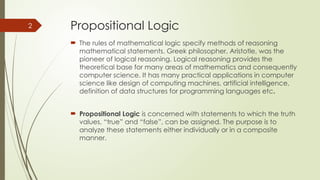
 The rules of mathematical logic specify methods of reasoning
mathematical statements. Greek philosopher, Aristotle, was the
pioneer of logical reasoning. Logical reasoning provides the
theoretical base for many areas of mathematics and consequently
computer science. It has many practical applications in computer
science like design of computing machines, artificial intelligence,
definition of data structures for programming languages etc.
 Propositional Logic is concerned with statements to which the truth
values, “true” and “false”, can be assigned. The purpose is to
analyze these statements either individually or in a composite
manner.
3 Propositional Logic-Definition
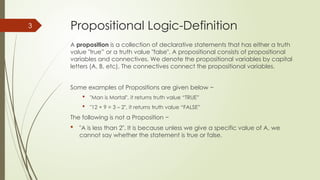
A proposition is a collection of declarative statements that has either a truth
value "true” or a truth value "false". A propositional consists of propositional
variables and connectives. We denote the propositional variables by capital
letters (A, B, etc). The connectives connect the propositional variables.
Some examples of Propositions are given below −
 "Man is Mortal", it returns truth value “TRUE”
 "12 + 9 = 3 – 2", it returns truth value “FALSE”
The following is not a Proposition −
 "A is less than 2". It is because unless we give a specific value of A, we
cannot say whether the statement is true or false.
4 Connectives
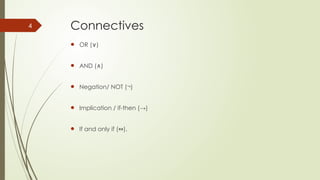
• OR ( )
∨
• AND ( )
∧
• Negation/ NOT (¬)
• Implication / if-then (→)
• If and only if ( ).
⇔
5 OR ( )
∨
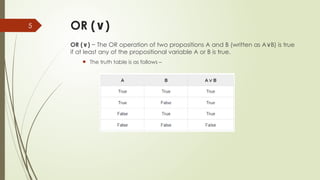
OR ( )
∨ − The OR operation of two propositions A and B (written as A B) is true
∨
if at least any of the propositional variable A or B is true.
• The truth table is as follows –
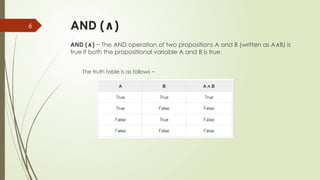
6 AND ( )
∧
AND ( )
∧ − The AND operation of two propositions A and B (written as A B) is
∧
true if both the propositional variable A and B is true.
The truth table is as follows −
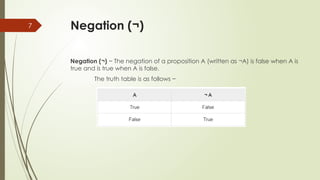
7 Negation (¬)
Negation (¬) − The negation of a proposition A (written as ¬A) is false when A is
true and is true when A is false.
The truth table is as follows −
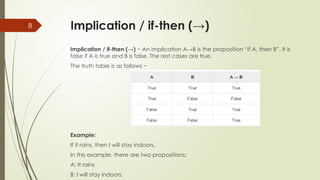
8 Implication / if-then (→)
Implication / if-then (→) − An implication A→B is the proposition “if A, then B”. It is
false if A is true and B is false. The rest cases are true.
The truth table is as follows −
Example:
If it rains, then I will stay indoors.
In this example, there are two propositions:
A: It rains
B: I will stay indoors.
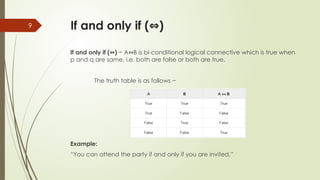
9 If and only if ( )
⇔
If and only if ( )
⇔ − A B is bi-conditional logical connective which is true when
⇔
p and q are same, i.e. both are false or both are true.
The truth table is as follows −
Example:
“You can attend the party if and only if you are invited.”
10 Tautologies
A Tautology is a formula which is always true for every value of its propositional
variables.
Example − Prove [(A→B) A]→B is a tautology
∧
The truth table is as follows −
As we can see every value of [(A→B) A]→B is "True", it is a tautology.
∧
11 Contradictions
A Contradiction is a formula which is always false for every value of its
propositional variables.
Example − Prove (A B) [(¬A) (¬B)]is a contradiction
∨ ∧ ∧
The truth table is as follows −
As we can see every value of (A B) [(¬A) (¬B)] is “False”, it is a contradiction.
∨ ∧ ∧
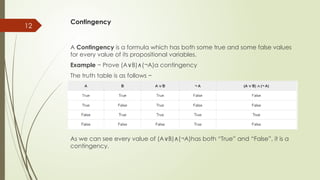
12
Contingency
A Contingency is a formula which has both some true and some false values
for every value of its propositional variables.
Example − Prove (A B) (¬A)a contingency
∨ ∧
The truth table is as follows −
As we can see every value of (A B) (¬A)has both “True” and “False”, it is a
∨ ∧
contingency.
13 Propositional Equivalences
Two statements X and Y are logically equivalent if any of the following two
conditions hold −
• The truth tables of each statement have the same truth values.
• The bi-conditional statement X Y is a tautology.
⇔
Example − Prove ¬(A B)and[(¬A) (¬B)] are equivalent
∨ ∧
Testing by 1st
method (Matching truth table)
Here, we can see the truth values of ¬(A B)and[(¬A) (¬B)] are same, hence the statements are equivalent.
∨ ∧
14
Testing by 2nd
method (Bi-conditionality)
As [¬(A B)] [(¬A) (¬B)] is a tautology, the statements are equivalent.
∨ ⇔ ∧
15
Any Questions?

Propositional Logics in Theoretical computer science

  • 1.
    1 Boolean Logic Ahmad Baryal SabaInstitute of Higher Education Computer Science Faculty Oct 26, 2024
  • 2.
    2 Propositional Logic The rules of mathematical logic specify methods of reasoning mathematical statements. Greek philosopher, Aristotle, was the pioneer of logical reasoning. Logical reasoning provides the theoretical base for many areas of mathematics and consequently computer science. It has many practical applications in computer science like design of computing machines, artificial intelligence, definition of data structures for programming languages etc.  Propositional Logic is concerned with statements to which the truth values, “true” and “false”, can be assigned. The purpose is to analyze these statements either individually or in a composite manner.
  • 3.
    3 Propositional Logic-Definition Aproposition is a collection of declarative statements that has either a truth value "true” or a truth value "false". A propositional consists of propositional variables and connectives. We denote the propositional variables by capital letters (A, B, etc). The connectives connect the propositional variables. Some examples of Propositions are given below −  "Man is Mortal", it returns truth value “TRUE”  "12 + 9 = 3 – 2", it returns truth value “FALSE” The following is not a Proposition −  "A is less than 2". It is because unless we give a specific value of A, we cannot say whether the statement is true or false.
  • 4.
    4 Connectives • OR( ) ∨ • AND ( ) ∧ • Negation/ NOT (¬) • Implication / if-then (→) • If and only if ( ). ⇔
  • 5.
    5 OR () ∨ OR ( ) ∨ − The OR operation of two propositions A and B (written as A B) is true ∨ if at least any of the propositional variable A or B is true. • The truth table is as follows –
  • 6.
    6 AND () ∧ AND ( ) ∧ − The AND operation of two propositions A and B (written as A B) is ∧ true if both the propositional variable A and B is true. The truth table is as follows −
  • 7.
    7 Negation (¬) Negation(¬) − The negation of a proposition A (written as ¬A) is false when A is true and is true when A is false. The truth table is as follows −
  • 8.
    8 Implication /if-then (→) Implication / if-then (→) − An implication A→B is the proposition “if A, then B”. It is false if A is true and B is false. The rest cases are true. The truth table is as follows − Example: If it rains, then I will stay indoors. In this example, there are two propositions: A: It rains B: I will stay indoors.
  • 9.
    9 If andonly if ( ) ⇔ If and only if ( ) ⇔ − A B is bi-conditional logical connective which is true when ⇔ p and q are same, i.e. both are false or both are true. The truth table is as follows − Example: “You can attend the party if and only if you are invited.”
  • 10.
    10 Tautologies A Tautologyis a formula which is always true for every value of its propositional variables. Example − Prove [(A→B) A]→B is a tautology ∧ The truth table is as follows − As we can see every value of [(A→B) A]→B is "True", it is a tautology. ∧
  • 11.
    11 Contradictions A Contradictionis a formula which is always false for every value of its propositional variables. Example − Prove (A B) [(¬A) (¬B)]is a contradiction ∨ ∧ ∧ The truth table is as follows − As we can see every value of (A B) [(¬A) (¬B)] is “False”, it is a contradiction. ∨ ∧ ∧
  • 12.
    12 Contingency A Contingency isa formula which has both some true and some false values for every value of its propositional variables. Example − Prove (A B) (¬A)a contingency ∨ ∧ The truth table is as follows − As we can see every value of (A B) (¬A)has both “True” and “False”, it is a ∨ ∧ contingency.
  • 13.
    13 Propositional Equivalences Twostatements X and Y are logically equivalent if any of the following two conditions hold − • The truth tables of each statement have the same truth values. • The bi-conditional statement X Y is a tautology. ⇔ Example − Prove ¬(A B)and[(¬A) (¬B)] are equivalent ∨ ∧ Testing by 1st method (Matching truth table) Here, we can see the truth values of ¬(A B)and[(¬A) (¬B)] are same, hence the statements are equivalent. ∨ ∧
  • 14.
    14 Testing by 2nd method(Bi-conditionality) As [¬(A B)] [(¬A) (¬B)] is a tautology, the statements are equivalent. ∨ ⇔ ∧
  • 15.