
PHIL 160 PHIL 160 "Explanation"
PHIL 160 Goals of science: predictions manipulations explanations What is required for  a good explanation?
Prediction vs. Explanation PHIL 160 What will happen next? Why  did it happen? Prediction: Explanation:
PHIL 160 Why did it  have   to  happen? How is it  possible  for  this to happen? Why did  this  happen rather than something else? Why  did it happen?
Deductive-Nomological model PHIL 160 An explanation is a deductive argument. Conclusion = fact to be explained. Premises include a “law of nature” (universal regularity). (from “nomos”, Greek for “law”)
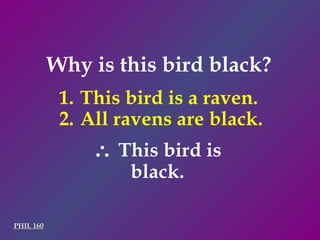
Why is this bird black? PHIL 160 This bird is a raven. All ravens are black.    This bird is black.
Deductive-Nomological model PHIL 160 Reduce explanations from one theory to equivalent explanations in terms of another theory. Explanation shed light on what’s  really  happening. Often requires “bridge laws”. at work in  “ intertheoretic reduction”
PHIL 160
PHIL 160
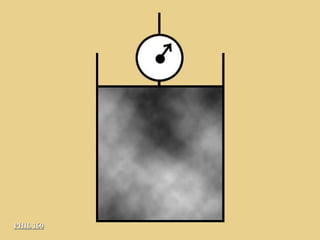
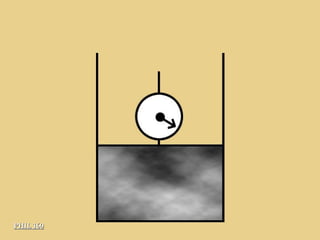
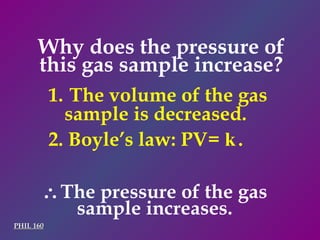
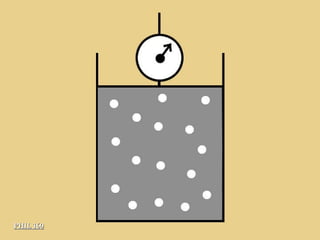
Why does the pressure of this gas sample increase? PHIL 160 The volume of the gas sample is decreased. 2. Boyle’s law: PV=  k .  The pressure of the gas sample increases.
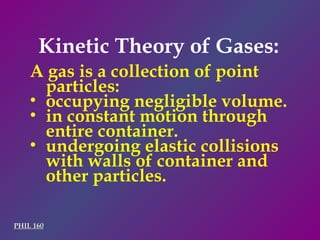
Kinetic Theory of Gases: PHIL 160 A gas is a collection of point particles: occupying negligible volume. in constant motion through entire container. undergoing elastic collisions with walls of container and other particles.
PHIL 160
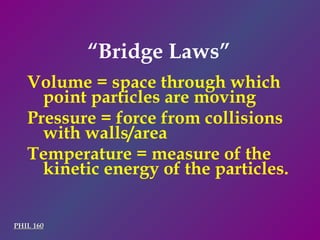
“ Bridge Laws” PHIL 160 Volume = space through which point particles are moving Pressure = force from collisions with walls/area Temperature = measure of the kinetic energy of the particles.
PHIL 160
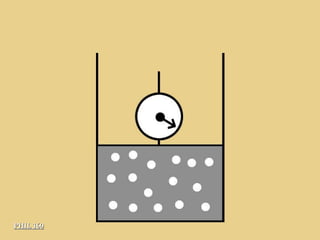
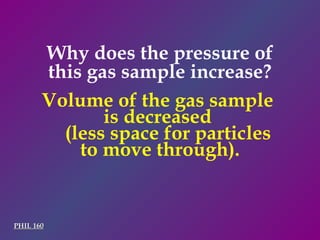
PHIL 160 Volume of the gas sample  is decreased  (less space for particles to move through). Why does the pressure of this gas sample increase?
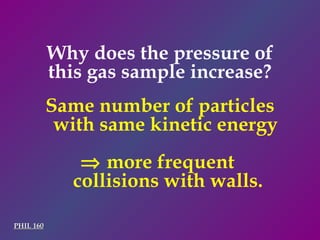
Why does the pressure of this gas sample increase? PHIL 160 Same number of particles with same kinetic energy     more frequent  collisions with walls.
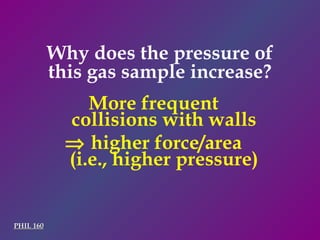
PHIL 160 More frequent  collisions with walls    higher force/area  (i.e., higher pressure) Why does the pressure of this gas sample increase?
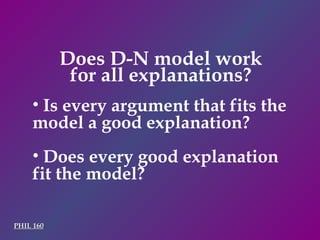
Does D-N model work for all explanations? PHIL 160 Is every argument that fits the model a good explanation? Does every good explanation fit the model?
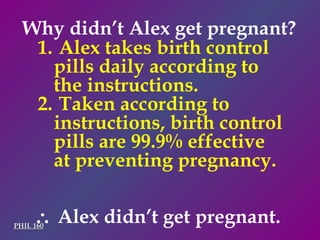
PHIL 160    Alex didn’t get pregnant. Why didn’t Alex get pregnant? Alex takes birth control pills daily according to the instructions. Taken according to instructions, birth control pills are 99.9% effective at preventing pregnancy.
PHIL 160
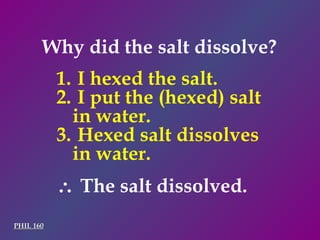
Why did the salt dissolve? PHIL 160 I hexed the salt. I put the (hexed) salt in water. Hexed salt dissolves in water.    The salt dissolved.
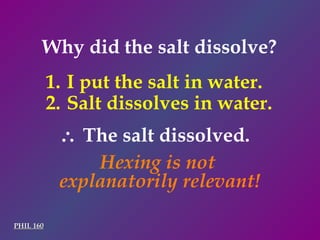
PHIL 160 I put the salt in water. Salt dissolves in water.    The salt dissolved. Hexing is not  explanatorily relevant! Why did the salt dissolve?
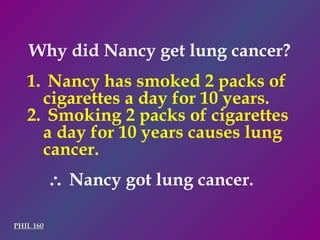
Why did Nancy get lung cancer? PHIL 160 Nancy has smoked 2 packs of cigarettes a day for 10 years. Smoking 2 packs of cigarettes a day for 10 years causes lung cancer.    Nancy got lung cancer.
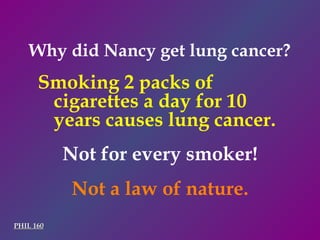
PHIL 160 Smoking 2 packs of cigarettes a day for 10 years causes lung cancer. Not for every smoker! Not a law of nature. Why did Nancy get lung cancer?
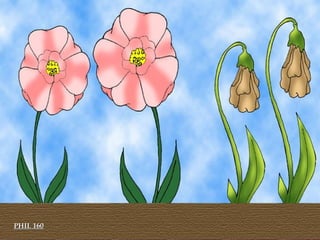
PHIL 160
Why did these camellias die? PHIL 160 The camellias were planted in hot, rich soil. Hot soil damages camellia roots.    These camellias died.
Why did these camellias thrive? PHIL 160 The camellias were planted in hot, rich soil. Camellias grow well in rich soil.    These camellias thrived.
Cartwright : We don’t need a law! PHIL 160 We don’t need to know a law of nature to explain the camellias dying or thriving. There might be no such law of nature!  (Explanation is still good.)
PHIL 160
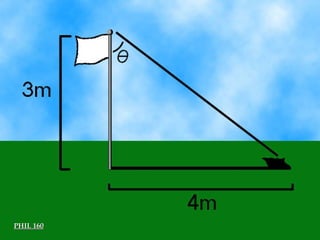
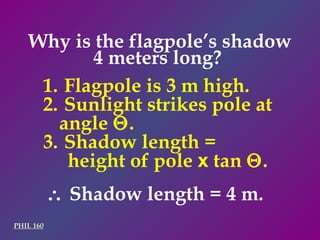
Why is the flagpole’s shadow 4 meters long?  PHIL 160 Flagpole is 3 m high. Sunlight strikes pole at angle   . Shadow length =  height of pole  x  tan   .    Shadow length = 4 m.
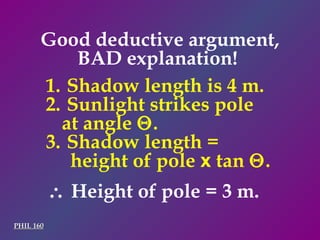
Good deductive argument, BAD explanation!  PHIL 160 Shadow length is 4 m. Sunlight strikes pole at angle   . Shadow length =  height of pole  x  tan   .    Height of pole = 3 m.
PHIL 160 What kind of explanations in science? Looking for universal regularities or statistical regularities? Possible mechanisms or how it actually happened? (Causes, or something else?)

Explanation classroomversion

  • 1.
    PHIL 160 PHIL160 "Explanation"
  • 2.
    PHIL 160 Goalsof science: predictions manipulations explanations What is required for a good explanation?
  • 3.
    Prediction vs. ExplanationPHIL 160 What will happen next? Why did it happen? Prediction: Explanation:
  • 4.
    PHIL 160 Whydid it have to happen? How is it possible for this to happen? Why did this happen rather than something else? Why did it happen?
  • 5.
    Deductive-Nomological model PHIL160 An explanation is a deductive argument. Conclusion = fact to be explained. Premises include a “law of nature” (universal regularity). (from “nomos”, Greek for “law”)
  • 6.
    Why is thisbird black? PHIL 160 This bird is a raven. All ravens are black.  This bird is black.
  • 7.
    Deductive-Nomological model PHIL160 Reduce explanations from one theory to equivalent explanations in terms of another theory. Explanation shed light on what’s really happening. Often requires “bridge laws”. at work in “ intertheoretic reduction”
  • 8.
  • 9.
  • 10.
    Why does thepressure of this gas sample increase? PHIL 160 The volume of the gas sample is decreased. 2. Boyle’s law: PV= k .  The pressure of the gas sample increases.
  • 11.
    Kinetic Theory ofGases: PHIL 160 A gas is a collection of point particles: occupying negligible volume. in constant motion through entire container. undergoing elastic collisions with walls of container and other particles.
  • 12.
  • 13.
    “ Bridge Laws”PHIL 160 Volume = space through which point particles are moving Pressure = force from collisions with walls/area Temperature = measure of the kinetic energy of the particles.
  • 14.
  • 15.
    PHIL 160 Volumeof the gas sample is decreased (less space for particles to move through). Why does the pressure of this gas sample increase?
  • 16.
    Why does thepressure of this gas sample increase? PHIL 160 Same number of particles with same kinetic energy  more frequent collisions with walls.
  • 17.
    PHIL 160 Morefrequent collisions with walls  higher force/area (i.e., higher pressure) Why does the pressure of this gas sample increase?
  • 18.
    Does D-N modelwork for all explanations? PHIL 160 Is every argument that fits the model a good explanation? Does every good explanation fit the model?
  • 19.
    PHIL 160  Alex didn’t get pregnant. Why didn’t Alex get pregnant? Alex takes birth control pills daily according to the instructions. Taken according to instructions, birth control pills are 99.9% effective at preventing pregnancy.
  • 20.
  • 21.
    Why did thesalt dissolve? PHIL 160 I hexed the salt. I put the (hexed) salt in water. Hexed salt dissolves in water.  The salt dissolved.
  • 22.
    PHIL 160 Iput the salt in water. Salt dissolves in water.  The salt dissolved. Hexing is not explanatorily relevant! Why did the salt dissolve?
  • 23.
    Why did Nancyget lung cancer? PHIL 160 Nancy has smoked 2 packs of cigarettes a day for 10 years. Smoking 2 packs of cigarettes a day for 10 years causes lung cancer.  Nancy got lung cancer.
  • 24.
    PHIL 160 Smoking2 packs of cigarettes a day for 10 years causes lung cancer. Not for every smoker! Not a law of nature. Why did Nancy get lung cancer?
  • 25.
  • 26.
    Why did thesecamellias die? PHIL 160 The camellias were planted in hot, rich soil. Hot soil damages camellia roots.  These camellias died.
  • 27.
    Why did thesecamellias thrive? PHIL 160 The camellias were planted in hot, rich soil. Camellias grow well in rich soil.  These camellias thrived.
  • 28.
    Cartwright : Wedon’t need a law! PHIL 160 We don’t need to know a law of nature to explain the camellias dying or thriving. There might be no such law of nature! (Explanation is still good.)
  • 29.
  • 30.
    Why is theflagpole’s shadow 4 meters long? PHIL 160 Flagpole is 3 m high. Sunlight strikes pole at angle  . Shadow length = height of pole x tan  .  Shadow length = 4 m.
  • 31.
    Good deductive argument,BAD explanation! PHIL 160 Shadow length is 4 m. Sunlight strikes pole at angle  . Shadow length = height of pole x tan  .  Height of pole = 3 m.
  • 32.
    PHIL 160 Whatkind of explanations in science? Looking for universal regularities or statistical regularities? Possible mechanisms or how it actually happened? (Causes, or something else?)