




PHIL 160 "Induction & Confirmation" PHIL 160
LEARNING OBJECTIVES: PHIL 160 Strategy for theorizing & testing Role of deduction Role of induction Problem of induction
PHIL 160 meaningful claims are testable Verifiability theory of meaning:
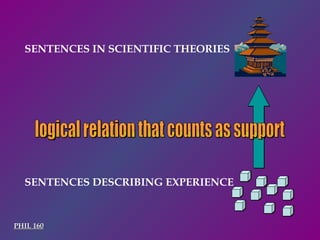
SENTENCES IN SCIENTIFIC THEORIES  PHIL 160 SENTENCES DESCRIBING EXPERIENCE logical relation that counts as support
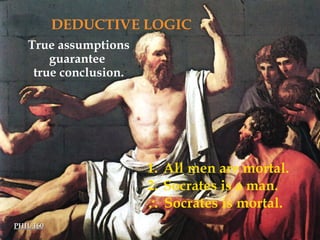
PHIL 160 True assumptions guarantee  true conclusion. DEDUCTIVE LOGIC All men are mortal. Socrates is a man.    Socrates is mortal.
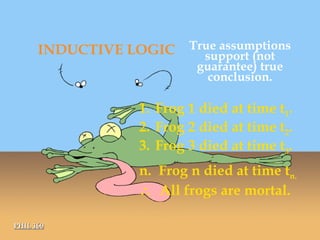
PHIL 160 True assumptions support (not guarantee) true conclusion. INDUCTIVE LOGIC Frog 1 died at time t 1 . Frog 2 died at time t 2 . Frog 3 died at time t 3 . n.  Frog n died at time t n.    All frogs are mortal.
PHIL 160
PHIL 160 Exemplar of good scientific reasoning: Semmelweis takes on childbed fever 1840s Vienna General Hospital, mothers becoming ill and dying shortly after giving birth. Death rate 5 times higher in 1 st  division ward than 2 nd  division ward. 1 st  division ward – staffed by physicians & med students 2 nd  division ward – staffed by midwives.
PHIL 160 Semmelweis asks: What’s causing childbed fever? How can we prevent childbed fever? Why more childbed fever in 1 st  division ward than 2 nd  division ward? Strategy: Identify differences between two wards that might explain different death rates.
PHIL 160
PHIL 160
PHIL 160
PHIL 160
PHIL 160
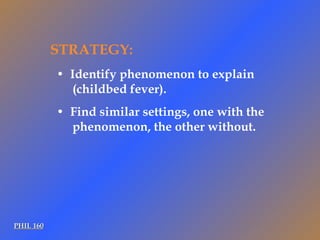
PHIL 160 STRATEGY: •  Identify phenomenon to explain (childbed fever). •  Find similar settings, one with the phenomenon, the other without.
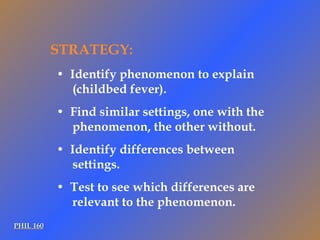
PHIL 160 STRATEGY: •  Identify phenomenon to explain (childbed fever). •  Find similar settings, one with the phenomenon, the other without. •  Identify differences between settings. •  Test to see which differences are relevant to the phenomenon.
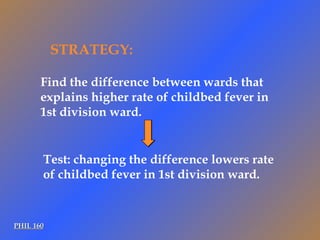
PHIL 160 Find the difference between wards that explains higher rate of childbed fever in 1st division ward. Test: changing the difference lowers rate of childbed fever in 1st division ward. STRATEGY:
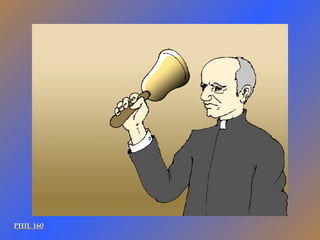
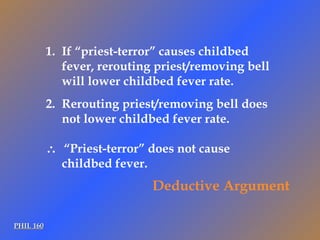
PHIL 160 Deductive Argument If “priest-terror” causes childbed fever, rerouting priest/removing bell will lower childbed fever rate. Rerouting priest/removing bell does not lower childbed fever rate.    “ Priest-terror” does not cause childbed fever.
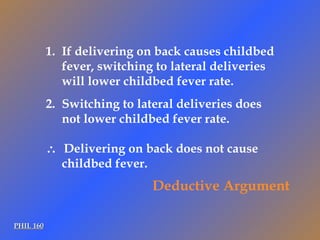
PHIL 160 If delivering on back causes childbed fever, switching to lateral deliveries will lower childbed fever rate. Switching to lateral deliveries does not lower childbed fever rate.    Delivering on back does not cause childbed fever. Deductive Argument
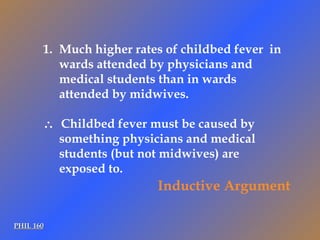
PHIL 160 Inductive Argument Much higher rates of childbed fever  in wards attended by physicians and medical students than in wards attended by midwives.    Childbed fever must be caused by something physicians and medical students (but not midwives) are exposed to.
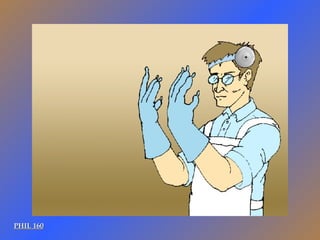
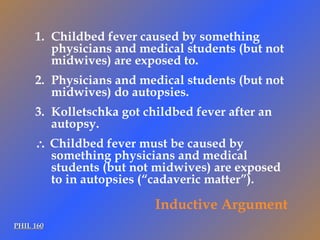
PHIL 160 Inductive Argument Childbed fever caused by something physicians and medical students (but not midwives) are exposed to. Physicians and medical students (but not midwives) do autopsies. Kolletschka got childbed fever after an autopsy.    Childbed fever must be caused by something physicians and medical students (but not midwives) are exposed to in autopsies (“cadaveric matter”).
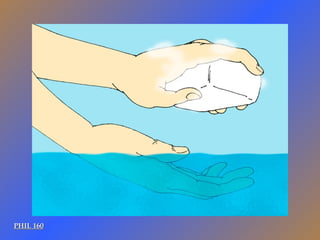
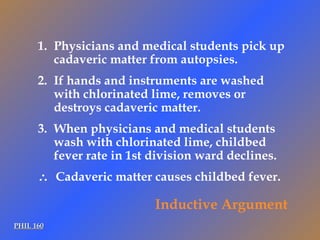
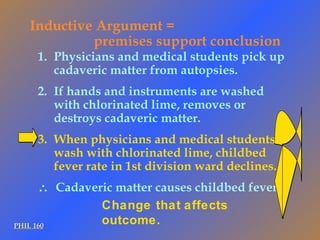
PHIL 160 Inductive Argument Physicians and medical students pick up cadaveric matter from autopsies. If hands and instruments are washed with chlorinated lime, removes or destroys cadaveric matter. When physicians and medical students wash with chlorinated lime, childbed fever rate in 1st division ward declines.    Cadaveric matter causes childbed fever.
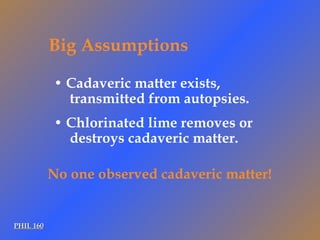
PHIL 160 Big Assumptions •  Cadaveric matter exists, transmitted from autopsies. •  Chlorinated lime removes or destroys cadaveric matter. No one observed cadaveric matter!
Physicians and medical students pick up cadaveric matter from autopsies. If hands and instruments are washed with chlorinated lime, removes or destroys cadaveric matter. When physicians and medical students wash with chlorinated lime, childbed fever rate in 1st division ward declines.    Cadaveric matter causes childbed fever. PHIL 160 Inductive Argument = premises support conclusion Change that   affects   outcome.
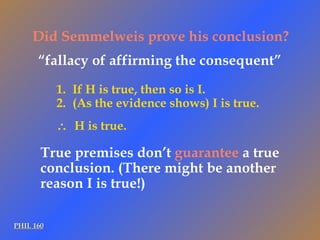
PHIL 160 Did Semmelweis prove his conclusion? If H is true, then so is I. (As the evidence shows) I is true.    H is true. “ fallacy of affirming the consequent” True premises don’t  guarantee  a true conclusion. (There might be another reason I is true!)
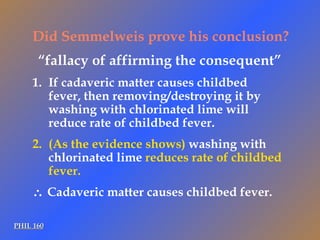
PHIL 160 If cadaveric matter causes childbed fever, then removing/destroying it by washing with chlorinated lime will reduce rate of childbed fever. (As the evidence shows)  washing with chlorinated lime  reduces rate of childbed fever.    Cadaveric matter causes childbed fever. Did Semmelweis prove his conclusion? “ fallacy of affirming the consequent”
PHIL 160 Semmelweis used his observations to find the relevant difference. His theory led to an effective intervention. But, the data didn’t prove his conclusion.
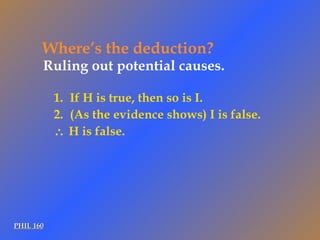
PHIL 160 Where’s the deduction? If H is true, then so is I. (As the evidence shows) I is false.    H is false. Ruling out potential causes.
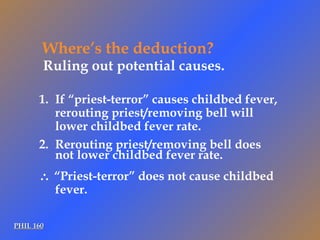
PHIL 160 If “priest-terror” causes childbed fever, rerouting priest/removing bell will lower childbed fever rate. Rerouting priest/removing bell does not lower childbed fever rate.   “ Priest-terror” does not cause childbed fever. Where’s the deduction? Ruling out potential causes.
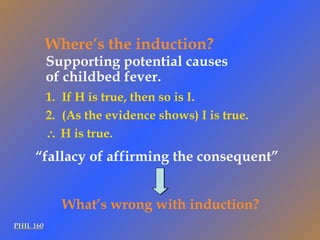
PHIL 160 What’s wrong with induction? Supporting potential causes of childbed fever. If H is true, then so is I. (As the evidence shows) I is true.    H is true. “ fallacy of affirming the consequent” Where’s the induction?
PHIL 160
PHIL 160 All knowledge through experience. Empiricism: (Anything I know has backing in empirical data.)
PHIL 160
PHIL 160
PHIL 160
PHIL 160
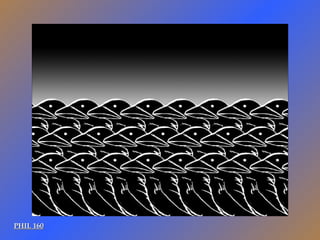
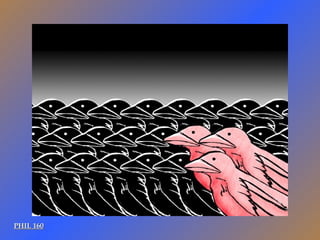
PHIL 160 Can’t get empirical data about things you haven’t observed! Problem of induction: Can’t be certain things you haven’t observed will be like things you have observed!

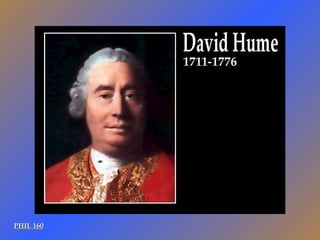
P160 Hempel, Hume, Deduction, and Induction

  • 1.
    PHIL 160 "Induction& Confirmation" PHIL 160
  • 2.
    LEARNING OBJECTIVES: PHIL160 Strategy for theorizing & testing Role of deduction Role of induction Problem of induction
  • 3.
    PHIL 160 meaningfulclaims are testable Verifiability theory of meaning:
  • 4.
    SENTENCES IN SCIENTIFICTHEORIES PHIL 160 SENTENCES DESCRIBING EXPERIENCE logical relation that counts as support
  • 5.
    PHIL 160 Trueassumptions guarantee true conclusion. DEDUCTIVE LOGIC All men are mortal. Socrates is a man.  Socrates is mortal.
  • 6.
    PHIL 160 Trueassumptions support (not guarantee) true conclusion. INDUCTIVE LOGIC Frog 1 died at time t 1 . Frog 2 died at time t 2 . Frog 3 died at time t 3 . n. Frog n died at time t n.  All frogs are mortal.
  • 7.
  • 8.
    PHIL 160 Exemplarof good scientific reasoning: Semmelweis takes on childbed fever 1840s Vienna General Hospital, mothers becoming ill and dying shortly after giving birth. Death rate 5 times higher in 1 st division ward than 2 nd division ward. 1 st division ward – staffed by physicians & med students 2 nd division ward – staffed by midwives.
  • 9.
    PHIL 160 Semmelweisasks: What’s causing childbed fever? How can we prevent childbed fever? Why more childbed fever in 1 st division ward than 2 nd division ward? Strategy: Identify differences between two wards that might explain different death rates.
  • 10.
  • 11.
  • 12.
  • 13.
  • 14.
  • 15.
    PHIL 160 STRATEGY:• Identify phenomenon to explain (childbed fever). • Find similar settings, one with the phenomenon, the other without.
  • 16.
    PHIL 160 STRATEGY:• Identify phenomenon to explain (childbed fever). • Find similar settings, one with the phenomenon, the other without. • Identify differences between settings. • Test to see which differences are relevant to the phenomenon.
  • 17.
    PHIL 160 Findthe difference between wards that explains higher rate of childbed fever in 1st division ward. Test: changing the difference lowers rate of childbed fever in 1st division ward. STRATEGY:
  • 18.
    PHIL 160 DeductiveArgument If “priest-terror” causes childbed fever, rerouting priest/removing bell will lower childbed fever rate. Rerouting priest/removing bell does not lower childbed fever rate.  “ Priest-terror” does not cause childbed fever.
  • 19.
    PHIL 160 Ifdelivering on back causes childbed fever, switching to lateral deliveries will lower childbed fever rate. Switching to lateral deliveries does not lower childbed fever rate.  Delivering on back does not cause childbed fever. Deductive Argument
  • 20.
    PHIL 160 InductiveArgument Much higher rates of childbed fever in wards attended by physicians and medical students than in wards attended by midwives.  Childbed fever must be caused by something physicians and medical students (but not midwives) are exposed to.
  • 21.
    PHIL 160 InductiveArgument Childbed fever caused by something physicians and medical students (but not midwives) are exposed to. Physicians and medical students (but not midwives) do autopsies. Kolletschka got childbed fever after an autopsy.  Childbed fever must be caused by something physicians and medical students (but not midwives) are exposed to in autopsies (“cadaveric matter”).
  • 22.
    PHIL 160 InductiveArgument Physicians and medical students pick up cadaveric matter from autopsies. If hands and instruments are washed with chlorinated lime, removes or destroys cadaveric matter. When physicians and medical students wash with chlorinated lime, childbed fever rate in 1st division ward declines.  Cadaveric matter causes childbed fever.
  • 23.
    PHIL 160 BigAssumptions • Cadaveric matter exists, transmitted from autopsies. • Chlorinated lime removes or destroys cadaveric matter. No one observed cadaveric matter!
  • 24.
    Physicians and medicalstudents pick up cadaveric matter from autopsies. If hands and instruments are washed with chlorinated lime, removes or destroys cadaveric matter. When physicians and medical students wash with chlorinated lime, childbed fever rate in 1st division ward declines.  Cadaveric matter causes childbed fever. PHIL 160 Inductive Argument = premises support conclusion Change that affects outcome.
  • 25.
    PHIL 160 DidSemmelweis prove his conclusion? If H is true, then so is I. (As the evidence shows) I is true.  H is true. “ fallacy of affirming the consequent” True premises don’t guarantee a true conclusion. (There might be another reason I is true!)
  • 26.
    PHIL 160 Ifcadaveric matter causes childbed fever, then removing/destroying it by washing with chlorinated lime will reduce rate of childbed fever. (As the evidence shows) washing with chlorinated lime reduces rate of childbed fever.  Cadaveric matter causes childbed fever. Did Semmelweis prove his conclusion? “ fallacy of affirming the consequent”
  • 27.
    PHIL 160 Semmelweisused his observations to find the relevant difference. His theory led to an effective intervention. But, the data didn’t prove his conclusion.
  • 28.
    PHIL 160 Where’sthe deduction? If H is true, then so is I. (As the evidence shows) I is false.  H is false. Ruling out potential causes.
  • 29.
    PHIL 160 If“priest-terror” causes childbed fever, rerouting priest/removing bell will lower childbed fever rate. Rerouting priest/removing bell does not lower childbed fever rate.  “ Priest-terror” does not cause childbed fever. Where’s the deduction? Ruling out potential causes.
  • 30.
    PHIL 160 What’swrong with induction? Supporting potential causes of childbed fever. If H is true, then so is I. (As the evidence shows) I is true.  H is true. “ fallacy of affirming the consequent” Where’s the induction?
  • 31.
  • 32.
    PHIL 160 Allknowledge through experience. Empiricism: (Anything I know has backing in empirical data.)
  • 33.
  • 34.
  • 35.
  • 36.
  • 37.
    PHIL 160 Can’tget empirical data about things you haven’t observed! Problem of induction: Can’t be certain things you haven’t observed will be like things you have observed!