
Trouble Shooting  Your Conformal Coating Process   Failure analysis of conformal coating and an explanation of defects, the reasons for occurrence and solutions to stop it occurring again!
Introduction Common Conformal coating failure mechanisms Root causes of conformal coating defects How to solve conformal coating defects in a process?
Conformal Coating Failure Mechanisms Capillary Flow De-wetting De-lamination Cracking Corrosion Orange Peel Pin holes, Bubbles & Foam
Capillary Flow
Capillary Flow Causes low viscosity of the conformal coating an abnormally high amount of coating applied  a low surface energy of substrate the high surface tension of the conformal coating.
Capillary Flow Solutions Increase viscosity of conformal coating Reduce film thickness Clean the board Use a solvent based conformal coating rather than water based or 100% solid Heat board prior to conformal coating
De-wetting
De-wetting Causes Residues from board manufacture Component residues like mould release agents  Silicone oil from adhesives in production Soldering processes Cleaning bath contamination Operator handling adding contaminants
De-wetting Solutions Minimise the contaminants that are on the component parts before assembly.  Clean the boards before coating to ensure cleanliness. After coating, locally strip the de-wetted area and re-apply the coating to the correct specification.
De-lamination
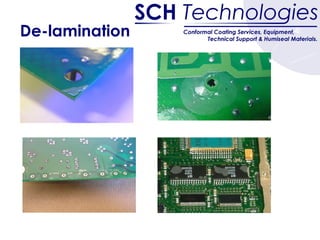
De-lamination / Loss of adhesion Causes Cleanliness of the surface for adhesion Compatibility between the conformal coating and the surface adhered to due to surface energies mismatch Permeability to moisture Degree of conformal coating cure
De-lamination / Loss of adhesion Solutions Reducing the coating thickness Reduce force drying (thermal profile) Remove contamination such as mould release agents Apply a primer to treat the board surface Change the coating and / or surface finish so the surface energies are favourable.
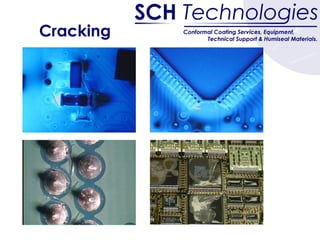
Cracking
Cracking Causes Cure temperature too high Conformal coating heat cured too quickly Film thickness too great causing coefficient of thermal expansion (CTE) mismatch and cracks occurring in the coating Operating temperature too high or too low causing the conformal coating to flex too much & crack.
Cracking Solutions Lowering the initial cure temperature Allowing an initial drying time at RT before exposure to elevated temperature Reduce coating thickness to avoid CTE mismatch issues  Select a coating with a wider Temp range Select a more flexible coating
Corrosion
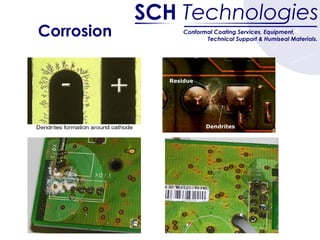
Corrosion Causes Factors that influence corrosion and, or electrochemical migration, usually revolve around ionic contamination & the cleanliness of a PCB.
Where do residues come from? Board fabrication Components Assembly equipment Soldering processes Operator handling Incorrect cleaning
Corrosion Solutions Clean the PCBs However, if you are using a no clean process then you may want to consider: Full inspection of Incoming boards and components for solderability and cleanliness All operators wear gloves “ low residue” no clean flux/paste used
Corrosion Solutions The soldering window fine tuned and the system controlled Low residue wire/flux used for rework Process controls are put in place the process is validated
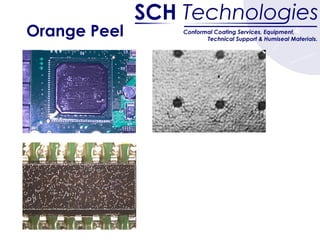
Orange Peel
Orange Peel Causes Not enough coating is deposited so that there is insufficient conformal coating to self level.  The incorrect cure profile is used when using an accelerated curing mechanism. This could be that the flash off zone before heat curing is inadequate or  the  oven profile is incorrect.
Orange Peel Solutions Reduce the viscosity of the conformal coating to allow the coating to level. Reduce the air pressure to the spray gun to reduce the evaporate effects on the conformal coating. Optimise the distance for conformal coating spraying to the manufacturer specification when applying the conformal coating.
Orange Peel Solutions Ensure enough layers of coating are applied to form a levelled coating.  Increase the flash off time for the solvents to evaporate before ramping up the temperature for elevated curing of the conformal coating. Re-profile the curing oven using the conformal coating recommended profile.
Bubbles
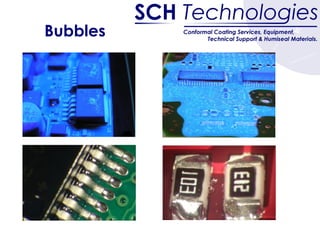
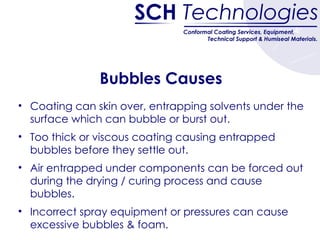
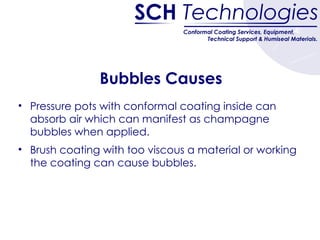
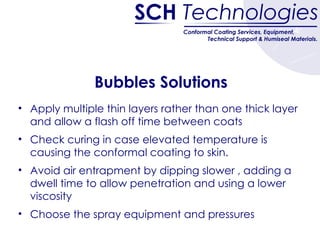
Bubbles Causes Coating can skin over, entrapping solvents under the surface which can bubble or burst out. Too thick or viscous coating causing entrapped bubbles before they settle out. Air entrapped under components can be forced out during the drying / curing process and cause bubbles. Incorrect spray equipment or pressures can cause excessive bubbles & foam.
Bubbles Causes Pressure pots with conformal coating inside can absorb air which can manifest as champagne bubbles when applied.  Brush coating with too viscous a material or working the coating can cause bubbles.
Bubbles Solutions Apply multiple thin layers rather than one thick layer and allow a flash off time between coats Check curing in case elevated temperature is causing the conformal coating to skin. Avoid air entrapment by dipping slower , adding a dwell time to allow penetration and using a lower viscosity  Choose the spray equipment and pressures
Bubbles Solutions Avoid leaving pressure pots pressurised for long periods of time when not being used or avoid running the pressure pots low When brushing blend the coating so it flows easily and “flow” the material onto the PCB. Do not work the coating into the PCB
Information to know in order to find out the root cause of coating defects: Type of coating Application method Curing method Understand whole coating process in general Are the defects recurrent or just one off? (Maybe batch related…) Trouble shooting
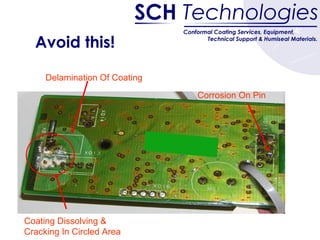
Avoid this! Corrosion On Pin Delamination Of Coating Coating Dissolving & Cracking In Circled Area
Full information on conformal coatings, equipment, training, FAQs etc can be found on  www.conformalcoating.co.uk   Conformal Coating Technical Bulletins for all these defects can be found at: www.conformalcoating.co.uk/technicalbulletins.php References

Troubleshooting Your Humiseal Conformal Coating Process

  • 1.
    Trouble Shooting Your Conformal Coating Process Failure analysis of conformal coating and an explanation of defects, the reasons for occurrence and solutions to stop it occurring again!
  • 2.
    Introduction Common Conformalcoating failure mechanisms Root causes of conformal coating defects How to solve conformal coating defects in a process?
  • 3.
    Conformal Coating FailureMechanisms Capillary Flow De-wetting De-lamination Cracking Corrosion Orange Peel Pin holes, Bubbles & Foam
  • 4.
  • 5.
    Capillary Flow Causeslow viscosity of the conformal coating an abnormally high amount of coating applied a low surface energy of substrate the high surface tension of the conformal coating.
  • 6.
    Capillary Flow SolutionsIncrease viscosity of conformal coating Reduce film thickness Clean the board Use a solvent based conformal coating rather than water based or 100% solid Heat board prior to conformal coating
  • 7.
  • 8.
    De-wetting Causes Residuesfrom board manufacture Component residues like mould release agents Silicone oil from adhesives in production Soldering processes Cleaning bath contamination Operator handling adding contaminants
  • 9.
    De-wetting Solutions Minimisethe contaminants that are on the component parts before assembly. Clean the boards before coating to ensure cleanliness. After coating, locally strip the de-wetted area and re-apply the coating to the correct specification.
  • 10.
  • 11.
    De-lamination / Lossof adhesion Causes Cleanliness of the surface for adhesion Compatibility between the conformal coating and the surface adhered to due to surface energies mismatch Permeability to moisture Degree of conformal coating cure
  • 12.
    De-lamination / Lossof adhesion Solutions Reducing the coating thickness Reduce force drying (thermal profile) Remove contamination such as mould release agents Apply a primer to treat the board surface Change the coating and / or surface finish so the surface energies are favourable.
  • 13.
  • 14.
    Cracking Causes Curetemperature too high Conformal coating heat cured too quickly Film thickness too great causing coefficient of thermal expansion (CTE) mismatch and cracks occurring in the coating Operating temperature too high or too low causing the conformal coating to flex too much & crack.
  • 15.
    Cracking Solutions Loweringthe initial cure temperature Allowing an initial drying time at RT before exposure to elevated temperature Reduce coating thickness to avoid CTE mismatch issues Select a coating with a wider Temp range Select a more flexible coating
  • 16.
  • 17.
    Corrosion Causes Factorsthat influence corrosion and, or electrochemical migration, usually revolve around ionic contamination & the cleanliness of a PCB.
  • 18.
    Where do residuescome from? Board fabrication Components Assembly equipment Soldering processes Operator handling Incorrect cleaning
  • 19.
    Corrosion Solutions Cleanthe PCBs However, if you are using a no clean process then you may want to consider: Full inspection of Incoming boards and components for solderability and cleanliness All operators wear gloves “ low residue” no clean flux/paste used
  • 20.
    Corrosion Solutions Thesoldering window fine tuned and the system controlled Low residue wire/flux used for rework Process controls are put in place the process is validated
  • 21.
  • 22.
    Orange Peel CausesNot enough coating is deposited so that there is insufficient conformal coating to self level. The incorrect cure profile is used when using an accelerated curing mechanism. This could be that the flash off zone before heat curing is inadequate or the oven profile is incorrect.
  • 23.
    Orange Peel SolutionsReduce the viscosity of the conformal coating to allow the coating to level. Reduce the air pressure to the spray gun to reduce the evaporate effects on the conformal coating. Optimise the distance for conformal coating spraying to the manufacturer specification when applying the conformal coating.
  • 24.
    Orange Peel SolutionsEnsure enough layers of coating are applied to form a levelled coating. Increase the flash off time for the solvents to evaporate before ramping up the temperature for elevated curing of the conformal coating. Re-profile the curing oven using the conformal coating recommended profile.
  • 25.
  • 26.
    Bubbles Causes Coatingcan skin over, entrapping solvents under the surface which can bubble or burst out. Too thick or viscous coating causing entrapped bubbles before they settle out. Air entrapped under components can be forced out during the drying / curing process and cause bubbles. Incorrect spray equipment or pressures can cause excessive bubbles & foam.
  • 27.
    Bubbles Causes Pressurepots with conformal coating inside can absorb air which can manifest as champagne bubbles when applied. Brush coating with too viscous a material or working the coating can cause bubbles.
  • 28.
    Bubbles Solutions Applymultiple thin layers rather than one thick layer and allow a flash off time between coats Check curing in case elevated temperature is causing the conformal coating to skin. Avoid air entrapment by dipping slower , adding a dwell time to allow penetration and using a lower viscosity Choose the spray equipment and pressures
  • 29.
    Bubbles Solutions Avoidleaving pressure pots pressurised for long periods of time when not being used or avoid running the pressure pots low When brushing blend the coating so it flows easily and “flow” the material onto the PCB. Do not work the coating into the PCB
  • 30.
    Information to knowin order to find out the root cause of coating defects: Type of coating Application method Curing method Understand whole coating process in general Are the defects recurrent or just one off? (Maybe batch related…) Trouble shooting
  • 31.
    Avoid this! CorrosionOn Pin Delamination Of Coating Coating Dissolving & Cracking In Circled Area
  • 32.
    Full information onconformal coatings, equipment, training, FAQs etc can be found on www.conformalcoating.co.uk Conformal Coating Technical Bulletins for all these defects can be found at: www.conformalcoating.co.uk/technicalbulletins.php References