RADTECH 2014
ROSEMONT, IL
MICHAEL KNOBLAUCH
DVUV HOLDINGS, LLC
D V U V , L L C
K E Y L A N D P O L Y M E R , L L C
D V U V S Y S T E M S , L L C
The Decorative and Functional
Finishing Possibilities
of UV-Curable Powder Coatings
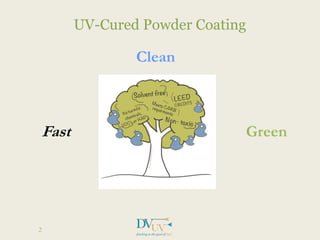
UV-Cured Powder Coating
2
Clean
Fast Green
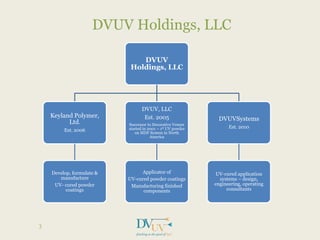
DVUV
Holdings, LLC
Keyland Polymer,
Ltd.
Est. 2006
Develop, formulate &
manufacture
UV- cured powder
coatings
DVUV, LLC
Est. 2005
Successor to Decorative Veneer
started in 2001 – 1st UV powder
on MDF System in North
America
Applicator of
UV-cured powder coatings
Manufacturing finished
components
DVUVSystems
Est. 2010
UV-cured application
systems – design,
engineering, operating
consultants
DVUV Holdings, LLC
3
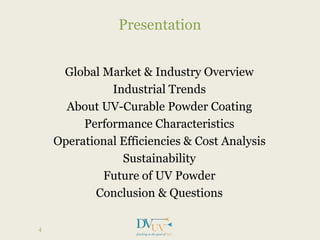
Global Market & Industry Overview
Industrial Trends
About UV-Curable Powder Coating
Performance Characteristics
Operational Efficiencies & Cost Analysis
Sustainability
Future of UV Powder
Conclusion & Questions
Presentation
4
GLOBAL MARKET &
INDUSTRY OVERVIEW
UV-Curable Powder Coating
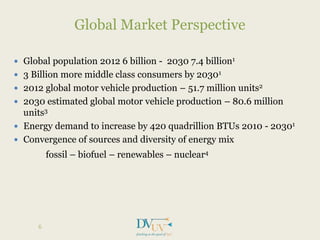
 Global population 2012 6 billion - 2030 7.4 billion1
 3 Billion more middle class consumers by 20301
 2012 global motor vehicle production – 51.7 million units2
 2030 estimated global motor vehicle production – 80.6 million
units3
 Energy demand to increase by 420 quadrillion BTUs 2010 - 20301
 Convergence of sources and diversity of energy mix
fossil – biofuel – renewables – nuclear4
Global Market Perspective
6
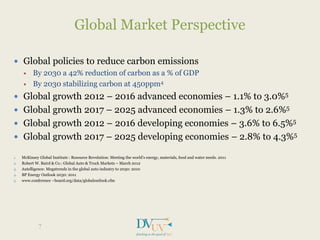
 Global policies to reduce carbon emissions
 By 2030 a 42% reduction of carbon as a % of GDP
 By 2030 stabilizing carbon at 450ppm4
 Global growth 2012 – 2016 advanced economies – 1.1% to 3.0%5
 Global growth 2017 – 2025 advanced economies – 1.3% to 2.6%5
 Global growth 2012 – 2016 developing economies – 3.6% to 6.5%5
 Global growth 2017 – 2025 developing economies – 2.8% to 4.3%5
1. McKinsey Global Institute : Resource Revolution: Meeting the world’s energy, materials, food and water needs. 2011
2. Robert W. Baird & Co.: Global Auto & Truck Markets – March 2012
3. Autelligence: Megatrends in the global auto industry to 2030: 2010
4. BP Energy Outlook 2030: 2011
5. www.conference –board.org/data/globaloutlook.cfm
Global Market Perspective
7
Growth in Emerging Markets
8
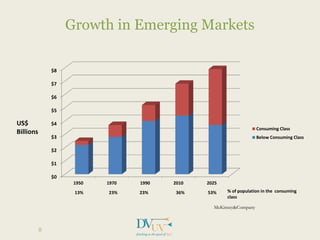
$0
$1
$2
$3
$4
$5
$6
$7
$8
1950 1970 1990 2010 2025
Consuming Class
Below Consuming Class
13% 23% 23% 36% 53% % of population in the consuming
class
US$
Billions
McKinsey&Company
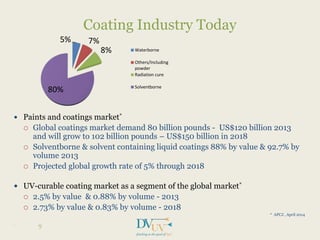
 Paints and coatings market*
 Global coatings market demand 80 billion pounds - US$120 billion 2013
and will grow to 102 billion pounds – US$150 billion in 2018
 Solventborne & solvent containing liquid coatings 88% by value & 92.7% by
volume 2013
 Projected global growth rate of 5% through 2018
 UV-curable coating market as a segment of the global market*
 2.5% by value & 0.88% by volume - 2013
 2.73% by value & 0.83% by volume - 2018
* APCJ , April 2014
•
Coating Industry Today
9
5% 7%
8%
80%
Waterborne
Others/Including
powder
Radiation cure
Solventborne
Global Market by Product
10
0% 10% 20% 30% 40% 50% 60% 70% 80% 90% 100%
Europe, Middle East & Africa
The Americas
Asia Pacific
Global
Europe, Middle East &
Africa
The Americas Asia Pacific Global
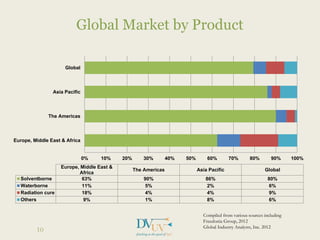
Solventborne 63% 90% 86% 80%
Waterborne 11% 5% 2% 6%
Radiation cure 18% 4% 4% 9%
Others 9% 1% 8% 6%
Compiled from various sources including
Freedonia Group, 2012
Global Industry Analysts, Inc. 2012
UV-Curable coating technology is increasingly being seen as the future
technology in the area of industrial coatings. The technology represents
one of the rapidly growing segments in the coatings industry, and is
arguably emerging as the answer to the rising environmental concerns
and stringent regulations. Several application related advantages come to
serve the technology that include absence of pot life issues, lower energy
costs, fast cure speed, and reduced environmental impact.
As such, one-component UV-Curable coating ranks among the fastest
coating chemistries available in the present context. Curing takes a few
seconds to a few minutes, which makes it more ideal for use in
applications that require faster turnaround time.
Global Industry Analysts, Inc. March 2012
Coating Industry Tomorrow
11
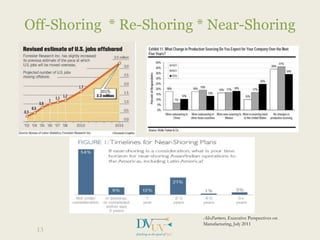
OFF-SHORING
RE-SHORING
NEAR-SHORING
NEXT-SHORING
Industrial Trends
Off-Shoring * Re-Shoring * Near-Shoring
13
AlixPartners, Executive Perspectives on
Manufacturing, July 2011
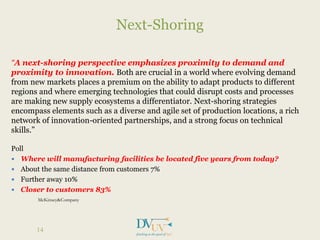
“A next-shoring perspective emphasizes proximity to demand and
proximity to innovation. Both are crucial in a world where evolving demand
from new markets places a premium on the ability to adapt products to different
regions and where emerging technologies that could disrupt costs and processes
are making new supply ecosystems a differentiator. Next-shoring strategies
encompass elements such as a diverse and agile set of production locations, a rich
network of innovation-oriented partnerships, and a strong focus on technical
skills.”
Poll
 Where will manufacturing facilities be located five years from today?
 About the same distance from customers 7%
 Further away 10%
 Closer to customers 83%
Next-Shoring
14
McKinsey&Company
ABOUT UV-CURABLE
POWDER COATING
UV-Curable Powder Coating
 Thermoset or thermally cured powder coatings were
developed in the 1960s as functional coatings and have
been adapted and developed for a variety of applications
 Powder coatings give superior wear resistance, barrier properties,
and cost effectiveness
 Products include home appliances, industrial equipment, automotive
primer, top coat
 Powder coatings have no volatile organic compounds (VOCs), or
hazardous air particulates (HAPs).
 Metal substrates are ideal for electrostatic powder application
 Thermal cure cycle for powder coating ranges from 20 to 60 minutes
depending on chemistry and part geometry
Powder Coating
16
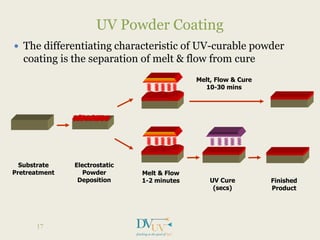
 The differentiating characteristic of UV-curable powder
coating is the separation of melt & flow from cure
UV Powder Coating
Melt & Flow
1-2 minutes UV Cure
(secs)
Electrostatic
Powder
Deposition Finished
Product
Substrate
Pretreatment
Melt, Flow & Cure
10-30 mins
17
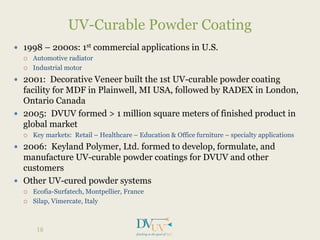
 1998 – 2000s: 1st commercial applications in U.S.
 Automotive radiator
 Industrial motor
 2001: Decorative Veneer built the 1st UV-curable powder coating
facility for MDF in Plainwell, MI USA, followed by RADEX in London,
Ontario Canada
 2005: DVUV formed > 1 million square meters of finished product in
global market
 Key markets: Retail – Healthcare – Education & Office furniture – specialty applications
 2006: Keyland Polymer, Ltd. formed to develop, formulate, and
manufacture UV-curable powder coatings for DVUV and other
customers
 Other UV-cured powder systems
 Ecofia-Surfatech, Montpellier, France
 Silap, Vimercate, Italy
UV-Curable Powder Coating
18
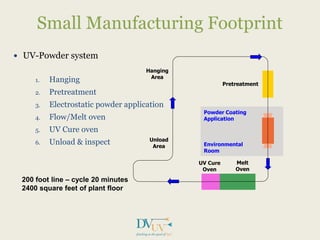
 UV-Powder system
1. Hanging
2. Pretreatment
3. Electrostatic powder application
4. Flow/Melt oven
5. UV Cure oven
6. Unload & inspect
Small Manufacturing Footprint
Powder Coating
Application
Environmental
Room
Unload
Area
Hanging
Area
Pretreatment
Melt
Oven
UV Cure
Oven
200 foot line – cycle 20 minutes
2400 square feet of plant floor
Video
20
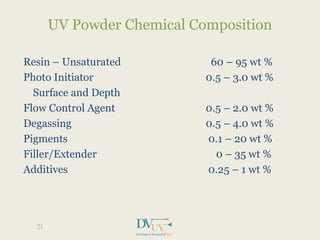
Resin – Unsaturated 60 – 95 wt %
Photo Initiator 0.5 – 3.0 wt %
Surface and Depth
Flow Control Agent 0.5 – 2.0 wt %
Degassing 0.5 – 4.0 wt %
Pigments 0.1 – 20 wt %
Filler/Extender 0 – 35 wt %
Additives 0.25 – 1 wt %
UV Powder Chemical Composition
21
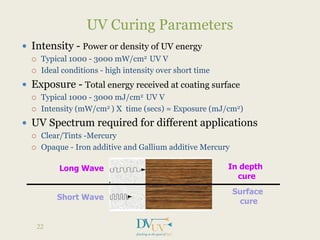
 Intensity - Power or density of UV energy
 Typical 1000 - 3000 mW/cm2 UV V
 Ideal conditions - high intensity over short time
 Exposure - Total energy received at coating surface
 Typical 1000 - 3000 mJ/cm2 UV V
 Intensity (mW/cm2 ) X time (secs) = Exposure (mJ/cm2)
 UV Spectrum required for different applications
 Clear/Tints -Mercury
 Opaque - Iron additive and Gallium additive Mercury
UV Curing Parameters
22
Long Wave
Short Wave
In depth
cure
Surface
cure
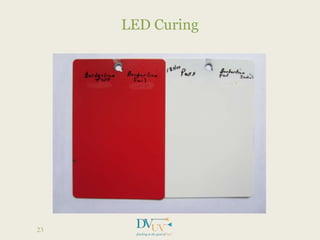
LED Curing
23
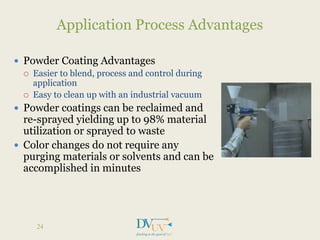
 Powder Coating Advantages
 Easier to blend, process and control during
application
 Easy to clean up with an industrial vacuum
 Powder coatings can be reclaimed and
re-sprayed yielding up to 98% material
utilization or sprayed to waste
 Color changes do not require any
purging materials or solvents and can be
accomplished in minutes
Application Process Advantages
24
Finishing at the Speed of LightFinishing at the Speed of Light
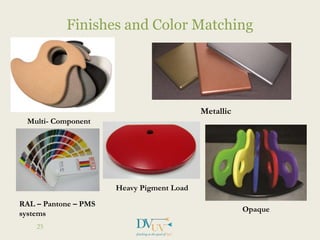
Finishes and Color Matching
Metallic
Multi- Component
Opaque
RAL – Pantone – PMS
systems
25
Heavy Pigment Load
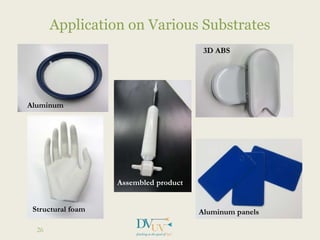
Application on Various Substrates
26
Aluminum
Structural foam
Assembled product
3D ABS
Aluminum panels
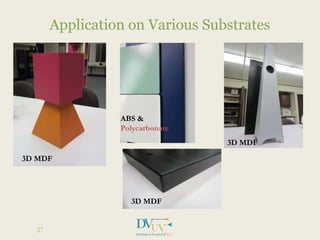
Application on Various Substrates
27
3D MDF
3D MDF
3D MDF
ABS &
Polycarbonate
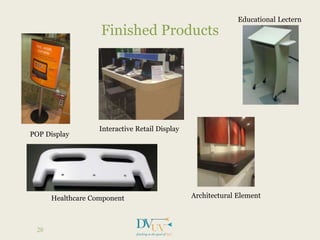
Finished Products
Interactive Retail Display
Healthcare Component
POP Display
Educational Lectern
Architectural Element
28
PERFORMANCE
CHARACTERISTICS
UV-Curable Powder Coating
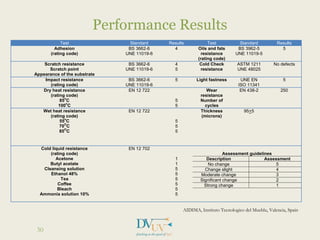
Performance Results
30
Test Standard Results Test Standard Results
Adhesion
(rating code)
BS 3662-6
UNE 11019-6
4 Oils and fats
resistance
(rating code)
BS 3962-5
UNE 11019-5
5
Scratch resistance
Scratch point
Appearance of the substrate
BS 3662-6
UNE 11019-6
4
5
Cold Check
resistance
ASTM 1211
UNE 48025
No defects
Impact resistance
(rating code)
BS 3662-6
UNE 11019-6
5 Light fastness UNE EN
ISO 11341
5
Dry heat resistance
(rating code)
85
o
C
100
o
C
EN 12 722
5
5
Wear
resistance
Number of
cycles
EN 438-2 250
Wet heat resistance
(rating code)
55
o
C
70
O
C
85
O
C
EN 12 722
5
5
5
Thickness
(microns)
95+5
Cold liquid resistance
(rating code)
Acetone
Butyl acetate
Cleansing solution
Ethanol 48%
Tea
Coffee
Bleach
Ammonia solution 10%
EN 12 702
1
1
5
5
5
5
5
5
Assessment guidelines
Description Assessment
No change 5
Change slight 4
Moderate change 3
Significant change 2
Strong change 1
AIDIMA, Instituto Tecnologico del Mueblu, Valencia, Spain
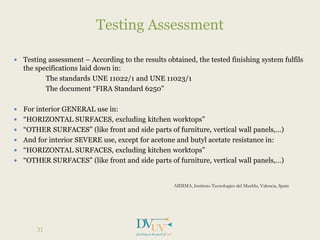
 Testing assessment – According to the results obtained, the tested finishing system fulfils
the specifications laid down in:
The standards UNE 11022/1 and UNE 11023/1
The document “FIRA Standard 6250”
 For interior GENERAL use in:
 “HORIZONTAL SURFACES, excluding kitchen worktops”
 “OTHER SURFACES” (like front and side parts of furniture, vertical wall panels,…)
 And for interior SEVERE use, except for acetone and butyl acetate resistance in:
 “HORIZONTAL SURFACES, excluding kitchen worktops”
 “OTHER SURFACES” (like front and side parts of furniture, vertical wall panels,…)
AIDIMA, Instituto Tecnologico del Mueblu, Valencia, Spain
Testing Assessment
31
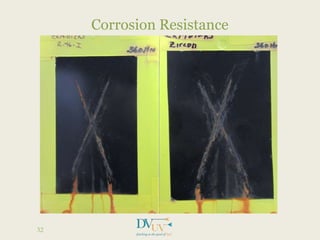
Corrosion Resistance
32
OPERATIONAL
EFFICIENCIES
&
COST ANALYSIS
UV-Curable Powder Coating
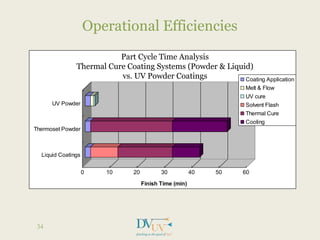
Operational Efficiencies
0 10 20 30 40 50 60
Finish Time (min)
Liquid Coatings
Thermoset Powder
UV Powder
Part Cycle Time Anaylsis
Thermal Cure Coating Systems (Powder & Liquid)
vs. UV Powder Coatings
Coating Application
Melt & Flow
UV cure
Solvent Flash
Thermal Cure
Cooling
34
Part Cycle Time Analysis
Thermal Cure Coating Systems (Powder & Liquid)
vs. UV Powder Coatings
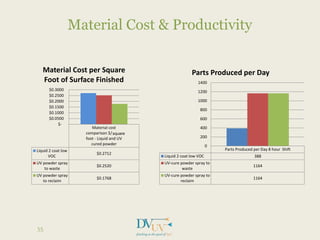
Material Cost & Productivity
35
Material cost
comparison $/sqare
foot - Liquid and UV
cured powder
Liquid 2 coat low
VOC
$0.2712
UV powder spray
to waste
$0.2520
UV powder spray
to reclaim
$0.1768
$-
$0.0500
$0.1000
$0.1500
$0.2000
$0.2500
$0.3000
Material Cost per Square
Foot of Surface Finished
Parts Produced per Day 8 hour Shift
Liquid 2 coat low VOC 388
UV-cure powder spray to
waste
1164
UV-cure powder spray to
reclaim
1164
0
200
400
600
800
1000
1200
1400
Parts Produced per Day
square
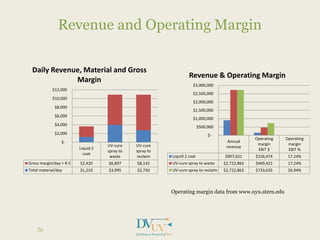
Revenue and Operating Margin
36
Operating margin data from www.nyu.stern.edu
Liquid 2
coat
UV-cure
spray to
waste
UV-cure
spray to
reclaim
Gross margin/day = R-C $2,420 $6,897 $8,142
Total material/day $1,210 $3,995 $2,750
$-
$2,000
$4,000
$6,000
$8,000
$10,000
$12,000
Daily Revenue, Material and Gross
Margin
Annual
revenue
Operating
margin
EBIT $
Operating
margin
EBIT %
Liquid 2 coat $907,621 $156,474 17.24%
UV-cure spray to waste $2,722,863 $469,422 17.24%
UV-cure spray to reclaim $2,722,863 $733,635 26.94%
$-
$500,000
$1,000,000
$1,500,000
$2,000,000
$2,500,000
$3,000,000
Revenue & Operating Margin
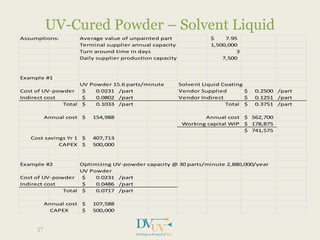
UV-Cured Powder – Solvent Liquid
37
Assumptions: Average value of unpainted part 7.95$
Terminal supplier annual capacity 1,500,000
Turn around time in days 3
Daily supplier production capacity 7,500
Example #1
UV Powder 15.6 parts/minute Solvent Liquid Coating
Cost of UV-powder 0.0231$ /part Vendor Supplied 0.2500$ /part
Indirect cost 0.0802$ /part Vendor Indirect 0.1251$ /part
Total 0.1033$ /part Total 0.3751$ /part
154,988$ 562,700$
178,875$
741,575$
407,713$
500,000$
Example #2 Optimizing UV-powder capacity @ 30 parts/minute 2,880,000/year
UV Powder
Cost of UV-powder 0.0231$ /part
Indirect cost 0.0486$ /part
Total 0.0717$ /part
107,588$
CAPEX 500,000$
Annual cost
Annual cost Annual cost
Working capital WIP
Cost savings Yr 1
CAPEX
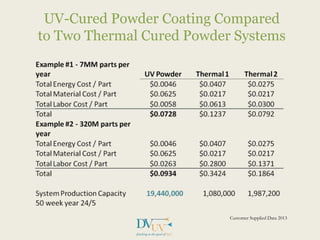
UV-Cured Powder Coating Compared
to Two Thermal Cured Powder Systems
Customer Supplied Data 2013
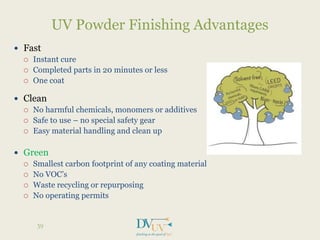
 Fast
 Instant cure
 Completed parts in 20 minutes or less
 One coat
 Clean
 No harmful chemicals, monomers or additives
 Safe to use – no special safety gear
 Easy material handling and clean up
 Green
 Smallest carbon footprint of any coating material
 No VOC’s
 Waste recycling or repurposing
 No operating permits
UV Powder Finishing Advantages
39
SUSTAINABILITY
UV-Curable Powder Coating
Sustainability
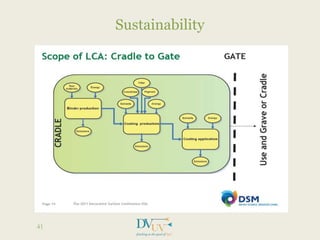
41
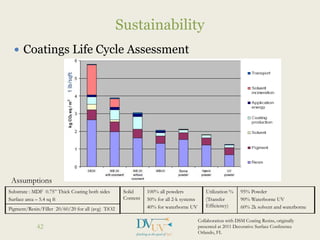
 Coatings Life Cycle Assessment
Sustainability
Solid
Content
100% all powders
50% for all 2-k systems
40% for waterborne UV
Utilization %
(Transfer
Efficiency)
95% Powder
90% Waterborne UV
60% 2k solvent and waterborne
Assumptions
Substrate : MDF 0.75” Thick Coating both sides
Surface area – 5.4 sq ft
Pigment/Resin/Filler 20/60/20 for all (avg) TiO2
42
Collaboration with DSM Coating Resins, originally
presented at 2011 Decorative Surface Conference
Orlando, FL
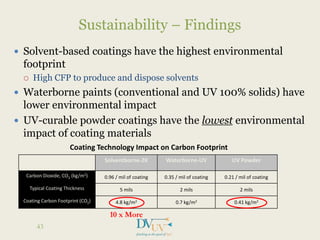
 Solvent-based coatings have the highest environmental
footprint
 High CFP to produce and dispose solvents
 Waterborne paints (conventional and UV 100% solids) have
lower environmental impact
 UV-curable powder coatings have the lowest environmental
impact of coating materials
Sustainability – Findings
Coating Technology Impact on Carbon Footprint
Solventborne-2K Waterborne-UV UV Powder
Carbon Dioxide, CO2 (kg/m2) 0.96 / mil of coating 0.35 / mil of coating 0.21 / mil of coating
Typical Coating Thickness 5 mils 2 mils 2 mils
Coating Carbon Footprint (CO2) 4.8 kg/m2 0.7 kg/m2 0.41 kg/m2
10 x More
43
FUTURE OF
UV POWDER
UV-Curable Powder Coating
 Convergence of the macro market forces creates greater
opportunity for UV-curable powder coating
 Population growth and growth of the consuming class
 Higher growth rates in emerging economies
 Increased consumer awareness and demand for sustainable chemistries
 Reduction of carbon consumption as a % of GDP & establishment of carbon targets
 Continuing growth of transportation other industrial products sectors
 Increase in regulatory constraints on solvent based chemistries
 UV-curable powder coating opportunities
 Innovative chemistries and application technologies deliver more value at lower cost
 New curing technologies - LED
 Displacing existing finishing chemistries & application technologies
 Develop and penetrate new markets and material applications
 Ideal for Next-Shoring market and product innovation
Future of UV-Curable Powder Coating
45
 The coatings market will grow at or above aggregate global GDP.
o The market offers better than average GPM and ROI opportunities to firms that bring
into the market innovative chemistries and coatings that meet market specific needs.
o Improved coating performance
o Demonstrably sustainable, economically viable and have a reduced carbon footprint
o Fast application time and fast cure response
o Generate economic profits
 UV-Curable powder coatings are a nascent but viable finishing system.
o The productive and economic capability UV-curable application technology is clearly
demonstrable and generates greater than market GPMs and higher ROIs.
o More resources need to be made available to take advantage of market opportunities.
o UV-curable powder coating application technology and chemistry are poised to
capture a significant and profitable marketshare of the Global Coatings Industry.
o Projected growth in Radcure market 2013-18 – 7% AGR*
o Projected growth in powder coating segment 2013-18 8% AGR*
Fast – Clean & Green™
Conclusion
46
* APCJ April 2014
THANK YOU
&
QUESTIONS
UV-Curable Powder Coating
M I C H A E L K N O B L A U C H
P R E S I D E N T
4 6 4 1 H I N C K L E Y I N D U S T R I A L P K Y
C L E V E L A N D , O H 4 4 1 0 9
2 1 6 - 7 4 1 - 5 5 1 1
M F K @ D V U V . C O M
W W W . D V U V . C O M
W W W . K E Y L A N D P O L Y M E R . C O M
DVUV Holdings, LLC
DVUV, LLC
Keyland Polymer, LLC
DVUVSystems, LLC

Radtech 2014 Presentation

  • 1.
    RADTECH 2014 ROSEMONT, IL MICHAELKNOBLAUCH DVUV HOLDINGS, LLC D V U V , L L C K E Y L A N D P O L Y M E R , L L C D V U V S Y S T E M S , L L C The Decorative and Functional Finishing Possibilities of UV-Curable Powder Coatings
  • 2.
  • 3.
    DVUV Holdings, LLC Keyland Polymer, Ltd. Est.2006 Develop, formulate & manufacture UV- cured powder coatings DVUV, LLC Est. 2005 Successor to Decorative Veneer started in 2001 – 1st UV powder on MDF System in North America Applicator of UV-cured powder coatings Manufacturing finished components DVUVSystems Est. 2010 UV-cured application systems – design, engineering, operating consultants DVUV Holdings, LLC 3
  • 4.
    Global Market &Industry Overview Industrial Trends About UV-Curable Powder Coating Performance Characteristics Operational Efficiencies & Cost Analysis Sustainability Future of UV Powder Conclusion & Questions Presentation 4
  • 5.
    GLOBAL MARKET & INDUSTRYOVERVIEW UV-Curable Powder Coating
  • 6.
     Global population2012 6 billion - 2030 7.4 billion1  3 Billion more middle class consumers by 20301  2012 global motor vehicle production – 51.7 million units2  2030 estimated global motor vehicle production – 80.6 million units3  Energy demand to increase by 420 quadrillion BTUs 2010 - 20301  Convergence of sources and diversity of energy mix fossil – biofuel – renewables – nuclear4 Global Market Perspective 6
  • 7.
     Global policiesto reduce carbon emissions  By 2030 a 42% reduction of carbon as a % of GDP  By 2030 stabilizing carbon at 450ppm4  Global growth 2012 – 2016 advanced economies – 1.1% to 3.0%5  Global growth 2017 – 2025 advanced economies – 1.3% to 2.6%5  Global growth 2012 – 2016 developing economies – 3.6% to 6.5%5  Global growth 2017 – 2025 developing economies – 2.8% to 4.3%5 1. McKinsey Global Institute : Resource Revolution: Meeting the world’s energy, materials, food and water needs. 2011 2. Robert W. Baird & Co.: Global Auto & Truck Markets – March 2012 3. Autelligence: Megatrends in the global auto industry to 2030: 2010 4. BP Energy Outlook 2030: 2011 5. www.conference –board.org/data/globaloutlook.cfm Global Market Perspective 7
  • 8.
    Growth in EmergingMarkets 8 $0 $1 $2 $3 $4 $5 $6 $7 $8 1950 1970 1990 2010 2025 Consuming Class Below Consuming Class 13% 23% 23% 36% 53% % of population in the consuming class US$ Billions McKinsey&Company
  • 9.
     Paints andcoatings market*  Global coatings market demand 80 billion pounds - US$120 billion 2013 and will grow to 102 billion pounds – US$150 billion in 2018  Solventborne & solvent containing liquid coatings 88% by value & 92.7% by volume 2013  Projected global growth rate of 5% through 2018  UV-curable coating market as a segment of the global market*  2.5% by value & 0.88% by volume - 2013  2.73% by value & 0.83% by volume - 2018 * APCJ , April 2014 • Coating Industry Today 9 5% 7% 8% 80% Waterborne Others/Including powder Radiation cure Solventborne
  • 10.
    Global Market byProduct 10 0% 10% 20% 30% 40% 50% 60% 70% 80% 90% 100% Europe, Middle East & Africa The Americas Asia Pacific Global Europe, Middle East & Africa The Americas Asia Pacific Global Solventborne 63% 90% 86% 80% Waterborne 11% 5% 2% 6% Radiation cure 18% 4% 4% 9% Others 9% 1% 8% 6% Compiled from various sources including Freedonia Group, 2012 Global Industry Analysts, Inc. 2012
  • 11.
    UV-Curable coating technologyis increasingly being seen as the future technology in the area of industrial coatings. The technology represents one of the rapidly growing segments in the coatings industry, and is arguably emerging as the answer to the rising environmental concerns and stringent regulations. Several application related advantages come to serve the technology that include absence of pot life issues, lower energy costs, fast cure speed, and reduced environmental impact. As such, one-component UV-Curable coating ranks among the fastest coating chemistries available in the present context. Curing takes a few seconds to a few minutes, which makes it more ideal for use in applications that require faster turnaround time. Global Industry Analysts, Inc. March 2012 Coating Industry Tomorrow 11
  • 12.
  • 13.
    Off-Shoring * Re-Shoring* Near-Shoring 13 AlixPartners, Executive Perspectives on Manufacturing, July 2011
  • 14.
    “A next-shoring perspectiveemphasizes proximity to demand and proximity to innovation. Both are crucial in a world where evolving demand from new markets places a premium on the ability to adapt products to different regions and where emerging technologies that could disrupt costs and processes are making new supply ecosystems a differentiator. Next-shoring strategies encompass elements such as a diverse and agile set of production locations, a rich network of innovation-oriented partnerships, and a strong focus on technical skills.” Poll  Where will manufacturing facilities be located five years from today?  About the same distance from customers 7%  Further away 10%  Closer to customers 83% Next-Shoring 14 McKinsey&Company
  • 15.
  • 16.
     Thermoset orthermally cured powder coatings were developed in the 1960s as functional coatings and have been adapted and developed for a variety of applications  Powder coatings give superior wear resistance, barrier properties, and cost effectiveness  Products include home appliances, industrial equipment, automotive primer, top coat  Powder coatings have no volatile organic compounds (VOCs), or hazardous air particulates (HAPs).  Metal substrates are ideal for electrostatic powder application  Thermal cure cycle for powder coating ranges from 20 to 60 minutes depending on chemistry and part geometry Powder Coating 16
  • 17.
     The differentiatingcharacteristic of UV-curable powder coating is the separation of melt & flow from cure UV Powder Coating Melt & Flow 1-2 minutes UV Cure (secs) Electrostatic Powder Deposition Finished Product Substrate Pretreatment Melt, Flow & Cure 10-30 mins 17
  • 18.
     1998 –2000s: 1st commercial applications in U.S.  Automotive radiator  Industrial motor  2001: Decorative Veneer built the 1st UV-curable powder coating facility for MDF in Plainwell, MI USA, followed by RADEX in London, Ontario Canada  2005: DVUV formed > 1 million square meters of finished product in global market  Key markets: Retail – Healthcare – Education & Office furniture – specialty applications  2006: Keyland Polymer, Ltd. formed to develop, formulate, and manufacture UV-curable powder coatings for DVUV and other customers  Other UV-cured powder systems  Ecofia-Surfatech, Montpellier, France  Silap, Vimercate, Italy UV-Curable Powder Coating 18
  • 19.
     UV-Powder system 1.Hanging 2. Pretreatment 3. Electrostatic powder application 4. Flow/Melt oven 5. UV Cure oven 6. Unload & inspect Small Manufacturing Footprint Powder Coating Application Environmental Room Unload Area Hanging Area Pretreatment Melt Oven UV Cure Oven 200 foot line – cycle 20 minutes 2400 square feet of plant floor
  • 20.
  • 21.
    Resin – Unsaturated60 – 95 wt % Photo Initiator 0.5 – 3.0 wt % Surface and Depth Flow Control Agent 0.5 – 2.0 wt % Degassing 0.5 – 4.0 wt % Pigments 0.1 – 20 wt % Filler/Extender 0 – 35 wt % Additives 0.25 – 1 wt % UV Powder Chemical Composition 21
  • 22.
     Intensity -Power or density of UV energy  Typical 1000 - 3000 mW/cm2 UV V  Ideal conditions - high intensity over short time  Exposure - Total energy received at coating surface  Typical 1000 - 3000 mJ/cm2 UV V  Intensity (mW/cm2 ) X time (secs) = Exposure (mJ/cm2)  UV Spectrum required for different applications  Clear/Tints -Mercury  Opaque - Iron additive and Gallium additive Mercury UV Curing Parameters 22 Long Wave Short Wave In depth cure Surface cure
  • 23.
  • 24.
     Powder CoatingAdvantages  Easier to blend, process and control during application  Easy to clean up with an industrial vacuum  Powder coatings can be reclaimed and re-sprayed yielding up to 98% material utilization or sprayed to waste  Color changes do not require any purging materials or solvents and can be accomplished in minutes Application Process Advantages 24
  • 25.
    Finishing at theSpeed of LightFinishing at the Speed of Light Finishes and Color Matching Metallic Multi- Component Opaque RAL – Pantone – PMS systems 25 Heavy Pigment Load
  • 26.
    Application on VariousSubstrates 26 Aluminum Structural foam Assembled product 3D ABS Aluminum panels
  • 27.
    Application on VariousSubstrates 27 3D MDF 3D MDF 3D MDF ABS & Polycarbonate
  • 28.
    Finished Products Interactive RetailDisplay Healthcare Component POP Display Educational Lectern Architectural Element 28
  • 29.
  • 30.
    Performance Results 30 Test StandardResults Test Standard Results Adhesion (rating code) BS 3662-6 UNE 11019-6 4 Oils and fats resistance (rating code) BS 3962-5 UNE 11019-5 5 Scratch resistance Scratch point Appearance of the substrate BS 3662-6 UNE 11019-6 4 5 Cold Check resistance ASTM 1211 UNE 48025 No defects Impact resistance (rating code) BS 3662-6 UNE 11019-6 5 Light fastness UNE EN ISO 11341 5 Dry heat resistance (rating code) 85 o C 100 o C EN 12 722 5 5 Wear resistance Number of cycles EN 438-2 250 Wet heat resistance (rating code) 55 o C 70 O C 85 O C EN 12 722 5 5 5 Thickness (microns) 95+5 Cold liquid resistance (rating code) Acetone Butyl acetate Cleansing solution Ethanol 48% Tea Coffee Bleach Ammonia solution 10% EN 12 702 1 1 5 5 5 5 5 5 Assessment guidelines Description Assessment No change 5 Change slight 4 Moderate change 3 Significant change 2 Strong change 1 AIDIMA, Instituto Tecnologico del Mueblu, Valencia, Spain
  • 31.
     Testing assessment– According to the results obtained, the tested finishing system fulfils the specifications laid down in: The standards UNE 11022/1 and UNE 11023/1 The document “FIRA Standard 6250”  For interior GENERAL use in:  “HORIZONTAL SURFACES, excluding kitchen worktops”  “OTHER SURFACES” (like front and side parts of furniture, vertical wall panels,…)  And for interior SEVERE use, except for acetone and butyl acetate resistance in:  “HORIZONTAL SURFACES, excluding kitchen worktops”  “OTHER SURFACES” (like front and side parts of furniture, vertical wall panels,…) AIDIMA, Instituto Tecnologico del Mueblu, Valencia, Spain Testing Assessment 31
  • 32.
  • 33.
  • 34.
    Operational Efficiencies 0 1020 30 40 50 60 Finish Time (min) Liquid Coatings Thermoset Powder UV Powder Part Cycle Time Anaylsis Thermal Cure Coating Systems (Powder & Liquid) vs. UV Powder Coatings Coating Application Melt & Flow UV cure Solvent Flash Thermal Cure Cooling 34 Part Cycle Time Analysis Thermal Cure Coating Systems (Powder & Liquid) vs. UV Powder Coatings
  • 35.
    Material Cost &Productivity 35 Material cost comparison $/sqare foot - Liquid and UV cured powder Liquid 2 coat low VOC $0.2712 UV powder spray to waste $0.2520 UV powder spray to reclaim $0.1768 $- $0.0500 $0.1000 $0.1500 $0.2000 $0.2500 $0.3000 Material Cost per Square Foot of Surface Finished Parts Produced per Day 8 hour Shift Liquid 2 coat low VOC 388 UV-cure powder spray to waste 1164 UV-cure powder spray to reclaim 1164 0 200 400 600 800 1000 1200 1400 Parts Produced per Day square
  • 36.
    Revenue and OperatingMargin 36 Operating margin data from www.nyu.stern.edu Liquid 2 coat UV-cure spray to waste UV-cure spray to reclaim Gross margin/day = R-C $2,420 $6,897 $8,142 Total material/day $1,210 $3,995 $2,750 $- $2,000 $4,000 $6,000 $8,000 $10,000 $12,000 Daily Revenue, Material and Gross Margin Annual revenue Operating margin EBIT $ Operating margin EBIT % Liquid 2 coat $907,621 $156,474 17.24% UV-cure spray to waste $2,722,863 $469,422 17.24% UV-cure spray to reclaim $2,722,863 $733,635 26.94% $- $500,000 $1,000,000 $1,500,000 $2,000,000 $2,500,000 $3,000,000 Revenue & Operating Margin
  • 37.
    UV-Cured Powder –Solvent Liquid 37 Assumptions: Average value of unpainted part 7.95$ Terminal supplier annual capacity 1,500,000 Turn around time in days 3 Daily supplier production capacity 7,500 Example #1 UV Powder 15.6 parts/minute Solvent Liquid Coating Cost of UV-powder 0.0231$ /part Vendor Supplied 0.2500$ /part Indirect cost 0.0802$ /part Vendor Indirect 0.1251$ /part Total 0.1033$ /part Total 0.3751$ /part 154,988$ 562,700$ 178,875$ 741,575$ 407,713$ 500,000$ Example #2 Optimizing UV-powder capacity @ 30 parts/minute 2,880,000/year UV Powder Cost of UV-powder 0.0231$ /part Indirect cost 0.0486$ /part Total 0.0717$ /part 107,588$ CAPEX 500,000$ Annual cost Annual cost Annual cost Working capital WIP Cost savings Yr 1 CAPEX
  • 38.
    UV-Cured Powder CoatingCompared to Two Thermal Cured Powder Systems Customer Supplied Data 2013
  • 39.
     Fast  Instantcure  Completed parts in 20 minutes or less  One coat  Clean  No harmful chemicals, monomers or additives  Safe to use – no special safety gear  Easy material handling and clean up  Green  Smallest carbon footprint of any coating material  No VOC’s  Waste recycling or repurposing  No operating permits UV Powder Finishing Advantages 39
  • 40.
  • 41.
  • 42.
     Coatings LifeCycle Assessment Sustainability Solid Content 100% all powders 50% for all 2-k systems 40% for waterborne UV Utilization % (Transfer Efficiency) 95% Powder 90% Waterborne UV 60% 2k solvent and waterborne Assumptions Substrate : MDF 0.75” Thick Coating both sides Surface area – 5.4 sq ft Pigment/Resin/Filler 20/60/20 for all (avg) TiO2 42 Collaboration with DSM Coating Resins, originally presented at 2011 Decorative Surface Conference Orlando, FL
  • 43.
     Solvent-based coatingshave the highest environmental footprint  High CFP to produce and dispose solvents  Waterborne paints (conventional and UV 100% solids) have lower environmental impact  UV-curable powder coatings have the lowest environmental impact of coating materials Sustainability – Findings Coating Technology Impact on Carbon Footprint Solventborne-2K Waterborne-UV UV Powder Carbon Dioxide, CO2 (kg/m2) 0.96 / mil of coating 0.35 / mil of coating 0.21 / mil of coating Typical Coating Thickness 5 mils 2 mils 2 mils Coating Carbon Footprint (CO2) 4.8 kg/m2 0.7 kg/m2 0.41 kg/m2 10 x More 43
  • 44.
  • 45.
     Convergence ofthe macro market forces creates greater opportunity for UV-curable powder coating  Population growth and growth of the consuming class  Higher growth rates in emerging economies  Increased consumer awareness and demand for sustainable chemistries  Reduction of carbon consumption as a % of GDP & establishment of carbon targets  Continuing growth of transportation other industrial products sectors  Increase in regulatory constraints on solvent based chemistries  UV-curable powder coating opportunities  Innovative chemistries and application technologies deliver more value at lower cost  New curing technologies - LED  Displacing existing finishing chemistries & application technologies  Develop and penetrate new markets and material applications  Ideal for Next-Shoring market and product innovation Future of UV-Curable Powder Coating 45
  • 46.
     The coatingsmarket will grow at or above aggregate global GDP. o The market offers better than average GPM and ROI opportunities to firms that bring into the market innovative chemistries and coatings that meet market specific needs. o Improved coating performance o Demonstrably sustainable, economically viable and have a reduced carbon footprint o Fast application time and fast cure response o Generate economic profits  UV-Curable powder coatings are a nascent but viable finishing system. o The productive and economic capability UV-curable application technology is clearly demonstrable and generates greater than market GPMs and higher ROIs. o More resources need to be made available to take advantage of market opportunities. o UV-curable powder coating application technology and chemistry are poised to capture a significant and profitable marketshare of the Global Coatings Industry. o Projected growth in Radcure market 2013-18 – 7% AGR* o Projected growth in powder coating segment 2013-18 8% AGR* Fast – Clean & Green™ Conclusion 46 * APCJ April 2014
  • 47.
  • 48.
    M I CH A E L K N O B L A U C H P R E S I D E N T 4 6 4 1 H I N C K L E Y I N D U S T R I A L P K Y C L E V E L A N D , O H 4 4 1 0 9 2 1 6 - 7 4 1 - 5 5 1 1 M F K @ D V U V . C O M W W W . D V U V . C O M W W W . K E Y L A N D P O L Y M E R . C O M DVUV Holdings, LLC DVUV, LLC Keyland Polymer, LLC DVUVSystems, LLC