TROPICAL RAINFORESTS
• rainforests that occur in areas of tropical rainforest climate in which there is
no dry season – all months have an average precipitation of at least 60 mm –
and may also be referred to as lowland equatorial evergreen rainforest.
• have fertile soil that supports the growth of trees and other vegetation found
in those places.
• Plants that grow on another plants for support but gain nourishment from
the air are called epiphytes.
PHYSICAL CONDITIONS OF
TROPICAL RAINFORESTS
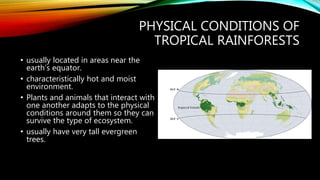
• usually located in areas near the
earth’s equator.
• characteristically hot and moist
environment.
• Plants and animals that interact with
one another adapts to the physical
conditions around them so they can
survive the type of ecosystem.
• usually have very tall evergreen
trees.
PHYSICAL CONDITIONS OF
TROPICAL RAINFORESTS
• Trees have broad leaves that remain functional and green through more than one
growing season.
• have wet and dry seasons.
• Temperature can rise to as high as 34o C and can from as low a below 20o C.
• Humidity or the average amount of water vapor in the air is between 77% and 88%.
The warmth and abundant moisture is ideal for the growth and survival of bacteria
and other organism.
• It can be found Eastern Visayas and Mindanao. Lowlang rainforest found in Davao,
South Cotabato, Cagayan de Oro, Samar, Leyte, Bohol, Biliran, and Basilan. Also in
Australia, Canada, China, Indonesia, United states, Peru, Russia, Africa, and Brazil.
LAYERS OF TREES IN
TROPICAL RAINFORESTS
1. Emergent layer
2. Upper Canopy
3. Understory
4. Forest floor
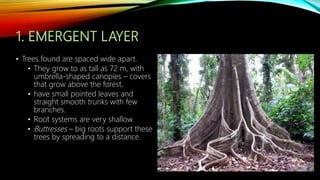
• Trees found are spaced wide apart.
• They grow to as tall as 72 m, with
umbrella-shaped canopies – covers
that grow above the forest.
• have small pointed leaves and
straight smooth trunks with few
branches.
• Root systems are very shallow.
• Buttresses – big roots support these
trees by spreading to a distance.
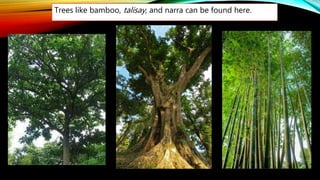
Trees like bamboo, talisay, and narra can be found here.
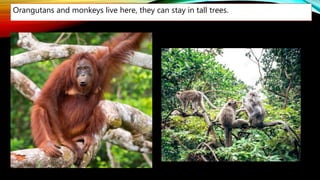
Orangutans and monkeys live here, they can stay in tall trees.
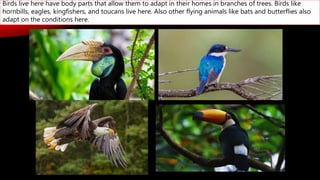
Birds live here have body parts that allow them to adapt in their homes in branches of trees. Birds like
hornbills, eagles, kingfishers, and toucans live here. Also other flying animals like bats and butterflies also
adapt on the conditions here.
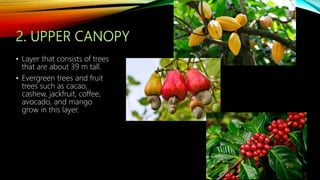
• Layer that consists of trees
that are about 39 m tall.
• Evergreen trees and fruit
trees such as cacao,
cashew, jackfruit, coffee,
avocado, and mango
grow in this layer.
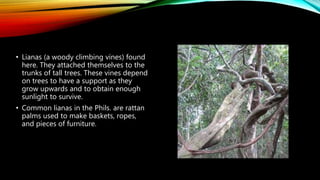
• Lianas (a woody climbing vines) found
here. They attached themselves to the
trunks of tall trees. These vines depend
on trees to have a support as they
grow upwards and to obtain enough
sunlight to survive.
• Common lianas in the Phils. are rattan
palms used to make baskets, ropes,
and pieces of furniture.
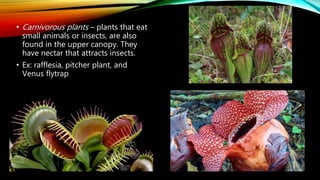
• Carnivorous plants – plants that eat
small animals or insects, are also
found in the upper canopy. They
have nectar that attracts insects.
• Ex: rafflesia, pitcher plant, and
Venus flytrap
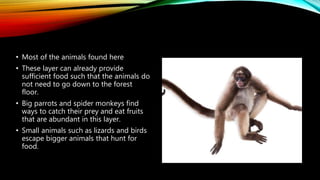
• Most of the animals found here
• These layer can already provide
sufficient food such that the animals do
not need to go down to the forest
floor.
• Big parrots and spider monkeys find
ways to catch their prey and eat fruits
that are abundant in this layer.
• Small animals such as lizards and birds
escape bigger animals that hunt for
food.
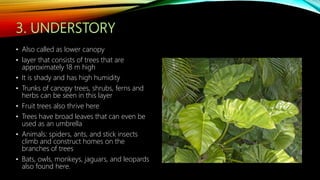
• Also called as lower canopy
• layer that consists of trees that are
approximately 18 m high
• It is shady and has high humidity
• Trunks of canopy trees, shrubs, ferns and
herbs can be seen in this layer
• Fruit trees also thrive here
• Trees have broad leaves that can even be
used as an umbrella
• Animals: spiders, ants, and stick insects
climb and construct homes on the
branches of trees
• Bats, owls, monkeys, jaguars, and leopards
also found here.
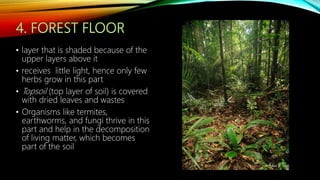
• layer that is shaded because of the
upper layers above it
• receives little light, hence only few
herbs grow in this part
• Topsoil (top layer of soil) is covered
with dried leaves and wastes
• Organisms like termites,
earthworms, and fungi thrive in this
part and help in the decomposition
of living matter, which becomes
part of the soil
PLANT LIFE IN RAINFORESTS
CHARACTERISTICS OF PLANTS IN RAINFORESTS
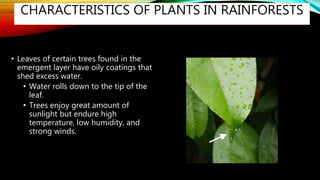
• Leaves of certain trees found in the
emergent layer have oily coatings that
shed excess water.
• Water rolls down to the tip of the
leaf.
• Trees enjoy great amount of
sunlight but endure high
temperature, low humidity, and
strong winds.
CHARACTERISTICS OF PLANTS IN RAINFORESTS
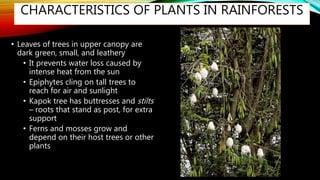
• Leaves of trees in upper canopy are
dark green, small, and leathery
• It prevents water loss caused by
intense heat from the sun
• Epiphytes cling on tall trees to
reach for air and sunlight
• Kapok tree has buttresses and stilts
– roots that stand as post, for extra
support
• Ferns and mosses grow and
depend on their host trees or other
plants
CHARACTERISTICS OF PLANTS IN RAINFORESTS
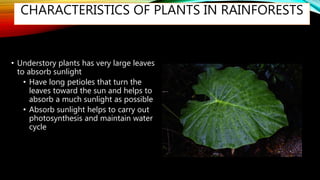
• Understory plants has very large leaves
to absorb sunlight
• Have long petioles that turn the
leaves toward the sun and helps to
absorb a much sunlight as possible
• Absorb sunlight helps to carry out
photosynthesis and maintain water
cycle
ANIMAL LIFE IN RAINFORESTS
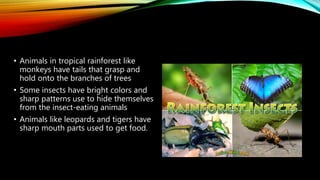
• Animals in tropical rainforest like
monkeys have tails that grasp and
hold onto the branches of trees
• Some insects have bright colors and
sharp patterns use to hide themselves
from the insect-eating animals
• Animals like leopards and tigers have
sharp mouth parts used to get food.
• Snakes have fangs and poison to kill
their enemies
• Monkeys and squirrels have agile
bodies that help them climb up trees
as fast to escape from enemies
• Wild birds have sharp talons or claws
help to catch prey
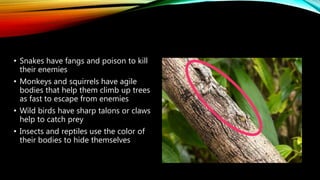
• Insects and reptiles use the color of
their bodies to hide themselves
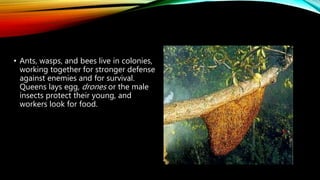
• Ants, wasps, and bees live in colonies,
working together for stronger defense
against enemies and for survival.
Queens lays egg, drones or the male
insects protect their young, and
workers look for food.
INTERACTION IN TROPICAL RAIN FORESTS
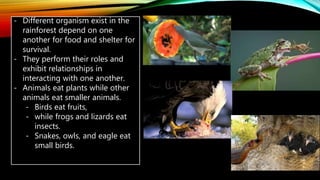
- Different organism exist in the
rainforest depend on one
another for food and shelter for
survival.
- They perform their roles and
exhibit relationships in
interacting with one another.
- Animals eat plants while other
animals eat smaller animals.
- Birds eat fruits,
- while frogs and lizards eat
insects.
- Snakes, owls, and eagle eat
small birds.
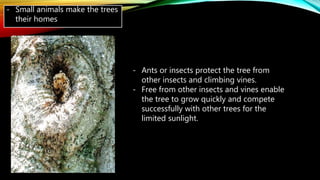
- Small animals make the trees
their homes
- Ants or insects protect the tree from
other insects and climbing vines.
- Free from other insects and vines enable
the tree to grow quickly and compete
successfully with other trees for the
limited sunlight.
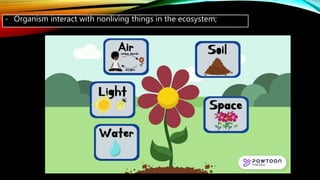
- Organism interact with nonliving things in the ecosystem;
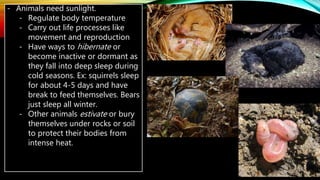
- Animals need sunlight.
- Regulate body temperature
- Carry out life processes like
movement and reproduction
- Have ways to hibernate or
become inactive or dormant as
they fall into deep sleep during
cold seasons. Ex: squirrels sleep
for about 4-5 days and have
break to feed themselves. Bears
just sleep all winter.
- Other animals estivate or bury
themselves under rocks or soil
to protect their bodies from
intense heat.
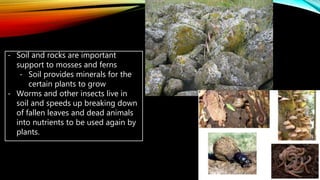
- Soil and rocks are important
support to mosses and ferns
- Soil provides minerals for the
certain plants to grow
- Worms and other insects live in
soil and speeds up breaking down
of fallen leaves and dead animals
into nutrients to be used again by
plants.
IMPORTANCE OF TROPICAL
RAINFORESTS
• Plants provides:
• Trees that are main supplier of oxygen
• Tall trees are sources of timber used for construction, for building
houses, pieces of furniture, and wall decorations
• Use as herbal medicines to relieve headache, boiling the flowers and
leaves is for mouthwash; mahogany seeds treat hypertension,
amoebiasis, and chest pains; narra’s bark concoction used for
bladder ailments, diarrhea, headache, and stone sore; approximately
1400 tropical plants may be potential to cure cancer, but still
studied further.
LOSS OF HABITAT IN TROPICAL RAINFOREST
DUE TO PEOPLE’S ACTIVITY:
1. Deforestation – process of clearing forest
2. Slash-and-burn technique – cutting and burning of trees, to
clear the forests
3. Pollution – introduction of waste and toxic material
EFFECTS OF MAN’S ACTIVITY:
• Deforestation and slash-and-burn technique: floods, soil erosion, and
drought, no shade that will help prevent the fast evaporation of water and
drying of soil, homes of animals are damage and animals will disappear.
• Pollution: acid rain and green house effect
• Acid rain – rain that has increased acidity due to pollutants like sulfur
dioxide and nitrogen oxide, cause damage to plants and the soil.
• Greenhouse effect endangers the life in the forest. Accumulation of
carbon dioxide and water vapor in the air increases surface temperature
of the forests, thus disrupting the natural life processes and cycles of
plants and animals.
PROTECTION AND CONSERVATION OF
TROPICAL RAINFORESTS
• Government:
• DENR (Department of Environmental and Natural Resources) –
government agency mandated to protect the country’s environment and
natural resources, is actively reforesting rain forests to protect the
animals, especially the endangered ones, and the forest plants.
• Also implement laws: against illegal animal hunting and plant
collection by considering the habitats of rare animals and species of
plants as protected area.
• Protected area – palace where collecting, hunting, and selling of plant
and animals are prohibited.
PROTECTION AND CONSERVATION OF
TROPICAL RAINFORESTS
• Government:
• Those who violates these laws is punished with corresponding
sanctions.
• Other law: Republic Act 9147 or the Wildlife resources Conservation and
Protection Act, aims to protect the wildlife in the forest by prohibiting
illegal logging and hunting in tropical rainforests.
PROTECTION AND CONSERVATION OF
TROPICAL RAINFORESTS
• Pupils:
• Inform others to follow laws prohibiting the people from hunting
endangered animals and cutting trees from the forests
• Promote reforestations or the act of planting more trees, because
protecting the trees also results in the conservation of the breeding
places of animals
• Help grow more trees by joining activities on reforestation
• Contribute and raise funds to assist private organizations with their
projects on protecting tropical rainforests
• Promote tree planting in the community

Tropical rainforests

  • 1.
  • 2.
    TROPICAL RAINFORESTS • rainforeststhat occur in areas of tropical rainforest climate in which there is no dry season – all months have an average precipitation of at least 60 mm – and may also be referred to as lowland equatorial evergreen rainforest. • have fertile soil that supports the growth of trees and other vegetation found in those places. • Plants that grow on another plants for support but gain nourishment from the air are called epiphytes.
  • 3.
    PHYSICAL CONDITIONS OF TROPICALRAINFORESTS • usually located in areas near the earth’s equator. • characteristically hot and moist environment. • Plants and animals that interact with one another adapts to the physical conditions around them so they can survive the type of ecosystem. • usually have very tall evergreen trees.
  • 4.
    PHYSICAL CONDITIONS OF TROPICALRAINFORESTS • Trees have broad leaves that remain functional and green through more than one growing season. • have wet and dry seasons. • Temperature can rise to as high as 34o C and can from as low a below 20o C. • Humidity or the average amount of water vapor in the air is between 77% and 88%. The warmth and abundant moisture is ideal for the growth and survival of bacteria and other organism. • It can be found Eastern Visayas and Mindanao. Lowlang rainforest found in Davao, South Cotabato, Cagayan de Oro, Samar, Leyte, Bohol, Biliran, and Basilan. Also in Australia, Canada, China, Indonesia, United states, Peru, Russia, Africa, and Brazil.
  • 5.
    LAYERS OF TREESIN TROPICAL RAINFORESTS 1. Emergent layer 2. Upper Canopy 3. Understory 4. Forest floor
  • 6.
    • Trees foundare spaced wide apart. • They grow to as tall as 72 m, with umbrella-shaped canopies – covers that grow above the forest. • have small pointed leaves and straight smooth trunks with few branches. • Root systems are very shallow. • Buttresses – big roots support these trees by spreading to a distance.
  • 7.
    Trees like bamboo,talisay, and narra can be found here.
  • 8.
    Orangutans and monkeyslive here, they can stay in tall trees.
  • 9.
    Birds live herehave body parts that allow them to adapt in their homes in branches of trees. Birds like hornbills, eagles, kingfishers, and toucans live here. Also other flying animals like bats and butterflies also adapt on the conditions here.
  • 10.
    • Layer thatconsists of trees that are about 39 m tall. • Evergreen trees and fruit trees such as cacao, cashew, jackfruit, coffee, avocado, and mango grow in this layer.
  • 11.
    • Lianas (awoody climbing vines) found here. They attached themselves to the trunks of tall trees. These vines depend on trees to have a support as they grow upwards and to obtain enough sunlight to survive. • Common lianas in the Phils. are rattan palms used to make baskets, ropes, and pieces of furniture.
  • 12.
    • Carnivorous plants– plants that eat small animals or insects, are also found in the upper canopy. They have nectar that attracts insects. • Ex: rafflesia, pitcher plant, and Venus flytrap
  • 13.
    • Most ofthe animals found here • These layer can already provide sufficient food such that the animals do not need to go down to the forest floor. • Big parrots and spider monkeys find ways to catch their prey and eat fruits that are abundant in this layer. • Small animals such as lizards and birds escape bigger animals that hunt for food.
  • 14.
    • Also calledas lower canopy • layer that consists of trees that are approximately 18 m high • It is shady and has high humidity • Trunks of canopy trees, shrubs, ferns and herbs can be seen in this layer • Fruit trees also thrive here • Trees have broad leaves that can even be used as an umbrella • Animals: spiders, ants, and stick insects climb and construct homes on the branches of trees • Bats, owls, monkeys, jaguars, and leopards also found here.
  • 15.
    • layer thatis shaded because of the upper layers above it • receives little light, hence only few herbs grow in this part • Topsoil (top layer of soil) is covered with dried leaves and wastes • Organisms like termites, earthworms, and fungi thrive in this part and help in the decomposition of living matter, which becomes part of the soil
  • 16.
    PLANT LIFE INRAINFORESTS
  • 17.
    CHARACTERISTICS OF PLANTSIN RAINFORESTS • Leaves of certain trees found in the emergent layer have oily coatings that shed excess water. • Water rolls down to the tip of the leaf. • Trees enjoy great amount of sunlight but endure high temperature, low humidity, and strong winds.
  • 18.
    CHARACTERISTICS OF PLANTSIN RAINFORESTS • Leaves of trees in upper canopy are dark green, small, and leathery • It prevents water loss caused by intense heat from the sun • Epiphytes cling on tall trees to reach for air and sunlight • Kapok tree has buttresses and stilts – roots that stand as post, for extra support • Ferns and mosses grow and depend on their host trees or other plants
  • 19.
    CHARACTERISTICS OF PLANTSIN RAINFORESTS • Understory plants has very large leaves to absorb sunlight • Have long petioles that turn the leaves toward the sun and helps to absorb a much sunlight as possible • Absorb sunlight helps to carry out photosynthesis and maintain water cycle
  • 20.
    ANIMAL LIFE INRAINFORESTS
  • 21.
    • Animals intropical rainforest like monkeys have tails that grasp and hold onto the branches of trees • Some insects have bright colors and sharp patterns use to hide themselves from the insect-eating animals • Animals like leopards and tigers have sharp mouth parts used to get food.
  • 22.
    • Snakes havefangs and poison to kill their enemies • Monkeys and squirrels have agile bodies that help them climb up trees as fast to escape from enemies • Wild birds have sharp talons or claws help to catch prey • Insects and reptiles use the color of their bodies to hide themselves
  • 23.
    • Ants, wasps,and bees live in colonies, working together for stronger defense against enemies and for survival. Queens lays egg, drones or the male insects protect their young, and workers look for food.
  • 24.
  • 25.
    - Different organismexist in the rainforest depend on one another for food and shelter for survival. - They perform their roles and exhibit relationships in interacting with one another. - Animals eat plants while other animals eat smaller animals. - Birds eat fruits, - while frogs and lizards eat insects. - Snakes, owls, and eagle eat small birds.
  • 26.
    - Small animalsmake the trees their homes - Ants or insects protect the tree from other insects and climbing vines. - Free from other insects and vines enable the tree to grow quickly and compete successfully with other trees for the limited sunlight.
  • 27.
    - Organism interactwith nonliving things in the ecosystem;
  • 28.
    - Animals needsunlight. - Regulate body temperature - Carry out life processes like movement and reproduction - Have ways to hibernate or become inactive or dormant as they fall into deep sleep during cold seasons. Ex: squirrels sleep for about 4-5 days and have break to feed themselves. Bears just sleep all winter. - Other animals estivate or bury themselves under rocks or soil to protect their bodies from intense heat.
  • 29.
    - Soil androcks are important support to mosses and ferns - Soil provides minerals for the certain plants to grow - Worms and other insects live in soil and speeds up breaking down of fallen leaves and dead animals into nutrients to be used again by plants.
  • 30.
    IMPORTANCE OF TROPICAL RAINFORESTS •Plants provides: • Trees that are main supplier of oxygen • Tall trees are sources of timber used for construction, for building houses, pieces of furniture, and wall decorations • Use as herbal medicines to relieve headache, boiling the flowers and leaves is for mouthwash; mahogany seeds treat hypertension, amoebiasis, and chest pains; narra’s bark concoction used for bladder ailments, diarrhea, headache, and stone sore; approximately 1400 tropical plants may be potential to cure cancer, but still studied further.
  • 31.
    LOSS OF HABITATIN TROPICAL RAINFOREST DUE TO PEOPLE’S ACTIVITY: 1. Deforestation – process of clearing forest 2. Slash-and-burn technique – cutting and burning of trees, to clear the forests 3. Pollution – introduction of waste and toxic material
  • 32.
    EFFECTS OF MAN’SACTIVITY: • Deforestation and slash-and-burn technique: floods, soil erosion, and drought, no shade that will help prevent the fast evaporation of water and drying of soil, homes of animals are damage and animals will disappear. • Pollution: acid rain and green house effect • Acid rain – rain that has increased acidity due to pollutants like sulfur dioxide and nitrogen oxide, cause damage to plants and the soil. • Greenhouse effect endangers the life in the forest. Accumulation of carbon dioxide and water vapor in the air increases surface temperature of the forests, thus disrupting the natural life processes and cycles of plants and animals.
  • 33.
    PROTECTION AND CONSERVATIONOF TROPICAL RAINFORESTS • Government: • DENR (Department of Environmental and Natural Resources) – government agency mandated to protect the country’s environment and natural resources, is actively reforesting rain forests to protect the animals, especially the endangered ones, and the forest plants. • Also implement laws: against illegal animal hunting and plant collection by considering the habitats of rare animals and species of plants as protected area. • Protected area – palace where collecting, hunting, and selling of plant and animals are prohibited.
  • 34.
    PROTECTION AND CONSERVATIONOF TROPICAL RAINFORESTS • Government: • Those who violates these laws is punished with corresponding sanctions. • Other law: Republic Act 9147 or the Wildlife resources Conservation and Protection Act, aims to protect the wildlife in the forest by prohibiting illegal logging and hunting in tropical rainforests.
  • 35.
    PROTECTION AND CONSERVATIONOF TROPICAL RAINFORESTS • Pupils: • Inform others to follow laws prohibiting the people from hunting endangered animals and cutting trees from the forests • Promote reforestations or the act of planting more trees, because protecting the trees also results in the conservation of the breeding places of animals • Help grow more trees by joining activities on reforestation • Contribute and raise funds to assist private organizations with their projects on protecting tropical rainforests • Promote tree planting in the community