Quotes on the subject
What is Natural vegetation?Natural Vegetation refers to plants that grow and develop by themselves without human help .
Why do we have to learn about Natural vegetation?The study of natural vegetation is important to geographers for two reasons.Vegetation is an integral part of the physical environmentHumans depend on vegetation for food, fuel, shelter, medicine etc.
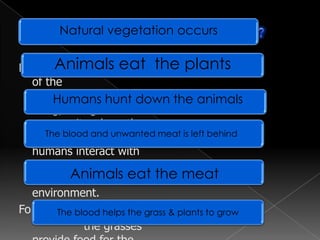
Natural vegetation occursIs Natural Vegetation part of something?Animals eat  the plantsThe blood helps the grass & plants to growNatural Vegetation is part of the ecosystem, which is a living, biological community where the plants, animals and humans interact with one another and with their physical environment.For example:                   the grasses provide food for the animals, which are hunted by the humans living there.Humans hunt down the animalsAnimals eat the meatThe blood and unwanted meat is left behind
Can Natural vegetation be classified into other forms of vegetation?Natural Vegetation can be classified into:Forest vegetationGrass land vegetationDesert vegetation
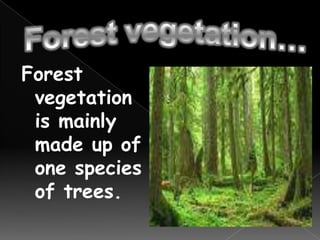
Forest vegetation…Forest vegetation is mainly made up of one species of trees.
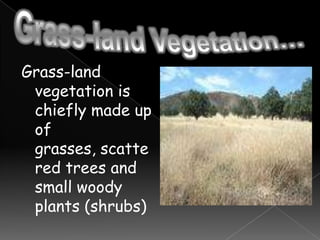
Grass-land Vegetation…Grass-land vegetation is chiefly made up of grasses, scattered trees and small woody plants (shrubs)
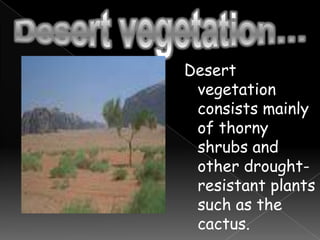
Desert vegetation…Desert vegetation consists mainly of thorny shrubs and other drought-resistant plants such as the cactus.
These three main types of natural vegetation can be further classified into different sub-types. The existence and global distribution of the different types of natural vegetation are influenced mainly by climatic conditions particularly precipitation and temperatures
Does temperature effect Natural Vegetation?   Natural vegetation tends to be most diverse and abundant in areas near the equator where the average annual rainfall and temperature are high. Between the tropic of cancer (latitude 23.5N) and the tropic of Capricorn (latitude23.5S), the dominant type of natural vegetation is the evergreen tropical rainforests and mangroves that spread along the equator. As one approaches latitudes 10 north & 10 south of the equator, the tropical monsoon forests become more widespread.Travelling from the equator towards the poles, one will encounter changes in the types of natural vegetation. As temperatures drop  and precipitation decreases and becomes more variable, one dominant type of forest found in the cool temperature areas is the evergreen temperature coniferous forests
How many types of tropical forests are their?There are three types of tropical forests:1. Tropical rain forests2. Mangrove forests3. Tropical monsoon forests
Tropical Rain Forest
Where are they found…The tropical rainforest spreads like a green belt around the earth.The most extensive areas with this type of forests are:     The Amazon Basin in south America.
     The Congo Basin of America
      Indonesia
      East Malaysia Difference in plant species…There is  great variety of plant species in tropical rainforests. One hectare of land in a tropical rain forest may contain as many as 400 species of trees.The trees in tropical rainforests are largely broadleaved evergreens. Many of the trees are hardwoods.Lianas and epiphytes (air plants) such as Bird’s nest Fern are also common in tropical rainforests.
Special characteristics of treesLeaves:Tropical rain forests trees have waxy, hairy or leathery leaves that allow rain water to run off easily. The shape of the leaves are usually broad with narrow, downward pointing tips.Roots: Some trees have buttress roots that can grow up to more than 5m high. The roots are rather shallow as they do not need to grow deep down into the soil to extract nutrition's.Fruit and Flowers:The fruit and flowers of tropical rainforests tend to be colorful and sweet smelling in order to attract agents of pollination.
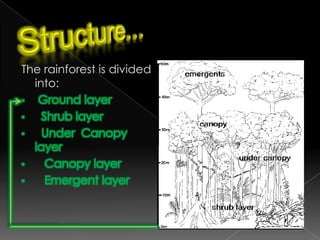
Structure…The rainforest is divided into: Ground layer
  Shrub layer
  Under  Canopy                                                layer
   Canopy layer
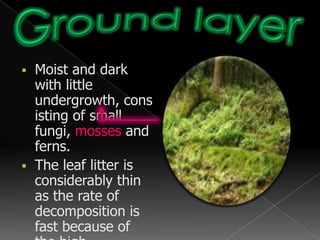
   Emergent layer       Ground layerMoist and dark with little undergrowth, consisting of small fungi, mosses and ferns.
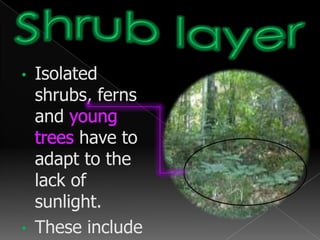
The leaf litter is considerably thin as the rate of decomposition is fast because of the high temperature and rainfall. Shrub layerIsolated shrubs, ferns and young trees have to adapt to the lack of sunlight.
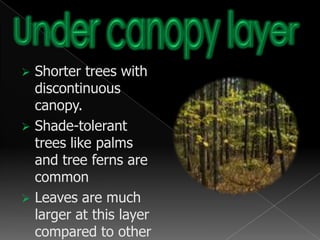
These include wild ginger, pandan and tapiocaUnder canopy layerShorter trees with discontinuous canopy.
Shade-tolerant trees like palms and tree ferns are common
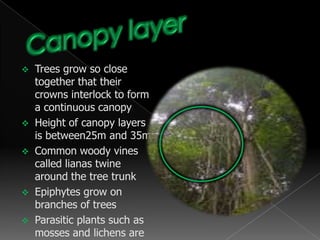
Leaves are much larger at this layer compared to other layersCanopy layerTrees grow so close together that their crowns interlock to form a continuous canopy
Height of canopy layers is between25m and 35m
Common woody vines called lianas twine around the tree trunk
Epiphytes grow on branches of trees
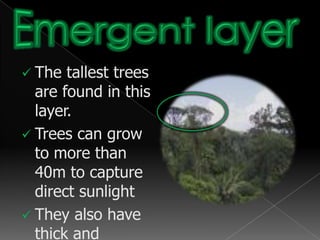
Parasitic plants such as mosses and lichens are also found on this layerEmergent layerThe tallest trees are found in this layer.
Trees can grow to more than 40m to capture direct sunlight
They also have thick and straight trunks.Mangrove Forest
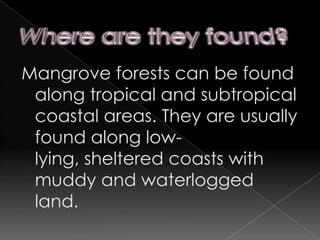
Where are they found?Mangrove forests can be found along tropical and subtropical coastal areas. They are usually found along low-lying, sheltered coasts with muddy and waterlogged land.
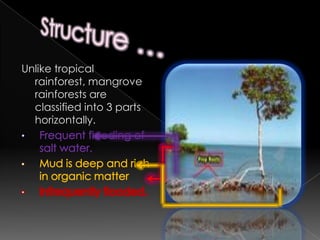
Difference in plant species…The dominant plants in this type of forests are generally those species that have special breathing roots that would enable them to take in oxygen under waterlogged conditions.These trees also have prop roots to anchor them firmly in the soft, muddy ground.
Special Characteristics of treesLeaves:Mangrove trees have broad leaves, which also have drip tips to enable rainwater to flow off quickly and easily. Some trees have leaves that contain special salt glands to prevent the building up of excess salt.Roots:Mangrove trees have prop roots & some have aerial roots.Fruit:Some mangrove trees have tube-like fruit that start to germinate while they are still on the trees. When the fruit ripen, they fall into the mud & start to grow.
Structure …Unlike tropical rainforest, mangrove rainforests are classified into 3 parts horizontally.Frequent flooding of salt water.
Mud is deep and rich in organic matter
Infrequently flooded.Tropical Monsoon Forests
Where are they found?The Tropical Monsoon forests are mostly found in areas from latitude 15 to just beyond the tropic of cancer and the tropic of Capricorn.They are mostly found in: Thailand
Bangladesh
Cambodia
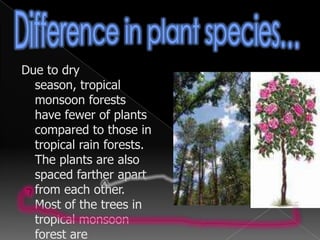
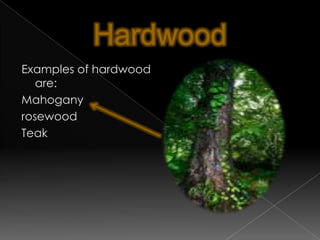
 The south part of china.Difference in plant species…Due to dry season, tropical monsoon forests have fewer of plants compared to those in tropical rain forests. The plants are also spaced farther apart from each other. Most of the trees in tropical monsoon forest are hardwoods. Teakand rosewood are two well known tropical hardwoods.
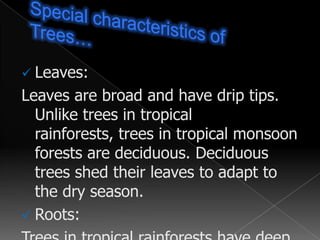
Special characteristics of Trees…Leaves:Leaves are broad and have drip tips. Unlike trees in tropical rainforests, trees in tropical monsoon forests are deciduous. Deciduous trees shed their leaves to adapt to the dry season.Roots:Trees in tropical rainforests have deep roots.
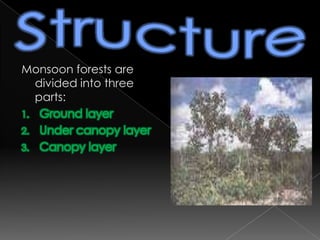
StructureMonsoon forests are divided into three parts:Ground layerUnder canopy layerCanopy layer
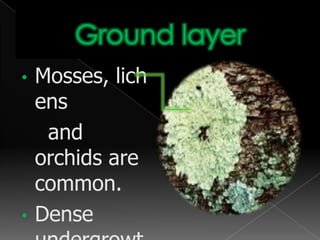
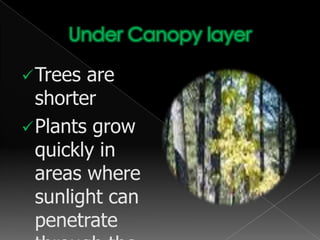
Ground layerMosses, lichens     and orchids are common.Dense undergrowth.Under Canopy layerTrees are shorter
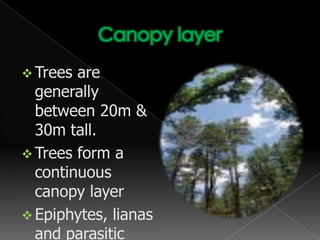
Plants grow quickly in areas where sunlight can penetrate through the canopy.Canopy layerTrees are generally between 20m & 30m tall.
Trees form a continuous canopy layer
Epiphytes, lianas and parasitic plants are commonly found on the trees.
How many types of temperate forests are their?There are two types of temperate forests:1.Temperate coniferous forests 2. Temperate deciduous forests
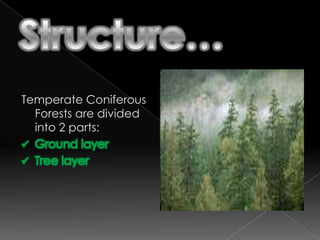
Temperate coniferous forests
Where are they found?Temperate Coniferous forests are found mainly between latitudes 40 & 65 in the northern hemisphere.
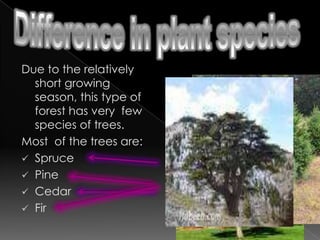
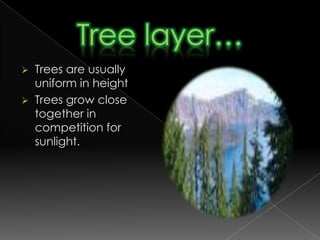
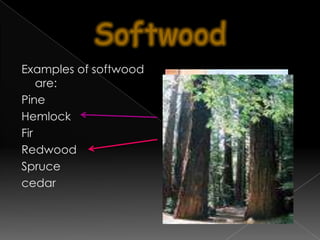
Difference in plant speciesDue to the relatively short growing season, this type of forest has very  few species of trees. Most  of the trees are:Spruce
Pine

The Earth's natural vegetation

  • 3.
  • 4.
    What is Naturalvegetation?Natural Vegetation refers to plants that grow and develop by themselves without human help .
  • 5.
    Why do wehave to learn about Natural vegetation?The study of natural vegetation is important to geographers for two reasons.Vegetation is an integral part of the physical environmentHumans depend on vegetation for food, fuel, shelter, medicine etc.
  • 6.
    Natural vegetation occursIsNatural Vegetation part of something?Animals eat the plantsThe blood helps the grass & plants to growNatural Vegetation is part of the ecosystem, which is a living, biological community where the plants, animals and humans interact with one another and with their physical environment.For example: the grasses provide food for the animals, which are hunted by the humans living there.Humans hunt down the animalsAnimals eat the meatThe blood and unwanted meat is left behind
  • 7.
    Can Natural vegetationbe classified into other forms of vegetation?Natural Vegetation can be classified into:Forest vegetationGrass land vegetationDesert vegetation
  • 8.
    Forest vegetation…Forest vegetationis mainly made up of one species of trees.
  • 9.
    Grass-land Vegetation…Grass-land vegetationis chiefly made up of grasses, scattered trees and small woody plants (shrubs)
  • 10.
    Desert vegetation…Desert vegetationconsists mainly of thorny shrubs and other drought-resistant plants such as the cactus.
  • 11.
    These three maintypes of natural vegetation can be further classified into different sub-types. The existence and global distribution of the different types of natural vegetation are influenced mainly by climatic conditions particularly precipitation and temperatures
  • 12.
    Does temperature effectNatural Vegetation? Natural vegetation tends to be most diverse and abundant in areas near the equator where the average annual rainfall and temperature are high. Between the tropic of cancer (latitude 23.5N) and the tropic of Capricorn (latitude23.5S), the dominant type of natural vegetation is the evergreen tropical rainforests and mangroves that spread along the equator. As one approaches latitudes 10 north & 10 south of the equator, the tropical monsoon forests become more widespread.Travelling from the equator towards the poles, one will encounter changes in the types of natural vegetation. As temperatures drop and precipitation decreases and becomes more variable, one dominant type of forest found in the cool temperature areas is the evergreen temperature coniferous forests
  • 14.
    How many typesof tropical forests are their?There are three types of tropical forests:1. Tropical rain forests2. Mangrove forests3. Tropical monsoon forests
  • 15.
  • 16.
    Where are theyfound…The tropical rainforest spreads like a green belt around the earth.The most extensive areas with this type of forests are: The Amazon Basin in south America.
  • 17.
    The Congo Basin of America
  • 18.
    Indonesia
  • 19.
    East Malaysia Difference in plant species…There is great variety of plant species in tropical rainforests. One hectare of land in a tropical rain forest may contain as many as 400 species of trees.The trees in tropical rainforests are largely broadleaved evergreens. Many of the trees are hardwoods.Lianas and epiphytes (air plants) such as Bird’s nest Fern are also common in tropical rainforests.
  • 20.
    Special characteristics oftreesLeaves:Tropical rain forests trees have waxy, hairy or leathery leaves that allow rain water to run off easily. The shape of the leaves are usually broad with narrow, downward pointing tips.Roots: Some trees have buttress roots that can grow up to more than 5m high. The roots are rather shallow as they do not need to grow deep down into the soil to extract nutrition's.Fruit and Flowers:The fruit and flowers of tropical rainforests tend to be colorful and sweet smelling in order to attract agents of pollination.
  • 21.

    Structure…The rainforest isdivided into: Ground layer
  • 22.
    Shrublayer
  • 23.
    Under Canopy layer
  • 24.
    Canopy layer
  • 25.
    Emergent layer Ground layerMoist and dark with little undergrowth, consisting of small fungi, mosses and ferns.
  • 26.
    The leaf litteris considerably thin as the rate of decomposition is fast because of the high temperature and rainfall. Shrub layerIsolated shrubs, ferns and young trees have to adapt to the lack of sunlight.
  • 27.
    These include wildginger, pandan and tapiocaUnder canopy layerShorter trees with discontinuous canopy.
  • 28.
    Shade-tolerant trees likepalms and tree ferns are common
  • 29.
    Leaves are muchlarger at this layer compared to other layersCanopy layerTrees grow so close together that their crowns interlock to form a continuous canopy
  • 30.
    Height of canopylayers is between25m and 35m
  • 31.
    Common woody vinescalled lianas twine around the tree trunk
  • 32.
    Epiphytes grow onbranches of trees
  • 33.
    Parasitic plants suchas mosses and lichens are also found on this layerEmergent layerThe tallest trees are found in this layer.
  • 34.
    Trees can growto more than 40m to capture direct sunlight
  • 35.
    They also havethick and straight trunks.Mangrove Forest
  • 36.
    Where are theyfound?Mangrove forests can be found along tropical and subtropical coastal areas. They are usually found along low-lying, sheltered coasts with muddy and waterlogged land.
  • 37.
    Difference in plantspecies…The dominant plants in this type of forests are generally those species that have special breathing roots that would enable them to take in oxygen under waterlogged conditions.These trees also have prop roots to anchor them firmly in the soft, muddy ground.
  • 38.
    Special Characteristics oftreesLeaves:Mangrove trees have broad leaves, which also have drip tips to enable rainwater to flow off quickly and easily. Some trees have leaves that contain special salt glands to prevent the building up of excess salt.Roots:Mangrove trees have prop roots & some have aerial roots.Fruit:Some mangrove trees have tube-like fruit that start to germinate while they are still on the trees. When the fruit ripen, they fall into the mud & start to grow.
  • 39.
    Structure …Unlike tropicalrainforest, mangrove rainforests are classified into 3 parts horizontally.Frequent flooding of salt water.
  • 40.
    Mud is deepand rich in organic matter
  • 41.
  • 42.
    Where are theyfound?The Tropical Monsoon forests are mostly found in areas from latitude 15 to just beyond the tropic of cancer and the tropic of Capricorn.They are mostly found in: Thailand
  • 43.
  • 44.
  • 45.
    The southpart of china.Difference in plant species…Due to dry season, tropical monsoon forests have fewer of plants compared to those in tropical rain forests. The plants are also spaced farther apart from each other. Most of the trees in tropical monsoon forest are hardwoods. Teakand rosewood are two well known tropical hardwoods.
  • 46.
    Special characteristics ofTrees…Leaves:Leaves are broad and have drip tips. Unlike trees in tropical rainforests, trees in tropical monsoon forests are deciduous. Deciduous trees shed their leaves to adapt to the dry season.Roots:Trees in tropical rainforests have deep roots.
  • 47.
    StructureMonsoon forests aredivided into three parts:Ground layerUnder canopy layerCanopy layer
  • 48.
    Ground layerMosses, lichens and orchids are common.Dense undergrowth.Under Canopy layerTrees are shorter
  • 49.
    Plants grow quicklyin areas where sunlight can penetrate through the canopy.Canopy layerTrees are generally between 20m & 30m tall.
  • 50.
    Trees form acontinuous canopy layer
  • 51.
    Epiphytes, lianas andparasitic plants are commonly found on the trees.
  • 52.
    How many typesof temperate forests are their?There are two types of temperate forests:1.Temperate coniferous forests 2. Temperate deciduous forests
  • 53.
  • 54.
    Where are theyfound?Temperate Coniferous forests are found mainly between latitudes 40 & 65 in the northern hemisphere.
  • 55.
    Difference in plantspeciesDue to the relatively short growing season, this type of forest has very few species of trees. Most of the trees are:Spruce
  • 56.

Editor's Notes